
Who Has it Worse?

There’s a game we progressives sometimes inadvertently play. I like to call it “Who’s More Oppressed?”

You can probably guess what I’m talking about here. It’s the tendency of social justice-oriented people to engage in lengthy polemics regarding “who has it worse.” Is it Black lesbians? Is it transsexual Hispanic men? Is it lower-class white teenage mothers?

In fact, some (quite liberal) friends and I recently tried to figure out which identities the hypothetical most oppressed person in the world would have. (I’ll leave the conclusion up to your imagination.)

I encountered a less dramatic form of this argument recently on (where else) Tumblr. A male user had responded to a graphic against slut-shaming with the comment, “Try to nail every girl you know? Douchebag. Try to be civil with every girl you know? Fuckin friend-zoned. It works both ways.”

A user named, of course, “stfuconservatives” reblogged the post and added some commentary to it, claiming that being called a slut is worse than being “friend-zoned” and that women have it worse than men. Further comments on that post agreed with stfuconservatives and generally bemoaned the preponderance of sexism in this world.

Let’s step back for a minute. Yes, being called a slut is awful. Nobody should ever call someone that. Period.

Besides which, what this guy wrote and the way in which he wrote it is definitely quite presumptuous and entitled-sounding. However, for the sake of argument, I’ll play devil’s advocate and take his perspective. First of all, he never said that this men’s issue is worse than being called a slut is for a woman, which is what the responders claim he says. But in fact, he specifically says, “It works both ways.” What does that NOT imply? That men have it worse. This man never said that he finds it appropriate to call a woman a slut, or that he doesn’t think this is a problem. Let’s not put words into his mouth.

Furthermore, why this immediate assumption that this man’s claim does not deserve attention? Several commenters immediately point out that they themselves have never “friend-zoned” a guy for being nice. Perhaps not. But this issue is one that I have heard mentioned by guys many, many times, and it strikes at the heart of the conflict between masculinity and sensitivity that most (if not all) American men have to face. This culture glorifies the “Bad Boy,” and men are taught from an early age that being a man means being callous and aloof. Rape culture permeates through our society, teaching men that inducing women to have sex with them is a worthy goal.

On a personal level, every “nice guy” I know has experienced at least one situation in which a girl he liked picked an asshole over him. In fact, when I was younger, I did this all the time. I don’t know why women do it. But it happens. There’s no need to pretend that this isn’t an issue, because it is, and it should be addressed.

Finally–and this relates to a topic I’ll be addressing in a later post–the name “stfuconservatives” (means “shut the fuck up, conservatives,” for those who aren’t familiar with chatspeak) is just so damn wrong. How will progressives benefit from silencing those who disagree with us? Argument and debate not only causes us to strengthen our ability to defend our own views, but it also reminds us that we might not be right about everything, and that many different perspectives exist in the world. These perspectives should be valued, respected, and engaged with.

But back to my original point. What good, exactly, does it do to argue about who has it worse? Why can’t we acknowledge that even groups that we associate with privilege can have issues, and that different kinds of privilege operate in different social contexts? There are so many different kinds of prejudice and stereotypes.

For what it’s worth, I’m glad that I’m a woman, and I can act as kind and generous with men as I want without them relegating me to the status of friend (and nothing more). I’m glad that when it comes to dating, being the person I truly want to be–caring, sensitive, and witty–actually helps me get dates and find relationships, rather than hurting my chances.

Ultimately, I think it’s unfair to make any claims about who has it worse. Each of us sees the world through our particular lens. In terms of things like access to employment opportunities, salaries, historical discrimination, and reproductive justice, women undoubtedly have it worse. But how about being expected to get a job that can provide for a family? How about being drafted to fight in wars? How about being expected to show little emotion, to know how to do practical things around the house, to love sports and be athletic, to propose marriage?

Who has it worse is irrelevant. Let’s fight for social justice without trampling on any group, whether it’s traditionally “privileged” or not. What this comes down to is choosing to speak, write, and argue in ways that are inclusive, rather than exclusive. Like it or not, about half the world is men. There’s no need to make them feel like we don’t care about their viewpoints.

Coming Home

[TMI Warning]

This weekend I went home to Ohio, where my family lives. I hadn’t been home since winter vacation (I spent spring break in New York) so the time seemed ripe for a visit.

The drive was spectacular in that unspectacular way. I took the Megabus, sat on the upper level, and spent whatever time I didn’t spend sleeping looking out the window at the Midwestern landscape. I watched as it changed from the industrial utilitarianism of Chicago and northwestern Indiana to the vast fields, punctuated by lonely farmhouses and islands of fluffy deciduous trees, that I grew up with.

When I got to Ohio, I was stunned by how green it was. Green trees, fields, and shrubs stretched in every direction. I was reminded of how I felt three years ago, when I came home from a summer in Israel–I felt like I’d never seen so much of one color in my life.

Coming home has a certain routine. I greet my family, especially my little brother and sister, whose screams of “Mashaaaaa!” (my Russian name) are always followed very closely by screams of “iPaaaaaaaad!” (my iPad is possibly their favorite thing about me). Then I go through the house and take an inventory of everything that has changed since I was last there. My sister has a new car seat, a much bigger one. There are new drawings and school projects and children’s books lying around. My dad has been cleaning out the little closet under the stairs.

My room, though, is just as I left it, more of a museum than a space where someone actually lives. Every time I’m home, I make changes to it, because that’s the only way I can continue to believe that someone actually inhabits it. Usually I box up some relics of my old life and put them in the closet. This time was no exception.

Yet it’s impossible to avoid the reminders of the fact that I don’t belong here anymore. The first thing my dad said upon seeing me was that my outfit (leggings, boots, and a long, non-revealing top–de rigueur in Chicago) was an “outrage.” He repeated this point several times, saying that just because I could wear something in Chicago doesn’t mean I can wear it in Ohio. Then he said I look like a slut.

This was far from the first time I’ve felt this way here. Come to think of it, I’ve always felt painfully out of place in this little suburb. I was one of very few foreign-born students in my high school, and one of even fewer Jews. I didn’t know anyone else who had ever visited Israel, let alone lived there. I looked different, dressed different, talked and acted different.

I was the subject of much speculation and well-meaning humor. I’ve been called such epithets as “commu-Jew,” “Russian spy,” and “weird Jewish Russian flute player.” I’ve been asked all sorts of naive questions; ranging from the innocent, such as, “Have you ever tried wearing your hair straight?” (Yes, I have. It’s ugly. I am Jewish and my hair is meant to be curly) and “Which church do you go to?” (Um, actually, I don’t go to any church); to the simply ridiculous, such as, “Do they have cars in Israel?” (Yes, Israel has come a long way since biblical times).

(Or, as an addendum–do I like bagels? Do I like vodka? Do I party a lot? How much can I drink? How much can my parents drink? Do my parents belong to the Russian mafia? Are they spies? Political refugees? Do they keep nukes in the basement? Will my dad beat up any guy I bring home? And while we’re at it, why didn’t the Jews accept Jesus Christ as the Messiah?)

I also found myself struggling to explain my developing identity to those around me. Whenever I tried to tell my friends about my life in Israel, I was generally met with blank stares, because many of the people I knew had never even traveled outside of the United States, and some had never even left Ohio or the Midwest. When discussing my travel plans, I usually encountered dumbfounded confusion as to why I would ever want to go to “that place,” since American media tends to portray Israel as a war-torn wasteland. One friend’s mom, a well-meaning woman who treated me like family, asked me to consider not going to Israel anymore because, and I quote, “We want you to be safe with us.”

Everything I’ve mentioned above, I generally took in stride, often even with a laugh. But sometimes the ignorance drifted subtly (or not-so-subtly) into prejudice. A boy in my third-grade class called me a “stupid Jew” (an experience now shared, sadly, by my nine-year-old brother). When a high school friend jokingly insulted me and I got a bit defensive, he smugly suggested that perhaps my defensiveness has to do with my Israeli nationality. Somewhat more disturbingly, a close friend in high school began to tell me once that her mom considers me egotistical–here I wondered, How? She’s hardly even talked to me–but then my friend inserted the explanatory qualifier–because I’m Jewish.

Oh, okay then. Makes perfect sense now.

Whether harmless and funny or crude and prejudiced, the way people interpreted and responded to me when I lived in Ohio could only have told me one thing–you don’t belong here.

Chicago is a different story. People mostly couldn’t care less which country my passport comes from or which type of religious congregation I attend (or, in fact, whether or not I attend one at all, which by the way, I don’t). When I tell friends about my time in Israel, they say “That’s really cool” and tell me about studying in Argentina or traveling through China. Although prejudice of various sorts still exists, even here, I don’t know which is rarer–someone deciding that I’m “egotistical” because of my ethnicity, or feeling like enough of a smart-ass to tell me that their mother thinks so. For the first time in my life, I’ve met people my own age who share  bits and pieces of my culture, and my identity has become even stronger because of it.

And yet…and yet. How I love coming back to Ohio. I miss the greenness and simplicity of it, the friendliness of the people, the lack of noise and traffic. Sometimes I even miss the prevalence of lawn gnomes and pickup trucks. I love escaping the pace of the city, and the police sirens screaming past my window at all hours of day and night. And the girls in heels and sunglasses looking down their noses at me, and the men who try to say things to me on the street.

In Ohio I don’t have to feel bad that my shoes are from eBay and my perfume is from T.J. Maxx–because so is everyone else’s. Even the extra pounds on my body seem to melt away when I’m home, because the “fashionable” waifishness I encounter every two steps at Northwestern is, needless to say, very rare back home.

In Ohio, in other words, I’m a big fish in a small pond.

I used to hate Ohio and especially Beavercreek, the suburb where I lived. They represented everything I hated about the United States–the stifling conservatism, the ethnocentricity, and, on a less serious note, the complete and utter lack of things to do. But over time I’ve grown to appreciate this leafy town. It is, in its own small-minded way, comforting, familiar, and serene.

I’m coming home, I’m coming home
Tell the world I’m coming home
Let the rain wash away
All the pain of yesterday
I know my kingdom awaits
And they’ve forgiven my mistakes
I’m coming home, I’m coming home
Tell the world that I’m coming

Think of the Children

Being a 20-year-old college student, I don’t often write about issues relating to children. However, not only do I plan on having kids someday, but I also think that how our society relates to children is often a fascinating subject to study. Furthermore, some things just piss me off.

The subject of this post is both fascinating and infuriating. A blog I follow called Free Range Kids had a post several days ago describing a new law in the works in New Jersey:

We’re getting to the point where ANYTHING having to do with children is so fraught with inflated fears that we are going absolutely crazy. Consider this bill just introduced in the New Jersey state assembly: It would outlaw the photographing or videotaping of kids in situations in which “a reasonable parent or guardian would not expect his child to be the subject of such reproduction.”

According to the post, the reason for this new law is that last summer, a 63-year-old man was caught taking photos of (fully-clothed) girls because, according to him, he finds prepubescent girls “sexy.” While this is, of course, culturally unacceptable (not to mention pretty gross), does it really harm anyone? Is it really that much worse than a camera-less old man simply watching those girls and discreetly masturbating?

Furthermore, as the post mentions, this law would criminalize anyone who takes pictures of their kids in a sports game or at a birthday party, or anyone who takes artistic photographs in public places, which may include children. Since I’m basically my family’s unofficial photographer, I can definitely imagine how frustrating that would be.

I think the question these lawmakers need to ask is, how would this law make children safer? It does nothing to prevent pedophilia or childhood sexual abuse. Someone who has a strong enough sexual urge towards kids to do something like this is unlikely to be restrained by any law, especially when it’s so easy to take photos on the sly.

Ultimately, law-making is about balance. Laws should not cause way more trouble for law-abiding citizens than they’re worth, and this one definitely does.

Mea Culpa

mea cul·pa. Latin. through my fault; my fault (used as an acknowledgment of one’s responsibility).

Apologies have an interesting social function. I think that many people underestimate their power because they don’t necessarily “fix” the harm that was done, but in my opinion that’s an overly simplistic view of things.

Many people have trouble saying sorry. Some think that an apology is unnecessary if the harm done was accidental or unavoidable. (Possibly they also argue that accidental implies unavoidable.) Others think that there is no need to apologize if they believe they behaved correctly and that the other person should not have been offended or upset. There are also people who don’t believe in apologies because they don’t actually “fix” anything. And still others–the largest group, I believe–simply don’t like the feeling of apologizing, so they avoid it altogether.

But why? Maybe because apologizing puts you in a vulnerable position. It forces you to admit, implicitly or otherwise, that you were wrong. It forces you to confront the fact that your actions sometimes have unexpected negative consequences and that people often see your actions very differently than you do. It also opens up the possibility that the other person will reject your apology, and nobody likes rejection.

I definitely used to belong to this group of people. I hated apologizing. It felt crappy and even after I did it, I still felt like the other person was going to hold a grudge.

I’ve grown up since then, though, and now I give out apologies like some people give out hugs. I apologize for everything that I might’ve done wrong, from accidentally cutting someone off as we’re walking into a classroom to not answering a friend’s text in a timely way to seriously upsetting someone. I apologize even for things that many people don’t think require an apology. And it feels great. I feel like my respect and consideration is a gift, but unlike the gifts you buy, I can give out as much of this one as I want.

From this, and from the pain I feel when others don’t extend me the same courtesy I extend to them, I’ve started slowly figuring out exactly what the function of apology in human society is. It’s a social lubricant–and I don’t mean in the same way alcohol is. It’s a social lubricant in the sense that it keeps relationships going smoothly and provides a way for people to let each other know that they care about and respect each other. An apology rarely fixes the problem that it caused, but it lets the person who was harmed know that the other person still cares.

For instance, several weeks ago I posted something on Facebook that a friend of mine found offensive (it made fun of her future career) and she posted a really angry comment on it saying that she was offended. I honestly found her response completely overreactive and entirely too public. Nevertheless, I set that aside and acknowledged that she was upset and wrote her a message apologizing and explaining that I hadn’t meant to offend her. She responded with an apology for her overreaction and accepted mine. And everything went on just as it had before.

But if at any point during this interaction–if I’d decided that her overreaction absolved me from having to apologize, or if she’d decided that my apology retroactively justified her overreaction–then things wouldn’t have gone so well. In the first case, she would’ve been stuck with a grudge against me, and in the second, I would’ve felt taken advantage of, like my conscientiousness had simply been abused.

Apologizing is one thing that I believe I do very well, so it’s difficult to understand why others can’t do it too. Like listening, writing, and reading critically, it’s one of those skills that are lacking in American society. I think it’s because people fail to recognize the power that a simple apology can have, and I wish there were a way (aside from writing slightly presumptuous blog posts) to show them they’re wrong.

Should the Personal be Political?

I recently came across the site Does This Make Sense? and I already love it. It’s got a lot of intelligent, thoughtful commentary. One piece that I particularly liked is called “Hell, No. I Won’t Say No.” It concerns the idea that women who want to change their society should withhold sex from men until their wishes are fulfilled. Lorraine Berry writes:

In principle, choosing not to have heterosexual sex as a protest against policies that restrict women’s abilities to have autonomy over their bodies seems the ultimate in women’s power. It did, to some extent, work in the case of Liberia, where the brave women there forced their men to continue negotiating for peace by sitting naked outside the building where the negotiations were taking place.

Ultimately, though, Berry argues that this form of protest is not only ineffective but counterproductive for women who happen to enjoy sex (which is, I might argue, almost all of them). There are many problems with a “sex boycott, such as what gays and lesbians would do, and the fact that it almost seems to confirm right-wingers’ anti-sex campaign (no abortion, no contraception, no pornography, no comprehensive sex ed, no premarital sex, no non-hetero sex, and so on).

However, I have another problem with it, and it involves the concept of “the personal is political.”

Here I’m going to just be a bad feminist and say that I disagree with this principle. Of course, I do believe that people should live according to their values (political ones included), but I cannot condone manipulating personal relationships for the sake of one’s politics. Unless your partner is personally overseeing the campaign to take control of women’s bodies, it’s completely unreasonable, not to mention unethical, to punish him for the actions of certain other members of his gender. (This is not even to mention that I cannot imagine a feminist woman dating an anti-feminist man to begin with.)

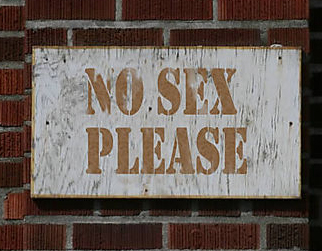
And, in general, I don’t think that politics should direct one’s personal life. If I choose to date a woman, it’ll be because I like her, not because I want to make a political statement about bisexuality. If I choose to date someone of a different race, it’ll be because I like him/her, not because I want to make a political statement about interracial dating. In contrast, the so-called “political lesbianism” movement advocated choosing to be a lesbian for political purposes. How is this an authentic way of living?

Of course, sometimes the personal becomes political, as when an anti-gay politician is revealed to be having same-sex relations, or when people speculate on whether or not Elena Kagan is a lesbian. In the first case, although people may bristle at the obvious hypocrisy, I think being anti-gay is bad enough regardless of what one does in his spare time (and sending inappropriate messages to teens is bad enough regardless of their gender). As for the second, most would agree that it shouldn’t matter. The fact that people make it matter is the crux of the problem.

So, is the personal political? Maybe, but it shouldn’t be. In my opinion, personal relationships are a sort of refuge from the outside world. I don’t bring politics into the bedroom, just like I wouldn’t bring my cell phone or my laptop or God into it.