
How Not to Argue Against Abortion

Our campus magazine, North by Northwestern, recently did a cool feature called “Dormroom Debate” in which it pitted a conservative and a liberal against each other to discuss the recent Arizona abortion laws.

I think that it’s great to expose yourself to dissenting viewpoints, not just for the sake of understanding and kumbaya (though that too) but so that you can learn how to better counter them.

However, just from glancing over the article, you’ll see a problem–both of the writers are men.

Now, as a disclaimer, I don’t see anything wrong with men discussing issues like abortion and contraception. I don’t think that having a penis and/or lacking a vagina makes you unqualified to even talk about these things. I do think, however, that it’s more difficult to have a well-informed opinion on these things if you’re a man. Why?  Because it means you have to take extra efforts to learn about things that women already know by default, such as how hormonal birth control actually works.

What I do think is downright wrong is the fact that women are continually being left out of conversations about their own bodies. It happens in congressional hearings, and it’s happening–albeit to a much less drastic and harmful degree–in our own campus magazine.

I’ll grant that this particular “panel” only involved two student writers, so it’s almost certain that women were left out of it entirely by accident. However, considering that Northwestern has slightly more women than men, and the school of journalism is even more skewed towards women, I find it very unlikely that the editors of NBN could not have produced at least one woman to participate in this debate.

What bothers me much more than the fact that NBN chose two men to discuss what women should and should not be able to do with their bodies, however, was the content of the conservative writer’s piece. Now, obviously, I knew from the get-go that I was going to disagree. However, I expected an entirely different line of argument.

For instance, as a conservative, you can make the argument that abortion laws should be left up to the states. You can make the argument that these laws make restrictions on abortion without actually taking away the right to get one. You can make the argument that these restrictions are necessary because they actually make abortion safer. You can even make the argument that abortion is morally wrong because you believe that life begins at conception.

You can make all those arguments, and I’d disagree with all of them, but they would at least be legitimate, logical arguments. Up until the end, the arguments that the conservative writer was making were mostly these. But then:

Opponents of this law do not really prioritize women’s health and their right to choose. Instead of wanting women to make smart decisions for themselves, they become “pro-abortion.” Their ultimate goal is the slaughter of innocent babies, so women can maintain their more comfortable lifestyles rather than live with the results of their choices — both the trials and the blessings.

Reread this: “Their ultimate goal is the slaughter of innocent babies.”

I’m going to go line by line now:

“Opponents of this law do not really prioritize women’s health and their right to choose.”

There is absolutely no evidence for this claim. None whatsoever.

“Instead of wanting women to make smart decisions for themselves, they become ‘pro-abortion.'”

Classic strawman fallacy. If indeed there are any pro-choice advocates who think that abortion is a “good” thing, or even that it is a decision to be made lightly, they can only be a tiny minority. In fact, the liberal writer in this piece explicitly states, “I believe every abortion is a tragedy.” Why not take him at his word?

“Their ultimate goal is the slaughter of innocent babies…”

Do I even need to say anything about this?

Just in case, I will anyway. Because there is no scientific or legal consensus regarding when life begins, individuals are free to define it for themselves as they choose. Those who believe life begins at conception probably would not choose to get an abortion. But those who believe that life begins at birth (or at the third trimester) do not believe that abortion is murder. Therefore, accusing them of promoting “the slaughter of innocent babies” is unfair. In other words, because there is considerable ambiguity in the definition of life’s beginning, it’s quite intellectually disingenuous to accuse those who disagree with your personal definition of advocating murder. Also, hello appeal to emotion.

“…so women can maintain their more comfortable lifestyles rather than live with the results of their choices — both the trials and the blessings.”

This statement shows a stunning lack of understanding of why women might choose to get abortions. First of all, statistically, most women who find themselves in that situation never had “comfortable lifestyles” to begin with. They tend to be young, single, and working-class. A woman who winds up accidentally pregnant is likely to be someone who didn’t have sufficient access to contraception–or, more tragically, a victim of sexual assault.

Second, the wording of this sentence clearly shows that the writer considers pregnancy, childbirth, and child rearing to be an acceptable consequence for a woman’s “choice”–meaning, obviously, the choice to have sex. Since I’m guessing this writer is someone who believes that sex should be for procreation only, there’s little I can really say in response except that, guess what, that’s not how the vast majority of people see it anymore.

I’m neglecting something here, of course. This writer made it clear from the very beginning of his piece that he’s not basing his arguments on logic or on conservative political ideology at all. At the very beginning, he writes:

My dad is a confessional Lutheran pastor, my mom a parochial school teacher, and I went to a Lutheran High School. Because of this upbringing, I have a strong belief in my innate sinfulness and need for my Savior, Jesus Christ. My faith is the primary foundation for my political ideology and is why I would say I’m a pretty staunch conservative all around. I believe that we should be good stewards of the blessings God has given us and we should live in a way that is pleasing to Him.

That’s right. He comes right out and says that the basis for his political beliefs is his religion–a religion that is legitimate and meaningful to him, but a religion that not all of us share.

Political arguments must not be based on religion. We have separation of church and state for a reason.

Setting the Record Straight

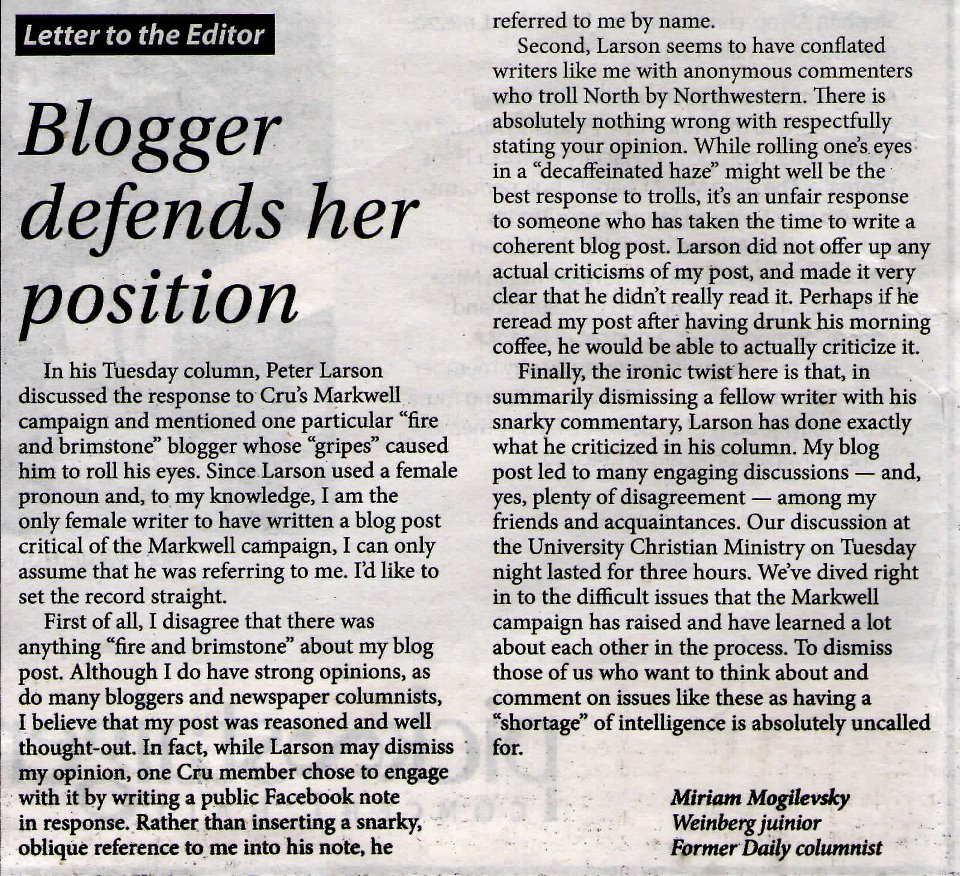
Note: On April 24, the Daily Northwestern published an opinion column that included a backhanded and (in my opinion) unfair reference to me and my blog–namely, to my Markwell post. I wrote the following letter to the editor in response.

To the editor:

In his Tuesday column, Peter Larson discussed the response to Cru’s Markwell campaign and mentioned one particular “fire and brimstone” blogger whose “gripes” caused him to roll his eyes. Since Larson used a female pronoun and, to my knowledge, I am the only female writer to have written a blog post critical of the Markwell campaign, I can only assume that he was referring to me. I’d like to set the record straight.

First of all, I disagree that there was anything “fire and brimstone” about my blog post. Although I do have strong opinions, as do many bloggers and newspaper columnists, I believe that my post was reasoned and well thought-out. In fact, while Larson may dismiss my opinion, one Cru member chose to engage with it by writing a public Facebook note in response. Rather than inserting a snarky, oblique reference to me into his note, he referred to me by name.

Second, Larson seems to have conflated writers like me with anonymous commenters who troll North by Northwestern. There is absolutely nothing wrong with respectfully stating your opinion, as I did and as Larson has done in his column. While rolling one’s eyes in a “decaffeinated haze” might well be the best response to trolls, it’s an unfair response to someone who has taken the time to write a coherent blog post. Larson did not offer up any actual criticisms of my post, and, in fact, made it very clear that he didn’t really read it. Perhaps if he reread my post after having drunk his morning coffee, he would be able to actually criticize it.

Finally, the ironic twist here is that, in summarily dismissing a fellow writer with his snarky commentary, Larson has done exactly what he criticized in his column. My blog post led to many engaging discussions–and, yes, plenty of disagreement–among my friends and acquaintances. Our discussion at the University Christian Ministry on Tuesday night lasted for three hours. We’ve dived right in to the difficult issues that the Markwell campaign has raised and have learned a lot about each other in the process. To dismiss those of us who want to think about and comment on issues like these as having a “shortage” of intelligence is absolutely uncalled for.

Urban Outfitters’ Possibly-Accidental Holocaust Reference

Aside from perhaps American Apparel, there might not be any clothing retailer that people love to hate more than Urban Outfitters.

This time, UO has angered the Jewish community by selling a t-shirt that seems made to resemble the patches that Jews were forced to wear on their clothes during the Holocaust:

Credit: Urban Outfitters

The Anti-Defamation League wrote a letter to CEO of Urban Outfitters explaining the uncanny similarity to Holocaust symbolism. Although UO itself hasn’t issued any sort of statement, the company that makes the shirt, Wood Wood, has. They replaced this shirt with a plain yellow one and explained that they had never intended to make a Holocaust reference:

As some of you are aware, several news sites have been writing about our “‘Kellog’ T-shirt, which features an image of a six-pointed star, allegedly similar to the yellow badge Jews were ordered to wear by the German nazis. First of all the graphic is not the Star of David, and I can assure you that this is in no way a reference to judaism, nazism or the holocaust.

While I’m obviously glad that they apologized to anyone who may have been offended and changed the shirt, I’m a bit confused as to how this happened to begin with.

Because here’s the thing–Wood Wood is a Danish company. That’s right, from Denmark. This is the same country that made an extraordinary effort to rescue its Jewish citizens from the Holocaust. Ordinary Danish citizens helped 8,000 Jews escape to Sweden after the Nazis invaded, and over 99% of Danish Jews ended up surviving.

This is particularly poignant if you think about how differently things went in many other European countries. Only 10% of Polish Jews, 12% of German Jews, and 25% of Dutch Jews survived the Holocaust.

Anyway, the point of this brief foray in Holocaust history is to show that the people of Denmark were once willing to put their own lives in danger to save their Jewish friends and neighbors. Today, meanwhile, a Danish company is apparently unaware of the symbolism in its design and mocks the Holocaust with a $100 cotton t-shirt.

I do understand that it’s completely possible–perhaps even likely–that this was completely unintentional. After all, not everyone sees a six-pointed star and immediately thinks “Star of David,” not everybody sees a yellow color and a patch on the chest and thinks “Jude.”

And that possibility brings up some difficult questions. How far should people go to avoid accidentally using Holocaust imagery and offending a ton of Jews? Are we being “too sensitive?” (And I should point out that Jews by no means agree on this. Granted, Jews never agree on anything.)

I can’t really answer those questions. However, I will say that based on UO’s history of culturally insensitive merchandise, I’m not necessarily as willing to give them the benefit of the doubt as I might be with another retailer. Come on, “Navajo Hipster Panty”? Who signed off on that?

Furthermore, it should be noted that the decision to take the six-pointed star off of the shirt was made not by UO, but by Wood Wood. UO seems intent not to learn from any of its mistakes and to continue producing merchandise that offends people, waiting until the inevitable uproar begins to remove said merchandise from the shelves. When will this stop? And, incidentally, when will UO also stop stealing indie artists’ designs, promoting anorexia, and denying collective bargaining rights to employees?

As I mentioned, this particular story does have a happy ending. The shirt is now being sold sans Holocaust-style patch, so it’s just a plain yellow shirt. Yours for only $100 at Urban Outfitters.

Leaving Medill

I knocked on the office door promptly at noon. She opened the door and said, “Can you just wait a few minutes? Our teleconference is running late.” I nodded. The door shut. I waited.

Twenty minutes later, I was sitting at a round table in a large, airy office full of plants. It had two windows, one of which faced my freshman year dorm.

“So, you’re thinking about transferring out of Medill?”

“Definitely transferring.” Her eyebrows go up. “I mean, I’m a junior, and I actually decided quite a while ago, so…”

“Can you tell me a little bit about your decision? I’m not trying to dissuade you.”

~~~

I remember all those nights. Clutching my camera or my notepad or both. Trying to find a way–any way–to escape the situation.

The worst time was when I was doing my final project for the last journalism class I ever took. I went to a gathering at my brother’s apartment–an event for young adults of Jewish/Russian descent. I had to interview people–not my brother, obviously. I couldn’t do it. I couldn’t make myself talk to anybody. My throat started closing up.

My brother’s apartment was on the sixteenth floor. Would that be high enough?

I ran outside and collapsed on a bench in a park, crying and trying to catch my breath. I felt ridiculous. The Medill School of Journalism had accepted just ten percent of its applicants the year I got in. There were nine other people who had desperately wanted my spot. And now I was bawling like an idiot because I had a terrible fear of talking to strangers.

They told me it gets easier with time, that you have to just make yourself do it. They said you would stop feeling self-conscious after a while. They explained how important it is to my future career that I learn to be pushy.

It never got easier. I always ended up gasping for breath and crying.

I don’t remember how I finished that project, but somehow I did. Not long after I started having weird neurological symptoms and became more or less numb to everything. I spent the summer at home, doing almost nothing. The one thing I accomplished was starting antidepressants to undo what being in Medill had, for whatever reason, done to me.

~~~

And today, two years later, I sat in her office and answered her question.

“It just wasn’t my thing,” I said.

~~~

Two years have passed, and I’m only now filling out this paperwork, going to this meeting, and making sure that the university knows whether to give me a BS in journalism or a BA in psychology.

Part of reason for the delay was my own laziness and lack of fondness for formalities like this, but another part of it was avoidance.

I hate going into the Medill buildings. Both of them. One is very new, all sleek and shiny, with high ceilings and plush chairs and new technology. The other is its opposite, old and creaky, with a rusty fire escape winding up the back. I once climbed all the way to the top of it and sat there late at night.

They’re both beautiful. I hate them both.

In these buildings I learned how to write a lede and use AP style. I learned how to use Adobe Flash and InDesign, Final Cut Pro, and Audacity. I learned how to shoot video and record audio. I learned how to harass people who didn’t want to answer my questions until they did it anyway.

Mostly, though, I learned what it feels like to fail.

I don’t mean what they call a “Medill F,” which is what happens when you make a factual error in a piece and receive a grade of 50%. That did happen to me, as it did to virtually everyone else.

But that’s not failure. That’s just screwing up. Failure is when your mind conspires against you and keeps you from doing something you desperately want to do.

I wanted to be a journalist, but I couldn’t stop the panic attacks that I got whenever I had to actually be one.

~~~

She signed my form and made sure I knew where to take it next.

“And know that we’re always here for you, even though you’re leaving. If you ever have any questions, I’m always happy to help–even you!” She smiled and I had to smile back.

She congratulated me again for my acceptance to the psychology honors program, and I thanked her kindly.

“Good luck, my dear,” she said.

And then, less than five minutes later, it was over. I left the building and I left Medill.

~~~

It’s been two years since I took a journalism class. My video camera, voice recorder, and microphone lie abandoned in my closet back home. I still use my tripod for my own photography.

My external hard drive died suddenly over a year ago, and with it died all the articles and projects I did. If there’s a heaven for vain attempts, that’s where they are.

My new chosen profession is similar to journalism in some ways. Both journalists and therapists do a certain amount of investigation and excavation. Both live and work by a code of ethics, and both must keep secrets. Therapists, like journalists, ask questions and listen and take notes.

But that’s basically where the similarities end. Therapists don’t get to attach their names to their successes. I don’t get to point out a person who came to me barely able to get through the day and now lives happily, and say, “This is my work.” They don’t award Pulitzers to therapists. If a therapist’s name is in the newspaper, it’s probably for something bad.

And yet. My freshman year, one of my journalism professors told me a story about something she saw as a young reporter. A horrific plane crash had just happened and many were injured or dead. She was assigned to cover the story and showed up at the local hospital along with all the other reporters. The hospital staff told the reporters that there was a special room for grieving friends and family and that they must not attempt to interview the people inside.

Then someone came out of the room and sat on the floor, next to the door, with her head in her hands. My professor couldn’t bring herself to do it, but another reporter walked right up and said, “So, who’d you lose?”

I retell this story whenever people ask me why I chose psychology over journalism. It illustrates so pointedly the differences between these professions. Journalists do important work, work without which our society couldn’t function. But their allegiance is to “the people,” who “need to know.” The allegiance of a therapist is always, always to her client.

~~~

But I won’t pretend that this is a happy choice. I’m glad to have found my calling in life, but when I tell people that I “chose” psychology instead of journalism, as I told you just now, I’m not really telling it like it is.

“Choosing” means picking one thing when you are equally free to do either.

I was never free to be a journalist, because my broken brain wouldn’t let me.

Maybe if I had been, I would still have chosen psychology. Maybe not. Either way, now I’ll never know.

Most of us were raised with the idea that we can be whatever we want to be. Well, maybe that isn’t always true.

Northwestern: Even More Racist than We Thought

Northwestern’s not known for being an oasis of tolerance. (Examples: here, here, and here.)

But a few members of our student body have decided to sink this school to a new low this past weekend by hosting a party/drinking game called the “Beer Olympics.” A student who saw the event described it this way:

[W]hat I saw Saturday afternoon was really just the “Racist Olympics.” In this backyard were at least 50 kids dressed up as some particular ethnic group or nationality. There were 6 teams: Canada, Ireland, Bangladesh, South Africa, Uganda, and Navajo Nation. All teams but Canada and Ireland signified via horribly racist and offensive mock-ups of these cultures. The noise I had heard came from the “Navajo Nation,” although almost every student in this yard participated in the “Indian call.” Moreover, these students are dressed up in headdresses, leather vests and other stereotypical indigenous garb.

Uganda was represented by students wearing tribalized Kony 2012 shirts. Students representing South Africa seemed to take a much simpler approach. In my presence, a passerby asked why the group chose to wear white t-shirts and black jeans. The response: “We’re South Africa! White on top, black on bottom!” Finally, the Bangladesh group simply dressed themselves in beads and painted red dots on their foreheads (the overwhelming majority of the population in Bengaldesh aren’t Hindi, but Muslim). These chants, the minstrelsy aimed at the expense of the dignity of non-Europeans and the sheer ecstasy of the partiers was sickening and traumatizing.

Apparently the group responsible for this has since released a “statement,” which you can read in the letter that I linked to.

Now, first of all. In case there’s any confusion, this is racist. If you don’t know why, here are some resources.

Second, I wish someone could explain to me this: why? Why do this? We all know college students need no excuse to get drunk, and there’s no reason why drinking games would be any less fun without racism involved.

Third, I feel that the Northwestern community needs to know which group was responsible for this. (Several people I’ve been discussing this with on Facebook have an idea of which group it might be, based on the apparent location of the photos and past traditions, but I won’t accidentally libel anybody.) It’s great that they’ve released a statement and have had “meetings” or whatever it is they’ve had, but ultimately, students who would like to avoid groups that hold big racist drinking games should probably be able to do so. (Yup, it’s the ski team.)

Fourth, when people are being drunk and doing shitty things, I often hear the argument that “Yeah well they’re drunk, what do you expect.” Okay, no. Once you’re an adult, you’re responsible for your actions–all of them–regardless of how much you’ve had to drink. This means that you need to either learn how to behave like a decent human being even if you’ve been drinking, or you need to stop drinking.

Finally, before anybody even goes there, yes, this is free speech. All free speech is legal. Not all free speech contributes anything to our society, and some of it actively harms that society. Let’s stop excusing terrible behavior simply because it happens to be legal.

Northwestern’s administration has been holding all sorts of “forums” on racial issues and proposing various “diversity initiatives,” but honestly, I don’t think any of it’s going to help. (Granted, that isn’t an excuse to just do nothing.) No matter how tolerant Northwestern’s environment is, it won’t undo 18 years of living in a society that perpetuates the stereotypes that these students poked fun at, and–even more insidiously–that teaches us that perpetuating these stereotypes is okay.

Unlearning these lessons is much harder than going to a required orientation program about diversity. After the infamous Northwestern blackface incident of 2009, Josh Feigelson, who used to be a rabbi here, wrote this:

I have long imagined a university in which every junior takes a seminar with a handful of others, drawn from diverse backgrounds, and whose common project is to learn to tell their own story and listen to the stories of others. What would it look like for Northwestern, or for other self-proclaimed secular universities, to actually enact the value of diversity–knowledge of oneself and others in a context of community–in not only its approach to student affairs, but into the heart of the curriculum itself?

I don’t know what that would look like. But I’d really like to know. I hope that Northwestern students, staff, and faculty keep talking about it and trying to imagine it. We shouldn’t abandon it just because it’s hard.