
Unknown's avatar

About Miri

Writer, activist, social worker, and huge fan of cats, flowers, and cities.

Empathy and Leadership: Why Romney Would be a Terrible President

What do we look for in a presidential candidate? Political experience, intelligence, charisma, and confidence are probably high up on the list. Good looks and an adherence to Christianity clearly don’t hurt either.

But what about empathy?

What terrifies me the most about the scant possibility of a Romney presidency is not the fact that I disagree with his political ideology. Rather, it’s Romney’s seemingly complete lack of empathy.

This thought first occurred to me back when the “Seamus incident” made the news a few months ago. But one can easily argue that the incident doesn’t exactly prove that Romney is a heartless robot–after all, the victim in question was a dog, not a human, and who really knows how the dog felt anyway?

Slightly less ambiguous is this new bit of insight into Romney’s past:

Friedemann entered Stevens Hall off the school’s collegiate quad to find Romney marching out of his own room ahead of a prep school posse shouting about their plan to cut Lauber’s hair. Friedemann followed them to a nearby room where they came upon Lauber, tackled him and pinned him to the ground. As Lauber, his eyes filling with tears, screamed for help, Romney repeatedly clipped his hair with a pair of scissors.

This is what Mitt Romney did to a classmate at his boarding school when he was a senior. The classmate, John Lauber, was presumed to be gay and wore his bleached-blond hair long–at least, until Romney decided to do something about it.

According to the Washington Post, this story was remembered and corroborated independently by five of Romney’s former classmates. Romney’s response:

“Back in high school, I did some dumb things and if anybody was hurt by that or offended, obviously I apologize for that…I don’t remember that incident,” Romney said, laughing. “I certainly don’t believe that I thought the fellow was homosexual. That was the furthest thing from our minds back in the 1960s, so that was not the case.”

I think it’s interesting that, despite claiming not to remember this incident, Romney nevertheless seems to file it into that large category of Dumb Things Teenagers Do. We all have those things, of course. For me, it was writing bad poetry and crushing on unattainable guys. For more typical teenagers, it’s probably something like getting really drunk when their parents are out of town and throwing up all over the Persian rug.

For the teenage Romney, though, it’s assaulting a fellow student because he’s (ostensibly) gay.

(Incidentally, Romney’s campaign has apparently been trying to get other former classmates of his to speak up in support of him. Good luck with that.)

It’s easy to make the argument that this happened decades ago and that Romney is probably a Completely Different Person now. Perhaps. But one writer on Mother Jones, discussing what “Romney the teenager” can tell us about “Romney the man,” says:

Romney the man has denied, and repeatedly denied yesterday, even remembering this incident. Sure, it was half a century ago, but he led a posse of his friends, tackled John Lauber in a hallway, dragged him into a bathroom, and then chopped off his hair while he struggled in terror. Even if you grant that this kind of extreme behavior was more common in a 1960s prep school than it is today, it’s really not the kind of thing you’d forget.


At least, you shouldn’t. So either Romney has done this kind of thing so often that the Lauber incident just blends into all the others, which suggests a far more vicious childhood than he’s owned up to, or else he remembers it just fine and is simply lying about it.

Furthermore, Romney has made his position on LGBT people clear more recently, too. As Governor of Massachusetts, he abolished a group looking into the issue of bullying and suicide in LGBT teenagers. One of his spokespeople outed a transgender woman running for political office in the same state, ending her career. Romney has also signed the National Organization for Marriage’s pledge, stating that he would support a constitutional amendment defining marriage as between a man and a woman, and donated $10,000 to that organization to support Proposition 8 in California. Of his stance on gay marriage as governor of Massachusetts, Romney has said, “On my watch, we fought hard and prevented Massachusetts from becoming the Las Vegas of gay marriage.”

So, while we can be reasonably sure that Romney wouldn’t physically bully anyone these days, I’m not so sure that his ability to empathize with people different from him has evolved at all.

Unfortunately for us–if Romney gets elected–empathy is essential for good leadership. (A U.S. Army Colonel makes that case very persuasively in this Washington Post column.) By definition, leaders are in a place of privilege compared to those they lead, so if they want to know how best to serve the people who elected them, they must be able to understand them and their lives.

For instance, take bullying. It’s one thing to take a stand against bullying because you were once bullied yourself, and another thing entirely to understand the harm that bullying does to individuals, families, communities, and society as a whole, without having experienced it firsthand. Since presidential candidates tend to be male, white, wealthy, Christian, straight, cisgender, able-bodied, and so on, they are unlikely to have experienced things like bullying firsthand. That is why having empathy is essential if they are to understand this increasingly politicized issue.

For a politician, being empathic doesn’t necessarily mean you have to be a bleeding-heart liberal; it just means you have to be able to understand how people different from you actually think, feel, and choose. You could still, for instance, choose to limit government spending for economic reasons while acknowledging and genuinely regretting the fact that your choices may hurt some people. You could propose and support ways of solving issues like social inequality without increasing government spending.You could understand that poor people are not always to blame for their own predicament, even if you don’t think that bringing them out of it is the government’s job.

You could recognize that you disagree with gay marriage because of your religious beliefs, but understand that not everyone shares your beliefs and not everyone should have to live by them. You could disagree with gay marriage because of your religious beliefs, but realize that gay and lesbian teenagers still deserve protection from bullying.

You could, in other words, be a Republican with a heart.

In short, having empathy doesn’t mean being politically liberal. There are plenty of liberals who seem to lack empathy, and there are–hopefully–conservatives who have it. But Romney isn’t one of them. And that, much more so than his politics, is why I really hope he’ll never be President.
Chet Hanks, Victim Blaming, and the “Weakness” of Suicide

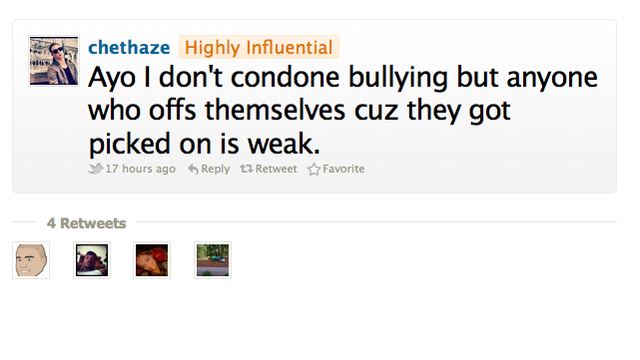
Chet Hanks, son of Tom Hanks and a student here at Northwestern, has this to say about victims of bullying:

Chet's tweet: "Ayo I don't condone bullying but anyone who offs themselves cuz they got picked on is weak."

Credit: Gawker

And then, perhaps in response to people who responded to him (including yours truly), Chet tweeted these followups:

“I say real shit and I always speak my mind if you don’t like it I could give a fuck less.”

“Lol…Haters: I am sorry I do not cater to your demographic: shlubby dudes that don’t get laid enough it’s ok go back to your Internet porn”

“G’head check my feed, all the people hatin are mediocre Lames and cute girls show me love #whatdoesthattellyou

How mature.

Sometimes I wish someone would invent a technology that allows you to connect to someone else’s brain and actually feel what they feel. Because language is a poor substitute.

Maybe if we had such a technology, people would finally understand that mental illness and suicide do not happen to people because they are “weak.”

However, since we don’t have such a technology, the best we can do is educate ourselves about other people, something that college provides a great opportunity to do. It’s too bad that Chet Hanks seems not to be taking advantage of it.

Some of the comments on the Gawker piece I linked to, while generally dismissive of Chet Hanks, are hardly any better:

His expression of emotion is misguided and a bit douche-y, but I second the sentiment. Suicide is a horrible option to exercise as a bullying deterrent. It’s a permanent solution to a potentially temporary problem. It exchanges the pain you feel for the pain of those around you who love you and is essentially a selfish act.
Suicide is selfish and hurts people who care about you, but calling people who are potentially thinking about doing it weak is only going to make things worse. He could have expressed this sentiment in a way that was constructive and helped people, instead of highlighting what an asshat he is.

It’s probably true that some people are psychologically more susceptible to suicide than others, but that difference has nothing to do with “strength” or “weakness.” It also has nothing to do with “willpower” and “selfishness.” To put it broadly, suicide is what happens when a person no longer wants to live–which isn’t necessarily the same thing as wanting to die.

Tragically, most people who commit suicide do so at least in part because they don’t feel like anyone will miss them, and contrary to what the self-righteous commenters above seem to think, not everyone does have friends or family who care about them. It’s also worth noting that, with the exception of people like me who were bullied for being nerdy, kids who get bullied tend to already be marginalized by society in numerous ways–because of fatness or ugliness, mental or physical disability, perceived or real homosexuality, noncompliance with gender roles, and so on. Sometimes, these are the very children who are least likely to have supportive parents, siblings, teachers, and friends cheering them on through their trials.

What Chet seems to miss is that the causal relationship between bullying and suicide isn’t just that a kid goes to school one day and gets called a fag and comes home and tries to kill himself. Bullying is almost never a one-time thing; it can continue over months or years. It’s a constant wearing down of an individual’s self-worth and belief that he/she belongs in this world. Bullies don’t simply call you names and beat you up–they convince you that nobody wants you here.

While supportive friends and family can alleviate these tragic effects somewhat, as I mentioned, not everyone has supportive friends and family. And even if they do, that may not be enough. Children don’t have the freedom that adults have–they’re completely powerless to escape the situation by moving or dropping out of school. The only recourse they generally have is telling an authority figure at school, and that tends to do nothing at best or backfire at worst.

But of course, pretty much everyone reading this blog probably already knows all that. What they probably don’t know is how it actually feels to seriously consider suicide, and how little it has to do with concepts like “weakness” and “selfishness.” If you’d like to hear about it from someone who knows of what she speaks, feel free to ask me personally. Otherwise, I’d recommend this amazing book.

After we read about Chet’s tweet, some of my friends and I started talking about the whole concept of victim blaming and how pervasive it is in our society. Although it’s usually talked about in the context of sexual assault, there really isn’t a single shitty human experience that doesn’t routinely get blamed on its victims: mental illness, bullying, poverty, racism, sexual harassment, you name it. If you have depression, it’s because you’re just not looking on the bright side of life. If you’re getting bullied, it’s because you stick out too much or “react” too much. If you’re poor, it’s because you’re too lazy to get a job. If you’re fat, it’s because you eat crap and don’t exercise. If you feel discriminated against, it’s because you’re “too sensitive.” If you’re getting harassed on the street, your skirt’s too short. And so on and so forth.

(In fact, as Barbara Ehrenreich notes in her brilliant book Bright-sided, even cancer, that ultimate of tragedies, is increasingly getting blamed on its victims. Why? Because they didn’t “think positively” enough.)

Sometimes, it’s really difficult and unpleasant to acknowledge the fact that, even in our pull-yourself-up-by-the-bootstraps, when-there’s-a-will-there’s-a-way sort of culture, sometimes life just screws people. Sometimes it just does.

It’s easier to blame the victim than to make the sort of cultural changes we would need to make sure that people get screwed over as little as possible. Much easier than to figure out how to teach compassion to kids, how to eradicate racism, how to get people to realize that there’s never an excuse for raping people.

But just because we may not yet know how to do those things does not mean we should just throw up our hands and say, “Yeah well, if they off themselves, it’s just cuz they’re weak.”

The more I study psychology, bullying, and the many challenges faced by people that society continually marginalizes, the more I think: If only it were that simple.

*edit* Also, I’m going to try really hard to believe that underneath all that idiocy is some actual intelligence, and that that’s why Chet Hanks got into this school–not because of who his father is.

And, here’s an awesome blog post about this from my friend Derrick.

How Not to Argue Against Abortion

Our campus magazine, North by Northwestern, recently did a cool feature called “Dormroom Debate” in which it pitted a conservative and a liberal against each other to discuss the recent Arizona abortion laws.

I think that it’s great to expose yourself to dissenting viewpoints, not just for the sake of understanding and kumbaya (though that too) but so that you can learn how to better counter them.

However, just from glancing over the article, you’ll see a problem–both of the writers are men.

Now, as a disclaimer, I don’t see anything wrong with men discussing issues like abortion and contraception. I don’t think that having a penis and/or lacking a vagina makes you unqualified to even talk about these things. I do think, however, that it’s more difficult to have a well-informed opinion on these things if you’re a man. Why?  Because it means you have to take extra efforts to learn about things that women already know by default, such as how hormonal birth control actually works.

What I do think is downright wrong is the fact that women are continually being left out of conversations about their own bodies. It happens in congressional hearings, and it’s happening–albeit to a much less drastic and harmful degree–in our own campus magazine.

I’ll grant that this particular “panel” only involved two student writers, so it’s almost certain that women were left out of it entirely by accident. However, considering that Northwestern has slightly more women than men, and the school of journalism is even more skewed towards women, I find it very unlikely that the editors of NBN could not have produced at least one woman to participate in this debate.

What bothers me much more than the fact that NBN chose two men to discuss what women should and should not be able to do with their bodies, however, was the content of the conservative writer’s piece. Now, obviously, I knew from the get-go that I was going to disagree. However, I expected an entirely different line of argument.

For instance, as a conservative, you can make the argument that abortion laws should be left up to the states. You can make the argument that these laws make restrictions on abortion without actually taking away the right to get one. You can make the argument that these restrictions are necessary because they actually make abortion safer. You can even make the argument that abortion is morally wrong because you believe that life begins at conception.

You can make all those arguments, and I’d disagree with all of them, but they would at least be legitimate, logical arguments. Up until the end, the arguments that the conservative writer was making were mostly these. But then:

Opponents of this law do not really prioritize women’s health and their right to choose. Instead of wanting women to make smart decisions for themselves, they become “pro-abortion.” Their ultimate goal is the slaughter of innocent babies, so women can maintain their more comfortable lifestyles rather than live with the results of their choices — both the trials and the blessings.

Reread this: “Their ultimate goal is the slaughter of innocent babies.”

I’m going to go line by line now:

“Opponents of this law do not really prioritize women’s health and their right to choose.”

There is absolutely no evidence for this claim. None whatsoever.

“Instead of wanting women to make smart decisions for themselves, they become ‘pro-abortion.'”

Classic strawman fallacy. If indeed there are any pro-choice advocates who think that abortion is a “good” thing, or even that it is a decision to be made lightly, they can only be a tiny minority. In fact, the liberal writer in this piece explicitly states, “I believe every abortion is a tragedy.” Why not take him at his word?

“Their ultimate goal is the slaughter of innocent babies…”

Do I even need to say anything about this?

Just in case, I will anyway. Because there is no scientific or legal consensus regarding when life begins, individuals are free to define it for themselves as they choose. Those who believe life begins at conception probably would not choose to get an abortion. But those who believe that life begins at birth (or at the third trimester) do not believe that abortion is murder. Therefore, accusing them of promoting “the slaughter of innocent babies” is unfair. In other words, because there is considerable ambiguity in the definition of life’s beginning, it’s quite intellectually disingenuous to accuse those who disagree with your personal definition of advocating murder. Also, hello appeal to emotion.

“…so women can maintain their more comfortable lifestyles rather than live with the results of their choices — both the trials and the blessings.”

This statement shows a stunning lack of understanding of why women might choose to get abortions. First of all, statistically, most women who find themselves in that situation never had “comfortable lifestyles” to begin with. They tend to be young, single, and working-class. A woman who winds up accidentally pregnant is likely to be someone who didn’t have sufficient access to contraception–or, more tragically, a victim of sexual assault.

Second, the wording of this sentence clearly shows that the writer considers pregnancy, childbirth, and child rearing to be an acceptable consequence for a woman’s “choice”–meaning, obviously, the choice to have sex. Since I’m guessing this writer is someone who believes that sex should be for procreation only, there’s little I can really say in response except that, guess what, that’s not how the vast majority of people see it anymore.

I’m neglecting something here, of course. This writer made it clear from the very beginning of his piece that he’s not basing his arguments on logic or on conservative political ideology at all. At the very beginning, he writes:

My dad is a confessional Lutheran pastor, my mom a parochial school teacher, and I went to a Lutheran High School. Because of this upbringing, I have a strong belief in my innate sinfulness and need for my Savior, Jesus Christ. My faith is the primary foundation for my political ideology and is why I would say I’m a pretty staunch conservative all around. I believe that we should be good stewards of the blessings God has given us and we should live in a way that is pleasing to Him.

That’s right. He comes right out and says that the basis for his political beliefs is his religion–a religion that is legitimate and meaningful to him, but a religion that not all of us share.

Political arguments must not be based on religion. We have separation of church and state for a reason.

Setting the Record Straight

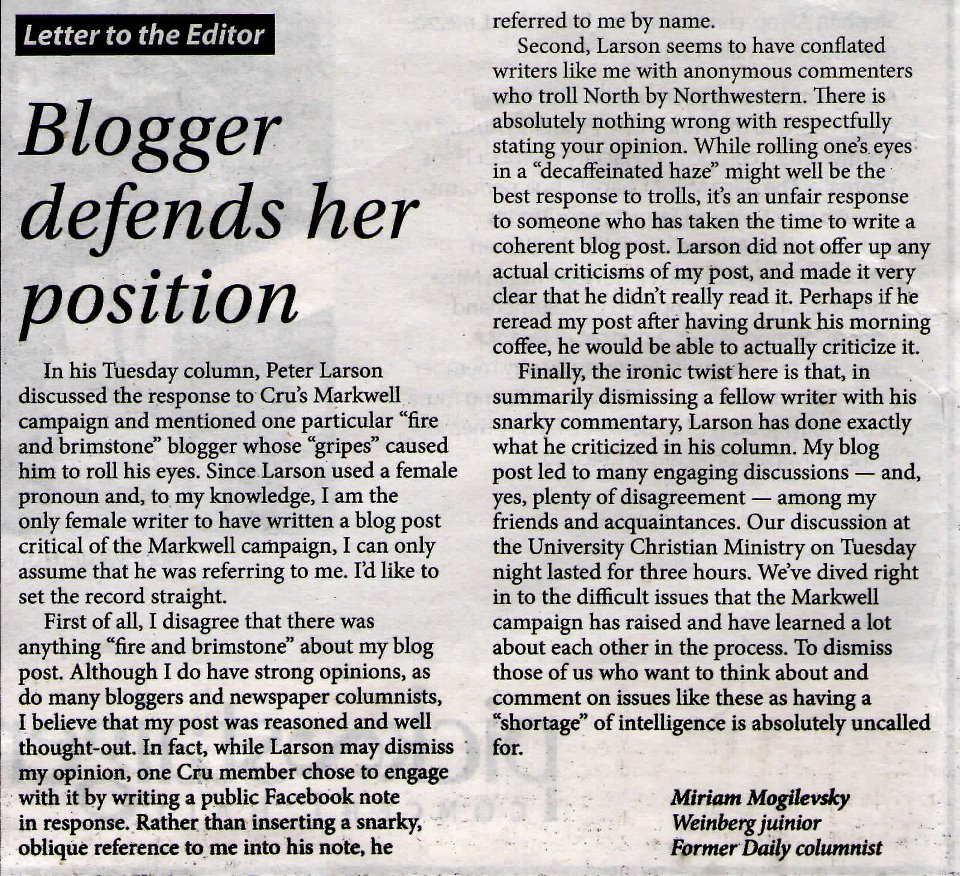
Note: On April 24, the Daily Northwestern published an opinion column that included a backhanded and (in my opinion) unfair reference to me and my blog–namely, to my Markwell post. I wrote the following letter to the editor in response.

To the editor:

In his Tuesday column, Peter Larson discussed the response to Cru’s Markwell campaign and mentioned one particular “fire and brimstone” blogger whose “gripes” caused him to roll his eyes. Since Larson used a female pronoun and, to my knowledge, I am the only female writer to have written a blog post critical of the Markwell campaign, I can only assume that he was referring to me. I’d like to set the record straight.

First of all, I disagree that there was anything “fire and brimstone” about my blog post. Although I do have strong opinions, as do many bloggers and newspaper columnists, I believe that my post was reasoned and well thought-out. In fact, while Larson may dismiss my opinion, one Cru member chose to engage with it by writing a public Facebook note in response. Rather than inserting a snarky, oblique reference to me into his note, he referred to me by name.

Second, Larson seems to have conflated writers like me with anonymous commenters who troll North by Northwestern. There is absolutely nothing wrong with respectfully stating your opinion, as I did and as Larson has done in his column. While rolling one’s eyes in a “decaffeinated haze” might well be the best response to trolls, it’s an unfair response to someone who has taken the time to write a coherent blog post. Larson did not offer up any actual criticisms of my post, and, in fact, made it very clear that he didn’t really read it. Perhaps if he reread my post after having drunk his morning coffee, he would be able to actually criticize it.

Finally, the ironic twist here is that, in summarily dismissing a fellow writer with his snarky commentary, Larson has done exactly what he criticized in his column. My blog post led to many engaging discussions–and, yes, plenty of disagreement–among my friends and acquaintances. Our discussion at the University Christian Ministry on Tuesday night lasted for three hours. We’ve dived right in to the difficult issues that the Markwell campaign has raised and have learned a lot about each other in the process. To dismiss those of us who want to think about and comment on issues like these as having a “shortage” of intelligence is absolutely uncalled for.

Urban Outfitters’ Possibly-Accidental Holocaust Reference

Aside from perhaps American Apparel, there might not be any clothing retailer that people love to hate more than Urban Outfitters.

This time, UO has angered the Jewish community by selling a t-shirt that seems made to resemble the patches that Jews were forced to wear on their clothes during the Holocaust:

Credit: Urban Outfitters

The Anti-Defamation League wrote a letter to CEO of Urban Outfitters explaining the uncanny similarity to Holocaust symbolism. Although UO itself hasn’t issued any sort of statement, the company that makes the shirt, Wood Wood, has. They replaced this shirt with a plain yellow one and explained that they had never intended to make a Holocaust reference:

As some of you are aware, several news sites have been writing about our “‘Kellog’ T-shirt, which features an image of a six-pointed star, allegedly similar to the yellow badge Jews were ordered to wear by the German nazis. First of all the graphic is not the Star of David, and I can assure you that this is in no way a reference to judaism, nazism or the holocaust.

While I’m obviously glad that they apologized to anyone who may have been offended and changed the shirt, I’m a bit confused as to how this happened to begin with.

Because here’s the thing–Wood Wood is a Danish company. That’s right, from Denmark. This is the same country that made an extraordinary effort to rescue its Jewish citizens from the Holocaust. Ordinary Danish citizens helped 8,000 Jews escape to Sweden after the Nazis invaded, and over 99% of Danish Jews ended up surviving.

This is particularly poignant if you think about how differently things went in many other European countries. Only 10% of Polish Jews, 12% of German Jews, and 25% of Dutch Jews survived the Holocaust.

Anyway, the point of this brief foray in Holocaust history is to show that the people of Denmark were once willing to put their own lives in danger to save their Jewish friends and neighbors. Today, meanwhile, a Danish company is apparently unaware of the symbolism in its design and mocks the Holocaust with a $100 cotton t-shirt.

I do understand that it’s completely possible–perhaps even likely–that this was completely unintentional. After all, not everyone sees a six-pointed star and immediately thinks “Star of David,” not everybody sees a yellow color and a patch on the chest and thinks “Jude.”

And that possibility brings up some difficult questions. How far should people go to avoid accidentally using Holocaust imagery and offending a ton of Jews? Are we being “too sensitive?” (And I should point out that Jews by no means agree on this. Granted, Jews never agree on anything.)

I can’t really answer those questions. However, I will say that based on UO’s history of culturally insensitive merchandise, I’m not necessarily as willing to give them the benefit of the doubt as I might be with another retailer. Come on, “Navajo Hipster Panty”? Who signed off on that?

Furthermore, it should be noted that the decision to take the six-pointed star off of the shirt was made not by UO, but by Wood Wood. UO seems intent not to learn from any of its mistakes and to continue producing merchandise that offends people, waiting until the inevitable uproar begins to remove said merchandise from the shelves. When will this stop? And, incidentally, when will UO also stop stealing indie artists’ designs, promoting anorexia, and denying collective bargaining rights to employees?

As I mentioned, this particular story does have a happy ending. The shirt is now being sold sans Holocaust-style patch, so it’s just a plain yellow shirt. Yours for only $100 at Urban Outfitters.