
Unknown's avatar

About Miri

Writer, activist, social worker, and huge fan of cats, flowers, and cities.

Leaving Medill

I knocked on the office door promptly at noon. She opened the door and said, “Can you just wait a few minutes? Our teleconference is running late.” I nodded. The door shut. I waited.

Twenty minutes later, I was sitting at a round table in a large, airy office full of plants. It had two windows, one of which faced my freshman year dorm.

“So, you’re thinking about transferring out of Medill?”

“Definitely transferring.” Her eyebrows go up. “I mean, I’m a junior, and I actually decided quite a while ago, so…”

“Can you tell me a little bit about your decision? I’m not trying to dissuade you.”

~~~

I remember all those nights. Clutching my camera or my notepad or both. Trying to find a way–any way–to escape the situation.

The worst time was when I was doing my final project for the last journalism class I ever took. I went to a gathering at my brother’s apartment–an event for young adults of Jewish/Russian descent. I had to interview people–not my brother, obviously. I couldn’t do it. I couldn’t make myself talk to anybody. My throat started closing up.

My brother’s apartment was on the sixteenth floor. Would that be high enough?

I ran outside and collapsed on a bench in a park, crying and trying to catch my breath. I felt ridiculous. The Medill School of Journalism had accepted just ten percent of its applicants the year I got in. There were nine other people who had desperately wanted my spot. And now I was bawling like an idiot because I had a terrible fear of talking to strangers.

They told me it gets easier with time, that you have to just make yourself do it. They said you would stop feeling self-conscious after a while. They explained how important it is to my future career that I learn to be pushy.

It never got easier. I always ended up gasping for breath and crying.

I don’t remember how I finished that project, but somehow I did. Not long after I started having weird neurological symptoms and became more or less numb to everything. I spent the summer at home, doing almost nothing. The one thing I accomplished was starting antidepressants to undo what being in Medill had, for whatever reason, done to me.

~~~

And today, two years later, I sat in her office and answered her question.

“It just wasn’t my thing,” I said.

~~~

Two years have passed, and I’m only now filling out this paperwork, going to this meeting, and making sure that the university knows whether to give me a BS in journalism or a BA in psychology.

Part of reason for the delay was my own laziness and lack of fondness for formalities like this, but another part of it was avoidance.

I hate going into the Medill buildings. Both of them. One is very new, all sleek and shiny, with high ceilings and plush chairs and new technology. The other is its opposite, old and creaky, with a rusty fire escape winding up the back. I once climbed all the way to the top of it and sat there late at night.

They’re both beautiful. I hate them both.

In these buildings I learned how to write a lede and use AP style. I learned how to use Adobe Flash and InDesign, Final Cut Pro, and Audacity. I learned how to shoot video and record audio. I learned how to harass people who didn’t want to answer my questions until they did it anyway.

Mostly, though, I learned what it feels like to fail.

I don’t mean what they call a “Medill F,” which is what happens when you make a factual error in a piece and receive a grade of 50%. That did happen to me, as it did to virtually everyone else.

But that’s not failure. That’s just screwing up. Failure is when your mind conspires against you and keeps you from doing something you desperately want to do.

I wanted to be a journalist, but I couldn’t stop the panic attacks that I got whenever I had to actually be one.

~~~

She signed my form and made sure I knew where to take it next.

“And know that we’re always here for you, even though you’re leaving. If you ever have any questions, I’m always happy to help–even you!” She smiled and I had to smile back.

She congratulated me again for my acceptance to the psychology honors program, and I thanked her kindly.

“Good luck, my dear,” she said.

And then, less than five minutes later, it was over. I left the building and I left Medill.

~~~

It’s been two years since I took a journalism class. My video camera, voice recorder, and microphone lie abandoned in my closet back home. I still use my tripod for my own photography.

My external hard drive died suddenly over a year ago, and with it died all the articles and projects I did. If there’s a heaven for vain attempts, that’s where they are.

My new chosen profession is similar to journalism in some ways. Both journalists and therapists do a certain amount of investigation and excavation. Both live and work by a code of ethics, and both must keep secrets. Therapists, like journalists, ask questions and listen and take notes.

But that’s basically where the similarities end. Therapists don’t get to attach their names to their successes. I don’t get to point out a person who came to me barely able to get through the day and now lives happily, and say, “This is my work.” They don’t award Pulitzers to therapists. If a therapist’s name is in the newspaper, it’s probably for something bad.

And yet. My freshman year, one of my journalism professors told me a story about something she saw as a young reporter. A horrific plane crash had just happened and many were injured or dead. She was assigned to cover the story and showed up at the local hospital along with all the other reporters. The hospital staff told the reporters that there was a special room for grieving friends and family and that they must not attempt to interview the people inside.

Then someone came out of the room and sat on the floor, next to the door, with her head in her hands. My professor couldn’t bring herself to do it, but another reporter walked right up and said, “So, who’d you lose?”

I retell this story whenever people ask me why I chose psychology over journalism. It illustrates so pointedly the differences between these professions. Journalists do important work, work without which our society couldn’t function. But their allegiance is to “the people,” who “need to know.” The allegiance of a therapist is always, always to her client.

~~~

But I won’t pretend that this is a happy choice. I’m glad to have found my calling in life, but when I tell people that I “chose” psychology instead of journalism, as I told you just now, I’m not really telling it like it is.

“Choosing” means picking one thing when you are equally free to do either.

I was never free to be a journalist, because my broken brain wouldn’t let me.

Maybe if I had been, I would still have chosen psychology. Maybe not. Either way, now I’ll never know.

Most of us were raised with the idea that we can be whatever we want to be. Well, maybe that isn’t always true.

Northwestern: Even More Racist than We Thought

Northwestern’s not known for being an oasis of tolerance. (Examples: here, here, and here.)

But a few members of our student body have decided to sink this school to a new low this past weekend by hosting a party/drinking game called the “Beer Olympics.” A student who saw the event described it this way:

[W]hat I saw Saturday afternoon was really just the “Racist Olympics.” In this backyard were at least 50 kids dressed up as some particular ethnic group or nationality. There were 6 teams: Canada, Ireland, Bangladesh, South Africa, Uganda, and Navajo Nation. All teams but Canada and Ireland signified via horribly racist and offensive mock-ups of these cultures. The noise I had heard came from the “Navajo Nation,” although almost every student in this yard participated in the “Indian call.” Moreover, these students are dressed up in headdresses, leather vests and other stereotypical indigenous garb.

Uganda was represented by students wearing tribalized Kony 2012 shirts. Students representing South Africa seemed to take a much simpler approach. In my presence, a passerby asked why the group chose to wear white t-shirts and black jeans. The response: “We’re South Africa! White on top, black on bottom!” Finally, the Bangladesh group simply dressed themselves in beads and painted red dots on their foreheads (the overwhelming majority of the population in Bengaldesh aren’t Hindi, but Muslim). These chants, the minstrelsy aimed at the expense of the dignity of non-Europeans and the sheer ecstasy of the partiers was sickening and traumatizing.

Apparently the group responsible for this has since released a “statement,” which you can read in the letter that I linked to.

Now, first of all. In case there’s any confusion, this is racist. If you don’t know why, here are some resources.

Second, I wish someone could explain to me this: why? Why do this? We all know college students need no excuse to get drunk, and there’s no reason why drinking games would be any less fun without racism involved.

Third, I feel that the Northwestern community needs to know which group was responsible for this. (Several people I’ve been discussing this with on Facebook have an idea of which group it might be, based on the apparent location of the photos and past traditions, but I won’t accidentally libel anybody.) It’s great that they’ve released a statement and have had “meetings” or whatever it is they’ve had, but ultimately, students who would like to avoid groups that hold big racist drinking games should probably be able to do so. (Yup, it’s the ski team.)

Fourth, when people are being drunk and doing shitty things, I often hear the argument that “Yeah well they’re drunk, what do you expect.” Okay, no. Once you’re an adult, you’re responsible for your actions–all of them–regardless of how much you’ve had to drink. This means that you need to either learn how to behave like a decent human being even if you’ve been drinking, or you need to stop drinking.

Finally, before anybody even goes there, yes, this is free speech. All free speech is legal. Not all free speech contributes anything to our society, and some of it actively harms that society. Let’s stop excusing terrible behavior simply because it happens to be legal.

Northwestern’s administration has been holding all sorts of “forums” on racial issues and proposing various “diversity initiatives,” but honestly, I don’t think any of it’s going to help. (Granted, that isn’t an excuse to just do nothing.) No matter how tolerant Northwestern’s environment is, it won’t undo 18 years of living in a society that perpetuates the stereotypes that these students poked fun at, and–even more insidiously–that teaches us that perpetuating these stereotypes is okay.

Unlearning these lessons is much harder than going to a required orientation program about diversity. After the infamous Northwestern blackface incident of 2009, Josh Feigelson, who used to be a rabbi here, wrote this:

I have long imagined a university in which every junior takes a seminar with a handful of others, drawn from diverse backgrounds, and whose common project is to learn to tell their own story and listen to the stories of others. What would it look like for Northwestern, or for other self-proclaimed secular universities, to actually enact the value of diversity–knowledge of oneself and others in a context of community–in not only its approach to student affairs, but into the heart of the curriculum itself?

I don’t know what that would look like. But I’d really like to know. I hope that Northwestern students, staff, and faculty keep talking about it and trying to imagine it. We shouldn’t abandon it just because it’s hard.

Why I Think Proselytism is Wrong

I was so happy to see this outside the psychology department.

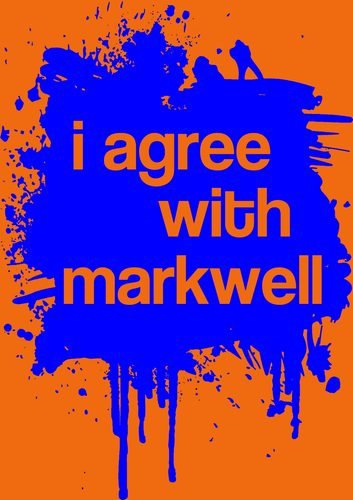
The whole controversy on our campus surrounding Cru and their “I Agree with Markwell” campaign has gotten me thinking about proselytism. (Proselytism, in case you don’t know, is just a fancy word for trying to convert people to another religion.)

In my view, proselytism is wrong.

I have two foundations for this view. One of them is my knowledge of psychology. Research in social psychology has confirmed, over and over again, that people are much more susceptible to peer pressure and manipulation than we’d like to believe. (For the sake of time and space, I’m not going to list studies here because I’m assuming most people have taken Psych 101 and have learned about them. But if you’re curious, ask, and I’ll send you a dozen.)

The success of dubious religious ventures like witch hunts and cults suggests that adding a spiritual element makes peer pressure even more potent. If people can be persuaded to do even such ridiculous and terrible things, how hard will it be to persuade them to take a pamphlet, give out their email address, come to church, donate money, gradually abandon the beliefs they’d had before?

This is especially harmful when it comes to non-Christians, who are a minority in the U.S. (and, in fact, in many other places). In many ways, it’s difficult enough as is to maintain your own beliefs and practices when the entire surrounding culture immerses you in another belief system. If you don’t believe me, talk to a Jewish kid at Christmastime. I still remember how indignant I felt when other kids got a big present from each of their extended family members and I got just one.

But in all seriousness, science typically shows that people are very suggestible. Proselytizing groups may claim that the only people who convert are people who really, genuinely, truly want to be Christians, I’m not so sure that you can always tell the difference between really, genuinely, truly wanting something, and being subtly manipulated into wanting that thing. And while I concede that Northwestern’s Cru chapter represents only the mildest, most harmless form of proselytism, I oppose any action that implies that you, the proselytizer, know better than everyone else.

Which brings me right to my next point. The second foundation for my opposition to proselytism is my moral code. I believe that, with a few exceptions, we have no right to try to alter the beliefs of others. I place religion on the same plane as several other areas of human experience, such as sexuality–things that are personal and that have no impact on anyone but ourselves. For instance, would you ever attempt to convince someone to have sex the way you have sex? I would hope not. So why would you attempt to convince them to believe the things you believe?

I obviously don’t think that all forms of persuasion are wrong. Arguing about politics is valuable and important because political decisions affect all of us. Influencing people’s purchasing decisions via marketing is necessary for our economy to work. If done sensitively, talking to someone who seems to be making a harmful decision about their career, relationships, etc. could be very helpful.

But ultimately, a person’s inner life belongs to them alone, and most people value that inner life and resent attempts to intrude upon it. I think intruding upon it is wrong.

Now, as a disclaimer, I’m not saying that mine is the best moral code in the world and that everyone should adopt it and that people who do not adopt it are Bad. If I thought that, it would make me no better than the Markwell people.

But I do think that we’d have less conflict in our society if people lived by a code such as this one, and it works for me because it helps me feel like I’m treating others with respect.

Is this moral code completely incompatible with evangelical Christianity? Yes. Christians and others who proselytize genuinely believe that others need to be saved/brought to Jesus/what have you, or else they’ll go to hell. However, it’s important to note that this brand of Christianity is incompatible with all other belief systems, including most Christian ones. In this brand of Christianity, only two types of people exist in the world: good Christians and people who haven’t been converted yet.

And before anyone goes all First Amendment on me, note that I would never suggest that proselytism should be illegal. After all, it’s a form of free speech. Laws have nothing to do with my argument.

After all, not everything that’s legal is right. It’s perfectly legal to spread rumors, use the n-word, and cheat on your partner. And yet these are things that we almost universally agree are wrong. Why? Because they hurt others.

Proselytism may not hurt in the same way that getting cheated on does, but it hurts in a more insidious way. It erodes minority traditions and belief systems and destroys trust between different religious groups.

For instance, if you ask Northwestern students whether or not they’d be willing to engage with Cru in any way, many of them will now tell you no. It’s not hard to figure out why: Cru members made their condescension and disrespect for others’ faith blatant when they expressed their wish to convert us all to Christianity. (In fact, this whole episode inspired me to join Northwestern’s chapter of the Secular Student Alliance. Apparently I’m not the only one.)

The various forms of backlash that “I Agree with Markwell” has inspired, much of which has taken on a deeply anti-Christian tone, only proves my point. While I obviously don’t condone insulting people or their religious beliefs and wish that people would be more civil, I’m not surprised that so many Northwestern students are so annoyed and angry at Cru. After all, they basically told us that we’re going to hell. Their proselytism has, in a way, torn this campus apart.

I don’t think that my moral code is one that will ever be adopted by our majority-Christian society. But I do think that the world would be a better place if people learned to leave each other alone. You may disagree.

We’re Not Lost: An Open Letter to Campus Crusade for Christ

Northwestern’s chapter of Campus Crusade for Christ, an evangelical Christian organization otherwise known as Cru, has an edgy new campaign.

It’s called “I Agree with Markwell” and consists of the following: students wearing bright orange shirts that say “I Agree with Markwell,” covering the campus with chalk writing and posters that say “I Agree with Markwell,” and making videos in which they explain why they agree with Markwell.

Who’s Markwell? He’s a senior here at Northwestern who was asked by Cru to be the face, so to speak, of this campaign. His first name is Matthew.

The purpose of the campaign is ostensibly to convince people that, like Markwell, they too can have a personal relationship with Jesus Christ. And the way to do this is by placing this quizzical phrase all over campus so that people will be compelled to look it up and find out what it’s all about.

Once they find themselves on the campaign’s website, they’ll learn a bit more about Markwell’s beliefs:

I believe in God. Not just any god, but the God who loves us more than we can imagine. I believe all people are sinful, messed up, jacked up, broken, whatever you want to call it. We intentionally rebel against God and choose to do our own thing, separating us from God and leading us toward death.

Well then.

As someone who vacillates between Judaism and agnosticism, I can say that this is definitively against my beliefs and I find it disempowering, depressing, and completely contrary to what I believe human nature to be.

However, that’s just my belief, and both Markwell and I are entitled to our own beliefs. And if that were all there was to it, I wouldn’t be writing this blog post right now.

The reason I am writing this blog post is because our campus magazine interviewed Markwell about this campaign. Here’s what he had to say:

When I see people here at Northwestern who don’t believe in God, I see them as lost, and that’s not probably how they would identify themselves. But from this side looking out, the best thing I can do to care for people is to show them why I believe what I believe. If anybody were to step into our shoes — step into my shoes — and see the people at Northwestern the way that I see them, then I think that the most loving thing you could do in that scenario is tell them about this opportunity to know the God of the Universe.

So, to rephrase: Markwell sees it as his loving duty to help us all find our way to Christ, because otherwise we’re “lost.”

Now, nothing I’m saying here is meant to apply to most Christians, because I’m hoping that most of them don’t see us non-Christians this way. But those Christians who do insist on proselytizing in such intrusive and condescending ways need to realize that, not only are they completely failing at being decent human beings, but they’re also pushing away the very people they’re trying to reach out to.

Cru is pretty well-known for their invasive tactics. As soon as I posted about this on Facebook, several Christian friends pointed out that they disagree with Cru. One said:

I remember last year they were handing out surveys and if you filled it out they gave you Play-Doh. And being a naive freshman, I was like “Yay! Play-Doh!” Little did I know they would use the information I gave them to show up at my door unannounced and harass me. While I was slightly creeped out, I actually kind of liked what they had to say and I was exploring my religious beliefs so I agreed to go out to coffee with this girl and talk some more. But after I did that she just kept calling me and texting me and emailing me and I tried to be polite by just telling her I was busy but she wouldn’t take the hint. If they really want to spread their message, this is not the way to do it. And they need to accept that not everyone is going to share their beliefs and that that’s okay.

Cru also realizes that people wouldn’t actually check out this campaign if they knew off the bat that it was about Christianity. From the NBN article:

The Christian faith is pretty well-known…[s]o if people just see a bunch of people wearing shirts that say ‘I Agree with Jesus’ then we probably won’t get as many conversations as ‘I Agree with Markwell’ and ‘Who is Markwell and why do you agree with him?’

Does anyone know why that is? It’s because people tend to already know whether they’re interested in Christianity or not. So tricking them into going to this website to learn more about it seems a bit disingenuous to me.

Supporters of the Markwell campaign attest that it’s their right to express their beliefs, just as I’m expressing mine right now. They say that their belief that we’re “lost” is equivalent to our belief that we’re not.

But it’s not the same at all. Because our beliefs about not being lost concern only us, whereas Markwell’s beliefs about us being lost concern someone else. Someone else who may want absolutely nothing to do with Jesus.

These supporters also pull out the argument that we’re just getting offended because they’re expressing those beliefs, which they have the right to do. But this campaign isn’t offensive to us because it’s religious. It’s offensive to us because it’s telling us that we don’t have the capability to choose our own beliefs, for ourselves. It’s offensive because it refuses to acknowledge that not everyone must believe in Jesus.

It’s telling that the organization sponsoring this campaign has the word “crusade” in its name. (Granted, it’s tried to rebrand itself as “Cru” to escape that.) I’m not suggesting that Cru is in any way equivalent to the actual Crusades, but I don’t think the use of that word was arbitrary. I think it says something about how much–or rather, how little–the members of this organization understand the fact different people choose different beliefs for a reason.

And no, that reason is not because we’re “rebelling against God.”

I don’t agree with Markwell. We’re not lost. We’re not “sinful, messed up, jacked up, broken” either. We just don’t believe in Jesus Christ. Can Markwell please get over that?

Edit 4/18: Here is a response to this post from a Cru member, and here is a post from an awesome friend of mine.

My opinion is not a personal insult to you.

[Snark Warning]

It never ceases to amaze me how the act of expressing an opinion opens you up to the most outlandish assumptions about your personality.

Good girls, I know, don’t blog. Or at least, they don’t blog about anything substantial, and they definitely don’t do it using their real names.

Blogging about your personal life is okay, although then you’ll get derided for making your diary public. Posting photos of your friends, family, pets, and outfits, posting recipes and craft projects, posting favorite song lyrics–all of that is okay, if irrelevant.

But when you start blogging about Issues–those things you aren’t supposed to discuss at a dinner party or with your boss–that’s when things get dicey.

A few weeks ago I interviewed for a position on the executive board of the sexual health peer education group I’m involved with on campus. I’ve been involved with it since my freshman year, and now I was interviewing for a position that would put me in charge of, among other things, doing outreach to sororities on campus.

At the interview, they asked me about my blog. Specifically, they mentioned that I’ve expressed the fact that I dislike the Greek system, and wanted to know, wouldn’t that affect my ability to do this job?

Honestly, I was completely flummoxed by this question. Because I disagree with the Greek system, I’m incapable of interacting with sorority women? Because I disagree with the Greek system, I’m unwilling to present educational programs at sorority houses? Because I disagree with the Greek system, I don’t care about sexual assault in the Greek community and don’t want to start an initiative to help prevent it?

I must’ve produced an acceptable response because I got the position. But the experience made me realize how naive I’d been, in a way. I thought that people would take my writing for what it is–ideological positions for which I (usually) provide sound reasoning. I didn’t realize that they would take it and extrapolate from it beliefs and character traits that I do not have.

Disliking the Greek system doesn’t affect my ability to create an outreach program for sororities. It doesn’t affect my ability to empathize with individual women who happen to be sorority members. It doesn’t affect my ability to do anything. It’s just an opinion. Not a personal attack on anyone. An opinion.

The only thing it could possibly affect is other people’s opinions of me. Other people may read about my opinions and take them personally. They may assume that I don’t like them–personally. They may assume that I’m a callous person.

But these are their problems, not mine. If they’ve never learned not to make assumptions about others, I’m not taking responsibility for that. And I’m not going to stop writing, or “tone it down,” for the sake of someone else’s comfort.

I love writing, and I specifically love writing about Issues. It’s my way of leaving my mark on the world, and, hopefully, of leaving the world a better place than I found it.

Other people find other ways of doing this. They volunteer, play music, do scientific research, start businesses, make art, get into politics, whatever. I write.

My greatest fear right now–aside from perhaps that I won’t get into graduate school and will end up living in a cardboard box, or that I’ll never get married and will end up living in that cardboard box alone–is that I’ll have to stop writing when I start my Career.

Why would I have to stop writing?

Because of other people’s unfounded assumptions about what my writing says about my character.

Because in the culture we’ve created, you can get fired from your day job for what you write on your blog, using your internet connection, in your home, on your time.

Because good girls are sweet and sensitive, and never express opinions that might offend someone.

Because people haven’t learned that others’ opinions are not personal attacks on them.