Unknown's avatar

About Miri

Writer, activist, social worker, and huge fan of cats, flowers, and cities.

Dancing With Myself

[This is a piece I wrote in response to a prompt at Open Salon and just thought I’d repost it here.]

You aren’t really a daughter of Russian parents unless they make you do ballet.

Mine did, though I started later than most–when I was five years old. I continued until I was  fifteen. Over those ten years, I perfected splits, fouettes, and grand jetes, danced in several professional ballets, and starred as Clara in the Nutcracker. I was thin and graceful, and my parents never demurred when asked to produce photos and videos of their talented daughter.I often danced for friends and relatives who came to visit, or who we went to visit ourselves.

But ballet took a toll on me, and not necessarily in the ways you would expect. Since I was prepubescent for most of that time, I didn’t need to worry about staying skinny; it was easy for me as a child. Dancing en pointe hurt my feet and gave me terrible blisters, but it really wasn’t that that did me in.

No, what led me to quit was the atmosphere that characterizes the world of ballet. The other girls were awful, catty, nasty people. The ballet teachers pit us against each other ruthlessly, calling one of us a favorite one day and choosing another the next.

We were talked down to, humiliated, and shamed. I recall one day when we were taking a break to stretch in the middle of class, and I politely asked my teacher if I may be excused to use the restroom. She nodded but pursed her lips and whispered, “Never again.

If you came late to a class, as I often did because I lived far away and my parents, believe it or not, had other responsibilities in addition to driving me around, you were required to wait meekly by the door until the class completed its current exercise, wait until the teacher acknowledged you, apologize for your tardiness, and ask permission to join the class. You would walk to a spot at the barre with thirty pairs of eyes glaring at you.

As a shy and bookish girl, this destroyed me.

I remember how my teacher would insist to my parents that my hair must be in a bun that doesn’t fall apart–not exactly a small thing to ask from a mane of hair that reached past my derriere. Inevitably my bun would fall apart and I would be unable to fix it and I could feel those same thirty pairs of eyes narrowing, thirty mouths sneering and snickering at me.

I quit ballet, inevitably, when I was in high school. I joined the marching band instead. I delighted in wearing a uniform that hid my developing and no longer skinny body, in meeting people who didn’t judge me, in being able to simply run to my place in the warmup circle when I was late rather than performing the humiliating ritual required by my ballet teachers.

I’m not skinny anymore. Not at all. I’m not so flexible. I can only do three or four fouettes before I start losing my balance.

But I still carry myself well, chin up, back straight. I still love to dance, though I prefer to dance to the Black Eyed Peas instead of Tchaikovsky.

Sometimes I regret quitting ballet because I’d invested so much into it. But I’m thankful every day that ritualized humiliation and catty competition are no longer a part of my daily life. I’m grateful that I didn’t stay long enough to have a chance to succumb to some of the  more well-known pressures that a ballet dancer’s life brings.

The beat of the music still plays in my head, but now I dance to it in my own way.

I ♥ NY

Consider this a love letter to my favorite city.

Looking down 5th Avenue towards southern tip of Manhattan, from the top of the Empire State Building

New York City was the first bit of America that I ever saw, fourteen years ago when my family immigrated from Israel. I can only imagine how my parents felt. They had escaped from social and religious oppression when they’d left Russia, and now, two casualties of Israel’s faltering economy, they looked to America for help. New York welcomed them with open arms.

And now, it welcomes me. Growing up wedged between four cultures, I never learned to speak the language of just one. I’m always some combination of Russian, Jewish, American, and Israeli. I’ve never felt at home anywhere. Except New York.

I don’t have to identify myself here, perhaps because there are plenty of people here just like me, who grew up in one culture, speaking the language of another, observing the religion of a third, and finally settling into a fourth. Here I don’t have to get into a car and drive far away to find the food I grew up with or a place to practice my religion. I don’t feel awkward when I pick up the phone to talk to my parents and a dozen sets of eyes immediately turn to stare at me. (You’d have to try pretty damn hard to get people to look at you in New York, and speaking Russian–there are 300,000 Russians there–definitely won’t do it.)

I’ve lived in six cities on three continents, and New York is the only one in which I’ve felt comfortable and accepted. I feel like it speaks my language.

Abandoned lot near Rockaway Beach, in Queens

It seems that achieving the American Dream means living in a way that you can forget your fellow dreamers even exist. My parents’ house in Ohio is located in one of the best neighborhoods in town. Backyards sprawl around their houses; often they’re larger than the house itself. They are usually surrounded by a fence,

You don’t really see many people out and about. You don’t have to; you have your own backyard to hide in. My mom and I are instantly recognized by many residents of our neighborhood because we take lots of walks. On the rare occasion that I actually talk to someone, they often point this out.

Interaction with people is minimized in many parts of the U.S., and that’s considered the ideal. There’s no super to pay the rent to, no neighbors to stomp on the ceiling above you, no musicians on the street corners or on the subway cars (since there aren’t any subways), no bus stops full of people, no beggars asking you for change. People move to the suburbs and count their blessings that they no longer have to deal with all these pesky people.

I don’t like it that way. I like it the New York way.

There’s nothing worse for me than silence and aloneness. In New York, you are never alone. Look down the street at night and you see hundreds of glowing windows peering back at you. People sit on porches, stoops, benches, balconies, and railings. They lean on buildings, cars, and fences. They eat, smoke, talk, read, play chess, embrace, make music, or do nothing.

When you’re feeling lonely, which is most of the time for me, there’s nothing more powerful than this reminder that you’re never really alone. Even if it feels that way.

The Manhattan Municipal Building

So yeah, I’ve done all the tourist stuff. I’ve been to the Met, the MoMA, the Lincoln Center, and the Museum of Natural History. I’ve walked all the way through Central Park and been to the Bronx Zoo. I’ve been to the top of the Rockefeller Center, the Empire State Building, and the Twin Towers, when they were still standing. After they weren’t, I went to Ground Zero. I’ve been to Wall Street and seen every inch of Broadway from Battery Park to Columbus Circle. I’ve been in Times Square, Washington Square, Madison Square, Union Square, and probably a lot of other important squares. I’ve been to both the Strand and Macy’s, Columbia and NYU, Chinatown and Greenwich Village, Brighton Beach and the Upper East Side. And I know I’m still not even close to being done.

But my favorite thing to do in New York is just to walk. You can lose yourself in the streets of Manhattan without ever really being lost, because getting lost in Manhattan would require not knowing how to count. It’s easy–the avenues go up and down the length of the island, and the number of the avenue increases as you go from east to west. The streets go perpendicular to the avenues, counting upwards as you go north. Below Houston Street things get a bit tricky, but you still can’t really get lost.

The reason I can’t do this anywhere but New York is because no other city has such a vast amount of walkable territory. In Chicago, you can find the nicest neighborhood you’ve ever seen, but walk a mere ten blocks in any direction and you’ll start to see housing projects.

Anything that chocolate, music, and sex can’t heal, walking can. New Yorkers know this, which might be why they’ve built a city that makes walking so easy.
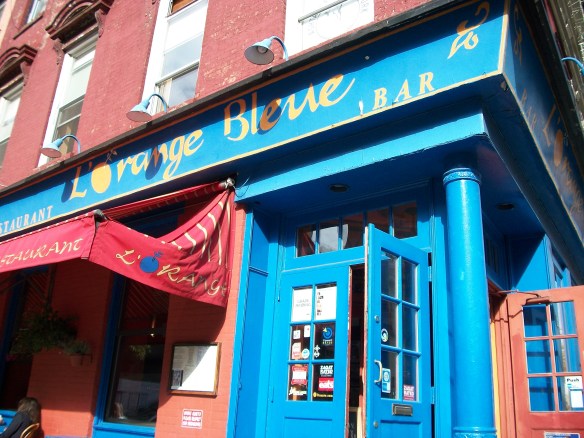
L'orange Bleue, a French restaurant in SoHo

My parents have a friend who works two blocks away from my aunt’s apartment, where I stayed for the past five weeks. When I told her that I’m planning to become a psychologist, she said, “Come to New York! There’s no better place to be a psychologist.” She said that elsewhere, people still believe that psychotherapy is something for crazy people to do. In New York, however, people understand that it can be a valuable tool for attaining self-knowledge and becoming happier. My impromptu adviser proudly pointed out that she herself has an excellent therapist.

Of course, psychology isn’t the only subject on which New Yorkers, generally speaking, have progressive views. In New York, it’s legal for a woman to go topless in public. Chain restaurants were required to provide calorie counts for all of their menu items even before Obama’s healthcare bill made that mandatory nationwide, and trans fats are illegal in restaurants. Homeless people don’t sleep on the streets anymore now that the city has a network of homeless shelters. Smoking is illegal not only in restaurants and bars, but also in parks, public squares (i.e. Times Square),  sports stadiums, and beaches. Cars are almost entirely unnecessary thanks to the constantly-improving public transit system. Gay marriage is legal.

When I hear about all the things that New York has and Chicago (let alone Dayton, Ohio) do not, I feel like this is a city that takes care of its people. It’s one more reason to feel welcome there.

Underneath a bridge in Central Park

Leaving New York sucked. On my last evening there, after I came down from the Empire State Building, I kept hanging around in Herald Square because I didn’t want to get on the subway and go home. That would put a note of finality into it.

On the plane the next day, I kept thinking about all the people I’d interacted with in New York. Not just my friends and family, but the nameless people–the Russian lady who asked me for help in CVS on my first night there, the stewardess I talked to while I was in line to buy snacks at the airport, the Spanish-speaking woman who offered to take my picture on top of the Empire State Building, the Bukharian Jew working for the Russian car service I used to get to the airport (we talked about family and the places we’ve lived), the giggly 40-year-old woman who approached me in Barnes & Noble in Union Square to ask me for help loading music onto her new laptop, the 16-year-old high school student from Florida who started talking to me about books in the Strand, the U of Iowa student I talked to about football in Washington Square, the street cart owner who chatted me up while making my chicken and rice on my first day out in the city, the gentleman with salt-and-pepper hair wearing a really nice suit who talked to me as we looked at male sex toys in the Museum of Sex.

I was so worried when I first set off for New York that I would be terribly lonely there. Everyone warned me that people are cold, that they ignore you, so I wasn’t at all prepared for the incredible variety of interesting and complex people I would meet there. And, despite having been in New York before, I had no idea of how the loneliness melts away when you find yourself actually walking through those streets.

Now I do, and now, more than anything, I just want to be back in those streets again.

Midtown and the Empire State Building, from the top of the Rockefeller Center

I’m Not Sorry

[TMI Warning]

As a person with a mental condition that often drastically affects interpersonal relationships, I’m a total pro at apologizing. I do it practically every day. Here’s a sample of depression-related things I’ve apologized for lately:

  • crying
  • being too tired to meet up with a friend
  • being late
  • leaving early
  • getting upset when a friend acted insensitively
  • needing to talk to someone
  • saying something negative
  • needing to go be alone for a bit
  • writing something emotional
  • being unsure of whether a friend really cares about me or not
  • not understanding a joke
  • not being dressed well/not having makeup on
  • taking criticism too harshly
  • not wanting to be in a big group of people
  • not wanting to drink
  • being quiet
  • not having an appetite

Now, I realize I should be counting my blessings for the fact that I now have friends who understand me and my brain enough to be able to accept those apologies–in high school it was much worse. But at the same time, I’ve become acutely aware of how inauthentic I’m being when I apologize for the various ways in which my depression manifests itself. Sure, I’m sorry if the way I am makes life difficult for people or makes them uncomfortable. But apologizing implies that I could’ve avoided the situation had I been more attentive or considerate, just like when one apologizes for, say, forgetting a friend’s birthday or for spilling hot coffee on someone.

I can’t avoid being fatigued or upset or sensitive, though, any more than a diabetic can avoid needing insulin shots.

Of course, most people who don’t know me very well don’t even know that I’m depressed. Thankfully, I’m not required to wear a scarlet letter “D” on my shirt. But even if they do know, I feel compelled to apologize every time my behavior deviates from that of a healthy person, just to remind them that I’m well aware of the fact that the way I am can be an inconvenience for people.

The truth is, though, that insofar as “I’m sorry” means “I messed up,” “my bad,” “this is on me,” “I should’ve known better,” “I should’ve tried harder,” “I should’ve been a better person,” and the like–I’m not sorry. It’s not my fault. I couldn’t have stopped it. There’s nothing I could’ve done. I’m getting treatment and trying my best to recover, and that’s as much as I should be held responsible for. I’m not even to blame for not getting treatment sooner, because I was a kid and had no idea there was anything wrong with me. I’d been told “that’s just how you are” all my life.

I wish I could stop apologizing for having an illness. But until people understand it well enough to react to my apologies the way they’d react to an asthma sufferer who apologizes for getting out of breath, I can’t.

I’m still not sorry, though.

Mental Illness as a Spectator Sport

Step right up, ladies and gents, see the amazing inhuman hoarders here!

Our culture seems to have three ways of relating to people with mental illnesses–either they’re pathetic losers who need to “snap out of it”, or they’re crazies who need to be locked away (think schizophrenia in popular culture), or they’re here for our pleasure and entertainment. That last one is a relative newcomer, and that’s the one I want to write about here.

Just look at our celebrities–specifically, the ones with substance abuse problems. When it comes to them, it’s all fun and games till someone dies. While the late Amy Winehouse was still alive, blogs and magazines loved to publish photos of her visibly drunk, putting her up for public ridicule. Sure, everyone knew she could use some rehab–she sang about it herself–but there was never an ounce of compassion in how we, as a society, related to her.

And take Charlie Sheen, clearly a troubled individual. I don’t even remember how many days went by that articles making fun of him littered my Google Reader feed. With him, there isn’t even any ambiguity regarding the diagnosis, but he was still treated like a circus animal, and everyone sat back in their seats, made some popcorn, and watched.

Take TV shows like A&E’s Hoarders, Intervention, and Obsessed. These shows literally turn mental illness–and the treatment thereof–into entertainment. You can laugh as the poor OCD sufferer cries when forced to touch a gas pump nozzle with her bare hands, or gag as that creepy hoarder guy reveals his apartment full of old snack wrappers and rotting food.

I’m not saying that it’s wrong to inform people about the lives of those with mental disorders. What I’m saying is that this informing should be done in a compassionate, humanizing way, and reality TV isn’t always the best format for that. For instance, the show In Treatment, which describes a (fictional) therapist and his clients, is a far cry from the carnival sideshow-like feel of the reality shows. I’m not exactly a big fan of reality TV in general, but as a medium for educating the public about mental illness, it’s even worse than usual, because it creates an environment in which people view their fellow human beings as freaks to be gawked at, not as peers to be sympathized with. (A counselor quoted on Everyday Health calls it “exploitanment.”) This happens on virtually every reality show–think how much the people on Jersey Shore and American Idol get made fun of. The difference is that the people on Jersey Shore and American Idol (arguably) do not have a serious mental illness.

Ultimately, all media companies want to provide stuff that sells, and in the case of magazines that publish photos of drunken celebrities (with witty commentary, of course) and TV networks that produce shows putting people with mental disorders up for display, the money’s definitely talking–people love it. But the quality of mental healthcare in the U.S. will never improve while our culture continues to treat people with mental disorders as amusing distractions and not as people.

Types of Moronic Blog Comments I Get

[Snark Warning, obviously]

When I receive comments like this either on this blog, on my Tumblr, on Facebook, or in person, I kind of want to shoot myself in the face.

“Yeah well, I’m [insert group name here] and this doesn’t apply to me.”

I will personally give you $20 if you can find a post on this blog claiming that all x are y. When you’re writing about culture and social science, as I do, a certain amount of generalization is necessary to be able to make a point. I’ve decided not to insult my readers’ intelligence by littering my blog posts with inane truisms like “but of course there is an exception to every rule” and “this may not apply to every individual but” and so on. Apparently, though, people don’t understand this, so I probably need to add a “generalization warning” to the two warnings that I already have.

“That’s just your opinion.”

Gee, brilliant observation, Einstein. This is my blog! Of course it’s just my opinion! I will gladly pay up another $20 if you find a post in which I claim to be the supreme authority on some subject or other.

“Don’t be so judgmental.”

Or what? I’ll be a Bad Person? I never claimed to be a perfect saintly individual who doesn’t judge people. Most people judge people. Granted, most people do not have a blog, so perhaps that’s what sets me apart. In which case, go ahead and state the problem as it really is–I’m a woman, I’m sharing my opinions, and my opinions aren’t always Nice and Kind and Loving. Oh noes!

“Check your privilege.” (and variations thereof)

I’ve already written about this so much that I hardly have anything to add and will simply direct you to this, this, and this.

“I like you better when you aren’t so angry.”

Yeah, and I like the world better when it doesn’t have any problems for me to get angry about. I also like YOU better when you don’t demand constant cheeriness from me. What can I say, we all have our likes and dislikes!

“lol”

I’m sorry, you must’ve gotten lost on the way to your junior high and accidentally ended up on my blog. You should probably get going now.

“Great post! I found it very interesting! For information about a new, low-cost solution to increase the size of your peni$ please visit http://www.cheapbigpeni$.com”

Enough said.