Unknown's avatar

About Miri

Writer, activist, social worker, and huge fan of cats, flowers, and cities.

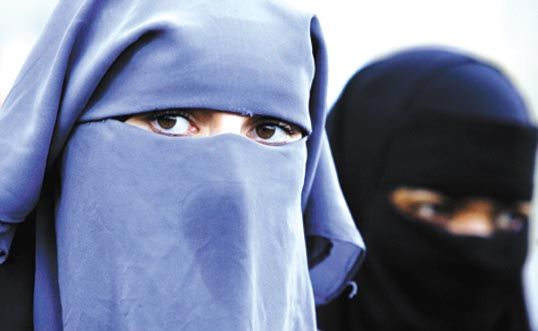
Why I Oppose Banning Burqas

This is not the problem.

And no, my reasoning has nothing to do with racism or any other ism!

Belgian lawmakers recently passed a bill that, if approved in their senate, would make it illegal to wear burqas in public. This comes on the heels of France’s

When justifying banning burqas or similar Islamic garments, people typically make two points–one, that burqas represent and facilitate the oppression of women, and two, that they pose a security risk.

I’ll address the oppression issue first. Some women do indeed wear burqas because they’ve been pressured into it by their culture or by specific men in their lives. But other women do it out of a genuine desire to observe their religion in that way. Some even see it as an empowering gesture. It is fundamentally unjust to oppress the latter group in the name of protecting the former.

But even if I’m being completely naive, and even if not a single Muslim woman willingly chooses to wear a burqa, I conveniently have a second argument. For those women who are being oppressed by the burqa, would banning it really help? The obvious answer, I should hope, is no. In this case, banning the burqa is the legal equivalent of slapping a band-aid over a knife wound–and of treating the symptoms rather than the disease. The disease being, of course, large-scale societal oppression of women. Not something that can be fixed with a single magical law. To use an analogy that’s even closer to my personal experience, banning burqas to promote feminism is like banning suicide to promote mental health.

Not only would banning it not help, but it would probably backfire. If these women’s husbands or fathers are pressuring them into wearing the burqa, they would probably keep right on doing it despite the new law, thus placing these women in a prime position for facing charges, jail time, or plain ol’ harassment by the police. After all, they would be the ones paying the price for breaking the law, not men.

As for the whole security issue, I don’t have too much to say about that because I’m honestly not an expert on the subject, but I’ll say this–Israel has no burqa ban, or any sort of ban on Islamic head coverings, and yet has an incredible security force that manages to stop virtually all potential terrorists within the country’s borders. They don’t release these statistics to the public, but all the time in the Jerusalem Post, you see another story about security guards catching a would-be terrorist. Maybe the security authorities in these European countries should have a big pow-wow with Israeli ones and see what they’ve been missing.

I think it’s very tempting for people (and governments) to believe that issues like the oppression of women by organized religion can be fixed by something as simple as a law banning burqas. But ultimately, you can never really know what’s going on in someone else’s mind. What looks like oppression to us may not feel that way to the women in question. Or maybe it does. In any case, banning burqas won’t help.

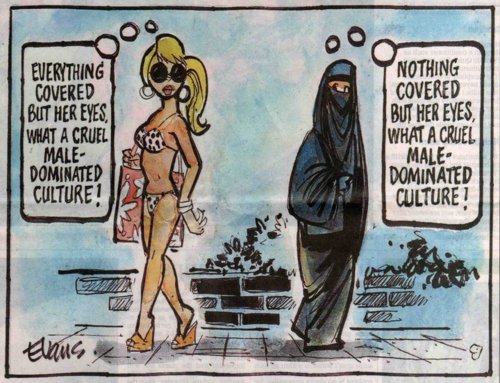
I’ll leave you with my favorite cartoon on this subject:
Leggings Are Pants, End of Story

Does it cover her butt? Then it's clothing.

[TMI Warning]

Since most of the people who read this probably know me in person, I can probably assume that you, my reader, know how I look. Specifically, you may have noticed that I’m curvy.

And when I say curvy, I’m not using that as a euphemism for “fat,” because that’s not what I am. I’m curvy. Specifically, I have fairly large boobs and a rather large giant ass.

Despite our society’s idolization of hourglass-shaped women such as Marilyn Monroe and Kim Kardashian (neither of whom I am attempting to compare myself to except where waist-to-hip ratio is concerned), this is not a body type that the American fashion industry tends to keep in mind. According to the clothes you find in virtually any store, be it a Walmart or a Prada, American women come in one shape only–a stick. Sometimes it’s a very thin stick and sometimes it’s a very fat stick, but it’s still a stick.

Jeans, the staple of casual style, are unfortunately no exception. Here’s what happens when you have a big ass and you try to wear jeans. First of all, any size that actually fits around your ass and zips all the way up will generally be way too long for you and much too loose around your actual waist. When you sit down, the back of the jeans rides down and everyone from London to France can see your underpants. Your thighs, if they’re nice and juicy like mine, will be constricted by the jeans and it’ll sometimes hurt to sit. Putting the jeans on and taking them off will be a Herculean effort. Usually, the jeans will be way too tight in general your body will literally spill out of them at the top.

Needless to say, I don’t like jeans very much, and most girls with my proportions don’t either. So if we want to wear jeans like everyone else does, we have two options:

  • Be really uncomfortable.
  • Starve ourselves, because that’s the only way to rid a curvy body of its curves.

Needless to say, neither of those options sound particularly appealing. So during the warmer months, we wear lots of skirts and dresses. But fall, winter, and spring pose a problem. Many girls, myself included, prefer to wear leggings because they’re comfortable and stretchy and fit our proportions. Unfortunately, however, many people seem to believe that leggings are “not pants.” Why? Because they’re form-fitting. This has apparently even inspired a Huffington Post article (which, then again, may not be saying much).

What this means is that if you want to wear leggings, you must always choose a top that’s long enough to cover your butt, because God forbid anyone be able to discern the outline of your behind–not that jeans hide it either. However, when you have a large ass, it’s pretty hard to find tops long enough to cover it up completely, meaning that this style is best suited for stick-women, too.

Well, what can I say. I apologize deeply for the fact that my body isn’t of the shape that this particular culture values, and I offer my condolences to anyone who has ever been offended by the sight of the outline of my ass when I wear leggings.

Actually, just kidding. I’m not fucking sorry! This sartorial snobbery is ridiculous. Here’s a quick guide to identifying whether or not something qualifies as clothing. Does it cover up all the body parts that need to be covered up? If yes, then–ding-ding-ding!–it’s clothing.

And if you’re one of these rabid “but but but leggings aren’t pants!” people, then I’d suggest that you issue yourself a stern reminder of the fact that not everyone’s willing to starve to gain the ability to dress themselves in the way you’d like them to.

Still not convinced? Well, find me a pair of jeans that will fit these T&A, and then we’ll talk. πŸ˜‰

Civil Disobedience Gone Horribly Wrong

Anyone who’s been at an airport lately probably agrees that those new TSA bodyscans/patdowns suck. One woman, however, apparently reserves some very special wrath for this procedure, because it infuriated her so much that she assaulted a female TSA officer. Not in the usual shoving/punching way, though:

TSA staff said Mihamae refused to be go through passenger screening and became argumentative before she squeezed and twisted the agent’s breast with both hands. Police said Mihamae admitted to the crime and was arrested on a felony count of sexual abuse.

Just in case this isn’t bad enough, there is now some sort of movement to keep Miyamae (that’s the actual spelling of her name; the media outlets got it wrong) from being prosecuted to the full extent of the law. It’s a Facebook page called “Acquit Yukari Mihamae” and it has currently been liked by 4,694 (and rapidly counting) people.

That’s a lotΒ of people who think that physically assaulting someone is a fair response to a policy they dislike.

Here are some of the comments I found on the page:

“I love the story about this those disgusting TSA pigs need a taste of their own putrid medicine. I hope everything goes well I will offer all the support possible. NO PARA-MILITARY a.k.a TSA”

“GOOD JOB!!!! you should have twisted those bad boys right off!!!! show them punk asses a case of trading places… they think this is bad wait till they push us so far into a corner that the only option left for us is to revolt!!!!!!!!!!!”

“THANK YOU, Yukari for standing up to the TSA and for doing what I have always wanted to do!! You are a true hero and you show that resistance ios NOT futile!! I hope everyone will learn from your example and resist the senseless groping. Thank you, thank you, thank you for your courage and bravery!!”

“Thank you Yukari for your courage. You are the modern day Rosa Parks”

“Well, if somebody doesn’t stands up as Yukari did ,the world will be destroyed already… kudos for you!”

“TSA is to the United States as The Gestapo was to Nazi Germany!!”

“I live in Australia and was thinking of vacationing in the US. Until TSA follows the Inquisition and the Stasi into the dumpster of History, I’ll go elsewhere.”

“Keep twisting Yukari-san.”

Perhaps nothing disturbs me more than the comparisons of Miyamae to Rosa Parks and of the TSA to the Gestapo, the Stasi, and the Inquisition.

As for the suggestion that what Miyamae did is somehow equivalent to what the TSA does, that’s preposterous. Whether or not you agree with the actual method, the TSA has been charged with keeping airline flights safe. They’re not scanning/patting people down in order to make them uncomfortable, molest them, or embarrass them. They’re doing it because they’re trying to stop potential terrorists.

Furthermore, last I checked, we don’t do “an eye for an eye” here in America. We don’t rob convicted burglars, we don’t rape convicted rapists, we don’t punch kids that we catch fighting with classmates.

It seems that people have, as usual, fallen victim to black-and-white thinking. To them, the TSA’s screenings are “bad.” Therefore, anyone who resists them in any way must be “good.” Even if that resistance takes the form of an assault on someone’s body.

The supporters of Miyamae, particularly the ones who compare her to Rosa Parks, also seem to neglect the fact that realΒ civil disobedience is powerful precisely because it harms no one. The image of Rosa Parks quietly sitting on the bus and refusing to stand is completely different from that of Miyamae forcefully grabbing and twisting the breast of another woman, a woman who is simply doing her job and trying to make a living.

Got a Job? No Fun For You

[Snark Warning]

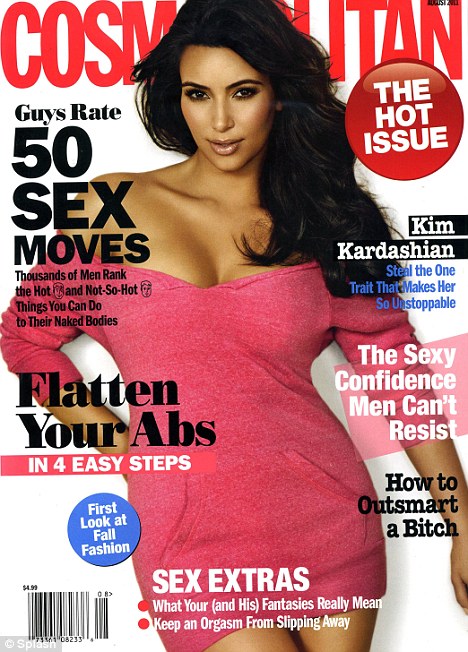
I read one of the advice columns in this month’s Cosmo. A woman was writing in and asking if it would be okay to wear a top that reveals her tan lines to work, provided the top was modest and work-appropriate. The response was, no, it wouldn’t. Why? Because you wouldn’t want your boss to think that you spend your free time lying around at the beach:

Even though the best of us can fall victim to zebra skin by accident, exposing your sun stripes at work would be flaunting your bad judgement (baking does lead to skin cancer, after all). Perhaps worse, as far as your boss is concerned, it suggests you spend lots of your free time being at one with your beach towel–not exactly impressive.

“Not exactly impressive?” What does that even mean? Apparently, you shouldn’t let your boss know that you actually have funΒ on your days off. Oh, heavens no! You ought to be at home, catching up on emails.

(As for the skin cancer thing, I’d just like to point out that even if you wear sunscreen, you’re eventually going to get a tan if you spent a lot of time outside. Trust me, my mom slathers my little brother and sister with sunscreen obsessively, yet at the end of the summer they still have those cute little freckles and tan lines.)

Naturally, I immediately thought back to an earlier post I wrote about why adults are always so miserable and try to make me as miserable as they are. Now I’m not surprised. Apparently, once you’re all grown up and have a job, you’re not even allowed to have a good time when you’re off work. No wonder adults are always in such a crappy mood, and no wonder they want to warn me that in a few years I’ll be in a crappy mood too.

What shocks me is that Cosmo isn’t exactly a serious, business-y magazine. It’s mostly read by people who like to enjoy themselves every now and then (or every day/night, as the case may be). If evenΒ CosmoΒ is saying that you can’t have fun once you’re a grown-up (or, at the very least, that you have to do it in secret), what’s the world coming to?

This doesn’t even make sense to me, because I would hope that my boss would wantΒ me to come to work refreshed and in a good mood. I would want him/her to know that I’m not going to be asking for time off to go see a therapist about how miserable I am because I never have fun.

(I’m hoping, perhaps in vain, that since I’m going into the mental healthcare field, things will be different for me. After all, if there’s anyone who knows that relaxing and having fun is absolutely necessary, it’s a therapist. In my opinion, therapists should be able to model healthy behavior for their clients. If a client casually asks me what I did over the weekend and I’m forced to either lie or confess that I spent the entire time huddling over my laptop in a corner, crying, and biting my nails off while my husband played with the kids, that’s not good.)

Where did we go wrong? Why is it that in other countries and cultures, it’s perfectly normal to take a nap after lunch before coming back to work? Why is it that the United States is the only country I could find that does not mandate a minimum amount of paid vacation time for all employees? Why is the United States one of the only developed countries that does not offer paid maternity leave (to say nothing of paternity leave)?

One thing that never fails to surprise me about American culture is how fixated it is on work. Β Russians, for instance, seem to view work mostly as a means to an end (money, security, providing for one’s family), whereas for Americans, it’s an end in itself. I rarely hear my parents talking about work when they’re home, and the only time I’ve seen them doing work-related things at home is when my dad starts maniacally writing some sort of equations on a napkin. My parents don’t have smartphones or tablets. If you send an email to their work address on Friday evening, you won’t receive a response till Monday. And yes, they go to the pool on weekends, and evenings, and any other time they fucking feel like it.Β That, in my opinion, is how it should be.

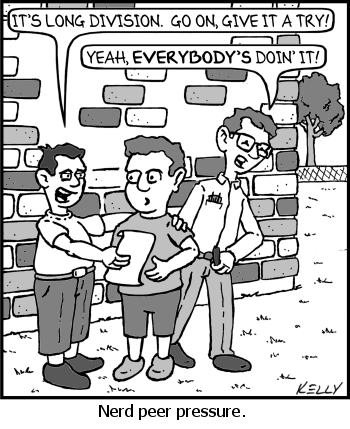
Bullying as a Social Regulator

If only it worked this way.

I came across a post by Tea Party Nation blogger Dr. Rich Swier called “Bullying, Peer Pressure and Gulf Coast Gives.” (You need a TPN account to see it, unfortunately.) I won’t describe the way in which the contents of my stomach forcibly exited my body upon my reading this, and I will also ignore the homophobia in this article because it’s obvious and there’s no need to comment on it. Rather, I’m going to simply explore an interesting idea that Swier brings up.

In this article, Swier is opposing Gulf Coast Gives, a charity foundation that, among many other things, advocates against LGBT-related bullying. He opposes this foundation because he disagrees with its stance on this issue:

This is not bullying. It is peer pressure and is healthy. There are many bad behaviors such as smoking, under age drinking and drug abuse that are behaviors that cannot be condoned. Homosexuality falls into this category. Homosexuality is simply bad behavior that youth see as such and rightly pressure their peers to stop it…

I agree with Gulf Coast Gives that “LGBT youth are up to five times more likely to attempt suicide than their straight counterparts”.Β Homosexuality, like drugs, harms young people if they experement with it. That is the greatest tragedy.

Again, I’m going to just ignore the self-evident homophobia and dissect Swier’s concept of bullying as some sort of social regulator. He reframes bullying as “peer pressure” and claims that it prevents young people from engaging in unsafe behaviors, in this case, homosexuality.

Leaving aside for now the fact that, unlike the other behaviors listed here, homosexuality is not a choice, I am left to wonder if Swier somehow managed to completely miss the reasoning behind all the anti-drugs and alcohol campaigns that public school kids are subjected to these days. Peer pressure isn’t typically a force that promotes healthy behavior. If it were, we wouldn’t need all these “just say no” lessons to teach kids how to resist it.

It seems that bullying and peer pressure serve more to encourage “normalcy” than anything else. Luckily for Swier’s argument, heterosexuality happens to be normative. But so are underage drinking and, in some circles, smoking and drug use. People don’t get bullied for doing things that are unsafe; they get bullied for doing things that are “weird.” Contrary to Swier’s argument, kids and teens don’t see homosexuality as “bad behavior.” They see it as weird.

Not only do kids not bully each other for doing things that are actually unsafe, but they frequently bully each other for doing things that most adults would see as positive. I’m sure that even social conservatives would agree with me that reading books is good for kids. Yet everyΒ avid reader I know, myself included, was made fun of for it in grade school. To quote the great Bill O’Reilly, you can’t explain that.

Of course, norms change. Homosexuality is becoming increasingly accepted in American society, so it’s only a matter of time before that acceptance starts trickling down to kids and teens and Swier’s argument starts falling apart, like all Tea Party arguments inevitably do.