
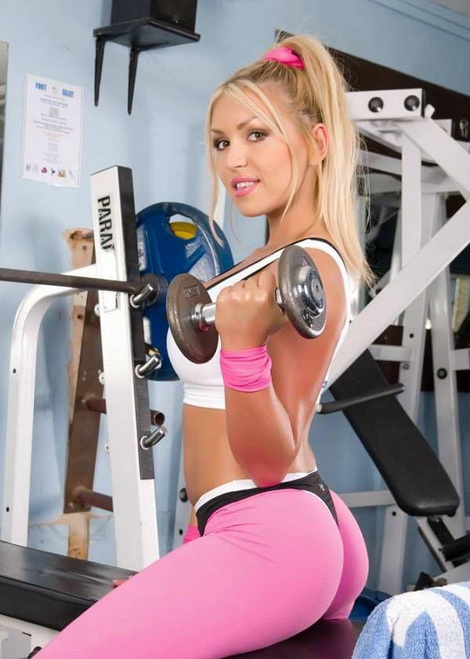
The Gym: the Poor Man’s Runway

But don't try TOO hard. Like this girl.

Yesterday, one of the main student publications at my illustrious university came out with this gem, titled “Dressing to Impress at the Gym.” After the title and byline, the article takes an unfortunately predictable route:

So the gym might not be the sexiest place on earth. But, who says that it can’t be one of the most social? However unlikely, SPAC, Blomquist and the Evanston Athletic Club are some of the best places to meet guys on campus. Yes, The Keg or a fraternity party would be obvious choices, but those get old quickly. Guys flock to the gym from all corners of the university and, like it or not, they could be on the prowl.

Oh, dear heavens no! Guys could be “on the prowl!”

First of all, I just want to congratulate the author of this article for her implied success in “meeting guys” at the Keg or at a frat party. I have never been able to find decent specimens there, but clearly, this girl is just more skillful than I am.

Anyway. The article goes on to list helpful tips for girls who are super duper concerned with the scant possibility that someone may look at them while they’re working out. Most of the tips involve buying severely overpriced clothing and accessories at places like Lululemon and Gap. One of them involves wearing a bright-colored bra (way to attract attention while also looking completely fucking ridiculous).

The one that really gets me, though, is the last tip:

Don’t be that girl. “You can tell when a girl is trying too hard,” Medill sophomore Antonia Cereijido said. “They’ll wear no clothing and walk on the treadmill rather than actually getting a workout. They just look kind of silly.”

That’s right, ladies–don’t be that girl who “tries so hard” and cares so much about how she looks while working out, but do go ahead and read an entire article that tells you how to look good while working out.

There are so many things wrong with this article. Where to begin?! Well, first of all, with the assumption–never stated in this article, but implied nonetheless–that no matter what a woman happens to be doing, what matters most is always how she looks doing it.

We’ve seen this before with women like Michelle Obama, Hillary Clinton, and Elena Kagan–women who are helping to run the country but find themselves subjected to neverending commentary about their looks.

What I didn’t expect, however, was to find this same principle at work in the student magazine of what I had hoped–before I got here, that is–was a fairly intellectual college. Women, according to this article, exist to be looked at (by men, of course). And this completely ignores the fact that many men find it really sexy when a woman is working out and doesn’t care how she looks.

The second major problem I had with this piece was the implication that even if you’re not at the gym in order to pick up guys, you should still concern yourself with the fact that you may be looked at. As the introduction says, “Guys flock to the gym from all corners of the university and, like it or not, they could be on the prowl.”

Like it or not? Well, I suppose I don’t, but what the hell do I care if they look? It’s not my job to make sure that no man is ever, G-d forbid, offended by my appearance–especially not while I’m at the gym. I don’t owe anyone anything, and if they look at me and don’t like what they see, they are free to look elsewhere.

But no. According to this article, girls should always care that they’re being looked at, which is why they should always look good, even while working out, even if they’re not even looking to meet any guys. How empowering!

A third issue here is the implication that the gym is only for people who are able to fit their bodies into the cute, tight little shorts and tops that the article practically advertises. Um, last I checked, many people go to the gym in order to lose weight and/or become more fit, not to show off their already-perfect bodies.

But then again, the article isn’t really aimed at those people, is it? Because, after all, who on earth would want to look at them, anyway?

And that’s just the thing. Articles like this always imply that gyms are for attractive people only, which is just as ludicrous as saying that French class is for people who speak French fluently, and art class is for people who can already paint.

Finally, even though the article is obviously aimed at women (men, after all, don’t need to concern themselves with such petty issues as appearance), it nevertheless constructs the gym as a man’s space–one that women may occupy only as long as they follow the rules. As a guy quoted in the beginning of the article says, “I think it’s good that girls take care of their bodies and that they’re not afraid to go into the gym where there’s guys lifting heavy weights and stuff.”

Not afraid to go into the gym? Please.

Of course, the fearlessness that this guy finds so incredible comes with strings attached–women must always look good at the gym, or else…well, I don’t know what happens then. Do our memberships get revoked?

What’s really disappointing about all of this is that I’ve always thought of the gym as a great equalizer, of sorts. Anyone can go there, anyone can benefit from going there. It’s the one place where I’ve never felt like my appearance was being scrutinized, and I’ve always felt comfortable letting go and getting into the flow of exercising.

But clearly, some of the people I go to school with don’t see it that way. You’d think that there are few pursuits more self-directed than exercise, but to them, the gym is just another place to “be seen,” and its health benefits are secondary.

Of course, the author would argue with me here. She even writes at one point, “Remember ladies, health is important, so when at the gym you should still be the number one priority.”

But if she really feels that way, why didn’t she write an article about, say, how to figure out what your heart rate should be while exercising? Or how to use all those damn strength training machines I still haven’t figured out how to use? Or how to work out as many different muscle groups as possible in as few different exercises as possible? Or any number of other health-related topics?

I’m very idealistic about journalism. I think that all journalists, even students at a campus publication, are, in a way, setting the agenda for us as a society. Every moment spent writing piece-of-shit articles like this is a moment not spent writing about stuff that actually matters.

Rather than writing an article that practically shits out the same sexist tropes we’ve all grown up with–that women owe it to men to look good, that only thin athletic women are worth looking at, that men are only attracted to women who actively try to look good rather than just doing what they love with abandon–this student could’ve written an article about why it doesn’t fucking matter what you look like when you’re working out.

But she didn’t do that. She chose to promote the sexist tropes instead, thus doing her small part to keep an unfortunate aspect of our culture going strong.


You Can Leave

[TMI Warning]

You’re allowed to leave. You’re allowed to walk away from things that hurt you.

Nobody ever tells you that, so I will.

~~~

Tonight should’ve been a great night. SHAPE, a campus organization that I’m involved with–it stands for Sexual Health and Assault Peer Educators–was holding an event in which a documentary filmmaker screened and discussed her documentary, which concerns college hookup culture. The event was mandatory for SHAPE members, but I would’ve come anyway because the subject interests me.

I should’ve known what I was getting into, but I didn’t really…

The documentary took a critical view of hookup culture and interviewed various students, as well as some professors and campus health professionals. It also interviewed a few frat guys, who were, of course, allowed to remain anonymous with their faces blacked out in the film.

The things the frat guys said stuck with me.

I can’t remember exact quotes, but it was the typical stuff–about “picking and choosing” girls, about how alcohol makes them less likely to protest, about how a girl who’s slept with at least three of the frat brothers is called a “toaster” because she’s “toast.”

Suddenly, I found myself feeling increasingly uncomfortable and anxious. It was hard to breathe. It made me think about the past.

~~~

“Come on. You know you want it. You let me touch your tits before.”

“No, I don’t. I’ve already told you. I’m interested in someone else and that’s the only person I want to sleep with right now.”

“You know, you’re lucky. Some guys would just…”

Would just what?”

He just smirks at me.

~~~

Nothing happened to me that night. Nothing physical, that is; he left me alone after spending three hours trying to manipulate me.

But emotionally, I was never the same again.

~~~

Another night, many months before that. My first college party. It was “registered” so there wasn’t even any alcohol.

I’m dancing with my friends. None of us have been drinking; we’re just happy to be at college and at a crowded, noisy dance party. He comes up to me and starts dancing with me. He’d clearly pregamed before coming to the house.

You’re such a good dancer. Are you a music major?”

“No, journalism.” I smile.

He nods and we keep dancing.

The song ends, and we dance for another one.

Then he leans in to kiss me. I pull back.

Sorry, I have a boyfriend at another school.”

You have a boyfriend? You should’ve had that written on your forehead!”

He storms off. I’d enjoyed just dancing…

~~~

Another time.

We used to be good friends, or at least so I thought.  We hung out all the time, talked about our lives and about school. We were attracted to each other, so one day we hooked up.

After that, things change. He only texts me at midnight, asking if I want to walk all the way to his frat and “chill.” He never asks me how I’m doing anymore. We stop talking after a while.

Months later, he messages me on Facebook.  “So, honest question. Did I start to annoy you after we hooked up?”

I say, “No, it’s not that. I just got the impression that you were more interested in me for just sex rather than actual conversation or friendship.”

“Alright, fair enough.”

“I mean, is that true?”

“To an extent, yeah.”

~~~

I should consider myself lucky. If the estimates of unreported sexual assault are accurate, the fact that I’ve never been raped puts me in the minority. But, like most women, I’ve been catcalled, groped, followed down the street, pressured for sex, offered unidentified drinks, called a bitch for not acquiescing.

That’s why I don’t go to parties. That’s why I don’t participate in hookup culture. And no, to any radical feminists reading this, it’s not because I think it’s a woman’s responsibility to prevent herself from being raped. It’s because hookup culture makes me want to throw up, cry, hurt myself.

I choose to walk away from it all. You can choose that, too, if that’s what you want to do. Don’t ever let anyone convince you otherwise.

~~~

So I didn’t stay at the film screening tonight. I probably should’ve, because it was mandatory and all. Because my committee was planning to meet afterwards and I don’t want to have to explain why I left. Because, on some level, it was interesting to me. Because I wanted to introduce myself to the filmmaker and ask her for advice about researching this topic.

But in the end, I didn’t stay. I walked away. Because I felt so uncomfortable, because I just wanted to go home so much.

So I stood up, swung my bookbag over my shoulder, and walked right out.

I walked home through the warm night and I felt so free. I wasn’t happy, by any means, but I felt like I’d made the right decision. I listened to my iPod and started to breathe easier.

~~~

I don’t mean to imply that it’s always possible–or even desirable–to just walk away from anything that makes you uncomfortable. Sometimes you need to examine what’s happening and confront your fears.

But I’ve examined this through and through. I can’t change the things that have happened to me, and there’s just no way to make myself believe that those things are okay and that anyone should ever have to go through them. And I don’t see the need to keep reminding myself of them.

Some people might read this and think, “Gee, that’s stupid. What’ll she do, avoid every painful thing in life?”

Obviously, no. Some people think that just because some pain is unavoidable, we should just accept every painful thing in our lives and let it in. Perhaps one can build up an immunity that way.

But I disagree. The fact that there are so many unavoidable painful things in life only proves to me that we should avoid the ones we can. After all, even a psychologically healthy person goes through so much–death of loved ones, illness, financial difficulty, heartbreak–and psychologically unhealthy people have it even worse. Shouldn’t we find a little corner of life that’s happy and fight to defend it?

I think so. That’s why I opted out of hookup culture, and that’s why I opted out of tonight’s film screening. I went home to my beautiful apartment. After I finish writing this, I’m going to make a cup of tea and read my psychology textbook and plan my research project and talk to my friends online and maybe call my mom.

Because, in the end, those are the things that make me want to keep living for as long as I possibly can.

Mental Illness Is Not a Punchline

Damn, I’m certainly on a crusade against humor these days.

That was sarcasm, by the way. I love humor. I just think it should be deployed carefully.

A few days ago in my Psychology of Personality class, the following happened:

Some people were having their own conversations while the professor was trying to give a lecture. The professor cracked a joke–“Hey guys, I have ADD so I can’t focus if other people are talking, so please stop!” followed by “I don’t really have ADD, but still.”

Now, for the record, I totally get that it sucks for a teacher when people are talking in class. But I also feel that there are other ways to address that situation without making a joke about having a mental illness that you don’t actually have. Especially, you know, if you’re a person who has a PhD in psychology and conducts research on people with actual mental illnesses.

The sad thing is, before he followed his comment up with that disclaimer, I was actually really touched. I thought it was wonderful that a professor of psychology would take a stand against the stigma of mental illness by stating in class that he has one. But then, you know, it turned out to just be a joke.

~~~

Last spring, I took a class on Cognitive Behavioral Therapy. It was an advanced class, with just around ten students or so, taught by one of the most esteemed professors in the department. We got to the chapter on Borderline Personality Disorder, which, as you may know, is considered one of the most frustrating mental disorders–both for clinicians and for the patient’s friends and family. So naturally, no discussion of it could be complete without my professor’s bombastic explanations about how she tries to avoid treating BPD patients because they’re just SUCH a pain and about how she once had a friend with BPD who was just SO hard to deal with. Everyone gasped and laughed at her descriptions.

Then, of course, the other students had to start raising their hands and talking about their own friends that they’d taken the liberty of diagnosing with BPD, and how  horrific those people were.

This was a time in my life when I was seriously wondering if I had BPD myself, so, yeah, that was pretty unpleasant.

~~~

Last fall, I took a class on psychopathology. It was my second psychology course ever, and my first that related specifically to mental disorders–a topic very close to my heart at the time since I’d been diagnosed with major depression only a month before.

Before the course started, the professor sent out an anonymous survey to the entire class about our experiences with mental illness. On the first day of class, she disclosed the stunning results–more than half of us said we’d been diagnosed with one.

So we got to the chapter on depression and the professor started talking about depressive cognitive distortions, using specific examples. The professor started listing them off in such a way that the whole class started laughing. And laughing, and laughing.

Now, I totally get that it sounds funny. Consider this dialogue:

X: I’m getting a B in calculus. I’m a total failure.

Y: You’re not a failure at all! You have straight As in the rest of your classes.

X: Well, those don’t count. They’re easy anyway.

Y: Yes, and calculus is pretty hard, so it makes sense that you wouldn’t do as well. Besides, a B is a pretty good grade.

X: No, it’s a shitty grade. Everything I do is shitty and I’m always going to be a failure.

That is an example of several cognitive distortions, including overgeneralization, disqualifying the positive, magnification, and labeling. And, when read aloud in a particular tone of voice, I can see how it might sound kind of funny.

But having been through it myself and studied it extensively, I can also hear the pain behind what X is saying. It’s not a punchline. It’s a cry for help from a person trapped inside their malfunctioning mind.

~~~

Here’s the thing. I get it. People with PhDs in psychology have spent years and years reading, writing, and talking about stuff like this. I’m sure that it’s completely normal for two psychologists to crack jokes about mental illness to each other.

Knowing that many people who pursue degrees in psychology are spurred to do so by their own experiences with mental illness (I’m an example of this), I understand the urge to joke about it because I joke about it myself. It helps alleviate the fear and pain of living with mental illness.

That doesn’t mean I’d joke about it to a room full of 100 people who don’t know me well and who may be dealing with their own issues, though.

Case in point–at the time I took the aforementioned psychopathology class, I was still learning how to recognize cognitive distortions in myself, and I was beginning to realize the extent to which they’d ruined all of my previous interactions, friendships, and relationships. To have a room full of 100 people laughing uproariously about something that nearly brought you to suicide just three short months before is, well, no laughing matter.

~~~

I’m not saying there’s no room for humor about mental illness. There definitely is, and humor has been one of several strategies that have helped me process what happened to me. But humor must be used carefully.

I’ve written before about the complex relationship between humor and mental illness–here, here, here, here, and here. But this time, the situation is very different because the off-color jokes are coming not from comedians, television writers, novelists, or clueless friends of mine, but from people who know more about psychology than 99% of the population.

Unfortunately, I still haven’t quite worked up the courage to tell a person with a PhD that they’ve offended me.

But I’m working on it.

The College Story

See, I'm not the only one.

I wish I could spin you the story everyone wants to hear.

That story has a whole cast of predictable characters, and many trunks’ worth of familiar props. The friends, the neat dorm rooms, the beer, the photo collages, the inside jokes, the cute frat guys, the walks by the lake, the hot chocolate, the study sessions, the mentoring professors, the sorority mixers, the coffee dates, the giggly all-nighters, the risque one-night-stands and the whispered confessions to friends in class the next day.

Sound familiar? That’s the College Story. You’ve seen it in every glossy brochure, TV show, Seventeen magazine article, and back-to-school commercial.

But that’s not my story. It never will be. Because the kind of person I am doesn’t get to live that story.

Halfway through my college career, it’s time to admit this to myself.

My story? Sure, it has some bright moments in it. Most stories do, and mine hasn’t been that awful. But then there’s all the stuff nobody wants me to talk about–the weather, the loneliness, the way guys at Northwestern treat me (to be precise, like a thing), the rich, preppy students that I’ll never resemble, the hours spent laboring over essays that professors barely even read (and then unceremoniously slap a B on without further explanation), the expectation to be a walking, talking, drinking/fucking/studying machine, the not-so-subtle bragging NU teaches us to perform, the bottles of anti-depressants lined up on my shelf, the many nights I spent considering transferring, asking for a quarter off, dropping out of college, or dropping out of life.

I played with my little sister today. I do that every day when I’m home, but today it was different because I was acutely aware of the fact that I’m leaving again in five days. I hugged her and my heart broke all over again. I hate that I’m not here to see her and my brother grow up. I hate that nobody at Northwestern loves me the way these two do. I hate that my little brother took one of my blankets to sleep with because he misses me while I’m at school. It all feels so wrong to me.

I’ll feel better once I’m actually there, I know that. Despite what it may look like, making the best of things is a skill of mine. Once I’m there, it’ll be easier to make myself forget the loving family I’ve left back in Ohio and to pretend that home isn’t where I’d always rather be. Sometimes I’m even able to get myself to believe that I somehow matter at this huge institution of higher learning and that it, or at the very least, the lives of some of the other people in it, would be noticeably different if I had never existed.

The truth is that I’m paying $200,000 and a lot of my own sanity for a stupid piece of paper saying that I’m qualified to go get a PhD and actually learn something relevant to my life, because all I’ve learned these past two years is how to act smarter, richer, and more well-adjusted than I actually am. Call me an idealist, but I hoped that college would be more than this.

I’m compelled to apologize for this. To apologize for hating college, because it goes against everything our culture dictates that I do. I’m supposed to love it.

Well, I’m sorry. I wish I could tell you that I do.

An Indictment of Party Pop

Just when you thought I was finally done writing about alcohol and partying, here I go with yet another post about it!

Before I start talking about party pop, though, I need to clarify what exactly I’m talking about, because apparently some people still don’t get it. Every once in a while someone who doesn’t know me too well says something like “OMG I READ YOUR BLOG AND I GUESS YOU HATE FUN HAHA.” Um no.

So let me explain. I do not hate alcohol. I do not hate parties. I do not hate fun. I do not hate people who drink and party, except when they’re infringing on my personal space. What I hate is something I call “party culture,” which, by my definition, contains the following components:

  • the belief, prevalent among people of all ages, that partying is the one and only acceptable way for young people to spend their free time and socialize
  • the glorification and normalization of binge drinking (formally defined as drinking five or more drinks in a row, but I also use it generally to refer to drinking in a way that jeopardizes one’s health and safety)
  • the use of alcohol as a means to coerce women and excuse sexual assault
  • the idea that people who choose not to party are deficient in some way
  • pressuring people to drink and party (This is truly unique in college. I was never pressured to join clubs, go to football games, explore Chicago, attend dorm events, or do any other social activity quite like I was pressured to party.)
  • the belief that alcohol is something people “need” in order to relax, talk to people, hook up, have fun, etc.
So there’s party culture for you. As for party pop, I read a piece about it in this summer’s issue of Bitch magazine. The piece was actually a really interesting analysis of the changes that this sort of music has gone through; whereas drunk girls in pop culture used to exist basically as a spectacle for men’s benefit, more recently they seem to be partying for themselves (the article mentions Ke$ha and Katy Perry as examples). Anyway, you’d really have to read the whole article to see all of the points it makes, but that’s the gist of it, and the author sees this as a positive development–female empowerment and blahblah.
However, where the article falls short is that it still seems to present party pop as a symbol of rebellion:
Today’s party-girl pop continues down the avenue of non-explicitly politicized, pleasure-focused rebellion against gender norms carved out by flappers and disco divas.
And:
[Party-girl pop] is valuable in its large-scale reflection of changing the meaning of pleasure and autonomy among young women, both to create a culture for girls themselves and to give older people a peek into these changing mores.
Here’s the thing, though. Whereas the music from which party pop presumably draws inspiration, such as the Beastie Boys’ “(You Gotta) Fight for Your Right (To Party!),” was actually made a time when partying was considered a subversive thing for people (especially women) to do, we’ve come quite a ways since then. Party culture has become normative. It’s not partying, rather than partying, that now draws judgment and scorn. Trust me, I’d know.

The truth is, even my socially conservative parents and their white middle-class friends think that partying is just what the kids do these days. For some reason, though, the party lifestyle continues to hold this impenetrable veneer of revolutionary coolness.

When I listen to music that glorifies party culture and hear people ranting about how rebellious and groundbreaking and cool it is, I imagine someone making music about how awesome it is not to live on a farm or to be able to live past age 50. Like, okay, cool, but I thought we were over that by now.

Maybe what we should be talking about instead is the fact that party pop contributes to a culture in which alcohol is viewed as the one and only means to having a worthwhile and enjoyable life, and partying is seen as something “everyone” does. And I’m not even making random unbased claims here: studies have shown that college students overestimate how much their peers drink, and that the more they think others drink, the more they drink themselves. That’s why, when I went through training to be an RA at Northwestern, we were told to provide our residents with the results of surveys done at NU that showed how much students actually drink. Because when you think that everybody is just constantly going out and knocking back six vodkas in a night, you’re more likely to try to do that, too.

Furthermore, I disagree with the Bitch article’s assertion that party pop is helping to redefine gender roles for women. The line of argument here is that because these women party for their own pleasure, they are paving the way for our culture to accept women as autonomous and equal to men. I don’t think it really works that way, though. I think that now, rather than having one function–pleasing men–women have two functions–pleasing men and getting shitfaced. I don’t see how this helps society recognize the right of women to hold positions of power, contribute to scientific research, control their own reproductive health, or generally do much of anything that doesn’t involve getting intimate with a toilet bowl at the end of the night. (As for the shitshow that consists of male-created party pop, I’m not even going to get into that now.)

The very artists that the author of the article considers pioneers in this regard have other songs (which the author conveniently ignored) that completely contradict the supposedly revolutionary message. For instance, here are some lyrics from a recent song by Katy Perry:

Kiss me, ki-ki-kiss me
Infect me with your love and
Fill me with your poison
Take me, ta-ta-take me
Wanna be a victim
Ready for abduction
That’s empowering, alright. As for Ke$ha:
I don’t care what people say
The rush is worth the price I pay
I get so high when you’re with me
But crash and crave you when you are away
Pardon my skepticism, but I really fail to see how this music is promoting women’s autonomy. What I do see, though, is that it promotes the dangerous party culture that has infected basically every college campus–and JUST A REMINDER, by “party culture” I mean the stuff listed with bullet points above. I’m not saying this music is inherently “bad” or that we shouldn’t listen to it (that would not only be a specious argument, but it would also be a hypocritical one since I listen to a lot of this stuff myself). I do think, though, that we should make a big-ass pause before we start painting it with Beastie Boys-esque shades of rebelliousness.
Pop music, and pop culture in general, is the pulse of our society and its values. I think that if we listen closely to it, we can discern the pressures and expectations that people face from the world around them. And right now, pop music is saying that partying is the epitome of what young people should do with their lives. I think that’s an unfortunately narrow-minded view.
So if you’re too school for cool,
And you’re treated like a fool,
You can choose to let it go
We can always, we can always
Party on our own
–P!nk, “Raise Your Glass”