Agribusiness is Ruining Capitalism (Among Other Things)

Agribusiness is the reason we can’t have nice things.

The same industry that recently terrified consumers by including pink slime (or, euphemistically, “boneless lean beef trimmings”) in 70% of supermarket ground beef is now responsible for a new Iowa law that makes it a crime to misrepresent yourself in order to get a job at a farm. It had already been a crime in Iowa to record audio or video at a farm without the owner’s permission, but now that the organization Mercy for Animals has inconveniently shot footage of atrocious animal abuse at the Iowa egg farm Sparboe, lawmakers are upping the ante.

Oops, did I say lawmakers? I meant the lobbyists that have them on puppet strings.

The purpose of these “ag-gag” laws (as they’re being called) is obvious–it’s to make it harder for people to get access to farms and find out what’s really going on there. Agribusinesses may claim that these laws prevent them from being “misrepresented” and that the abuses filmed by activists were just a “one-time” thing, the truth is that if they had nothing to hide, they’d have no problem with people coming in and looking at their farms. As one hog farmer says, “We have a problem with a lot of undercover videos that go into livestock production facilities looking for things that might be out of ordinary and, I think many times, fabricating things that are not happening on regular basis.”
He does not specify how it is possible to “fabricate” something that, as he says, is simply “out of the ordinary.” (Which, of course, it isn’t.)

One might wonder why it would even be necessary to pretend to be someone else in order to get a job at a farm, or to film without the owner’s permission. Well, it’s because they won’t let you do it otherwise. All the books I’ve read about factory farming, such as Eric Schlosser’s Fast Food Nation and the companion book to Food, Inc., mention how difficult it is to obtain access to these farms.

Even assuming that a journalist manages to enter the premises without hiding his/her identity or intentions, many states have laws that make it extremely dangerous to criticize agribusiness. Consider this passage from Fast Food Nation:

Having centralized American agriculture, the large agribusiness firms are now attempting, like Soviet commissars, to stifle criticism of their policies. Over the past decade, “veggie libel laws” backed by agribusiness have been passed in thirteen states. The laws make it illegal to criticize agricultural commodities in a matter inconsistent with “reasonable” scientific evidence. The whole concept of “veggie libel” is probably unconstitutional; nevertheless, these laws remain on the books. Oprah Winfrey, among others, has been sued for making disparaging remarks about food. In Texas, a man was sued by a sod company for criticizing the quality of its lawns. … In Colorado, violating the veggie libel law is now a criminal, not a civil, offense. Criticizing the Greeley slaughterhouse could put you behind bars. (pg. 266-67)

So, it’s not very surprising that activists now have to go undercover to tell the truth about what’s going on inside factory farms.

Iowa’s new law wouldn’t be so bad if these films didn’t have as huge an impact as they do. Four of Sparboe’s biggest clients–Target, McDonald’s, Sam’s Club, and Supervalu–have stopped doing business with the farm since seeing video that Mercy for Animals created. Similar results came about for other farms due to whistleblowing films (see the fifth paragraph of this article for some examples).

Ag-gag laws like Iowa’s are now pending in seven other states, including Illinois, where I attend school and where I will soon be writing to my district’s state representatives.

One may debate the importance of animal welfare (well, I wouldn’t debate it, but many people would), but here’s something that most Americans probably consider undebatable: consumers deserve to know the truth about the products they buy so that they can make informed decisions about their purchases. Companies that cannot make products that consumers want to buy should either change their business model or go out of business.

But laws that protect agribusiness from public scrutiny turn this model upside down. Now industrial farms can produce food (or, I should say, “food”) using whichever methods are cheapest and easiest for them, regardless of what consumers would actually buy if they knew the truth.

Of course, the notion of companies hiding their manufacturing methods from the public in order to cut costs without sacrificing consumer loyalty is neither new nor limited to the agriculture industry. Controversies over conditions at iPhone factories and the safety of pharmaceuticals, for instance, are old news by now.

However, agriculture is different for several reasons. First of all, the fact that certain states depend so heavily on it means that agribusiness lobbyists can more easily bend state lawmakers to their will. Second, the increasing pervasiveness of industrial farms means that, without regulation, it is becoming impossible for ethical farmers to compete (except by pandering to the sort of consumers who shop at Whole Foods). Third, unlike iPhones or Nike sneakers, food directly impacts people’s health, making it that much more urgent for people to know how their food is produced and to be able to make choices based on that knowledge. Finally, unlike most other industries, agriculture affects every single person who eats animal products of any kind. To avoid products from industrial farms, you would literally have to become a vegan–or, at the very least, dedicate your life to finding out exactly where all those free-range hens and cage-free eggs are actually coming from, since product labeling standards are pretty lax for these things.

A free market isn’t really free if basic information about products is kept from consumers. Most Americans probably wouldn’t want to eat eggs that come from hens whose beaks are burned off to keep them from pecking each other in overcrowded, filthy cages. They probably wouldn’t want to eat beef from cows that were literally bulldozed into the slaughterhouse because they were too sick to walk.

The legislators who pass laws allowing for these flagrant abuses to be kept secret from the American public ought to remember who they were elected to serve.

Here’s a hint: it’s not the agribusinesses.

Update (3/15/12): Et tu, Utah?

Not All Activism is Good Activism

I’ll be honest with you: whenever I see a social media campaign going viral, I get suspicious.

It’s not because I think people are evil or stupid, or because I dislike popular things (although that is often the case). It’s because for anything to become popular, it must be simple, easy-to-understand, without nuance.

The violence in Uganda is none of these things.

I have not posted the Kony 2012 video to my Facebook like so many of my friends have. That is because I don’t know–I can’t know, really–if the video does justice to the reality in Uganda. If you haven’t seen it yet, you can watch the video here.

My views on this subject are much more complex than the act of posting a video. That’s why I’ve chosen to add my two cents not by reposting it, but by writing this.

First of all, look at some other types of activism that have gone viral lately. There were the SlutWalks, started when a Toronto cop told a bunch of students that women should avoid “dressing like sluts” in order to not be raped. SlutWalk consists of some very simple concepts: Don’t blame women for their own rapes. It’s not about what they’re wearing. And, by the way, what’s so bad about being a “slut?”

Then there was Occupy Wall Street, and all the other Occupy protests it spawned. The message of OWS was simple, too: there is too much damn inequality. The gap between the One Percent and the 99 Percent is too wide. Wall Street’s gains have become excessive.

There’s obviously plenty to criticize about SlutWalk and OWS. The former has been accused of marginalizing the voices of non-white, non-hetero, non-middle class women and pandering to the very sexist forces it seeks to combat by having women march around in their underwear.

The latter, meanwhile, has been criticized for being too ambiguous, not having specific demands for the government or for the financial sector, being anarchist/socialist/Communist, being unrealistic, consisting of too many people who supposedly majored in something stupid in college and don’t deserve jobs anyway.

But for all of their failures, SlutWalk and OWS have ensured that the issues of victim-blaming and economic inequality have entered our public dialogue–and stayed in it.

Kony 2012 seeks to do a similar thing. By “making Kony famous,” its creators insist, we can place Joseph Kony on the public agenda and “do something” about his terrible crimes.

But this is where things start to get dicey.

First of all, let me just say that I think awareness is extremely important. I think that American citizens, as a whole, aren’t nearly aware enough of what’s going on in their own backyards, let alone on another continent. More awareness, in my opinion, is almost always better than less awareness.

So on that front, I commend Invisible Children and the Kony 2012 campaign. The video they have created is well-made in a way that ensures that nobody who watches it can remain ambivalent about what’s going on in Uganda.

However, the purpose of the video isn’t just to spread awareness. It’s to raise money.

For what, exactly?

Invisible Children supports military intervention–yes, you read that correctly–to stop Kony. Specifically, the money it raises goes towards supporting Uganda’s government and its army, which Kony’s LRA is fighting against.

But here’s the sad, sad irony of the situation: Uganda’s army is likely just as bad as Kony’s. It has also been reported to use child soldiers and has been accused of raping civilians and looting their property.

Guys, I don’t know how else to say this: do not give money to these people.

Besides this glaring issue, Invisible Children has also been criticized for their own actions as a charity organization. Last year, they spent about 8.7 million dollars, but only 32% of that money went to direct services. The rest covered the organization’s internal costs.

I know what you’re thinking: yeah, yeah, that’s any charity. Sure, all charities have to cover certain costs before they can contribute money to the actual causes that they support. However, not all charities are as bad about this as Invisible Children, which was rated 2/4 stars by Charity Navigator.

Here’s another thing not all charities do, but Invisible Children does. That’s right, they’re actually posing with guns and soldiers from the Ugandan army. This is unprofessional at best and narcissistic and self-congratulatory at worst. (Here’s the source.)

According to Foreign Affairs magazine, Invisible Children has also exaggerated its “facts” about the LRA in order to gain support. Now, some people don’t see much of a problem with this. Whatever keeps the checks coming, right?

Needless to say, I disagree. If you need to manipulate information in order to raise money, you’re not behaving ethically, and that’s the case whether you’re a Fortune 500 company or a non-profit. That’s just what I believe.

Fortunately, there are plenty of more reputable charities that provide aid to Uganda. Here are some: War Child, Children of Uganda, Kiva (you can make microloans to people all over the world, including, obviously, Uganda). Some great organizations that aren’t specific to Uganda are Doctors Without Borders, Help International, Women for Women.

So giving money to Invisible Children might not be the best idea, especially if you don’t want your money going to an army that rapes people. But what about the other half of Kony 2012’s mission, raising awareness?

I’m not sure how making Kony a “household name” is going to help things, to be honest. Unlike campaigns like SlutWalk and OWS, which targeted ordinary American citizens to make themselves aware of issues they can actually do something about, Invisible Children wants to stop a powerful Ugandan warlord. But contrary to their claims that Kony needs to be “made famous,” he’s already quite well-known among the people who matter. The International Criminal Court indicted him for war crimes back in 2005, and the American government has already had Kony on their radar for some time. In fact, as the Foreign Affairs article I linked to above discusses, they’ve been sending troops there for a while. So far, though, they haven’t succeeded in actually capturing him.

But even that raises difficult questions. Does Invisible Children want the United States to intervene militarily in order to stop Kony? If so, how is this any different from the wars in Afghanistan and Iraq (which, ironically, were strongly opposed by the very same progressive-minded people who are now feverishly posting the Kony video on Facebook)? And if not, what exactly are ordinary Americans supposed to do upon learning about Kony?

These are all questions that aren’t really being asked in the rush to spread an admittedly powerful and emotional video. But they need to be asked. You’ve Facebooked it, you’ve Tweeted it, you’ve favorited the video on YouTube. Now what?

Unfortunately, just the act of asking these questions, and of suggesting that Invisible Children may not be winning any awards for the world’s most ethical charity, is frowned upon. Every article and Facebook post I’ve come across that criticizes this campaign has been deluged with comments about how “they’re just trying to do a good thing” and “why do you have to criticize everything.”

Ah, the age-old question–why, indeed, must we criticize everything?

Here’s the thing. The stakes are quite a bit higher here than for other viral campaigns. If SlutWalk fails, nothing happens. If Occupy Wall Street fails, nothing happens. If Kony 2012 fails, nothing may happen–or, Uganda’s army will obtain more power that it can use to rape more people and enslave more child soldiers. Kony may be captured and someone else may take over who is even crueler. The United States may become involved in yet another costly foreign entanglement.

Another fact worth noting is that many, many African writers (including Ugandan ones) have been criticizing this campaign very strongly. Now, I’m not one of those people who claim that Americans have no place doing charity work in Africa because White Man’s Burden, but I do think that when the very people you’re trying to help are criticizing the help you’re providing, you need to sit down and listen. I’ve included some links to these criticisms at the end of this post.

I keep hearing the remark that criticizing Kony 2012 only “brings down morale” and keeps people from donating money. However, as long as the criticism is factual–that is, as long as Invisible Children really does support the Ugandan army and really is only spending a third of its money on actual aid to Uganda–then those are facts that potential donors ought to know before they make their decision.

If you’re relying on misinformation or lack of information to get people to donate to your cause, what you’re spreading isn’t awareness. It’s propaganda.

As I said before, awareness is important. But a free society thrives on dialogue. Posting a video and then condemning everyone who dares to criticize it is not dialogue.

These are, quite literally, matters of life or death. This is not the time to be upbeat and positive about everything you hear just because you don’t want to rain on the parade.

For more perspectives on Kony and Invisible Children’s campaign, here are some good sources:

Free Speech: What it is, What it Isn’t

It’s pretty rare that a single idiot spawns two whole posts on this blog, but Rush Limbaugh has done it.

As journalists and bloggers continue to debate the fallout of Limbaugh’s calling a female law student a slut and a prostitute on his show, I’ve noticed one particular phrase coming up again and again in these discussions. That phrase, of course, is “free speech.”

For every five online comments I see that demand for Limbaugh’s show to go off the air, there’s at least one that goes something like this: “Limbaugh is an idiot and I don’t listen to his show, but seriously, what happened to free speech?” (Examples: here, here, really any thread that discusses this incident.)

Occasionally, even the mere suggestion that his comments were inappropriate garners this rhetorical question.

The non-rhetorical answer is that absolutely nothing has happened to free speech. Although there are certainly some liberals who seek to limit it, the vast majority seek only to convince people that they shouldn’t be assholes. I’m looking at you, Limbaugh.

I’m not a constitutional scholar or even a political science major, so feel free to take my opinions on this issue with a grain of salt, but I think that what far-right conservatives are referring to when they say “free speech” is very different from what moderates, liberals, and, yes, the Founding Fathers meant by it.

First of all, the right to free speech–and the rest of the First Amendment rights–constitutes a restriction on the government, not on private individuals or institutions. For instance, here are some things the government cannot do in the United States:

  • order a newspaper not to publish a piece that portrays the administration in a negative light
  • forbid individuals from forming a new political party
  • pass a law making it illegal to utter a racist slur
  • criminalize the production, sale, and/or possession of pornography
  • ban a violent film from being produced or screened

In certain cases, of course, the government can make some restrictions on free speech in order to keep people safe–a practice that many Libertarians consider unconstitutional, showing how differently the Constitution can be interpreted by different people. However, for now, that remains an acceptable use of the government’s powers. For instance, the government can ban:

  • the production, sale, and possession of child pornography
  • yelling “fire” in a crowded theater (incidentally, why is the example always a theater? It can be any crowded room.)
  • revealing classified military information
  • publishing libel
  • minors from buying pornography, cigarettes, alcohol, or lottery tickets

However, as I said, First Amendment rights pertain to actions by the government, not by individuals or businesses. Here are some things that are NOT in violation of free speech that many conservatives seem to think are:

  • a company firing an employee who has brought it negative attention
  • a newspaper or radio channel choosing not to syndicate a column or show anymore because it does not fit with the outlet’s purpose or philosophy
  • an advertiser pulling its ads from an outlet with which it no longer wants to do business
  • a group of consumers starting a petition asking for any of the above to happen

Limbaugh’s fans would do well to note that these things are not violations of free speech. They’re capitalism at work. If consumers show that they no longer want to support a company that does business with such a cretin, then these companies are entitled to do what it takes to preserve their customers’ loyalty.

And another thing that isn’t a violation of free speech: telling someone that they’re an idiot and should shut up. If Limbaugh has the right to spew his idiocy into the public sphere, the rest of us have the right to label it as such.

And really–now I might be getting too off-topic–these conservatives who are so desperate to ensure that Limbaugh’s liberty goes unrestrained might want to focus instead on the very real, very flagrant abuses of individual rights that the U.S. government actually does perpetrate.

But strangely, these are often the very abuses that Limbaugh and his ilk support.

Funny how that works.

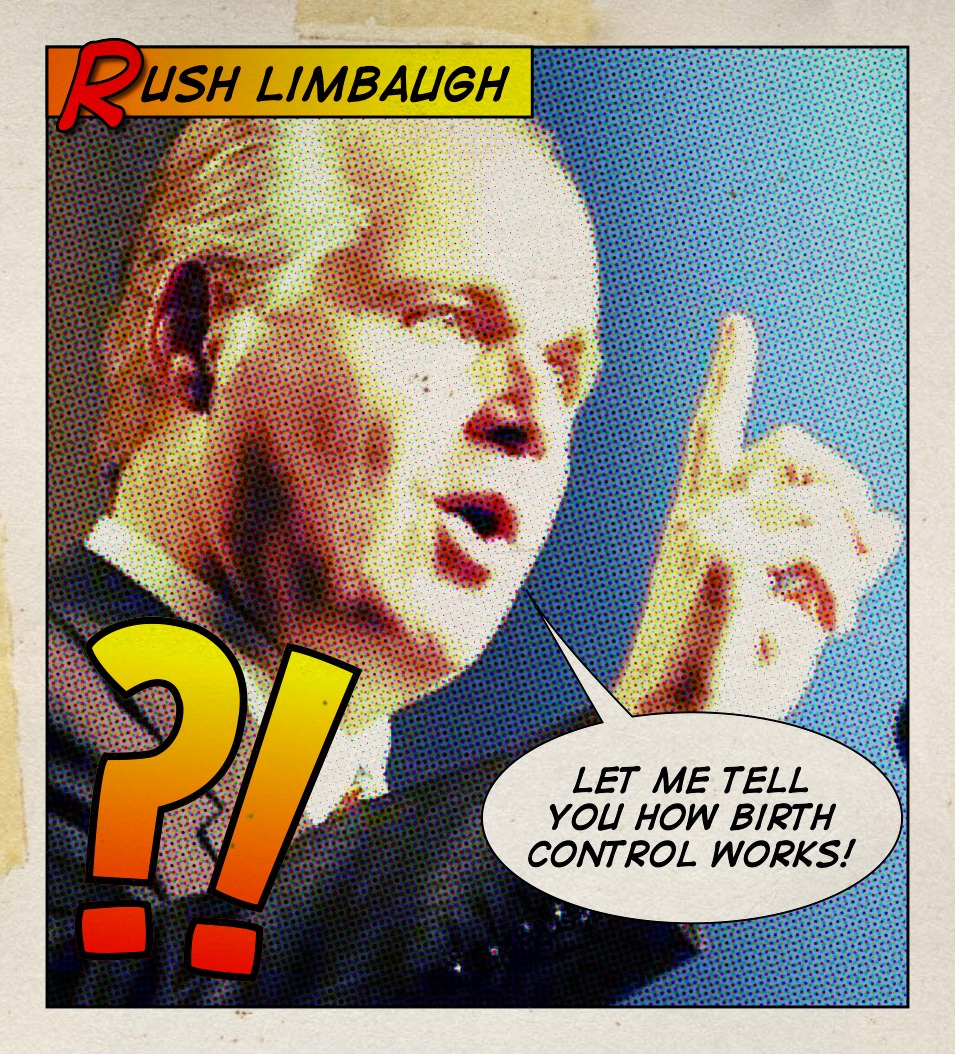
Limbaugh Really Should Educate Himself About Birth Control

Up until this week, those of us with a shred of optimism and/or naivete could have pretended that the difference between liberals’ and conservatives’ perspectives on birth control were due to something as benign as “differing beliefs.”

However, now that Rush Limbaugh has run his mouth on the subject, I think we can all agree that much of the conservative opposition to birth control is due not to differing beliefs that are equally legitimate and should be respected, but to simple, stupid ignorance.

The following is probably common knowledge now, but I’ll rehash it anyway:

  • Sandra Fluke, a 31-year-old Georgetown University law student, was proposed by the Democrats as a witness in the upcoming Congressional hearings on birth control. Her history of feminist activism and her previous employment with a nonprofit that advocated for victims of domestic violence made her an appropriate witness for their side.
  • Representative Darrell Issa (R-CA), the chairman of the House Committee on Oversight and Government Reform, turned her down because, he claimed, her name had been submitted too late.
  • The resulting panel of witnesses for the Congressional hearings turned out to consist of absolutely no women whatsoever, which is really funny in that not-actually-funny-way because hormonal birth control of the sort whose mandated insurance coverage was being debated is only used by women/people with female reproductive systems.
  • A week later, she testified for House Democrats, mentioning that birth control would cost her $3,000 over three years. Lest anyone misinterpret her argument as being solely about those slutty women’s desire to have tons and tons of sex, she also mentioned her friend with polycystic ovary syndrome who developed a cyst because she was denied coverage for birth control pills (which would’ve helped because they would’ve reinstated a regular menstrual cycle).

A few days later, Rush Limbaugh decided to insert his expert opinion into the discourse surrounding mandated insurance coverage of birth control. His expert opinion?

What does it say about the college coed Susan Fluke [sic], who goes before a congressional committee and essentially says that she must be paid to have sex? What does that make her? It makes her a slut, right? It makes her a prostitute. She wants to be paid to have sex.

The next day, he clarified his views:

So, Ms. Fluke and the rest of you feminazis, here’s the deal. If we are going to pay for your contraceptives, and thus pay for you to have sex, we want something for it, and I’ll tell you what it is. We want you to post the videos online so we can all watch.

And the next day (allow me to shamelessly quote Wikipedia):

The following day Limbaugh said that Fluke had boyfriends “lined up around the block.”[18] He went on to say that if his daughter had testified that “she’s having so much sex she can’t pay for it and wants a new welfare program to pay for it,” he’d be “embarrassed” and “disconnect the phone,” “go into hiding,” and “hope the media didn’t find me.”[19]

I’m not going to waste anyone’s time by explaining how misogynistic Limbaugh’s comments were, especially since plenty of excellent writers have done so already. However, it continually shocks me how he gets away with saying things that are not only offensive and inflammatory, but simply inaccurate.

First of all, a primer for anyone who’s still confused: except for barrier-based forms of birth control (i.e. condoms and diaphragms), the amount of birth control that one needs does not depend on how much sex one is having. Hormonal birth control works by preventing ovulation, and in order for it to work, it has to be taken regularly and continually. For instance, you take the Pill every day, or you apply a new patch every week, or you get a new NuvaRing each month, or you get a new Depo-Provera shot every three months. You stick to this schedule whether you’re having sex once a week or once a day or ten times a day. You stick to it if you’re having sex only with your husband, and you stick to it if you’re having sex with several fuck buddies, and you stick to it if you’re a prostitute and have sex with dozens of different people every day.

Same goes for IUDs, which last for years.

Therefore, when Limbaugh says that those who support mandated insurance coverage of birth control are “having so much sex [they] can’t pay for it,” he’s not merely being an asshole. He’s also simply wrong.

And for the record, he didn’t even get her name right. It’s Sandra, not Susan. One word of advice for you, Limbaugh: if you’re going to call someone a slut and a prostitute, at least use their correct name. But I guess we should give him credit for knowing which letter it starts with.

I don’t care what your views are on mandated insurance coverage of birth control. I don’t care what your views are on how much or what kind of sex women should be allowed to have (as much as they want and whichever kind they want, in my opinion). Because whatever your views are on these things, you have to agree that these questions should not be getting answered by people who have absolutely no understanding of how these things actually work.

For instance, Limbaugh completely ignored the part of Fluke’s testimony in which she described the problem faced by her friend with polycystic ovary syndrome. This friend’s predicament has nothing to do with sex. Absolutely nothing. For all we know, she’s a virgin.

After all, polycystic ovary syndrome isn’t caused by anything that involves sex. The current medical opinion is that it’s probably caused by genetics.

Unlike some feminists, I don’t think that men should be excluded from debates about women’s health. But men (and women) who show little or no understanding about women’s health should absolutely be excluded from these debates.

You wouldn’t let a doctor who believes that babies come from storks deliver your baby. You wouldn’t let a mechanic who doesn’t know how an engine works work on your car. And you shouldn’t let politicians and commentators who think that you need more birth control if you have more sex decide whether or not birth control will be covered by your insurance.

And, for the record, I also don’t think that Congressional hearings on birth control should look like this:

Northwestern Will Survive Without the Keg (Or: Actions Have Consequences)

[Snark Warning]

The Northwestern community is abuzz this week with the news that the Keg, Evanston’s trashiest, craziest, collegiest bar, has had its liquor license revoked for continually allowing underage drinking. The loss of the license means that the Keg can no longer sell alcohol, meaning that its demise is probably imminent.

Naturally, Northwestern students (many of whom admit to never even having visited the Keg) are enraged. They see the license revocation not only as the end of a place they like to frequent (“like” being used only in the vaguest sense here), but as yet another tyrannical attempt by the city government to disrupt the Northwestern way of life.

I must admit that if my life revolved around drinking, I might see some sense in that view. But then again, I might not, given how many bars, frats, and off-campus apartments there are around me–and the latter two usually don’t even charge, let alone card.

In a perfect world, the Keg wouldn’t be closing. Why? Because the legal drinking age would be 18, just like the age of consent, enfranchisement, and conscription. In that perfect world, our culture would pay enough attention to mental health that people wouldn’t need alcohol to relax or socialize, meaning that binge drinking would be much less common.

But, clearly, we don’t live in that world yet, and for now, as in the future, we are obligated to follow the laws created by our elected government. The Keg’s ownership has proven over and over that it does not take the issue of underage drinking seriously, and it should not be permitted to flagrantly violate the law as it currently stands.

In one of the very few intelligent responses to this news that I have seen from NU students, my fellow columnist at the Daily Northwestern points out that closing the Keg will not stop underage drinking. That is correct. Nothing can stop underage drinking among college students aside from lowering the drinking age.

However, not revoking the Keg’s liquor license despite its violations of federal law send the message that we value profit and fun over law enforcement. Nowhere in the Constitution are we guaranteed the right to drink alcohol without any reasonable limits. What we are guaranteed, however, is a government with the power to make and enforce laws.

(My friend and fellow blogger Michael also writes about why revoking the Keg’s liquor license is not the evil tyrannical anti-capitalist move that some students seem to think it is.)

Furthermore, while closing the Keg will not prevent underage drinking, neither will ticketing speeders prevent speeding, or cleaning up litter prevent littering. yet both must be done for the sake of a fair and orderly society.

Many NU students, of course, don’t look at it this way and have no desire to. They react like a toddler reaching for her fifth piece of candy and having it taken away. In fact, they reacted by creating a fake Twitter account for Evanston mayor Elizabeth Tisdahl. Read it and weep.

(The fake Twitter account is partially a nod to the fact that the Keg’s “unofficial” Twitter was, according to students, the reason for its untimely demise, as Tisdahl pointed out the references to underage drinking in the satirical tweets. However, students who pretend that the Keg is closing due to a fake Twitter account are creating a straw man. It’s closing because of constant, documented violations of the law.)

Anyway, one of the writers over at the blog Sherman Ave responds to the attacks on Tisdahl with much more punch than I could ever muster:

Also, if you are attacking Mayor Tisdahl you are an idiot. You may not think you are an idiot, but you are. I’m sorry, but anyone who scapegoats an elected official for enforcing the law deserves the title of idiot. And that’s that.

For what it’s worth, I applaud Tisdahl for doing something “uncool,” since that’s something that many Northwestern students are apparently incapable of.

I’ve also seen a lot of comments from other students bemoaning the fact that the Keg’s closing means that their social lives are, for all intents and purposes, dead. I don’t know how many of these are “ironic” as opposed to genuine, but I do know that “irony” is a defense frequently trotted out by people who have been caught saying something idiotic.

If any of those comments do have any truth to them, I have only this to say–if your entire social life consists of getting wasted in a grimy bar, that is really sad.

Finally, and perhaps most irritatingly, many students are reacting to the closure of the Keg as though some irrevocable, unique part of Northwestern culture is gone. An article to this effect was even published at North by Northwestern.

People. Seriously. Seedy bars where you can get piss-drunk are a dime a dozen. Go to any college town in the country and you’ll see that.

For people like me, who observe what most call “college life” only from the sidelines, the Keg’s imminent closure is both a cause of celebration and, well, of consternation. The former for obvious reasons, and the latter because it’s quite disappointing to see one’s fellow students ranting and raving over the closing of some dumb bar as though they’ve just gotten rejected from their favorite country club or something.

For now, though, I’ll leave you with this hilarious take on the Keg’s closure from Sherman Ave. Don’t watch if you’re easily offended.