Islamophobia Does Not “Cause” Riots

So I was reading the current issue of Utne Reader (great magazine, by the way) and came across an article about Islamophobia, reprinted from Intelligence Report.

At was a good article, at least up until the third paragraph. There, I saw something that made my eyes want to pop out of my head, migrate to the author’s place of residence, and slap him in the face:

Recent news reports strongly suggest a spike in anti-Muslim hate crimes. In May 2010, for example, a bomb exploded at an Islamic center in Jacksonville, Florida. In August, a man slashed the neck and face of a New York taxi driver after finding out he was a Muslim. Four days later, someone set fire to construction equipment at the future site of an Islamic center in Murfreesboro, Tennessee. In March 2011, a radical Christian pastor burned a Koran in Gainesville, Florida, leading to deadly riots in Afghanistan that left at least 20 people dead. [emphasis mine]

No. No no no. First of all, unlike the first three incidents, burning a Koran is not an “anti-Muslim hate crime.” Last I checked, in America that counts as free speech, heinous as it may be. Second, Islamophobia may have caused the first three incidents, but it did not cause the fourth one. That one was caused by morons who chose to respond to a provocation in a violent way.

One of my biggest issues with liberal discourse on societal problems is its proclivity to diminish or erase entirely the concept of human agency. (Some) liberals talk as though society just makes people do things without them actually processing information and deciding how to act on it.

(Among more radical liberals, this lends itself to the belief that violent response to injustice is not only inevitable, but morally justified, even if innocent people are injured or killed in the process. See: Hamas apologists.)

Leaving aside the morality of the rioters’ actions, it nevertheless takes quite a few conceptual steps to get from American Islamophobia to Muslims killing people in Afghanistan. While one could reasonably assume that Islamophobia (along with a number of other factors, such as having a violent disposition) caused people to do things like bomb mosques, stab Muslim taxi drivers, and burn Korans, one cannot then jump from that to “Islamophobia causes people in Afghanistan to riot and kill people.” Just, no.

I should hope that it’s quite clear that moderating variables must be at play here. (Case in point: Jews have been subject to as much [if not more] racism and discrimination throughout history as Muslims have, but if we rioted and killed each other every time somebody did something anti-Semitic, there’d be none of us left. Do a Google search on “burning Israeli flag” and you’ll see how common this is, and don’t tell me nobody ever burns Bibles, either.) For whatever reason, the rioters in question chose not to respond to this incident by starting an initiative to educate Westerners about Islam, by simply ranting about it to family and friends, or by shrugging and moving on.

Instead, they chose to respond to a no-name dipshit burning a Koran thousands of miles away by killing 20 innocent people.

Clearly, the vast, vast majority of Muslims in the world did not react this way, just like most teenagers who happen to come into possession of a loaded gun do not immediately go shoot up a school. The few who do go shoot up schools have serious issues that go way beyond the fact that they have access to a gun.

Islamophobia is a serious problem and should not be swept under the rug. But let’s not get ahead of ourselves here. All humans have agency, and we should assign the same level of responsibility to the Muslims who rioted as to the Americans who provoked them.

Obama the Patriarch

I usually stay away from commenting on Obama’s presidency because, to be honest, I was just a kid during all the previous presidencies I’ve lived through and really have no comparison to make.

However, a recent statement by Obama has caused me to come out of my apolitical cave and rage. After the FDA made a recommendation that Plan B One-Step, a form of emergency birth control that is available over the counter to anyone over 17, be available to girls under 17 without a prescription as well, Kathleen Sebelius, Obama’s secretary of health and human services, overruled the FDA’s recommendation. This is disappointing enough as is, but then Obama came out in support of her and said the following:

“I will say this, as the father of two daughters: I think it is important for us to make sure that we apply some common sense to various rules when it comes to over-the-counter medicine….And as I understand it, the reason Kathleen made this decision was she could not be confident that a 10-year-old or an 11-year-old going into a drugstore should be able — alongside bubble gum or batteries — be able to buy a medication that potentially, if not used properly, could end up having an adverse effect.  And I think most parents would probably feel the same way.”

As usual when I write about women’s issues, I literally don’t even know where to start with this. First, and perhaps most obviously, I don’t understand why we’re having all this conversation about 10- and 11-year-olds. The change would have applied to all girls under 17, and the majority of teenage girls who might need to buy Plan B are not 10 and 11. Try 15 and 16. If Obama and Sebelius are that concerned about 10- and 11-year-olds specifically, they could’ve asked the FDA to recommend allowing only girls 12 and over to get Plan B without a prescription.

Second, and also very tellingly, if the FDA has deemed Plan B safe for over-the-counter use, who are Sebelius and Obama to assume they know better? Sebelius has a BA in political science and an master’s in public administration; Obama has a BA in political science and a law degree. Unlike many cynics, I don’t necessarily doubt that these two have the knowledge and ability to perform their respective jobs, but I would not trust them over the doctors and researchers who staff the FDA when it comes to medical issues.

Third, Obama immediately reveals what this is really about when he says, “as the father of two daughters…” Understandably, Obama would be worried for his two daughters if they were ever in a position to need Plan B. However, for all of the battling that Obama has had to do with the Far Right of this country, he clearly doesn’t seem to realize that many girls don’t have daddies like Obama who would care for them, be able to afford doctors’ appointments, support their right to get an abortion, and guide them through a decision. For many girls, it would be a choice between obtaining Plan B on their own or being shamed, abused, disowned, and/or forced to carry a baby to term.

Finally, I’m disturbed by the ageist and patriarchal notion that young women are somehow incapable of making their own decisions about sexual health. Yes, children need and should have access to guidance from adults. In a perfect world, every girl would be able to go to her parents for help with something like this. But that’s not the world we live in, and we must make do accordingly. Not only has the FDA already determined that Plan B is safe, but, unlike many medications that are available over the counter to children, you can’t overdose on it or otherwise fuck it up–when you buy it, you only get one.

Furthermore, there are other ways to make sure young teens know what they’re doing when it comes to emergency birth control. For instance, mandate pharmacists to provide an option for girls to privately ask them questions about how to use Plan B. Pharmacists know a lot. Why not use them as a resource?

Much has been made of Obama’s failure (or lack thereof) to support women’s rights, and it’s a debate I don’t normally follow because one can really spin it either way. On this issue, however, I would argue that Obama has definitively failed to support women and girls. Instead, he has promoted the antiquated notion that beliefs trump science when it comes to reproductive rights.

Difficult ≠ Impossible

I’m going to come out of my cave and write about something that pisses me off. (OK, so I could start any blog post this way, but whatever.)

Here’s something that I consider one of the most glaring cultural problems in America today–it’s the idea that just because something is difficult, it is impossible and not worth trying. Our culture has become a deeply pessimistic one, and the message that it sends these days is “Oh, forget it, we could never change that anyway.”

Don’t believe me? Well, you should, because I’m right. There’s a reason that the issues that land on the political agenda are fairly simple–go to war, or not go to war. Allow gay marriage, or not allow gay marriage. Raise the debt ceiling, or don’t raise it.

Don’t get me wrong, I’m not saying these issues aren’t fraught with difficulties of their own. But they are very simple–yes or no. Right or wrong. Do, or don’t.

The issues that don’t really get talked about much are the complex ones. How to fix our education system. How to achieve equality between women and men, and between whites and people of color. How to create a more just and sustainable food system. How to end our addiction to oil. How to end the Israeli/Palestinian conflict. How to encourage democracy to take root in other parts of the world without shoving it down people’s throats.

To be sure, our government does things to try and ameliorate these issues somewhat, but they’re always band-aid solutions to broken-bone problems. For instance, George W. Bush tried to “fix” our schools with No Child Left Behind. President Obama issued empty threats to Israeli Prime Minister Netanyahu to stop settlement building, with no regard for the religious and political complexities that the settlement issue dredges up. Then there’s that little Iraq thing. As for our screwed-up food system, racial justice, and ditching the oil habit, I don’t think anything’s being done at all.

Try coming up to an older person (by which I mean, someone old enough to have their own kids) and talking to them about these issues. About education, about food, about the racism still embedded deep within our society. Ten bucks says they tell you something like, “Yeah, it’d be great if that could get fixed, but face it–it’s never gonna happen.”

Why? Why the hell not?

Well, because it’s hard.

People think that these things are never gonna get fixed because it’s so hard to fix them. And by hard, I mean like when you’re trying to do a math problem and you don’t even know where to start. You’re completely stuck. Nothing you’ve ever learned is going to help you here.

The stuff that gets in the news, like gay marriage, the debt ceiling, and all of that sort of stuff, is different from these issues because, despite our disagreement on them, we know what to do. We either vote yes, or no. But you can’t vote “yes” or “no” on education reform or on ending racism, because you have to figure out what the hell to actually do about it.

Note what a clusterfuck occurs when our government actually tries to take on a complex and nuanced issue–for instance, healthcare reform. It nearly stops functioning. Our culture is terrified of complexity.

Usually when young people like me talk about fixing some of these complicated problems, older people call us “idealists.” (And that’s at best–sometimes they use less charitable labels.) To me, all that’s saying is that we’re willing to think about and talk about things that are hard, and “realistic” people are not.

Well, realism is dooming this country. Realists are people who don’t think we can stop global warming, who don’t think we can have just and efficient healthcare, education, and food systems, who don’t think we can ever achieve equality between sexes, races, socioeconomic classes, or sexual orientations.

And guess what? If you tell yourself you can’t do something, it’s not going to get done.

And anyway, isn’t that a terribly demoralizing thing to say? I think we’re selling ourselves short when we say that we can’t solve complex problems like these. After all, the human race invented democracy, finance and agriculture, created the Mona Lisa, painted the Sistine Chapel, put a man on the moon, eradicated polio, and set up the Internet. Do our accomplishments really end there?

Just because something is difficult does not mean it’s impossible. Things that are impossible, at least with our current knowledge and technology, are traveling through time, sprouting wings and flying, curing cancer, and turning lead into gold. But things that are merely difficult? Well, that’s just about everything else.

Why I Oppose Banning Burqas

This is not the problem.

And no, my reasoning has nothing to do with racism or any other ism!

Belgian lawmakers recently passed a bill that, if approved in their senate, would make it illegal to wear burqas in public. This comes on the heels of France’s

When justifying banning burqas or similar Islamic garments, people typically make two points–one, that burqas represent and facilitate the oppression of women, and two, that they pose a security risk.

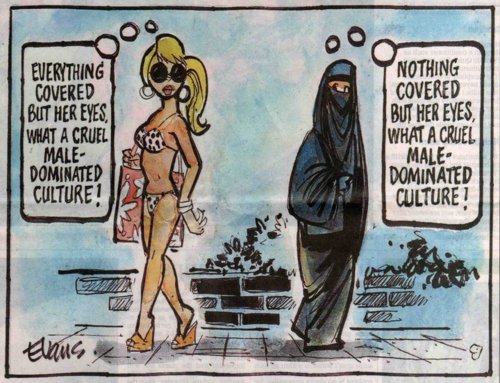
I’ll address the oppression issue first. Some women do indeed wear burqas because they’ve been pressured into it by their culture or by specific men in their lives. But other women do it out of a genuine desire to observe their religion in that way. Some even see it as an empowering gesture. It is fundamentally unjust to oppress the latter group in the name of protecting the former.

But even if I’m being completely naive, and even if not a single Muslim woman willingly chooses to wear a burqa, I conveniently have a second argument. For those women who are being oppressed by the burqa, would banning it really help? The obvious answer, I should hope, is no. In this case, banning the burqa is the legal equivalent of slapping a band-aid over a knife wound–and of treating the symptoms rather than the disease. The disease being, of course, large-scale societal oppression of women. Not something that can be fixed with a single magical law. To use an analogy that’s even closer to my personal experience, banning burqas to promote feminism is like banning suicide to promote mental health.

Not only would banning it not help, but it would probably backfire. If these women’s husbands or fathers are pressuring them into wearing the burqa, they would probably keep right on doing it despite the new law, thus placing these women in a prime position for facing charges, jail time, or plain ol’ harassment by the police. After all, they would be the ones paying the price for breaking the law, not men.

As for the whole security issue, I don’t have too much to say about that because I’m honestly not an expert on the subject, but I’ll say this–Israel has no burqa ban, or any sort of ban on Islamic head coverings, and yet has an incredible security force that manages to stop virtually all potential terrorists within the country’s borders. They don’t release these statistics to the public, but all the time in the Jerusalem Post, you see another story about security guards catching a would-be terrorist. Maybe the security authorities in these European countries should have a big pow-wow with Israeli ones and see what they’ve been missing.

I think it’s very tempting for people (and governments) to believe that issues like the oppression of women by organized religion can be fixed by something as simple as a law banning burqas. But ultimately, you can never really know what’s going on in someone else’s mind. What looks like oppression to us may not feel that way to the women in question. Or maybe it does. In any case, banning burqas won’t help.

I’ll leave you with my favorite cartoon on this subject: