
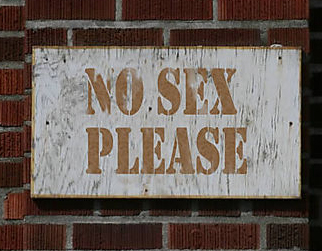
Should the Personal be Political?

I recently came across the site Does This Make Sense? and I already love it. It’s got a lot of intelligent, thoughtful commentary. One piece that I particularly liked is called “Hell, No. I Won’t Say No.” It concerns the idea that women who want to change their society should withhold sex from men until their wishes are fulfilled. Lorraine Berry writes:

In principle, choosing not to have heterosexual sex as a protest against policies that restrict women’s abilities to have autonomy over their bodies seems the ultimate in women’s power. It did, to some extent, work in the case of Liberia, where the brave women there forced their men to continue negotiating for peace by sitting naked outside the building where the negotiations were taking place.

Ultimately, though, Berry argues that this form of protest is not only ineffective but counterproductive for women who happen to enjoy sex (which is, I might argue, almost all of them). There are many problems with a “sex boycott, such as what gays and lesbians would do, and the fact that it almost seems to confirm right-wingers’ anti-sex campaign (no abortion, no contraception, no pornography, no comprehensive sex ed, no premarital sex, no non-hetero sex, and so on).

However, I have another problem with it, and it involves the concept of “the personal is political.”

Here I’m going to just be a bad feminist and say that I disagree with this principle. Of course, I do believe that people should live according to their values (political ones included), but I cannot condone manipulating personal relationships for the sake of one’s politics. Unless your partner is personally overseeing the campaign to take control of women’s bodies, it’s completely unreasonable, not to mention unethical, to punish him for the actions of certain other members of his gender. (This is not even to mention that I cannot imagine a feminist woman dating an anti-feminist man to begin with.)

And, in general, I don’t think that politics should direct one’s personal life. If I choose to date a woman, it’ll be because I like her, not because I want to make a political statement about bisexuality. If I choose to date someone of a different race, it’ll be because I like him/her, not because I want to make a political statement about interracial dating. In contrast, the so-called “political lesbianism” movement advocated choosing to be a lesbian for political purposes. How is this an authentic way of living?

Of course, sometimes the personal becomes political, as when an anti-gay politician is revealed to be having same-sex relations, or when people speculate on whether or not Elena Kagan is a lesbian. In the first case, although people may bristle at the obvious hypocrisy, I think being anti-gay is bad enough regardless of what one does in his spare time (and sending inappropriate messages to teens is bad enough regardless of their gender). As for the second, most would agree that it shouldn’t matter. The fact that people make it matter is the crux of the problem.

So, is the personal political? Maybe, but it shouldn’t be. In my opinion, personal relationships are a sort of refuge from the outside world. I don’t bring politics into the bedroom, just like I wouldn’t bring my cell phone or my laptop or God into it.

Sex, Morals, and Academic Freedom

A fucksaw.[First, some backstory–this post concerns a controversial event at Northwestern in which the professor for a class called Human Sexuality held an optional live demonstration that showed a man penetrating a woman with a sex toy. The story, which was first reported by our campus newspaper (the Daily Northwestern), quickly blew up and was featured in media outlets all over the world, including the front page of the Chicago Tribune. Here are the NYT and CNN articles on it.

Second, I wrote this piece for the blog of Northwestern Sex Week, an annual event that I’m on the planning committee of. Here’s the original post.]

Much has already been written about the infamous Professor Bailey and the optional sex-toy demonstration he held for his Human Sexuality class. I’m going to throw my hat in the ring.

First of all, I’m not in the class and did not witness the demonstration. From what I’ve heard, I’m not sure that it would’ve had educational value for me, personally. That said, I am a member of SHAPE (Sexual Health and Assault Peer Educators) and the Sex Week committee, and therefore, I already know quite a bit about sex. And yes, I know that women have g-spots and can potentially ejaculate. I also know that the range of human sexualities and sexual proclivities is virtually limitless, and that each individual views and experiences sex differently.

However, not everybody realizes this. For much of my adolescence, I didn’t either. Like some of the people I’ve met here at Northwestern, I freely labeled others’ sexual behaviors as disgusting, weird, abnormal, pathological. I didn’t realize how wrong this perspective was. The impression I get of Professor Bailey’s class and this demonstration is that they aim to eradicate this perspective. To that end, I can only endorse them both with complete confidence.

Second, even supposing that this demonstration had no educational value for anyone–which I highly doubt–we enter dangerous territory when we advocate banning something simply because we, as individuals, do not see its value. This is especially true in the academic realm. The concept of intellectual freedom does not exist to protect someone’s right to claim that the sky is blue; it exists to protect someone’s right to challenge existing norms and assumptions. It does not exist just to protect my English professor’s right to interpret a Dickens novel in a particular way; it exists to protect a human sexuality professor’s right to teach controversial material to his students. Even if Professor Bailey’s demonstration ultimately taught nothing, he should have the right to try unorthodox teaching styles, just like he has the right to conduct unorthodox research. Even if he failed, he has learned. That’s what academic life is all about.

I am also disappointed to read the numerous online comments from Northwestern alumni claiming that, because they disagree with this demonstration, they will no longer be donating money to Northwestern. This is, to put it bluntly, incredibly selfish and narrow-minded. In my opinion, one donates to an institution to support its overall mission, not because one agrees with every policy, every professor, every class, and every lecture. I, for instance, do not agree with some of the things that Northwestern faculty and administrators do–quite a lot of things, actually. Yet you can be sure that after I graduate, I will be donating money to this amazing school, probably for the rest of my life.

Third, this entire controversy, in my opinion, was started by a campus media given to sensationalism. With the media firestorm that has ensued, you would think that there had been some high-profile complaint from a student or parent, some allegation that the demonstration deeply disturbed a student–something. To my knowledge, there was not. In the article that broke the story, the Daily Northwestern failed to quote even a single person, student or otherwise, who had been offended or displeased by the presentation. Yet the article’s headline referred to this event as a “controversy.”

Finally, I would like to challenge all those who oppose this demonstration on moral grounds. Professor Bailey himself said it perfectly in his statement of apology:

Those who believe that there was, in fact, a serious problem have had considerable opportunity to explain why: in the numerous media stories on the controversy, or in their various correspondences with me. But they have failed to do so. Saying that the demonstration “crossed the line,” “went too far,” “was inappropriate,” or “was troubling” convey disapproval but do not illuminate reasoning. If I were grading the arguments I have seen against what occurred, most would earn an “F.” Offense and anger are not arguments.

Students were warned multiple times of the graphic nature of the presentation, and told that they were free to leave at any time. The individuals who staged and participated in the demonstration were all consenting adults. The course itself involves watching videos of people having sex, and no controversy has arisen because of that. The course, and this demonstration, involves an act that is as normal and natural as breathing, eating, and sleeping. Like Professor Bailey, I have yet to find a convincing argument for why this should not have happened that does not hinge on personal values, and that does not seek to impose one’s personal values on others.

In short, the fact that Professor Bailey was forced to apologize for the world’s closed-mindedness is tragic. And it means that we, the Sex Week committee, have our work cut out for us this year.

Let’s not forget that there was a time when you couldn’t say the word “pregnant” on television. There was a time when discussing sexuality in a classroom setting would’ve been impermissible. There was a time when a play like the Vagina Monologues could never have been staged in public, and there was a time when Sex Week could never have happened on a university campus.

Apparently, there is also a time when demonstrating the use of a sex toy on a consenting woman in front of a hundred consenting adults is unacceptable, too. That time is now. But we should remember how strange–how silly–yesterday’s taboos seem to us today.

Northwestern Doesn’t Care About its Students

Evanston, Illinois, which is where I go to school, has a stupid housing ordinance that states that no more than three unrelated people may live together in a house or apartment. It’s intended to ensure proper upkeep because, apparently, people who aren’t related to each other don’t care about the state of their housing, whereas people who are related do. (???)

Anyway, up until now, Evanston has not been enforcing the rule. But now it’s going to. Hundreds of Northwestern students will be evicted this summer because they live in houses or apartments with more than three unrelated people.

And today, the Daily Northwestern reports that the Northwestern administration will not attempt to lobby Evanston’s city government regarding this issue despite the fact that it directly affects so many students.

The Assistant Dean of Students’ response? Students should move farther away from campus.

Let me give you some background on Evanston. Although it’s obviously safer than some Chicago neighborhoods, there were eight homicides in Evanston in 2010 compared to just one in 2009–something that the University and the city police don’t seem to be too concerned about. Every couple of weeks, the entire University community receives an email alert regarding a crime that has just been committed on or near campus–muggings, assaults, break-ins, you name it. Last year, a man attempted to assault a woman in one of our academic buildings.

And with all this, the University administration thinks students should move even farther away from campus, risk even longer walks home in the dark, and live even further apart from other students–all to avoid getting off of its ass and lobbying against an outdated and useless rule.

Landlords, too, will be hurt by the enforcement of this law. The first Daily article I linked to mentions the fact that many of these houses and apartments really aren’t of the quality that families moving to a supposedly wealthy place like Evanston would be looking for. Many of the houses for rent near campus used to be for sale–until their owners realized that nobody’s going to buy them. Without students to fill these houses and apartments, many of them would probably be left empty.

Furthermore, Evanston officials have stated that the reason they’re starting to enforce the ordinance is to crack down on student parties. First of all, that won’t work–the number of people living in an apartment doesn’t determine whether or not those students have a party; that’s preposterous. In fact, if people have to live with fewer roommates, they may be more likely to throw parties so that more people come over.

Also, as the Daily article mentions, having students live in concentrated areas makes it easier for the police to patrol those areas. If students start living miles away from campus and having parties there, not only will that piss off even more Evanston residents who otherwise wouldn’t have had to deal with it, but it will also make it harder for the police to stop the parties.

But, most importantly–at least, to me–the hope of stopping college students from partying (something that’s never going to happen anyway) is not worth jeopardizing their safety. Evanston isn’t a small town in Ohio. It’s a city that’s located close to a major metropolitan area. It has very real crime issues. I am shocked that for how much money I’m paying to go here, the Northwestern administration won’t stick up for its students and battle this ridiculous ordinance. Instead, it’s asking us to move farther away from campus, dilute the sense of community that is already so fragile at this school, and expose ourselves to a greater risk of becoming the victims of crime.

I should’ve invested my $200,000 wiser.

[Update] Several of my friends have pointed out that this ordinance was probably originally enacted in order to prevent minorities (who ostensibly have lower incomes and would benefit from being able to share houses or apartments with other people) from moving into Evanston. I’m still looking for a credible source confirming this, but if it’s true–and it probably is–then that’s just one more reason to repeal the law. If the city of Evanston is using a racist law to attempt to control student partying, that is ridiculous. Not to mention that the law probably does disproportionately affect minorities.

A (Very) Belated Reaction to the Helen Thomas Fiasco

Yes, this is extremely belated, but somehow I didn’t get around to writing about it.

Anyway, everybody knows by now what Helen Thomas said, but what very few mainstream media outlets (aside from Jewish blogs and Wikipedia) have mentioned is that the person to whom Thomas made her now-infamous comments was a rabbi wearing a kippah (Jewish skullcap) on his head. In light of this, what Thomas said wasn’t just culturally insensitive, ignorant, and crude–it was an uncalled-for personal insult to a Jewish individual. It would be equivalent to saying that Muslims should “get the hell out of Europe and go home to Iran, Iraq, and everywhere else”–to a woman wearing a hijab. (The notable difference being that Iran and Iraq, while dangerous and unstable, are at least Muslim countries, while Germany and Poland, the two most enthusiastic perpetrators of the Holocaust, certainly aren’t Jewish ones.)

In light of this, I’m frankly shocked that so many people have defended Helen Thomas and bemoaned the fact that she decided (or was asked/forced/persuaded/coerced) to resign. This is especially “feminist” bloggers who seem to feel that people should be able to say anything they want, no matter how reprehensible, without having to face the consequences–as long as they are women. Feministing is guilty of this, though it at least refrains from going a step further like some others have by claiming that Thomas’ remarks were perfectly acceptable and in fact, accurate.

(There is also much to be said regarding the fact that Feministing regularly and enthusiastically denounces intolerant remarks made about women, blacks, Hispanics, the LGBT community, and many others–as it should, of course–while mostly excusing intolerant remarks made about Jews. This, however, is a topic for a future, very scathing post.)

Anyway, the particular circumstances in which Thomas chose to reveal her views on Jews make a terrible comment even worse, and it’s unfortunate that the media has largely ignored those circumstances. Thomas was right to resign. Journalists are free to hold whatever views they choose, no matter how intolerant or controversial, but journalists who crudely espouse those views to the very subjects of their prejudice have no place in the field.

The Courage to Protest

Last week I went to see a speaker named Gloria Feldt. She came to campus as part of the annual Sex Week, and, since she is a former CEO of Planned Parenthood and was speaking about women’s rights (which I am a full supporter of, in case anybody was wondering), some students actually came out to protest the event.

They stood outside the auditorium holding anti-abortion signs for the entire hour and a half that Feldt was speaking. At first I was annoyed by this, because they glared at me as I walked in and because I felt that they should’ve at least listened to what Feldt had to say (after all, her message was primarily one of female empowerment and had almost nothing directly to do with abortion).

However, the more I thought about it, the more I realized how relieved I was to see actual protesters on this campus. Because, let me tell you, that doesn’t happen often. Sure, there’s the occasional rally–yesterday was Take Back the Night, the infamous anti-rape rally, and a few months ago the Living Wage Movement (which seeks to provide a living wage to all of Northwestern’s employees) held a rally.

But see, it doesn’t take much courage to hold a rally against rape or supporting a living wage. Most people at this school will either agree with you or keep their disagreement to themselves (or, occasionally, post immature, ignorable comments on related news articles).

Protesting abortion, however–now that’s going to get you some dirty looks.

Maybe that’s just because this is a liberal campus. In a more conservative area, maybe holding a living wage rally would be gutsy and controversial. But here it’s not. And I, too, support things like abortion, rape prevention, and the living wage. But I still like to see people taking a stand for what they believe in, even if it’s not what I believe in.

The last time we had a protest that actually seemed controversial was way back at the beginning of the year, when some random people stood around holding signs that were meant to highlight the fact that low-income people do indeed exist at Northwestern. However, the way they went about this was questionable. While there are certainly people here who are struggling to get by (and people who have to work fulltime to put themselves through college), the protesters instead chose to hold signs saying things like “My top 3 sororities didn’t want me” and “I can’t afford North Face.” Haha. Well, honey, neither can I, and I’m hardly disadvantaged!

(Also, personally, I would be absolutely honored to be rejected by a sorority. Means I’m not a carbon copy of somebody. But that’s a topic for another blog post.)

(Also, while not evidence of actual economic disadvantage, the North Face sign could perhaps be viewed as a protest against Northwestern’s homogeneous fashion sense. But I don’t think that was the point.)

That protest also included signs about race relations on campus and the fact that they need to be improved, but honestly, nobody can seriously argue with that. That fact that one of the protesters was asked if she wears her hijab in the shower is pretty sad.

In any case, I’ve yet to see someone publicly display a controversial viewpoint on this campus and face the possibility of scorn and ridicule. It’s a completely apolitical campus in that sense. Until now. And honestly, it restored my faith in this school a little bit (after it was gradually shattered over the course of this past year). I guess there really are people here who care enough to stand up for something–and I mean, really stand up for something. As in, stand in a group of just several people and hold signs while dozens file into an auditorium and sneer at you. That’s a far cry from attending a big feel-good rally that represents the opinions of 90% of the campus with your twenty best friends.

The truth is that, as much as I disagree with people who oppose abortion, I’m proud to go to school with them. I’m proud that at a campus where it often feels like everybody’s on a mission to look, talk, and act like everybody else, some people still aren’t afraid to stick out.