Leaving Medill

I knocked on the office door promptly at noon. She opened the door and said, “Can you just wait a few minutes? Our teleconference is running late.” I nodded. The door shut. I waited.

Twenty minutes later, I was sitting at a round table in a large, airy office full of plants. It had two windows, one of which faced my freshman year dorm.

“So, you’re thinking about transferring out of Medill?”

“Definitely transferring.” Her eyebrows go up. “I mean, I’m a junior, and I actually decided quite a while ago, so…”

“Can you tell me a little bit about your decision? I’m not trying to dissuade you.”

~~~

I remember all those nights. Clutching my camera or my notepad or both. Trying to find a way–any way–to escape the situation.

The worst time was when I was doing my final project for the last journalism class I ever took. I went to a gathering at my brother’s apartment–an event for young adults of Jewish/Russian descent. I had to interview people–not my brother, obviously. I couldn’t do it. I couldn’t make myself talk to anybody. My throat started closing up.

My brother’s apartment was on the sixteenth floor. Would that be high enough?

I ran outside and collapsed on a bench in a park, crying and trying to catch my breath. I felt ridiculous. The Medill School of Journalism had accepted just ten percent of its applicants the year I got in. There were nine other people who had desperately wanted my spot. And now I was bawling like an idiot because I had a terrible fear of talking to strangers.

They told me it gets easier with time, that you have to just make yourself do it. They said you would stop feeling self-conscious after a while. They explained how important it is to my future career that I learn to be pushy.

It never got easier. I always ended up gasping for breath and crying.

I don’t remember how I finished that project, but somehow I did. Not long after I started having weird neurological symptoms and became more or less numb to everything. I spent the summer at home, doing almost nothing. The one thing I accomplished was starting antidepressants to undo what being in Medill had, for whatever reason, done to me.

~~~

And today, two years later, I sat in her office and answered her question.

“It just wasn’t my thing,” I said.

~~~

Two years have passed, and I’m only now filling out this paperwork, going to this meeting, and making sure that the university knows whether to give me a BS in journalism or a BA in psychology.

Part of reason for the delay was my own laziness and lack of fondness for formalities like this, but another part of it was avoidance.

I hate going into the Medill buildings. Both of them. One is very new, all sleek and shiny, with high ceilings and plush chairs and new technology. The other is its opposite, old and creaky, with a rusty fire escape winding up the back. I once climbed all the way to the top of it and sat there late at night.

They’re both beautiful. I hate them both.

In these buildings I learned how to write a lede and use AP style. I learned how to use Adobe Flash and InDesign, Final Cut Pro, and Audacity. I learned how to shoot video and record audio. I learned how to harass people who didn’t want to answer my questions until they did it anyway.

Mostly, though, I learned what it feels like to fail.

I don’t mean what they call a “Medill F,” which is what happens when you make a factual error in a piece and receive a grade of 50%. That did happen to me, as it did to virtually everyone else.

But that’s not failure. That’s just screwing up. Failure is when your mind conspires against you and keeps you from doing something you desperately want to do.

I wanted to be a journalist, but I couldn’t stop the panic attacks that I got whenever I had to actually be one.

~~~

She signed my form and made sure I knew where to take it next.

“And know that we’re always here for you, even though you’re leaving. If you ever have any questions, I’m always happy to help–even you!” She smiled and I had to smile back.

She congratulated me again for my acceptance to the psychology honors program, and I thanked her kindly.

“Good luck, my dear,” she said.

And then, less than five minutes later, it was over. I left the building and I left Medill.

~~~

It’s been two years since I took a journalism class. My video camera, voice recorder, and microphone lie abandoned in my closet back home. I still use my tripod for my own photography.

My external hard drive died suddenly over a year ago, and with it died all the articles and projects I did. If there’s a heaven for vain attempts, that’s where they are.

My new chosen profession is similar to journalism in some ways. Both journalists and therapists do a certain amount of investigation and excavation. Both live and work by a code of ethics, and both must keep secrets. Therapists, like journalists, ask questions and listen and take notes.

But that’s basically where the similarities end. Therapists don’t get to attach their names to their successes. I don’t get to point out a person who came to me barely able to get through the day and now lives happily, and say, “This is my work.” They don’t award Pulitzers to therapists. If a therapist’s name is in the newspaper, it’s probably for something bad.

And yet. My freshman year, one of my journalism professors told me a story about something she saw as a young reporter. A horrific plane crash had just happened and many were injured or dead. She was assigned to cover the story and showed up at the local hospital along with all the other reporters. The hospital staff told the reporters that there was a special room for grieving friends and family and that they must not attempt to interview the people inside.

Then someone came out of the room and sat on the floor, next to the door, with her head in her hands. My professor couldn’t bring herself to do it, but another reporter walked right up and said, “So, who’d you lose?”

I retell this story whenever people ask me why I chose psychology over journalism. It illustrates so pointedly the differences between these professions. Journalists do important work, work without which our society couldn’t function. But their allegiance is to “the people,” who “need to know.” The allegiance of a therapist is always, always to her client.

~~~

But I won’t pretend that this is a happy choice. I’m glad to have found my calling in life, but when I tell people that I “chose” psychology instead of journalism, as I told you just now, I’m not really telling it like it is.

“Choosing” means picking one thing when you are equally free to do either.

I was never free to be a journalist, because my broken brain wouldn’t let me.

Maybe if I had been, I would still have chosen psychology. Maybe not. Either way, now I’ll never know.

Most of us were raised with the idea that we can be whatever we want to be. Well, maybe that isn’t always true.
The “Right” Way to Be Depressed

CNN did a great thing today. They published a first-person account by one of their editors, Stephanie Gallman, about her experience of being diagnosed with depression, and of telling her friends and family about it.

Initially when I saw this article, I was overjoyed. It’s good to see mainstream media outlets publishing articles about depression that are personal rather than scientific in nature, and I’m relieved that more people are willing to publicly state the fact that they have depression.

But then I actually started reading it:

In August, after several months of seeing a therapist and a psychiatrist, I was diagnosed with depression.

The news came as a shock.

“I’m not depressed,” I said defiantly, shaking my head when the doctor deducted that must be what was ailing me.

“I hate depressed people.”

She laughed at my strange reaction, but I was serious. I don’t want to be in that category of people. Everything they take in and spew out just breathes negativity, and they are difficult to be around. I despise these people.

Gee, thanks, Stephanie. We despise you too.

She goes on to describe how, at her doctor’s urging, she finally realized that the symptoms of depression really did describe her experience. When her doctor suggests antidepressants, she’s not too excited about the idea but seems to at least consider it.

Then she discusses dropping the “D-bomb” to friends and family. Her favorite response from them, apparently, is surprise:

A lot of the people reacted to the D-bomb the same way I did — “You’re depressed?! You?  Stephanie Gallman? But you’re one of the happiest people that I know! You Hula-Hoop in Walmart!” (I really do Hula-Hoop in Walmart — every time I go.)

These are the people I wanted to reach out and hug; they made me feel like I hadn’t turned into Debbie Downer.

It’s true, to the outside world, I do appear happy. And I realize this is hard to grasp, even for me, but I am happy most of the time. I am fully aware of how blessed my life is and express gratitude for it daily. I have worked hard not to let what’s going on with me on the inside affect the way I present myself on the outside.

It’s hard not to notice how much this smacks of a certain self-congratulatory relief, of “doing” depression the right way. This woman is clearly such a considerate person, for not letting her depression affect how she presents herself!

Gallman’s gratitude for her blessed life strikes a chord with me, as it will with many other people with depression, because of how damn often we’re told to “count our blessings” and “be grateful for what we have.” There’s nothing worse, apparently, then being ungrateful.

That said, there are definitely some great things about the article. Gallman talks about her anger at being told to “do more of the things that you enjoy” rather than taking antidepressants. “Bite me,” she writes. “These patronizing (“The Secret”? Are you serious?) prescriptions infuriated me, as if the reason I wasn’t happy is because I hadn’t tried hard enough.”

She also makes a great point about the need for more openness surrounding mental illness. One of the responses she often received when she dropped the “D-bomb” was stories about friends and family members who had also suffered from depression:

I was dumbfounded. I wanted to scream like Adam Sandler in “The Wedding Singer”: “Gee, you know that information … really would’ve been more useful to me yesterday!” Why isn’t anyone talking about these illnesses that affect our most important body part — our brain?

Indeed, why aren’t more people taking about these common, devastating illnesses?

Unfortunately for Gallman, one answer is that it’s because of people like her.

Specifically, it’s because of the people who call us “Debbie Downers,” who tell us that we’re “spewing negativity,” who blame us for our own illness just like Gallman (tragically) blamed herself.

The problem with Gallman’s narrative is that we’re not all as “blessed” as she is. Her theory that she may be to blame for her own depression because she withdrew from friends may be applicable to her own life (though I doubt it), but it’s not very applicable to those depression sufferers who may not have a strong support network like she does. She writes, “No surprise, the wonderful people in my life have all been very kind and sympathetic, offering words of comfort and support.” Well…good for her. Not everybody has that.

Furthermore, not everybody is an accomplished adult who has a dream job as an editor at CNN. Gallman’s habits of eating well and exercising healthfully, which she is proud enough of to mention in this article, are not available as options to everybody. It’s clear that she has a full enough life that she’s able to throw herself into other things and avoid that terrible label of “unhappy.” Her optimistic personality, another trait of which she is very proud, is something that psychologists generally agree is inborn and possibly genetic–not something that all of us are so lucky to have.

After reading this article, I was struck by the pervasiveness of the message hidden between its lines–that there is a “right” way to be depressed. Gallman plays this role well. She does not embrace her diagnosis, nor her doctor’s suggested treatment; after all, doing so would imply that she “wants” to be a victim. She steadfastedly counts her blessings every day and reaches out to her supportive friends and family. She eats well and exercises. She is absolutely not to blame for her depression because she does everything “right.”

And most of all, she sees her depressive side as something shameful and ugly, just a foil to her sunny personality.

What about those of us who don’t have a sunny personality?

I feel for Gallman, not just because of her struggle with depression, but because of how indelibly she has internalized the idea of depression and unhappiness in general as something Wrong and Bad. There’s no room in this article for the scandalous idea that depression, while being difficult and unpleasant, is something that a person can make peace with–the way they might make peace with having asthma or diabetes.

There’s also no room in this article for sympathy for those who don’t play the role of Optimistic Depression Sufferer as well as Gallman does. No sympathy for those who don’t identify themselves as happy people at all.

I’m glad that Gallman has shared her story, and I wish more people would do the same–with their real name attached. But I hope that readers who don’t have experience with depression do not assume that Gallman speaks for all of us.

Edit 4/2/12: If you want to see a brilliant, prominent person discuss her experiences with depression without being judgmental and promoting stigma like Gallman does, read this.

Liking Yourself and Being a Good Person–Is There a Connection?

Read this quote:

“I am now the most miserable man living. If what I feel were equally distributed to the whole human family, there would not be one cheerful face on the earth. Whether I shall ever be better I can not tell; I awfully forebode I shall not. To remain as I am is impossible; I must die or be better, it appears to me.”

If you were to take a wild guess, would you say that the person who wrote this was a productive member of society? Do you think that he or she was the type of person who helped others, who contributed meaningfully to his or her community? Was he or she a good person?

If you’re like most people (which, if you read this blog, you’re probably not, but bear with me), you’d probably answer “no” to those questions.

And you’d be dead wrong, because the author of those dismal thoughts was Abraham Lincoln.

This past weekend, my Jewish education group had its second retreat of the quarter. (I wrote about the first one here.)

One of our many discussions during the retreat was on which qualities are necessary for someone to be a good person (however one defines “good”). Some of my group’s suggestions, such as empathy, seemed completely accurate.

Some, however, did not. One student mentioned that she thinks that liking yourself is a prerequisite to being a good person, and everyone enthusiastically agreed.

I waited for her to explain. She said that you have to be fine with yourself before you can focus on being a good person to other people. She said that not liking yourself is unhealthy. (And unhealthy, by extension, must mean bad.)

I said, “What if the person you are right now just isn’t likable to you?”

She said, “Well, then you would just be bitter.”

I said, “I don’t like myself and I’m not bitter.”

She stammered, said sorry, and left the subject alone.

Here’s the thing. I would agree that genuinely liking yourself is a pretty good goal to have in terms of your own psychological development. However, I completely oppose the moralization of this quality. That is, I oppose the idea that liking yourself makes you a “good” person and that not liking yourself makes you a “bad” person. I also oppose the idea that you can’t be a “good” person unless you like yourself.

I have several reasons for opposing this concept. One is that I truly don’t believe that your opinion of yourself is strongly correlated with your treatment of others and your ability to contribute positively to society. There’s a stereotype of people who have low self-worth as selfish, miserable, and–as the girl in my group said–bitter. While it’s quite possible that not liking yourself would lead some people to be this way, it can also push people to turn outwards and do incredible things for others. Abraham Lincoln, for instance, may have been one such person.

Second, while the argument that you must like yourself in order to be a good person does not necessarily imply that liking yourself automatically makes you a good person, I think that’s something that should be examined. Once you do that, you’ll hopefully realize that there’s simply no connection. Some people who like themselves are great people. Some are horrible people. Some like themselves so much that they don’t give a crap about anyone else.

Third, there is an illness that up to a quarter of adults will experience at some point during their lives that has as one of its symptoms feeling worthless and hating yourself. That, of course, is depression. I hope I don’t have to explain why I find the suggestion that depressed people can’t be “good” people to be inaccurate, superficial, and downright offensive.

Fourth, all of this hinges on one’s personal definition of a “good person,” which was never elaborated on during our discussion. (I find that in conversations of a religious nature, these things tend to just be left undefined.) To me, a person who isn’t good is a person who has the opportunity to help others but chooses not to. A person who cannot help others due to circumstances beyond his or her control should not be labeled as “bad.” So if disliking yourself really is keeping you from helping others, that doesn’t mean you’re not a good person. It just means you have to work on your issues before you can put your goodness into action.

As I told the girl in my group, I dislike myself. There are two main reasons for that. One is that I have depression, and as I mentioned, that’s one of its symptoms. The other is that the culture I live in rejects many of my most defining traits, and it’s really, really hard to like yourself when you’re bombarded with cultural messages that tell you that you’re unlikeable.

With time, I’ll probably learn how to ignore those messages. But to suggest that I can’t be a good person right now because of them (and because of my depression) is extremely condescending. I do my best to be a good friend, daughter, sister, and leader in the Northwestern community. I have found causes that I support and advocate for them tirelessly. Because of my openness about my own experiences with mental illness, I have been able to serve as a source of information and support for many other people that I’ve met over the past few years.

Now, that’s hardly on the level of, say, Abraham Lincoln. But it’s more than a lot of other people my age do. A lot of the ones, I might add, who insist that this time of our lives is a time to “just focus on me” and “just do what I want.”

Liking yourself is great. It feels nice. But we shouldn’t confuse it with having the ability and the desire to do good.

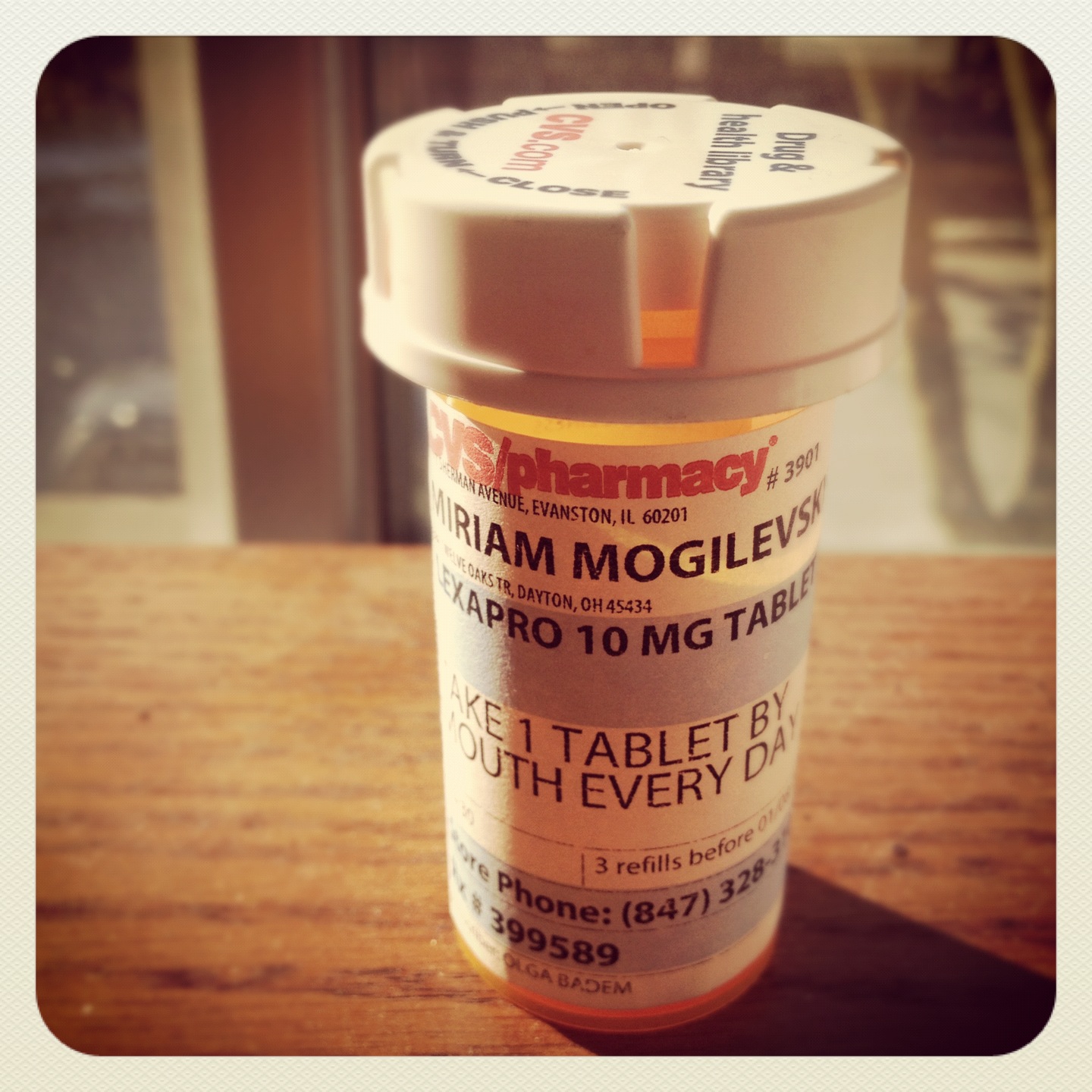
Goodbye Lexapro

[TMI Warning]

Today marks the end of an era of my life.

Today I took my last dose of antidepressants, and tomorrow, for the first time in a year and a half, I will get up in the morning and (purposefully) not take that pill again.

I went on Lexapro as a last resort in July 2010. I won’t go into all those details here since I’ve written about it before, but I’ll say that, at the time, I had no other choice. When a body has been critically injured, it enters a coma. I was in the mental version of that.

Lexapro did a lot of things to me, some expected, some not so much. I stopped crying every day and wanting to kill myself, at least for a while. I also became, according to my friends, more lively, more social, and visibly happier.

But then, there was the other stuff. Lexapro broke up the one meaningful romantic relationship I’ve had in my life. (Was it destined to break up anyway? Now I’ll never know.) It altered my values and beliefs for some time and turned me into the sort of person I would’ve hated a few months before. Now I’m back to my normal self, thankfully.

It was also a cruel helper at times. If I missed just a day of it, I’d be a wreck by nightfall. If I missed two days, the withdrawal symptoms kicked in, and they were horrible. I’d be dizzy, nauseous, barely able to walk, completely unable to explain to people why I was suddenly sick when I’d been fine just that morning. (“Sorry, I’m going through drug withdrawal” isn’t really an effective explanation for most people.) The worst symptom of antidepressant withdrawal has no official name, but depressives refer to it as “brain zaps.” They’re momentary sensations of being shocked or stunned in the head and they happen every few minutes or so, or even more often.

Theoretically, of course, there’s no need to ever miss a day of a prescribed medication, but when you factor in insurance issues, CVS’s constant fuckups, weird sleeping schedules, and other crap, it happens pretty often. I remember one awful time when I forgot to bring my medication back to school from break with me and I had to get my parents to ship it. Those were an unpleasant few days. Another time, my psychiatrist refused to renew my prescription unless I came in to see her, but I’d already be back at school by the time she had her first available appointment slot, and there was no way I could skip classes to drive six hours home to Ohio. She wouldn’t budge.

I’m not going to go into a whole condemnation of psychiatry or the pharmaceutical industry because they gave me back my life. However, I will say this: there is so, so much work to be done.

My psychiatrist prescribed me Lexapro after a nurse practitioner talked to me for ten minutes, and she for about five. She said that “academic stress” was causing my depression and that antidepressants would help me deal with it. She must’ve missed the part where I said that my depression started when I was 12 years old. She also apparently missed the glaring cognitive distortions and emotional issues I was having, and had been having for years and years. She oversimplified my problems and thus prescribed a simple remedy.

It took a while to even begin to sort out what the problem really was, and I’m still not there yet.

Some other things my psychiatrist didn’t tell me: the personality changes. The withdrawal symptoms. The fact that I was more likely than not to have a relapse (which I did). And, of course, the fact that you don’t really recover from depression. You only learn how to avoid it for bursts of time.

That was stuff I shouldn’t have had to learn through experience.

Now I look at that almost-empty bottle and I just can’t look at it with a sense of gratitude. I will never be an enthusiastic advocate of psychiatry, though I will continue fighting for the rights of patients to obtain complete information about medication and to make their own decisions.

I look forward to the end of that daily reminder of what I’ve lost. For the past year and a half, I have started every day by taking Lexapro and remembering that I’m not okay. Now I won’t have that anymore. Now I’ll be able to go half the day, maybe even an entire day, without thinking about that part of myself.

I’m not nearly naive enough to think that this is the end. For all I know, I’ll be back on the medication in a month. I’m almost certain that I’ll be back on it within the next few years.

But for now, at least, I’m done with it.

For now, the only things I’ll be taking in the morning are a multivitamin and a shower.

Normal, just like everybody else.

Depressed on Shabbos

[TMI Warning]

This past weekend, I participated in an overnight retreat with a Jewish education program I’m involved in called the Maimonides Leaders Fellowship. In Jewish parlance, the trip is called a shabbaton as it takes place over the weekly holiday of Shabbat (“Shabbos” is the Ashkenazi variant of the word, in case you’re confused).

On shabbatons, the custom is generally to observe Shabbat in accordance with Jewish law. Although this is commonly interpreted as not doing any “work,” our rabbi pointed out that the actual rule is that you cannot “act” on the physical world. For observant Jews, sundown on Friday to sundown on Saturday is a time when writing, using electricity, driving a car, tearing paper, cooking, exchanging money, and tons of other activities are all forbidden.

Anyway, I won’t go too far into the religious significance of Shabbat, since I’m sure you can read about that elsewhere and I’m not really the best authority on it anyway. But from the discussions we had as a group, I gathered this much about Shabbat, which I didn’t know before: it’s not only a time of rest, but of reflection. The idea is that you don’t do much of anything except be with your friends and family, eat good food, and think about how your life is going.

All of this sounds awesome in theory. Everyone could probably use some time to just think.

However, for people who struggle with depression, as I do, there is literally nothing worse than to have to spend a day doing nothing but eating, socializing, and thinking.

In fact, Shabbat is tragically full of the very things that depressives should generally try to avoid. For instance, like most Jewish holidays, it revolves around eating and drinking. The amount of food that it’s customary to consume at a Shabbat lunch or dinner could probably feed a family for a week. While this does theoretically sound awesome, overeating takes a huge toll on my mental state.

A similar issue is the compulsory socializing. Although not all depressives are introverts, many are, and the disorder sort of turns everyone into a bit of a loner. I wish I could spend hours with people and feel good about that, but I just can’t. After an hour or two, I start to sink into a funk and desperately want to escape. Unfortunately for me, Shabbat meals last for hours.

The prohibition on writing hits me hard, too, because writing is the main outlet I have for channeling my emotions in a positive way. It’s one of the few things that helps when I’m very upset. Reading is an okay substitute, but it’s just not the same.

Thinking, however, is the worst. Depressives can’t really “think,” they can only ruminate–which means endless, circular thoughts about why they’re terrible people unworthy of love. If I had to sit down for a while and think about how my life is going, I would probably become very, very miserable, and that’s exactly why I vastly prefer doing things to sitting around and thinking about them.

And indeed, on Saturday night when Shabbat was over, I didn’t feel refreshed and at ease like I was told I would feel. I didn’t feel stressed, either, but then I rarely do. Rather, I felt vaguely overwhelmed, like my mental capacity had been drained. Later that evening, I burst into tears for literally no discernible reason, and that’s not something that happens to me often anymore.

Unlike certain other religions, Judaism does not want its adherents to suffer or put their health at risk. That’s why, for instance, those who are sick or pregnant are not obligated to fast on the Jewish fast days. That’s why Jews are not only allowed, but obligated to break Shabbat in order to save a life.

However, the entire concept of mental health has only really been around for the past century, whereas the laws of Judaism were written thousands of years ago. I can no more expect Judaism to make allowances for people with clinical depression than I can expect it to, say, condone same-sex marriage.

Religion in general isn’t particularly kind to the mentally ill. When it’s not telling us that we’ve brought this upon ourselves and it’s God’s punishment, it’s telling us that we ought to be able to drag ourselves out of it on our own by praying, repenting, being good wives and husbands, or just sheer willpower. One of my favorite bloggers refers to depression as “spiritually incorrect,” capturing perfectly the way I feel about the intersection between my faith and my mental disorder.

I hope that as I learn more about Judaism, I’ll discover ways to make it work with the person that I am. That person will probably never be able to enjoy a full day of eating and being with people; I’m just not built that way. But I know that Judaism does have much to tell me about living well.

However, I doubt that I will ever be willing to observe Shabbat the “right” way. Spending one-seventh of my life without the ability to do the one thing that always makes me feel good seems like a waste. Ultimately, I don’t believe in God and I don’t believe in an afterlife, so this is the only one I’ve got.