Why You Should Date a Feminist

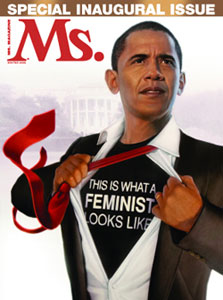
Now don't tell me you wouldn't date Obama.

Men, this post is for you.

I’ve been told by trusted sources that potential suitors may read my blog and find themselves intimidated by my feminist ideas. I would never want to discourage a potential suitor until I discover him to be deplorable, so I’m offering up this post as an olive branch of sorts.

So, here’s why you should date feminist girls like me.*

  1. We split the check. Now, I’m not gonna lie–I don’t speak for all feminists, but I personally appreciate when a guy offers to pay for me. Sometimes I even accept. However, that doesn’t mean I expect it. Hell, sometimes I even pay for the guy.
  2. We won’t use you as a free plumber/computer technician/mover. I can unclog my own toilet, fix my own computer, and–usually–schlep my own shit up the stairs. Why? Because rather than sitting around looking pretty and helpless, I’ve enjoyed figuring out how to do that stuff myself. (Case in point: I once ran Linux (Ubuntu, if you’re interested) on my laptop for an entire year just for the hell of it.)
  3. We’re great in bed. Most–though of course not all–feminists refuse to buy in to the idea that a woman is only sexy if she’s either a shy, girlish virgin or a porn star. We recognize that sexiness is an attitude, not a set of genetically inherited traits. We understand that there’s nothing shameful or dirty about sex.
  4. We don’t expect you to be rich. I’ve dated (or at least crushed on) guys who’ve majored (or worked) in anything from business, economics, biology, and pre-med to philosophy, history, English, and psychology. I’ve been into guys whose parents are lawyers and guys whose parents barely make ends meet. Because I don’t see dating as a way to become financially secure. I can do that for myself.
  5. We will never subject you to monologues about our physical flaws. (Or, at least, we’ll do so very rarely.) After many years, I’ve finally stopped thinking I’m fat. But it’s not because I got any thinner or got an expensive therapist. It’s because I’ve finally realized that even if I were fat, that would in no way diminish my worth as a human being–and that’s an idea I can thank feminism for. Once I realized that, I finally stopped pinching my stomach and analyzing my thighs, and got to work thinking about the stuff that matters.
  6. We don’t buy into the whole Valentine’s Day shebang. Every February, I discover magazine advice columns full of letters from men terrified that they won’t be able to provide the “perfect” Valentine’s Day experience for their girlfriends, fiancées, or wives. Well, gentlemen, you don’t have to worry with me. I appreciate Valentine’s Day gifts and usually give them myself, but I have no special expectations for that day aside from a hug and a kiss.
  7. We don’t need you to be super ripped and athletic. Most feminists recognize that there are soooo many interesting things a person could do with his/her life aside from trying to look good. I like to date people who are passionate about something. If they’re passionate about sports, cool. If they’re passionate about something totally different and don’t have much time for sports, still cool.
  8. We care about things. Now, I realize that for some men, this is a dealbreaker. But I truly believe that most guys like it when a girl actually cares about things that happen in the world and has plenty of interests. I have lots of flaws, but one word that’s never been used to describe me is “boring.”
Of course, no discussion about dating feminists would be complete without an examination of the stereotypes associated with them. Many people unfortunately think that feminists are rude, uncaring, etc. Obviously, I don’t think that’s true. But a better argument is this–don’t you also know non-feminists who are rude and uncaring?

Not every feminist woman will be right for you. That much, I hope, is obvious. I’m not arguing that you should date women just because they’re feminists. Rather, I’m arguing that you shouldn’t write them off just for that reason.

So, give it a try. Don’t let my mom be terrified for my romantic future. You wouldn’t do that to her, would you?

~~~

*Disclaimer: I don’t claim to speak for all feminists. However, this list is applicable to most feminists that I’ve personally met and/or read the writing of. If you’re a feminist and some of this doesn’t apply to you, that’s perfectly fine. I still consider you a feminist. Don’t worry.
“Yeah, well, what did you expect?” (Or, Douchebag Apologists)

There’s a story that’s been running through my mind all week. It’s about a woman who posted a photo of her beaten face on Reddit after she was sexually assaulted, and the community responded by claiming that it “looked fake.”

One user claimed that since she’d used makeup to dress up like a zombie before, then it was probably fake. Another user claimed that he was a medical student (and therefore qualified to judge) and that the bruise just didn’t look genuine. Yet another user claimed that because the woman in question had mentioned previously that she has anal sex and that she likes being burned during sex, she must be faking.

The douchey Redditors didn’t let up until the woman responded, saying that she’s unsure of how to prove that the wound is real short of running a wet cloth over it and posting a video. They convinced her to do it. She did. Only then did they start going back on their previous judgments.

What disturbed me most about this story wasn’t the fact that there were a few douchebags on the internet. Rather, it was many of the comments on the Jezebel piece I linked to, which included the following:

Of all the places on the internet, why the fuck would you go to Reddit looking for sympathy and support?

This whole thing is pretty stomach turning. But I still don’t understand why one would want to take their story of sexual assault to a space like Reddit. It doesn’t, uh, seem like a safe space.

That’s what I was just thinking! Of all places, why would you post there?

There’s some truth to these comments, of course. Reddit really isn’t anything close to a safe space. However, I’m pretty disturbed by the idea that many people have–even commenters on a progressive blog like Jezebel–that some places are just unsafe and some people are just bad and all we can do is avoid those places and people.
As members of a sentient race, yes, we have the right to expect and demand a reasonable degree of civility from our fellow humans. I’m really no idealist, but I still don’t think there’s any reason we should assume that where we are now is the apex of human development. Shrugging your shoulders and saying, “Yeah, well, what did you expect?” doesn’t change anything, and it doesn’t help anyone.
One commenter put it this way:
The whole “You should have known better than to post here” thing gets really close to victim blaming, IMO. The Reddit community is perfectly fine with providing group therapy and noncontroversial messages of support 90% of the time. Safe spaces exist (though with all the transphobic shit occuring in /r/femisims, I’m not sure it is one), but that doesn’t mean you should expect to be harassed and denigrated in “unsafe” spaces. That’s akin to saying “Well of course you had some people catcall you when you went out in the street. Why didn’t you just stay at home, where it’s safe?”
Like this commenter, I can easily see the connection between “Yeah, well, people are just assholes” and “Yeah, well, men always catcall and rape women.” Not only do statements like these put the onus on the victims to change their behavior (don’t go out alone, don’t post your story on the internet), but they’re pretty dismissive towards our fellow humans. People can be taught not to catcall and rape, and they can be taught not to be assholes to others on the internet. Not immediately, perhaps, but over time.
Like I’ve mentioned before, I think that people have become too cynical about changing the status quo. We’ve gotten into the habit of selling people short by assuming that they can’t change. But I think it’s worth pointing out that there was a time when a woman who was beaten by her husband for not fixing dinner would’ve been met with the response, “Yeah, well, what did you expect? You didn’t fix him dinner!” An African American who was beaten for using a “white only” drinking fountain would’ve been told, “Yeah, well, what did you expect? You should’ve used the ‘colored’ fountain!”
Obviously, beating people up for stepping out of their culturally-sanctioned proper place is in no way equivalent to being a dick to a woman who’s just been sexually assaulted. But the similarity lies in the idea that some things, while unfortunate, are “just the way things are.”
Don’t be an apologist for douchebags. Next time you see or hear about a story like this one, don’t ask, “Yeah, well, what did you expect?” Instead, ask, “What could we do to change that?”

Feminism is Choice

A friend sent me a link to this piece in the Huffington Post titled “Tough Gals: Do They Still Exist?” The piece is a jeremiad against the supposed “girliness” of today’s women and how we’ve all apparently abandoned the precedent set by our tough, bitchy, bra-burning feminist foremothers:

Women are girly. Again.

Don’t believe me? The proof is in the blogosphere: Women who blog about cupcakes! Women who blog (okay, rant) about gardeningHello Kitty, and knitting! Even BUST magazine is sponsoring a Craft Fair in NYC. Women who blog about cats! And then there are cats who blog, but let’s not get into that just now. Don’t get me wrong, these are all lovely blogs, smart and entertaining. And some blogs, like the wonderful Jezebel, keep us on our toes pointing out what a long way we haven’t come, baby (like in this piece on how female superheroes are sexualized). But.. seriously… cupcakes?

To be frank, this article is so stupid that I was almost reluctant to even respond to it. (My first reaction was, who pays someone to write this shit? And then I remembered that HuffPo doesn’t pay.) Really, there’s so much wrong with it–a false dichotomy (be a feminist OR be feminine), the judgment of lifestyles that differ from the author’s, the assumption that there’s only one way to “do” feminism, and not to mention some good ol’ misogyny–that is, the idea that women are only worth the air they breathe as long as they act like men.

I could respond to this with abundant examples from my own life–the fact that I actually (shocker) enjoy cooking, cleaning, and doing my hair, the fact that some of my best memories are of taking care of my younger siblings, the fact that I knit, crochet, and sew, and…I am still a feminist. Don’t believe me? Take a look at my love life. I can barely date anymore because most men I meet piss me the hell off with their sexism.

So yeah, I could use myself (and my friends) as a counterexample easily enough, but I’m not even gonna go into detail about that because it’s unnecessary. The larger problem with this article isn’t that it doesn’t even begin to describe any of the women I know, it’s that it doesn’t even begin to describe the feminism that I know.

Feminism was (and still is) a response to two basic tenets of human society–one, that women are inferior to men, and two, that there is a right way for women to live. For centuries, this “right way” consisted of what we typically associate with oppression of women–having to stay home to cook, clean, and produce/raise babies.

In the mid-20th century, feminists obliterated this ideal. Or at least, they set us on the path to obliterating it. But the woman who wrote this HuffPo article, like many other so-called feminists–I say “so-called” because I don’t think they really represent feminism–seem to want to replace one ideal with another.

Repeat after me: feminism is choice. There can be no feminism without choice, just as there can’t really be choice (at least, not for women) without feminism. The minute you start dictating how a woman needs to behave in order to be worthy of your respect, you’re destroying decades of progress. Whether it’s that she can’t have too much sex or that she can’t cook and knit her own clothes, you’re still imposing an ideal on women. Women who have different personalities, backgrounds, and ideals than you do.

The comments on this article are awesome because they’re full of women talking about their lives and what they like and what they do, and basically demolishing all of the author’s assumptions. Take this one:

I have guns; a pink .22 and a purple .38 among others. My husband and father made dang sure I could protect myself and my kids when alone. I’d shoot first and ask questions later. I love cupcakes, gardening, knitting and just being a holly homemaker. Having a husband who deploys leaves me to my own devices often enough and screw Army strong I am my own breed of tough. Dare I mention the 3 children I delivered without an epidural? I can fix a flat, change my oil, bake bread from scratch, and sew my own curtains. I have degrees of my own, but being with my children and showing them to be tolerant and productive men in this world trumps proving I’m “feminist” Yes, i get to have my cake and eat it too!

Who’s a bad feminist now?

The author of this article is, in fact, an even more egregious sexist than most of these college guys I’m always bitching about, because she actually believes that the things our culture labels as “feminine” are inherently worse than the things it labels as “masculine.” To get all jargony on you, that’s called “internalized sexism.”

Feminism is not a convenient ideology for you to use to get people to live their lives in a way you approve of. That’s patriarchy. We don’t need more of that.

Why I Oppose Banning Burqas

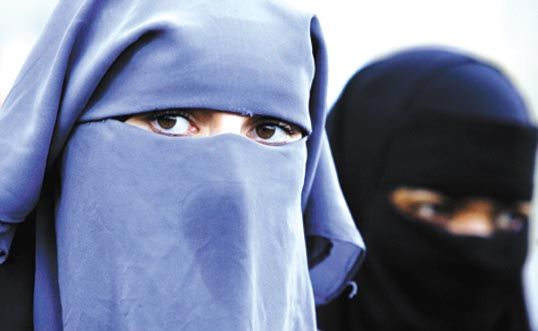
This is not the problem.

And no, my reasoning has nothing to do with racism or any other ism!

Belgian lawmakers recently passed a bill that, if approved in their senate, would make it illegal to wear burqas in public. This comes on the heels of France’s

When justifying banning burqas or similar Islamic garments, people typically make two points–one, that burqas represent and facilitate the oppression of women, and two, that they pose a security risk.

I’ll address the oppression issue first. Some women do indeed wear burqas because they’ve been pressured into it by their culture or by specific men in their lives. But other women do it out of a genuine desire to observe their religion in that way. Some even see it as an empowering gesture. It is fundamentally unjust to oppress the latter group in the name of protecting the former.

But even if I’m being completely naive, and even if not a single Muslim woman willingly chooses to wear a burqa, I conveniently have a second argument. For those women who are being oppressed by the burqa, would banning it really help? The obvious answer, I should hope, is no. In this case, banning the burqa is the legal equivalent of slapping a band-aid over a knife wound–and of treating the symptoms rather than the disease. The disease being, of course, large-scale societal oppression of women. Not something that can be fixed with a single magical law. To use an analogy that’s even closer to my personal experience, banning burqas to promote feminism is like banning suicide to promote mental health.

Not only would banning it not help, but it would probably backfire. If these women’s husbands or fathers are pressuring them into wearing the burqa, they would probably keep right on doing it despite the new law, thus placing these women in a prime position for facing charges, jail time, or plain ol’ harassment by the police. After all, they would be the ones paying the price for breaking the law, not men.

As for the whole security issue, I don’t have too much to say about that because I’m honestly not an expert on the subject, but I’ll say this–Israel has no burqa ban, or any sort of ban on Islamic head coverings, and yet has an incredible security force that manages to stop virtually all potential terrorists within the country’s borders. They don’t release these statistics to the public, but all the time in the Jerusalem Post, you see another story about security guards catching a would-be terrorist. Maybe the security authorities in these European countries should have a big pow-wow with Israeli ones and see what they’ve been missing.

I think it’s very tempting for people (and governments) to believe that issues like the oppression of women by organized religion can be fixed by something as simple as a law banning burqas. But ultimately, you can never really know what’s going on in someone else’s mind. What looks like oppression to us may not feel that way to the women in question. Or maybe it does. In any case, banning burqas won’t help.

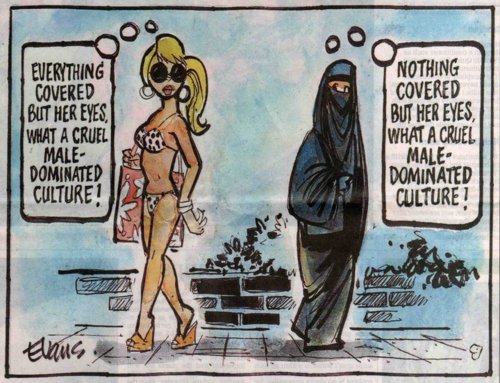
I’ll leave you with my favorite cartoon on this subject: