
This gallery contains 41 photos.
There’s a story that’s been running through my mind all week. It’s about a woman who posted a photo of her beaten face on Reddit after she was sexually assaulted, and the community responded by claiming that it “looked fake.”
One user claimed that since she’d used makeup to dress up like a zombie before, then it was probably fake. Another user claimed that he was a medical student (and therefore qualified to judge) and that the bruise just didn’t look genuine. Yet another user claimed that because the woman in question had mentioned previously that she has anal sex and that she likes being burned during sex, she must be faking.
The douchey Redditors didn’t let up until the woman responded, saying that she’s unsure of how to prove that the wound is real short of running a wet cloth over it and posting a video. They convinced her to do it. She did. Only then did they start going back on their previous judgments.
What disturbed me most about this story wasn’t the fact that there were a few douchebags on the internet. Rather, it was many of the comments on the Jezebel piece I linked to, which included the following:
Of all the places on the internet, why the fuck would you go to Reddit looking for sympathy and support?
This whole thing is pretty stomach turning. But I still don’t understand why one would want to take their story of sexual assault to a space like Reddit. It doesn’t, uh, seem like a safe space.
That’s what I was just thinking! Of all places, why would you post there?
The whole “You should have known better than to post here” thing gets really close to victim blaming, IMO. The Reddit community is perfectly fine with providing group therapy and noncontroversial messages of support 90% of the time. Safe spaces exist (though with all the transphobic shit occuring in /r/femisims, I’m not sure it is one), but that doesn’t mean you should expect to be harassed and denigrated in “unsafe” spaces. That’s akin to saying “Well of course you had some people catcall you when you went out in the street. Why didn’t you just stay at home, where it’s safe?”
A friend sent me a link to this piece in the Huffington Post titled “Tough Gals: Do They Still Exist?” The piece is a jeremiad against the supposed “girliness” of today’s women and how we’ve all apparently abandoned the precedent set by our tough, bitchy, bra-burning feminist foremothers:
Women are girly. Again.
Don’t believe me? The proof is in the blogosphere: Women who blog about cupcakes! Women who blog (okay, rant) about gardening, Hello Kitty, and knitting! Even BUST magazine is sponsoring a Craft Fair in NYC. Women who blog about cats! And then there are cats who blog, but let’s not get into that just now. Don’t get me wrong, these are all lovely blogs, smart and entertaining. And some blogs, like the wonderful Jezebel, keep us on our toes pointing out what a long way we haven’t come, baby (like in this piece on how female superheroes are sexualized). But.. seriously… cupcakes?
To be frank, this article is so stupid that I was almost reluctant to even respond to it. (My first reaction was, who pays someone to write this shit? And then I remembered that HuffPo doesn’t pay.) Really, there’s so much wrong with it–a false dichotomy (be a feminist OR be feminine), the judgment of lifestyles that differ from the author’s, the assumption that there’s only one way to “do” feminism, and not to mention some good ol’ misogyny–that is, the idea that women are only worth the air they breathe as long as they act like men.
I could respond to this with abundant examples from my own life–the fact that I actually (shocker) enjoy cooking, cleaning, and doing my hair, the fact that some of my best memories are of taking care of my younger siblings, the fact that I knit, crochet, and sew, and…I am still a feminist. Don’t believe me? Take a look at my love life. I can barely date anymore because most men I meet piss me the hell off with their sexism.
So yeah, I could use myself (and my friends) as a counterexample easily enough, but I’m not even gonna go into detail about that because it’s unnecessary. The larger problem with this article isn’t that it doesn’t even begin to describe any of the women I know, it’s that it doesn’t even begin to describe the feminism that I know.
Feminism was (and still is) a response to two basic tenets of human society–one, that women are inferior to men, and two, that there is a right way for women to live. For centuries, this “right way” consisted of what we typically associate with oppression of women–having to stay home to cook, clean, and produce/raise babies.
In the mid-20th century, feminists obliterated this ideal. Or at least, they set us on the path to obliterating it. But the woman who wrote this HuffPo article, like many other so-called feminists–I say “so-called” because I don’t think they really represent feminism–seem to want to replace one ideal with another.
Repeat after me: feminism is choice. There can be no feminism without choice, just as there can’t really be choice (at least, not for women) without feminism. The minute you start dictating how a woman needs to behave in order to be worthy of your respect, you’re destroying decades of progress. Whether it’s that she can’t have too much sex or that she can’t cook and knit her own clothes, you’re still imposing an ideal on women. Women who have different personalities, backgrounds, and ideals than you do.
The comments on this article are awesome because they’re full of women talking about their lives and what they like and what they do, and basically demolishing all of the author’s assumptions. Take this one:
I have guns; a pink .22 and a purple .38 among others. My husband and father made dang sure I could protect myself and my kids when alone. I’d shoot first and ask questions later. I love cupcakes, gardening, knitting and just being a holly homemaker. Having a husband who deploys leaves me to my own devices often enough and screw Army strong I am my own breed of tough. Dare I mention the 3 children I delivered without an epidural? I can fix a flat, change my oil, bake bread from scratch, and sew my own curtains. I have degrees of my own, but being with my children and showing them to be tolerant and productive men in this world trumps proving I’m “feminist” Yes, i get to have my cake and eat it too!
Who’s a bad feminist now?
The author of this article is, in fact, an even more egregious sexist than most of these college guys I’m always bitching about, because she actually believes that the things our culture labels as “feminine” are inherently worse than the things it labels as “masculine.” To get all jargony on you, that’s called “internalized sexism.”
Feminism is not a convenient ideology for you to use to get people to live their lives in a way you approve of. That’s patriarchy. We don’t need more of that.
I’m going to come out of my cave and write about something that pisses me off. (OK, so I could start any blog post this way, but whatever.)
Here’s something that I consider one of the most glaring cultural problems in America today–it’s the idea that just because something is difficult, it is impossible and not worth trying. Our culture has become a deeply pessimistic one, and the message that it sends these days is “Oh, forget it, we could never change that anyway.”
Don’t believe me? Well, you should, because I’m right. There’s a reason that the issues that land on the political agenda are fairly simple–go to war, or not go to war. Allow gay marriage, or not allow gay marriage. Raise the debt ceiling, or don’t raise it.
Don’t get me wrong, I’m not saying these issues aren’t fraught with difficulties of their own. But they are very simple–yes or no. Right or wrong. Do, or don’t.
The issues that don’t really get talked about much are the complex ones. How to fix our education system. How to achieve equality between women and men, and between whites and people of color. How to create a more just and sustainable food system. How to end our addiction to oil. How to end the Israeli/Palestinian conflict. How to encourage democracy to take root in other parts of the world without shoving it down people’s throats.
To be sure, our government does things to try and ameliorate these issues somewhat, but they’re always band-aid solutions to broken-bone problems. For instance, George W. Bush tried to “fix” our schools with No Child Left Behind. President Obama issued empty threats to Israeli Prime Minister Netanyahu to stop settlement building, with no regard for the religious and political complexities that the settlement issue dredges up. Then there’s that little Iraq thing. As for our screwed-up food system, racial justice, and ditching the oil habit, I don’t think anything’s being done at all.
Try coming up to an older person (by which I mean, someone old enough to have their own kids) and talking to them about these issues. About education, about food, about the racism still embedded deep within our society. Ten bucks says they tell you something like, “Yeah, it’d be great if that could get fixed, but face it–it’s never gonna happen.”
Why? Why the hell not?
Well, because it’s hard.
People think that these things are never gonna get fixed because it’s so hard to fix them. And by hard, I mean like when you’re trying to do a math problem and you don’t even know where to start. You’re completely stuck. Nothing you’ve ever learned is going to help you here.
The stuff that gets in the news, like gay marriage, the debt ceiling, and all of that sort of stuff, is different from these issues because, despite our disagreement on them, we know what to do. We either vote yes, or no. But you can’t vote “yes” or “no” on education reform or on ending racism, because you have to figure out what the hell to actually do about it.
Note what a clusterfuck occurs when our government actually tries to take on a complex and nuanced issue–for instance, healthcare reform. It nearly stops functioning. Our culture is terrified of complexity.
Usually when young people like me talk about fixing some of these complicated problems, older people call us “idealists.” (And that’s at best–sometimes they use less charitable labels.) To me, all that’s saying is that we’re willing to think about and talk about things that are hard, and “realistic” people are not.
Well, realism is dooming this country. Realists are people who don’t think we can stop global warming, who don’t think we can have just and efficient healthcare, education, and food systems, who don’t think we can ever achieve equality between sexes, races, socioeconomic classes, or sexual orientations.
And guess what? If you tell yourself you can’t do something, it’s not going to get done.
And anyway, isn’t that a terribly demoralizing thing to say? I think we’re selling ourselves short when we say that we can’t solve complex problems like these. After all, the human race invented democracy, finance and agriculture, created the Mona Lisa, painted the Sistine Chapel, put a man on the moon, eradicated polio, and set up the Internet. Do our accomplishments really end there?
Just because something is difficult does not mean it’s impossible. Things that are impossible, at least with our current knowledge and technology, are traveling through time, sprouting wings and flying, curing cancer, and turning lead into gold. But things that are merely difficult? Well, that’s just about everything else.

This is not the problem.
And no, my reasoning has nothing to do with racism or any other ism!
Belgian lawmakers recently passed a bill that, if approved in their senate, would make it illegal to wear burqas in public. This comes on the heels of France’s
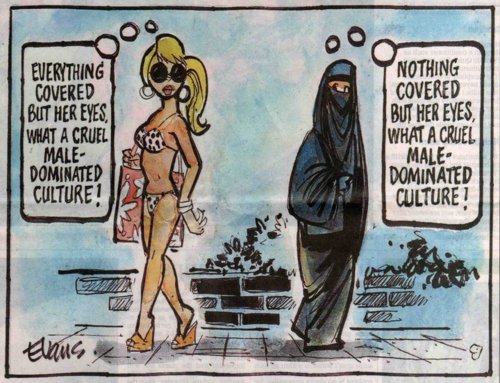
When justifying banning burqas or similar Islamic garments, people typically make two points–one, that burqas represent and facilitate the oppression of women, and two, that they pose a security risk.
I’ll address the oppression issue first. Some women do indeed wear burqas because they’ve been pressured into it by their culture or by specific men in their lives. But other women do it out of a genuine desire to observe their religion in that way. Some even see it as an empowering gesture. It is fundamentally unjust to oppress the latter group in the name of protecting the former.
But even if I’m being completely naive, and even if not a single Muslim woman willingly chooses to wear a burqa, I conveniently have a second argument. For those women who are being oppressed by the burqa, would banning it really help? The obvious answer, I should hope, is no. In this case, banning the burqa is the legal equivalent of slapping a band-aid over a knife wound–and of treating the symptoms rather than the disease. The disease being, of course, large-scale societal oppression of women. Not something that can be fixed with a single magical law. To use an analogy that’s even closer to my personal experience, banning burqas to promote feminism is like banning suicide to promote mental health.
Not only would banning it not help, but it would probably backfire. If these women’s husbands or fathers are pressuring them into wearing the burqa, they would probably keep right on doing it despite the new law, thus placing these women in a prime position for facing charges, jail time, or plain ol’ harassment by the police. After all, they would be the ones paying the price for breaking the law, not men.
As for the whole security issue, I don’t have too much to say about that because I’m honestly not an expert on the subject, but I’ll say this–Israel has no burqa ban, or any sort of ban on Islamic head coverings, and yet has an incredible security force that manages to stop virtually all potential terrorists within the country’s borders. They don’t release these statistics to the public, but all the time in the Jerusalem Post, you see another story about security guards catching a would-be terrorist. Maybe the security authorities in these European countries should have a big pow-wow with Israeli ones and see what they’ve been missing.
I think it’s very tempting for people (and governments) to believe that issues like the oppression of women by organized religion can be fixed by something as simple as a law banning burqas. But ultimately, you can never really know what’s going on in someone else’s mind. What looks like oppression to us may not feel that way to the women in question. Or maybe it does. In any case, banning burqas won’t help.
I’ll leave you with my favorite cartoon on this subject:
See the line where the sky meets the sea? It calls me…
Body love, mental health, and critical theory
Care and responsibility.
Where Crunk Meets Conscious and Feminism Meets Cool
"Let me live, love and say it well in good sentences." - Sylvia Plath
Life, Liberty, and the Pursuit of Happiness Are For All Sizes
"Social adaptation has to proceed via the intellect." - Hans Asperger
Notes on fieldwork and other sundries
Social Data for the Queer Revolution...
she thinks. she says. she writes.
Meg-John Barker's website
Feminism is for everyone!
if you're afraid of socialism, you're afraid of yourself.
thoughts on sex and life
A feminist perspective about the feminist perspective
From My Eyes...
Feminism + Social Justice + Pop Culture = (???) x (Total Chaos)
Ramblings about life between young adulthood and middle age.
 Brute Reason