Won’t Someone Please Think of the Sluts?

[Snark Warning]

I was bemused recently by the reaction when I mentioned on my Tumblr–in the context of a larger conversation–that I’m proud of the fact that I’m not, for lack of a better term, “promiscuous.”

I was promptly accused of “slut-shaming,” which, according to this blog, is constituted by the following:

the idea of shaming and/or attacking a woman or a girl for being sexual, having one or more sexual partners, acknowledging sexual feelings, and/or acting on sexual feelings.

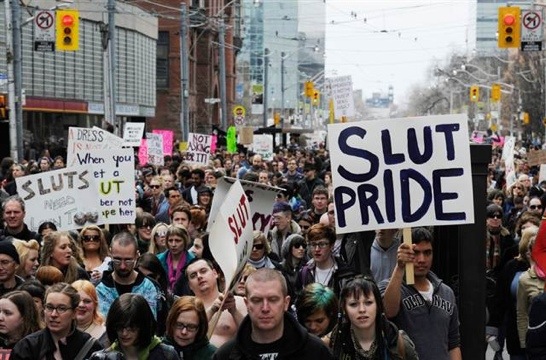
The word “slut” has recently undergone a revival of sort, and was used for the infamous SlutWalks of this past spring and summer. Naive as I am, I’d assumed that the point of this new discourse on slut-shaming was to emphasize that everyone should be free to choose–and to take pride in–whatever sort of sexual life they desire. This would be an idea that I would support till my dying day.

Apparently, though, the hidden side of this message is that it’s no longer fashionable to be sexually abstinent or to reserve sex for serious, loving relationships, and that anyone who takes pride in their decision to do so is necessarily shaming sluts.

Well, needless to say, I don’t subscribe to that notion. Here’s why.

I love my major (psychology). I’m proud of the fact that I’m studying to be a psychologist and would not have it any other way. Does that mean I look down upon everyone who chooses a different major and think that everyone should study psychology? No.

Another example. I’m proud of being Jewish. Although I’m not observant, I take a lot out of the Jewish tradition and would not want to belong to any other faith. Does that mean I look down upon everyone who has another religion? No.

But for some reason, when we’re talking about sexual politics, everyone seriously loses their heads. This entire branch of the social justice movement is subject to the very same dichotomous thinking it despises (i.e. the virgin-whore dichotomy, and others). A bunch of people simply assumed that just because I’m proud of my own decisions about my sex life, I look down upon all other possible decisions and therefore am taking part in slut-shaming.

Sorry to complicate things for you, but no. As I’m constantly posting things on my Tumblr regarding sexual freedom and related topics, and as I’m a member of a campus organization dedicated to, among other things, promoting sex positivity, I think I can safely vouch for the fact that I don’t deplore anybody’s personal choices as long as they do not involve harming others.

But that simply does not mean that I don’t take pride in my own actions and decisions. I think people are assuming that “pride” implies a moral stance, but it doesn’t. I’m not proud of my abstinence from casual sex because I think I’m more moral than others. I’m proud of it for other reasons, such as:

  • it’s a rejection of college social norms, and I’m always happy to reject some social norms;
  • it’s a way of observing my beliefs about sexuality and spirituality–beliefs that are not necessarily religious in nature, but that I hold very strongly (for myself);
  • and, most importantly, it’s the healthiest choice for me, and in a culture where psychological health plays second fiddle (hell, last fiddle) to everything else, I’m proud of doing what’s healthiest for me.

You might have noticed that in the preceding list, I italicized “for myself” and “for me.” This is because I’m acknowledging that the choices I’ve made, and my pride regarding those choices, reflects the fact that this is what’s right for me as an individual, and not necessarily what I’d wish to impose on the rest of the general population.

I realize that this distinction may have been lost on some people–namely, the ones that accused me of “slut shaming”–in my original post, but that’s why I’ve dedicated this entire article to illuminating it.

The end result of all this is that I’m no longer quite so enthusiastic about participating in a movement that denies me the right to take pride in my lifestyle just because it’s not what the cool kids are doing these days. That’s not even considering the fact that, as difficult as “sluts” have it, my decision to abstain from casual sex hasn’t been entirely free of consequences either. Where’s the discourse on virgin-shaming? Or, in my case, people-who-hate-hooking-up-shaming?

(Just recently on Tumblr, I witnessed dozens of people ganging up on a girl who declared in a completely judgment-free way that she wishes to remain a virgin till marriage. To these sexually liberated but mentally stunted morons, I only have this to say–for shame.)

So I’ll end with this: to any self-described sluts who are reading this and feel shamed by my personal lifestyle choices, I offer my sincere apologies. However, I’ll also advise you to learn how to derive your self-esteem from internal pride rather than external approval. I’ll keep advocating for sex-positivity because it’s what I believe in, but I’m sure as hell going to live my life the way I want to and be proud of it, with or without your approval.
20111129-143346.jpg

Facebooking in Class–Symptom, not Disease

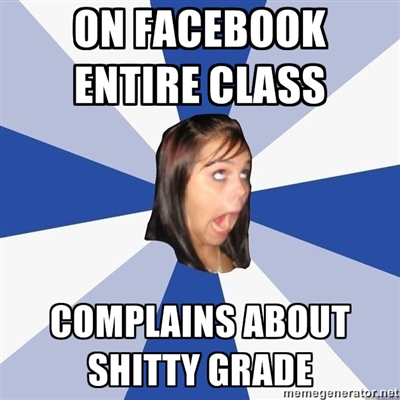
FINALLY I get to use this meme in a serious context.

I think I’m going to have a series of posts criticizing GOOD’s pathetic education section, which is currently failing even harder than my insomniac classmates are at their finals.

This is an older article, but I decided to dig it up and poke fun at it anyway.

This article suggests that having a “15-minute tech break” for each half-hour of class would help students focus because they’d do all their Facebooking in those 15 minutes and then put their phones away.

The people who propose these initiatives seemingly have a complete lack of understanding of how young people actually use technology, and for what purpose. For instance:

Rosen says his tech break concept “works amazingly.” For every half-hour of focused work, he recommends allowing a 15-minute tech break. Once a students sees that nothing is happening on Facebook or send a friend that critical text message—they’re able to refocus, he says.

That’s not the way Facebook and texting work, though. You don’t just check it and then forget about it. You like to be on it. What’s to stop people from having their phones out under their desks outside of the “tech break?”

Furthermore, I don’t see how this is even doable. This would increase class time by a whopping 50%—ludicrous when everyone, both students and teachers, are already severely overbooked. (In fact, that may be why students use their phones in class to begin with.)

In addition, like it or not, multitasking is here to stay. If students are forced to learn how to integrate technology with learning rather than strictly separating the two, they’ll be better equipped to handle modern work environments, where you’re usually required to answer phones/emails/messages while working, and so on.

Finally, I still don’t understand why people see Facebooking/texting in class as some sort of crisis of epic proportions that requires a complete restructuring of the school day. Are students actually becoming dumber? Are their grades dropping? And even if they are, might it be because of much-needed and still-lacking education reforms, and not because of Evil Technology?

I obviously haven’t done research on this (though, by the looks of it, this guy hasn’t either), but I’d guess that Facebooking and texting in class aren’t a cause of distraction–they’re a symptom. Back in the day, kids would doodle or pass notes or just stare into space. These days they text and go on Facebook. What’s the difference? Oh, right, there’s a convenient piece of Evil Technology to blame.

That, ultimately, is the argument that I believe overrules everything else I’ve just said. If the problem is–shocker–not Those Darn Kids but the fact that school is worthlessly boring, then it’s time to have a completely different dialogue. This dialogue will have to be about how to make school both educational and fun and not about how to get Those Darn Kids to do what we want them to do.

Why You Should Date a Feminist

Now don't tell me you wouldn't date Obama.

Men, this post is for you.

I’ve been told by trusted sources that potential suitors may read my blog and find themselves intimidated by my feminist ideas. I would never want to discourage a potential suitor until I discover him to be deplorable, so I’m offering up this post as an olive branch of sorts.

So, here’s why you should date feminist girls like me.*

  1. We split the check. Now, I’m not gonna lie–I don’t speak for all feminists, but I personally appreciate when a guy offers to pay for me. Sometimes I even accept. However, that doesn’t mean I expect it. Hell, sometimes I even pay for the guy.
  2. We won’t use you as a free plumber/computer technician/mover. I can unclog my own toilet, fix my own computer, and–usually–schlep my own shit up the stairs. Why? Because rather than sitting around looking pretty and helpless, I’ve enjoyed figuring out how to do that stuff myself. (Case in point: I once ran Linux (Ubuntu, if you’re interested) on my laptop for an entire year just for the hell of it.)
  3. We’re great in bed. Most–though of course not all–feminists refuse to buy in to the idea that a woman is only sexy if she’s either a shy, girlish virgin or a porn star. We recognize that sexiness is an attitude, not a set of genetically inherited traits. We understand that there’s nothing shameful or dirty about sex.
  4. We don’t expect you to be rich. I’ve dated (or at least crushed on) guys who’ve majored (or worked) in anything from business, economics, biology, and pre-med to philosophy, history, English, and psychology. I’ve been into guys whose parents are lawyers and guys whose parents barely make ends meet. Because I don’t see dating as a way to become financially secure. I can do that for myself.
  5. We will never subject you to monologues about our physical flaws. (Or, at least, we’ll do so very rarely.) After many years, I’ve finally stopped thinking I’m fat. But it’s not because I got any thinner or got an expensive therapist. It’s because I’ve finally realized that even if I were fat, that would in no way diminish my worth as a human being–and that’s an idea I can thank feminism for. Once I realized that, I finally stopped pinching my stomach and analyzing my thighs, and got to work thinking about the stuff that matters.
  6. We don’t buy into the whole Valentine’s Day shebang. Every February, I discover magazine advice columns full of letters from men terrified that they won’t be able to provide the “perfect” Valentine’s Day experience for their girlfriends, fiancées, or wives. Well, gentlemen, you don’t have to worry with me. I appreciate Valentine’s Day gifts and usually give them myself, but I have no special expectations for that day aside from a hug and a kiss.
  7. We don’t need you to be super ripped and athletic. Most feminists recognize that there are soooo many interesting things a person could do with his/her life aside from trying to look good. I like to date people who are passionate about something. If they’re passionate about sports, cool. If they’re passionate about something totally different and don’t have much time for sports, still cool.
  8. We care about things. Now, I realize that for some men, this is a dealbreaker. But I truly believe that most guys like it when a girl actually cares about things that happen in the world and has plenty of interests. I have lots of flaws, but one word that’s never been used to describe me is “boring.”
Of course, no discussion about dating feminists would be complete without an examination of the stereotypes associated with them. Many people unfortunately think that feminists are rude, uncaring, etc. Obviously, I don’t think that’s true. But a better argument is this–don’t you also know non-feminists who are rude and uncaring?

Not every feminist woman will be right for you. That much, I hope, is obvious. I’m not arguing that you should date women just because they’re feminists. Rather, I’m arguing that you shouldn’t write them off just for that reason.

So, give it a try. Don’t let my mom be terrified for my romantic future. You wouldn’t do that to her, would you?

~~~

*Disclaimer: I don’t claim to speak for all feminists. However, this list is applicable to most feminists that I’ve personally met and/or read the writing of. If you’re a feminist and some of this doesn’t apply to you, that’s perfectly fine. I still consider you a feminist. Don’t worry.

Mental Illness Is Not a Punchline

Damn, I’m certainly on a crusade against humor these days.

That was sarcasm, by the way. I love humor. I just think it should be deployed carefully.

A few days ago in my Psychology of Personality class, the following happened:

Some people were having their own conversations while the professor was trying to give a lecture. The professor cracked a joke–“Hey guys, I have ADD so I can’t focus if other people are talking, so please stop!” followed by “I don’t really have ADD, but still.”

Now, for the record, I totally get that it sucks for a teacher when people are talking in class. But I also feel that there are other ways to address that situation without making a joke about having a mental illness that you don’t actually have. Especially, you know, if you’re a person who has a PhD in psychology and conducts research on people with actual mental illnesses.

The sad thing is, before he followed his comment up with that disclaimer, I was actually really touched. I thought it was wonderful that a professor of psychology would take a stand against the stigma of mental illness by stating in class that he has one. But then, you know, it turned out to just be a joke.

~~~

Last spring, I took a class on Cognitive Behavioral Therapy. It was an advanced class, with just around ten students or so, taught by one of the most esteemed professors in the department. We got to the chapter on Borderline Personality Disorder, which, as you may know, is considered one of the most frustrating mental disorders–both for clinicians and for the patient’s friends and family. So naturally, no discussion of it could be complete without my professor’s bombastic explanations about how she tries to avoid treating BPD patients because they’re just SUCH a pain and about how she once had a friend with BPD who was just SO hard to deal with. Everyone gasped and laughed at her descriptions.

Then, of course, the other students had to start raising their hands and talking about their own friends that they’d taken the liberty of diagnosing with BPD, and how  horrific those people were.

This was a time in my life when I was seriously wondering if I had BPD myself, so, yeah, that was pretty unpleasant.

~~~

Last fall, I took a class on psychopathology. It was my second psychology course ever, and my first that related specifically to mental disorders–a topic very close to my heart at the time since I’d been diagnosed with major depression only a month before.

Before the course started, the professor sent out an anonymous survey to the entire class about our experiences with mental illness. On the first day of class, she disclosed the stunning results–more than half of us said we’d been diagnosed with one.

So we got to the chapter on depression and the professor started talking about depressive cognitive distortions, using specific examples. The professor started listing them off in such a way that the whole class started laughing. And laughing, and laughing.

Now, I totally get that it sounds funny. Consider this dialogue:

X: I’m getting a B in calculus. I’m a total failure.

Y: You’re not a failure at all! You have straight As in the rest of your classes.

X: Well, those don’t count. They’re easy anyway.

Y: Yes, and calculus is pretty hard, so it makes sense that you wouldn’t do as well. Besides, a B is a pretty good grade.

X: No, it’s a shitty grade. Everything I do is shitty and I’m always going to be a failure.

That is an example of several cognitive distortions, including overgeneralization, disqualifying the positive, magnification, and labeling. And, when read aloud in a particular tone of voice, I can see how it might sound kind of funny.

But having been through it myself and studied it extensively, I can also hear the pain behind what X is saying. It’s not a punchline. It’s a cry for help from a person trapped inside their malfunctioning mind.

~~~

Here’s the thing. I get it. People with PhDs in psychology have spent years and years reading, writing, and talking about stuff like this. I’m sure that it’s completely normal for two psychologists to crack jokes about mental illness to each other.

Knowing that many people who pursue degrees in psychology are spurred to do so by their own experiences with mental illness (I’m an example of this), I understand the urge to joke about it because I joke about it myself. It helps alleviate the fear and pain of living with mental illness.

That doesn’t mean I’d joke about it to a room full of 100 people who don’t know me well and who may be dealing with their own issues, though.

Case in point–at the time I took the aforementioned psychopathology class, I was still learning how to recognize cognitive distortions in myself, and I was beginning to realize the extent to which they’d ruined all of my previous interactions, friendships, and relationships. To have a room full of 100 people laughing uproariously about something that nearly brought you to suicide just three short months before is, well, no laughing matter.

~~~

I’m not saying there’s no room for humor about mental illness. There definitely is, and humor has been one of several strategies that have helped me process what happened to me. But humor must be used carefully.

I’ve written before about the complex relationship between humor and mental illness–here, here, here, here, and here. But this time, the situation is very different because the off-color jokes are coming not from comedians, television writers, novelists, or clueless friends of mine, but from people who know more about psychology than 99% of the population.

Unfortunately, I still haven’t quite worked up the courage to tell a person with a PhD that they’ve offended me.

But I’m working on it.

On People Who Think They’re so Damn Funny

[Snark Warning]

Like many depressives, I have a love-hate relationship with humor. A well-crafted joke, anecdote, or cartoon can cheer me up during the worst times, but because of the various cognitive deficits associated with depression, I have a lot of trouble processing humor when it’s directed at me or my life.

Enter another thing I have a love-hate relationship with: Facebook. As one of those rare people who’s “out” about having a mental illness (to shamelessly borrow terminology from the LGBT community), I occasionally post something related to my current troubles on my Facebook. Most of the people who bother reading it are fairly good friends of mine who know what’s going on and often stop by and leave a nice comment or a simple “<3” on those posts.

But then there are people who insist on trying to force a joke about the situation. These well-intentioned but insufferably clueless people are the bane of any depressive’s life. They’re our friends, sometimes even pretty good ones, and as much as we know that they mean well, it can be very painful to have a really difficult aspect of your life reduced to a dumb joke like that. And it’s nearly impossible to find a way to respond–any suggestion that the joke was out of place is inevitably met with “but I was just trying to lighten the mood” or “I just wanted to cheer you up.”

Here’s the thing, though–you can’t fix a depressed person anyway. (Sometimes, you can’t even fix a depressed person if you’re a psychiatrist or psychologist.) The most you can do is offer a message of support and refrain from trying to turn a depressed person’s misery into a big huge joke.

Honestly, I doubt that even healthy people are actually “cheered up” by jokes made at their expense. I can’t imagine that’s pleasant for anyone who’s already in kind of a bad mood. But it’s especially unpleasant for a depressed person and can trigger all sorts of nasty stuff.

I think people have a huge fear of others’ unhappiness. The moment you see a sad person, you immediately want to drag them, kicking and screaming, out of their sadness, whether they asked you to or not. This is understandable, but it should be avoided, not only because there’s so little you can really do, but because you should try to understand people before you try to help them.

If anyone ever bothered to ask me what they could do to help me feel better, you can guarantee I wouldn’t say “crack a dumb joke at my expense.” And, don’t worry, I wouldn’t say “sit here for hours and listen to me cry,” either. I would probably ask you to have a conversation about something interesting, like politics or culture, with me. Or I’d ask you to come over and bring a good movie. Or I’d ask you to bake some cookies with me. Or, I’d say, “Nothing, but thanks for asking.”

What people don’t understand about depression is that it’s different from normal sadness not only in quantity, but in quality. To put it more simply, it’s just a different kind of sadness. When someone has a depressive episode, they go to a really dark place that healthy people don’t go to ever. Not even when their significant other breaks up with them or something like that. It’s a darkness that can’t be lit up by a stupid joke. Really, it can’t be fully lit up by anything. But human connection, love, and support can sometimes help.

Obviously, not everybody is willing to provide that for everybody else. That’s fine, and that’s how it should be. But if you can’t give me what I need to feel better, don’t give me something that makes me feel worse, either.

Like many problems that I come across in my life, this turns out to be something that’s actually a much larger issue. I believe that the reason people are so desperate to immediately try to “lighten the mood” the instant they see something unpleasant is because our culture has an extreme fear of negative emotion. We avoid it like the plague, and it comes as no surprise to me that most of our culture’s solutions for achieving happiness seem to focus on eliminating things like fear, sadness, and anger entirely, rather than incorporating them into one’s life in a normal, healthy way. Clearly, what I have isn’t healthy, but it’s only the extreme end of spectrum. I see this sort of blind and terrified avoidance of anything that’s sad, whether it’s severe like depression or totally normal, everywhere I look.

If you’ve just read this and realized that what I’m describing sounds exactly like you, I hope you’re not offended. If you are, my apologies. But I hope you trust that behind all this snark is a lot of pain.

And, if you’re still reading, I have a challenge for you. Next time you come across a post from a friend that’s unhappy in some way, don’t rush to make a joke about it. Don’t try to drag your friend away from what they’re feeling. If you absolutely need to comment on it somehow, say “I’m sorry, that really sucks,” or “I hope you feel better.” I guarantee that unless you happen to be Jon Stewart, that’ll work better than any joke.

I’ll leave you with a quote by Dutch priest and writer Henri Nouwen:

“The friend who can be silent with us in a moment of despair or confusion… that is a friend who cares.”