This blog will now have short posts too!

After much deliberation, I’ve decided to start writing more short posts on this blog. By short I mean, several hundred words as opposed to my usual 1000-plus-word ones.

The reason for this is twofold:

  • to make it easier for me to write more often, since I don’t always have time and energy for those huge pieces, and
  • to allow me to comment on things that I just don’t have enough Thoughts to write a thousand words on.

I will label all of the short-ish posts with an [In Brief] tag in the post title, so that if you’re really only here for the novella posts, you can just avoid them.

That said, I think you’ll like them! 🙂

[Guest Post] Thank You, Todd Akin

One of my blog’s readers, who wishes to use the pseudonym Dubs, asked me to publish this guest post. Trigger warning for sexual assault.

I can’t keep quiet any more.  Thank you, Todd Akin.

And less sarcastically, for inspiring me to finally write my first public piece, thank you Eve Ensler, quoted from her response to Representative Akin here:

You used the expression “legitimate” rape as if to imply there were such a thing as “illegitimate” rape. Let me try to explain to you what that does to the minds, hearts and souls of the millions of women on this planet who experience rape. It is a form of re-rape. The underlying assumption of your statement is that women and their experiences are not to be trusted. That their understanding of rape must be qualified by some higher, wiser authority. It delegitimizes and undermines and belittles the horror, invasion, desecration they experienced. It makes them feel as alone and powerless as they did at the moment of rape.

I, like many of the women I know (and many of the women YOU know, whether you know it or not), am a survivor of rape. I am a survivor of several rapes. It is not an easy thing to say, to any one at any time, let alone to try and say it to the entirety of your Facebook community, where this post originated. But here’s my story. (For those of you who avoid such things, trigger warning & naughty language ahead.)

I was 25. I was out with a friend. We’ll call her B. She was something of a Bad Idea Bear… the little devil on my shoulder that would convince me to do things that my little angel knew I’d regret in the morning. Clearly, my choices were my own, but she definitely helped me make them.

I was in the midst of a rough divorce, and she was determined to help me regain my self-esteem and confidence with men. We were at a bar, both flirting with the bartender, hereafter known as Dog.

Dog is graciously providing us with deeply discounted drinks, and I’m enjoying the attention. B is cheering me on. Dog’s shift is over, and he convinces a now rather unsober me-and-B duo to join him at this great piano bar. Off we go, staggering away in his car. (Are you keeping count of how many mistakes I’ve made yet, and how this is all terribly my fault, and I brought it all on myself?  Exactly… keep counting, there’s more coming…) At the piano bar, I don’t remember much, except that it was such a classy joint, they only served beer and wine, and I don’t drink beer.  Dog insisted on choosing a great red wine for me, despite my assertion that red wines give me migraines, but not wanting to be rude, I acquiesced. When the piano bar closed down, Dog convinced B and me to head to his place to keep the party going. I vaguely remember staggering into a cab, and feeling utter shame at what the patrons and the staff must think of me, and I think I caught a look of sympathy from either a doorman or another bartender who caught me once as I tripped.

We get to Dog’s place, and I’m in the head lolling stage of my drunk.  B & Dog are still conversing amiably (in retrospect, I believe they were probably both functional alcoholics).  At one point, I remember thinking how smooth I was, because I was able to hide the fact that I was vomiting by just swallowing. Anyone else who’s had that thought knows–you actually haven’t been smooth. B helped me to the bathroom to clean me up. (I was still cleaning pink stains out of the stitching on my leather coat weeks later…red wine, remember?).

After that embarrassment cleared, Dog guided us into his bedroom. All 3 of us laying on the bed just drunkenly talking and being… drunk. At some point kissing started, in which B was involved. When Dog started getting more aggressive, she stands up and says “Nope, I don’t want any part of that.” and walks out of the room.

(The bitch fucking left me there–after he had shown that he was sexually aggressive and didn’t give a fuck about consent. She fucking left me alone with him.)

I remember telling him I didn’t mind making out and stuff, but I didn’t want sex. I said no. I was drunk, I wasn’t in complete control of myself. I put myself in really compromising situations with untrustworthy people. I fucking said no. Did I stab him? Did I push him off?  Did I scream and yell and cry? Or did I just lay there, and wait for him to be done with me, since clearly he didn’t care about my opinion anyway? Roll over, go to sleep, and do the walk of shame in the morning. One more notch in the slut shame hall of fame.

A few days later, I was talking to B about our random drunken escapades and drunken regrets. I told her “Yeah, so that night with Dog? Not that I’m going to press charges or anything, but it really could be construed as rape. I did tell him I didn’t want to have sex… he just pushed right on anyway.”

Did I mention that B is a rape survivor herself? But hers was “legitimate.” Home invasion, serial rapist. Nationwide coverage. Big trial, conviction, the whole bit.

I stepped in a land mine. “HOW DARE YOU COMPARE WHAT I WENT THROUGH TO A DRUNKEN ONE NIGHT STAND REGRET?!?!” She immediately regaled me with full details of what happened to her. Admittedly, it was horrific. But suddenly, because she had suffered horrendously, I wasn’t allowed bodily autonomy.

It wasn’t until about a year ago that I could admit to myself that I had been raped at all without qualifying it with “could be construed as” (I muttered the magical word NO!, but it was still my fault). I am an imperfect victim, I am quite sure many will say I brought it on myself (when I told my own mother, her response was “Hopefully with time, you can forgive yourself.”). But at the end of the day, whether I put myself in a risky position or not, a man felt entitled to use my body in a way I did not consent to. When I confided in a friend, I was promptly told that my experience of violation was ILLEGITIMATE.

You want to know how to make a person who already feels worthless feel any smaller? Just let her know that the abuse of her person isn’t worth being concerned about.

I’ve talked to my friends a lot lately. You know that statistic about 1 in 4 women have been raped or molested? It’s bullshit. It’s more like 3.5/4. Chances are, your wife, your mother, your sister, your friends, your daughters–at least some of them have been sexually assaulted. They just don’t tell you because it’s shameful. They don’t tell you, because they don’t want you to tell them that it was their fucking fault. They don’t tell you because women aren’t allowed to know what violation of their own bodies feels like. But we know.  And if we trust you enough, some day we’ll tell you. And when enough of us speak up about how much we’ve been hurt, hopefully you’ll stop passing laws that hurt us.

Recently laid off from the IT sector after over 10 years, Dubs is a somewhat unwilling though not unhappy stay-at-home mother of two, both boys, both under the age of 4. A self-proclaimed “mommy who says fuck… a lot”, she is a new contributor to the blogosphere and is using the new-found free time that unemployment brings to begin finding her voice and to use it loudly to fight some of the injustice in this world. Once her toddlers require a little less of her brain space, time and energy, Dubs hopes to return to school so she can heal the world one mind at a time as a therapist.
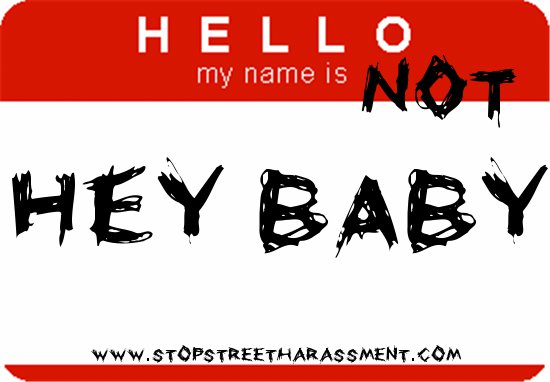
[storytime] These Streets Are Mine: On Street Harassment

I got sexually harassed today.

Actually, it happens all the time. Like, almost every time I venture out on the city streets for longer than ten minutes. It’s kinda like when you have to drive in the city and you can never find a good parking spot, or when you’re stuck behind a group of sluggish tourists on the street.

You know, annoying stuff that happens when you live in the city.

Except this is different. Because this only affects people who are (or appear to be) women, and because this is a conscious, purposeful attempt to make us feel unsafe and violated. It is not a compliment. It is not “boys being boys.” It is harassment.

This time, I’m on a dark El platform at 10 PM. I’d just been out with a friend and had a great time. I’m wearing a nice dress, same one I wore to work, not that it’s any of your business. An old man calls something to me from 10 yards away; I ignore him.

A few minutes later he ambles over, passes in front of me so close as to brush against me, and says, “Mhm.”

He stands on the other side of me until the train comes and gets into the same car as me. He doesn’t get a seat near me because there are too many people, but I see him looking over.

I slowly reach into my bag and pull out my pepper spray, letting it dangle from my fingers. And I look up with a face of stone, and he knows that I know what he did.

I am attractive. You can think I’m vain for saying that, but I don’t really care what you think. It’s hard not to know you’re attractive when you’ve been told from birth. My parents always say, “You’re so beautiful, you can get any guy you want if you just stop being in such a bad mood all the time.” They say, “Make sure you have a guy walk you home.” They say, “Try to find a job where your boss is a man. It’ll be easier that way.”

In the past, when I had friends who didn’t get it, they did it too. They thought I couldn’t possibly have any trouble in my love life. They thought I couldn’t possibly have a problem with the number on the scale.

Beauty carries a lot of privilege in our society–and, really, in any human society, although standards of beauty vary. But, unlike most kinds of societal privilege, this one comes at a cost. I’m not particularly interested in debating who has it worse, but suffice it to say that I would rather not have strange men brushing up against me when I’m trying to take the train home at night.

And no. I will not demand that my male friends take me home; that’s not their job. I will not dress in ugly, baggy clothing. I will not stop leaving my apartment in the evenings. I will not stop taking public transportation. I will not stop walking down these streets, because these streets are mine.

I’m not afraid. Not because I have no reason to be, but because I couldn’t keep living if I were. I can’t keep crossing the street every time I see a man. I can’t keep wincing visibly every time I hear their slurred come-ons. I can’t keep tugging at my clothes in front of the mirror, trying to figure out how to cover up what I never chose to have in the first place.

I’m not afraid. I’m angry.

A while back, the writer Norah Vincent dressed as a man for a year and a half and wrote about her experience. This is what she said about the first time she went out in drag:

I had lived in that neighbourhood for years, walking its streets, where men lurk outside of bodegas, on stoops and in doorways much of the day. As a woman, you couldn’t walk down those streets invisibly. You were an object of desire or at least semiprurient interest to the men who waited there, even if you weren’t pretty. But that night in drag, we walked by those same stoops and doorways and bodegas. We walked by those same groups of men. Only this time they didn’t stare. On the contrary, when they met my eyes they looked away immediately and concertedly, and never looked back. It was astounding, the difference, the respect they showed me by not looking at me, by purposely not staring.

They can choose to look away from women, too. But our society teaches them that women are there for their eyes.

There are things I can do. And I’m not talking about the “don’t go out alone” types of things. I find that anger deters these pathetic men more than anything else. They don’t want a woman who’s going to cause trouble, who’s going to whip around and snarl, hit, tell them to fuck off. They don’t want a woman sitting straight up, glaring, with a can of pepper spray ready in her hand.

Nine of out ten of them will stop at that.

As for the other one, well, I suppose that’s a risk I have to take if I’m going to fight for my right to walk down the fucking street.

Just like any man can do.

For more information: Hollaback and Stop Street Harassment

Why Do We Keep Talking About Akin and Not About Other Stuff?

I’ve noticed that every time a high-profile conservative says or does something stupid and it blows up in the media, some rank-and-file conservatives–in my Facebook newsfeed, elsewhere on the internet–have a very interesting response. They say something to the effect of this:

“Why are people talking about [insert stupid conservative here] so much more than about [insert Terrible Thing that also happened recently, such as a mass shooting]?”

They will ask if the former is “more important” than the latter, and wonder why people seem more willing to condemn a stupid politician than the perpetrator of a terrible act of violence. They will lament that the media seems to care more about bashing Republicans than about reporting “real news.” I saw this apples-and-oranges comparison being made between the Chick-Fil-A controversy and the Sikh temple shooting, and between Todd Akin and the FRC shooting.

This smacks to me of defensiveness and a certain type of persecution complex. What these people seem to be saying is this: “Yes, [high-profile conservative] said something stupid. But do you really have to talk about it so much? Why can’t you talk about this other important thing instead? Why can’t you just forget how stupid [high-profile conservative] is?”

There are a number of problems with this response:

1. Unless you’ve really done your research, you can’t really claim that the media is covering one subject more than another. Because how do you know? Many conservatives, I’ve noticed, seem to have a paranoid conviction that they are constantly being persecuted, denied their rights, and “attacked” by The Liberal Media (if you don’t believe me, go to the current affairs section of a bookstore and look at the titles of books written by prominent conservatives about the media). This means that their belief that certain subjects are being covered “more” in the media could simply be confirmation bias: you take note of all the news stories that deal with that subject and forget all the ones that deal with other subjects.

Now, I don’t mean to accuse conservatives of stupidity or of purposefully misrepresenting things. Confirmation bias is something we are all sometimes guilty of. But in this case, it might explain what’s going on.

2. “The Media” is not a monolith. What you see covered in it depends entirely on what media sources you’re consuming. For example, my Google Reader has a section called “News” and a section called “Social Justice.” (It also has many others, such as “Tech/Business,” “Science,” “Literature,” etc.) The “News” section is going to have more stories about mass shootings than about stupid things conservatives say about the female reproductive system. The “Social Justice” section will be the other way around–although it, too, will have many stories about mass shootings as they relate to societal inequality, the justice system, mental health, and so on.

Also, I have trouble believing that Fox News inadequately covered the FRC shooting and lent too much airtime to Todd Akin’s comments. I really, really have trouble believing that.

But in any case, I get a bit annoyed whenever I see anyone complaining about the mainstream media not covering adequately the issues that are important to them. If that’s the case, stop consuming mainstream media. Find the websites, blogs, magazines, and radio shows that provide the news you’re looking for and support them with your money. The “mainstream media” (whatever that even is these days) will gradually lose its clout.

That said, it could very well be that the media covers stuff like Todd Akin and Chick-Fil-A more than it covers mass shootings, and that’s not necessarily because of The Liberal Media.

Here are some reasons why that might be the case:

1. When there’s more disagreement on an issue, it gets talked about more. I think we can all agree that shootings are Bad, that shooters are violent criminals who should be brought to justice, that shootings should be prevented if possible, and so on. When people agree, there’s less to discuss.

(One caveat: people disagree very strongly on how to prevent shootings. If you somehow managed to miss all the recent discourse on mental health and violence, and on gun control, you’re living under a rock.)

But with something like the Chick-Fil-A controversy or Todd Akin’s comments, there’s a lot of room for disagreement. Half of this country believes that same-sex couples should be denied the right to marry, and nearly half believe that women should be denied the right to an abortion. Although not everyone in the latter group agrees with Akin’s ridiculous misunderstanding of human anatomy, many do. We have a lot to discuss, so the media jumps on board.

2. It is, after all, an election season. The Sikh temple shooter and the FRC shooter are not running for political office; Akin is. (Trust me, if Akin had a history of shooting up people he disagrees with, we’d be discussing him even more.) People want to know who to vote for, so media outlets cover candidates in detail.

3. Stories like Akin and Chick-Fil-A often contain much more nuance and relevant backstory than stories about mass shootings. When a mass shooting occurs, there are usually only three types of stories that you’ll see. There will be stories about what happened, what might have led the shooter to do what he did (usually membership in certain groups, mental health problems, etc.), and how to prevent future shootings (usually better mental healthcare and/or gun control). There may also be some stories about the victims of the shooting and how they’re coping.

With stories like Todd Akin, however, there’s just so much interesting and important material to dredge up. There were stories about the medieval origins of Akin’s beliefs, ways in which other politicians fail at science, reactions from other Republicans, about Akin’s “apology,” what happens if Akin drops out, idiots who defended him (pretty sure nobody defended the FRC shooter, by the way), other relevant crap that Akin has done, reactions from doctors, and, of course, what “legitimate rape” actually is (watch that video, it’s funny).

See? Lots to talk about.

In general, I consider the “but why aren’t we talking about this instead” response to be a bit dishonest. People are talking about the other thing, first of all. And second, no, we will not brush these “gaffes” under the rug. Political gaffes are generally those rare moments when a politician says what he/she really thinks, and as such, they’re extremely important.

Rape and Activism Are Not Mutually Exclusive: The Case Against Assange

It’s disturbing that the debate about Julian Assange and the rape charges against him has taken on such a black-and-white quality.

Either Assange did a terrible thing with WikiLeaks and ought to be tried for treason and is a vile rapist to boot, or WikiLeaks was an important and necessary project and Assange was right to publish the information and all those women accusing him of rape are lying bitches just doing it for attention/money.

Could it be that WikiLeaks is an important contribution to activism, but that Assange is also guilty of sexual assault?

I would say so.

According to the allegations against him, Assange had condomless sex with a woman after she insisted he use a condom, and he also had sex with her while she was asleep. The former is illegal under Swedish law*, and the latter is just obviously not consensual. You can’t consent if you’re asleep.

A British MP, however, disagrees:

Woman A met Julian Assange, invited him back to her flat, gave him dinner, went to bed with him, had consensual sex with him, claims that she woke up to him having sex with her again. This is something which can happen, you know. I mean, not everybody needs to be asked prior to each insertion.

First of all, congratulations to MP George Galloway for devising the most awkward and unsexy way to refer to penis-in-vagina intercourse.

Second, what he said is technically true. Not everybody needs to be asked prior to each “insertion.” But if they don’t need to be asked, that is something they must indicate to their partner in order for sex to be consensual. If someone says, “Hey, you can have sex with me while I’m asleep” (assuming they say it while sober and of their own free will), then they’ve consented to sex while they’re asleep. If they say, “Next time we have sex, I would like you to take control and do what you want without asking for my consent,” then they have consented to “nonconsensual” sex (although setting a safeword is a good idea). But if they haven’t said anything like that, then yes, you need to ask.

Sleep notwithstanding, consent is still a process (something that even Naomi Wolf, who describes herself as a feminist, does not understand). Even if you’ve had sex with someone five hundred times, you still need their consent before you have sex with them again. Even if they’ve had sex with half of New York City, you still need their consent before you have sex with them. Even if they’re your spouse, you still need their consent before you have sex with them. If you don’t obtain their consent and have sex with them anyway, you are raping them. Even if they choose not to accuse you of rape, you’re still raping them. This is not a difficult concept.

Even those who understand that this is rape may doubt that Assange actually did it. Perhaps people think that he’s too committed to his cause to be the sort of guy who rapes people. However, it’s pretty naive to assume that passionate activists who truly care about making the world a better place cannot also be abusive in their personal lives. (If that were the case, this important book would not have needed to be written.) People are complex and full of contradictions, and they can compartmentalize their lives in surprising ways. For example, last week’s shooting at the Family Research Council headquarters was carried out by someone who volunteered for LGBT causes. There is no group of human beings–activists, liberals, LGBT people, atheists, socialists, what have you–that does not contain immoral, abusive individuals.

Also, it really says something about our society when people are more willing to believe that a government (or several governments) tracked down a man’s sexual partners and paid them to lie that he raped them, than that a powerful man may also be a rapist. Can we just take a moment to acknowledge how ridiculous and conspiratorial that is?

And despite the constant hand-wringing over the supposed prevalence of false rape accusations, this, too, seems outlandish given the reality. What could possibly motivate a woman to put herself through the process of pressing charges (which is traumatic enough to have been termed the “second rape“), have her character and personal history eviscerated in the media, face retribution from the person she accused, and have her name associated with the scandal for the rest of her life?

While “tons of money” could be the answer, that explanation nonetheless fails Occam’s razor. Given how common sexual assault is, it seems much more likely that Assange really raped those women than that somebody offered them thousands of dollars to frame him.

It’s possible, though, that the charges against Assange are false–and I don’t think we should assume that he’s guilty until he’s been indicted. But the assumption that he’s innocent just because his innocence would serve our political goals is dangerous.

Laurie Penny writes brilliantly in the Independent:

Let’s be clear here: nobody should have to stifle one set of principles in order to allow another to live. If you choose to do so, that’s a matter for your conscience. For myself, I believe in freedom of speech, and in the power of journalism– it’s what I do for a living. I believe that governments need to be made to answer for pursuing profit in the name of peace and massacring thousands in the name of security. I believe in ending the age of secrecy, and I believe that the United States currently seeks to prevent that by pursuing and prosecuting hackers, whistleblowers and journalists across the world. And I also believe women.

I believe women when they say that their sexual consent is infringed, violently and by coercion, by men they trust and admire, as well as by strangers. I believe that rape and sexual violence are wilfully ignored and misunderstood by governments, except when they happen to be accusing radical transparency campaigners of assault. I believe that it is possible to believe women and to support WikiLeaks at the same time without moral hypocrisy, and I believe that those across the left who seem to have a problem with holding those two simple ideas in their heads at the same time need to ask themselves what accountability actually means.

Read the whole piece. It’s worth it.

And make no mistake–if Assange did what he is being accused of, that’s not just “something which can happen.” It’s not, as Galloway also put it, “bad sexual etiquette.” That’s sexual assault.

Or, you know, “legitimate rape.

*On having sex without a condom against your partner’s wishes: as I mentioned, this is illegal in Sweden, but I don’t know how it works in U.S. law (anybody know?). Legal issues notwithstanding, it can be terrifying and traumatic–not to mention dangerous to your health–if a partner refuses to use a barrier and goes ahead with sex even though you’ve made barrier use a precondition for sex. I’ve known people that this happened to, and they felt violated just as any other victim of sexual assault might. It’s not something to take lightly.