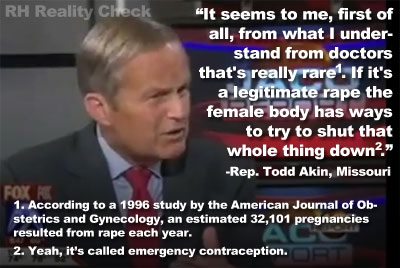
“Legitimate” Rape Does Cause Pregnancy

Credit: RHRealityCheck.org

…and so do all those other kinds of rape.

It amazes me what lengths pro-lifers will go to when trying to justify imposing their version of morality upon the rest of the country.

Senate nominee Todd Akin (R-AR) thinks that, even in the case of rape, abortion shouldn’t be necessary. Why?

“First of all, from what I understand from doctors [pregnancy from rape] is really rare,” Akin told KTVI-TV in an interview posted Sunday. “If it’s a legitimate rape, the female body has ways to try to shut that whole thing down.”

And if the female body fails to do its job?

“Let’s assume that maybe that didn’t work, or something,” Akin said. “I think there should be some punishment, but the punishment ought to be on the rapist and not attacking the child.”

So…a couple things here.

What is “legitimate rape”? Akin didn’t explain, but based on what I hear from those on his side of the aisle, I can assume that a “legitimate rape” goes something like this: a young woman is walking alone down a dark street, wearing jeans and a baggy sweatshirt. It’s not a dangerous neighborhood, because no woman would go to a dangerous neighborhood alone unless she wants to get raped. She is out because she has important things to take care of, not because she was out having fun or anything like that. She is attractive–but not too attractive–and thin, straight, and white, because fat women, queer women, and women of color can’t possibly be raped and/or should be happy if they are. She is a virgin, or at least has only had sex with her husband or with a serious boyfriend. She’s not that type of girl who sleeps around, that is.

Then a man literally jumps out of the bushes and rapes her without warning, even though she screams for help and tries to fight back.

That is a legitimate rape, and in this situation, her body would “shut down” her fertility, or something like that.

As for whether or not this epic pregnancy-avoidance mechanism actually exists, I haven’t seen any evidence for it in the scientific literature (which, by the way, is the only kind that matters here). And since Akin’s the one who brought it up, the burden of proof is on him. I’m not sure which “doctors” he’s been speaking with, but I wouldn’t be surprised if they happen to be barred from practicing medicine in several states.

To me, this points to a need for more and better sex education in schools–before kids grow up, get a degree in divinity, and make a career out of spouting this kind of rubbish and ruining people’s lives with it. Akin is far from the only pro-lifer to think that rape (excuse me, “legitimate” rape) can’t cause pregnancy, as this anti-abortion website proves. (I don’t want to bog down this post with lengthy quotes, but search that page for “sophisticated mix of hormones” and try not to laugh.)

So, moving on to Akin’s statement about what happens if “that didn’t work, or something.” Akin seems to view abortion as a punishment or an “attack” on the child for having the chutzpah to get conceived. It’s not. First of all, you can’t punish something that isn’t alive. Second, it’s interesting that Akin would apparently not consider forcing a living, conscious woman to continue a pregnancy that resulted from rape to be “punishment.” Sure seems like it to me! And, unfortunately, research shows that about 32,000 pregnancies result from rape each year.

Obviously, Akin has “apologized” for his statement. In his apology, he said that abortion “is a very emotionally charged issue” and that his statement “does not reflect the deep empathy I hold for the thousands of women who are raped and abused every year.” He then reconfirmed his pro-life stance, dissed on the Democrats for trying to expand the government in these trying economic times, and notably, said nothing about whether or not the female body can “shut down” pregnancy in the case of “legitimate rape.”

Akin’s comments about rape and pregnancy are laughable, but they should not merely be laughed at. For one thing, he is far from alone in holding this ludicrous belief, and his advocacy against reproductive rights does not end  here. Akin has also supported a complete ban on emergency contraception, and he cosponsored a bill that would’ve restricted funding for abortions to pregnancies that occurred as a result of “forcible” rape (you know, as opposed to the kind where she was asking for it).

Furthermore, as Ilyse Hogue points out at The Nation, comments like Akin’s can have significant political consequences. She notes that for the past few years, the Republicans have employed a strategy in which a politician voices an extreme far-right opinion and gets media coverage for it, allowing the opinion to percolate. Then, less extreme Republicans gradually adapt that stance and it becomes part of the Republican platform.

I would imagine that statements like these can also shift the goalposts in a slightly different way. When a far-right Republican makes such a statement, he/she often receives deserved opprobrium from both liberals and conservatives, and thus allows the more “reasonable” conservatives to reframe their own opinions as valid and acceptable. In this case, for instance, the more “reasonable” conservatives may denounce Akin’s statement and say something like, “Akin’s ridiculous; of course abortion should be legal in all cases of rape.” Key words: in all cases of rape. Not if the woman just doesn’t want to be pregnant. To moderates who lean conservative, then, this viewpoint now starts to seem much more reasonable, because it’s being compared with Akin’s.

Over at The AtlanticTa-Nehisi Coates has a great analysis of Akin’s comments using the concept of privilege:

I think what’s interesting here is the assumed power. I have the right to objectively define pregnancy from rape as rare. I have the right to determine separate legitimate rape from all those instances when you were in need of encouragement, wearing a red dress or otherwise asking for it. I have the right to manufacture scientific theories about your body — theories which reinforce my power. If the body doesn’t “shut that whole thing down” then clearly you weren’t raped, and there’s no need to talk about an abortion. And even if I am wrong on every count, I still have the right to dictate the terms of your body and the remaining days of your life.

In other words, Akin can literally tell you whether or not a woman was “legitimately” raped based on whether or not she gets pregnant. Not because of any scientific evidence, not because of anything the woman herself claimed or testified, but simply because that’s how he would like it to be.

He can do this despite the fact that he currently sits on the House Science and Technology Committee.

That, right there, is the punchline, which actually isn’t funny at all.

P.S. Sign the petition to have Akin removed from the science committee, and to stop lying about rape.
More responses:

Depression Personified

This is a work of fiction. Trigger warning for depression and abuse.

And again.

Everything starts to swirl in my mind again, tears pool in my eyes. Everything about me is shit–my writing, my activism, my appearance, my personality. I cry everywhere–in the office, in the bathroom, on the train, in bed.

Just yesterday I had been able to see clearly. Now that haze is back and everything turns to grey because of it.

He has me by the wrist now, his long nails digging into my skin and leaving red half-moons, just like I used to do.

He jerks my hand towards him, makes me caress his face with it. His eyes seem as black as his hair in that moment. They pop against the smooth porcelain of his skin, cold under my unwilling fingers.

His thin lips twist into an ironic smile.

“You thought we were done,” he says in a low, throaty voice.

I don’t deny it.

“You told all your friends how happy you were to be through with me.”

Can’t deny that either.

He grabs me by the shoulders and pulls me in, putting both hands on my face and tilting it towards his. If you ignore my facial expression it would probably look romantic. But don’t be fooled.

When I’m with him I feel as black as his eyes. I see myself reflected in them. Looking into them is like looking into a cave or an abyss–you don’t know where they end.

I could probably wriggle out of his grip if I tried hard enough. He’s not even holding me that tightly. But I can’t find the will, and he knows.

His eyes narrow and I know he’s not done.

“Here’s the thing.”

I let out a sigh and try to look away, but he’s still holding my face in his hands, stronger than I thought.

“I decide when we’re through. Not you. Because I own you.”

I can never quite believe that someone so beautiful could be so cruel.

“I can come back for you whenever I want. I’ve been choosing not to because I thought you needed a little break. So let this be your reminder.”

He runs one hand through my hair, gathering it up into his fist. He tugs on it, not enough to hurt, but enough to keep me still. We stare each other down–him with his calmly brutal black eyes, me with my terrified, wet hazel ones.

Then suddenly he pulls me into an embrace that feels almost real, if not for its coldness. I’m taken aback. It’s one of the only times he’s shown me anything resembling care. Or love.

I keep shivering long after he’s gone, but gradually the fire relights in my heart.

Some people have real problems.

Occasional Link Roundup

This is my occasional link roundup, in which I occasionally post links to things I like. Feel free to link to something you’ve written recently in the comments!

1. Ever wondered what the manic phase of bipolar disorder feels like? Read this.

2. Attachment parenting might be harmful to mothers’ mental health. It always gave me a weird feeling. “What is especially sad is that self-evident things like ‘mothers are human beings,’ ‘having a life outside of child-rearing is necessary for maternal well-being,’ ‘there is nothing that makes a mother a more capable parent than a father’ still need to be proven by research.”

3. So, a bunch of crap went down in the atheist blogosphere this past week–or at least, in my corner of it. A lot of people seem to disagree that a concern for social justice has any place within atheism. My friend Andrew has this take on it, and another atheist blogger, Zach, wrote this: “I want a new atheist movement that actually cares about people. An atheist movement that will look at the way religion poisons our views on gender, race, or sexuality and actively tries to combat that. I want an atheist movement that will reach out help other people, regardless of their race, gender, sexuality, ability, education, wealth, visibility, or even religion.”

4. And speaking of the atheist movement, here’s an example of racism within it.

5. A great post about misconceptions about demisexuality. I’ve wanted to write about this for a while, but it seems like few things bring out nasty comments quite like this subject does.

6. An analysis of the media’s portrayal of Jennifer Aniston as perpetually pitiful. Never really thought about this before, but it’s fascinating.

7. A takedown of one man’s sexist blog post, in which he obsesses about an Australian Olympic athlete because she’s so “sweet” and “feminine”–you know, unlike the rest of us bitches. I’m not linking to the original piece because I don’t want to give him pageviews, but this post quotes heavily.

8. What anti-feminists don’t understand. “Then one day, women stopped telling men what they wanted to hear. They asked what they were without us – or, at least, without our definitions. Men never stopped to ask the same thing, and when they sort-of did, they returned too readily to rhetoric of supremacy and strength. Anti-feminists are so caught up in being the victim that they never consider positive identity formation to be a goal, or even a possibility.”

9. And, on a similar note, what people who call themselves “equalists” don’t understand. “As for the “equalists”, if they truly wanted to take a neutral stance on the gender roles, they could start by not always attacking feminists – while, at the same time, rushing towards the defence of the men’s rights movement.”

10. Kids who sleep later do better in school, but schools don’t seem to be interested in addressing this.

11. Mara Glatzel, a blogger I admire, on why she writes.

12. Why it matters that we now have our first out pansexual politician.

13. A really touching post about sexual assault, friendship, and recovery. TW.

14. And on a similar note, post of the week goes to my friend Cassy, who wrote this heartbreaking four-part narrative about her experiences with sexual assault, abuse, mental illness, and recovery. Huge trigger warning on this, so please watch out. But if you can, read it.

~~~

Like Brute Reason on Facebook!

Public Breastfeeding Should Not Be a Big Deal

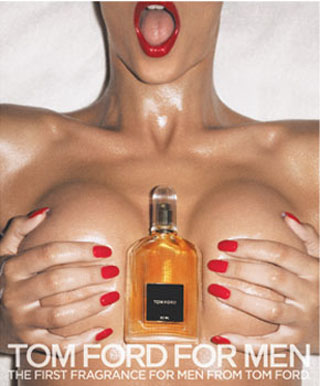
Something’s wrong with our culture if this is appropriate in public, but breastfeeding is not.

Breastfeeding has been somewhat of a hot topic lately. On one hand, mothers’ decision to breastfeed or not has been subject to intense moralizing and even actual regulation, which is creepy.

On the other hand, public breastfeeding has been under attack, too. Facebook disables/deletes accounts of people who post photos of themselves breastfeeding. Mothers lose their jobs and get kicked out of public places because of it. This spring, people were actually debating whether or not mothers in the military should breastfeed while in uniform.

Every time, the justification is that breastfeeding constitutes “indecent exposure” (or even pedophilia, depending on who’s doing the breastfeeding). The protest “There are children here!” gets thrown around a lot, which is ironic given that what’s at stake is the fact that infants need to be fed, and pretty often at that. But no, what matters more is that women’s breasts are presumed to be sexual, whether women themselves see them that way or not.

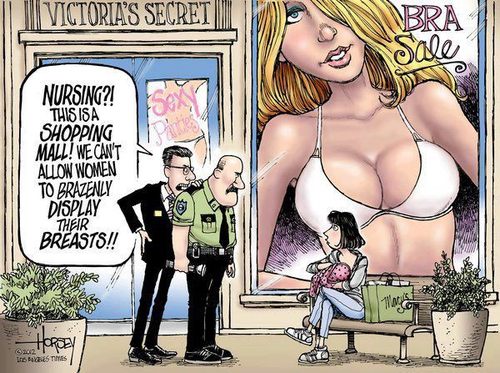
This cartoon summarizes my thoughts on the issue:

The reality is that breasts are everywhere in our public spaces. They’re used to advertise not just bras, but vegetable oil, men’s cologne, french fries, and TV shows. Beaches and swimming pools, which are always full of children, are also full of women in bikinis. And no matter where you go in the U.S., aside from perhaps certain parts of Brooklyn, you’re going to see women in low-cut shirts.

And yet, breastfeeding in public remains controversial. Why?

First of all, it seems that our culture has decided–somewhat arbitrarily–that the only “indecent” parts of the breast are the areola and nipple. Although those are the most sensitive parts, this nevertheless seems strange to me. People who find breasts attractive and arousing aren’t just attracted to their areolas and nipples. To say that those are the only “indecent” parts would be like saying that women should be free to walk around with their labia showing, but not their clitoris or vagina. What?! (But of course, vaginas and clitorises are much easier to hide.)

Besides, when a mother nurses an infant, you can’t see anything that you don’t see in all those ads and at the beach, except for that brief moment when she’s first taking her breast out (or “whipping” it out, as the hand-wringers love to say, in total defiance of human anatomy). All this fuss for a few seconds during which someone might possibly see a nipple?

What’s perhaps more to the point is that our culture has decided that breasts are always inherently sexual, no matter what they’re being used for. They are always sexual, and in a different way than, say, a man’s beautifully toned pectoral muscles–which can be displayed in virtually any public setting even without cries of “There are children here!”–even though there’s no infant depending upon them for survival.

The reason I say that “our culture” has decided that breasts are sexual is because there are other cultures that haven’t. Even a cursory glance through a National Geographic magazine will show you that many people around the world think that naked breasts are no big deal. Women walk around topless and life goes on. Even in Europe, topless sunbathing is normal, and the children there grow up just fine, without being traumatized by the sight of boobs.

(And, on the flip side, some cultures sexualize things that we would never think of sexually, such as hair.)

But regardless, we’ve created a culture in which breasts are sexual. Now what?

Well, now we ask ourselves what’s more important–mothers’ need to feed their infants quickly and easily, or children growing up without ever seeing naked breasts. Since I’ve yet to see any evidence for the latter being harmful, I think we should prioritize the former.

What’s ironic is that when breasts are on display for the purpose of advertising or enhancing women’s sex appeal, that’s okay. But when they’re on display for a clearly nonsexual purpose, such as providing sustenance for an infant, then it’s suddenly “inappropriate,” and won’t anybody think of the children.

Right now, we have ourselves a dilemma. Women are being commanded by doctors and politicians to breastfeed rather than use formula. And yet, the United States is one of the only countries in the world that provides no guaranteed maternity leave. There’s no government-sponsored daycare, either, and funding for childcare subsidies is being cut left and right. This leaves many mothers with few options other than breastfeeding their babies, often in public.

But we wring our hands over how “indecent” and “sexual” this basic human act is.

Why Being Pro-Gay is More Than Just a Smart Business Move

Last Tuesday, Equally Wed magazine held a National Starbucks Appreciation Day and encouraged people to go to Starbucks to show support for their pro-gay rights stance. The event was a response to Chick-Fil-A Appreciation Day, in which droves of people went to Chick-Fil-A to celebrate their right to deny others their rights. The magazine later renamed it “National Marriage Equality Day” and invited other gay-friendly companies to participate.

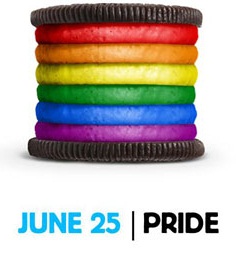
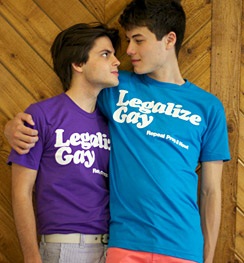
Starbucks established itself as a company that supports marriage equality earlier this year when its Executive Vice President, Karen Holmes, released a statement on behalf of the company in support of gay rights legislation in Washington state, where it’s headquartered. But it’s far from alone in taking a public stand for gay rights. For example, the Oreo cookie’s official Facebook page made news by posting this photo back in June. American Apparel–hardly a bastion of ethics otherwise–carries a “Legalize Gay” shirt. Companies frequently march in gay pride parades. And so on.

Gay rights are obviously an emotional issue for many people (myself included), and I’ve seen some very different responses to this trend of companies coming out in support of gay rights. Some people get very excited and enthusiastic about supporting these companies in return, and take this to mean that the leadership of these companies is strongly invested in gay rights. Others are extremely cynical and claim that it’s all just a business ploy and means nothing.

I think that, as it often does, the reality lies somewhere between these two extremes. Businesses never do anything–especially not anything that requires them to spend money–solely out of the goodness of their hearts (hell, businesses aren’t people, so they don’t even have hearts). But that doesn’t mean that businesspeople don’t genuinely care about certain issues and want to use their position as leaders to advance those issues.

First of all, many companies literally put their money where their mouth is when it comes to being pro-gay. They don’t merely post a picture on Facebook or sell a pro-gay t-shirt; they combine their ideological stance with tangible action. Starbucks, for instance, provides same-sex partner benefits to its employees, meaning that an employee’s partner can use their health insurance. (Pretty cool that Starbucks provides insurance even for part-time employees, too.)

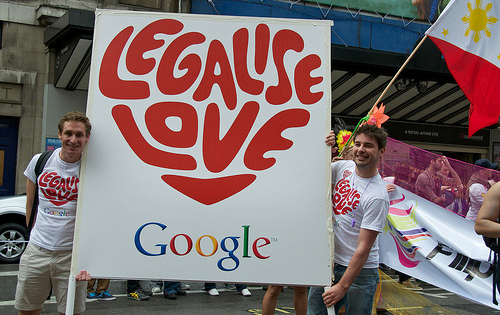
Google, meanwhile, not only provides same-sex partner benefits, but even compensates its gay and lesbian employees for a tax on partner benefits that heterosexual couples do not have to pay. It also launched a campaign called “Legalize Love,” which will work to combat workplace discrimination in countries with anti-gay laws on the books.

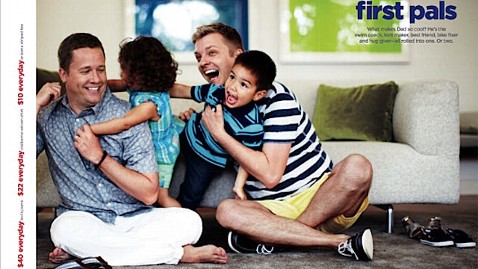
Aside from partnering with one of the most well-known queer people in the country, JCPenney has recently run ads in its catalogs that feature same-sex parents. What’s more, they did this soon after One Million Moms ran a highly-publicized boycott against them for hiring Ellen Degeneres as a spokeswoman–kind of like an extra fuck-you.

People who know more about marketing than I do seem to agree that being pro-gay is good for business. Furthermore, a study shows that even internal policies–as opposed to public actions like these–helps businesses, at least according to the businesses themselves.

Credit: lightfran/Flickr

But what’s more important, at least to me, is that these smart business moves are also helpful to LGBT people. Even the symbolic gestures that some companies make–such as Oreo’s Facebook picture–can make a difference. If even one LGBT person comes across them on their newsfeed and feels like the world is a bit less shitty, I would consider that a good deed done.

A lot of the cynical pushback against this comes down to the mistaken assumption that there is such a thing as “true” altruism. Hypothetically, true altruism is when the person doing the altruistic act derives absolutely no benefit from it–no financial gain, no social capital, no personal sense of worth and value. The latter is, of course, an inescapable aspect of doing good things for people–doing good feels good and everyone knows that. And yet you still see people claiming that altruism is ultimately “selfish” because it feels good.

So, either there is no such thing as altruism, or our concept of “selfishness” needs to be redefined. In their support of gay rights, these companies are being “selfish” in the sense that they’re serving a few of their own interests, but they’re also being altruistic in that they’re taking up an issue they don’t have to take up–nobody asked them to do it, and a lot of good may come of it.

Finally, trends in business can be a barometer of public opinion. The reason all these companies are suddenly “jumping on the bandwagon” (as a cynic would say) and openly supporting gay rights is because they can. In prior decades, companies that lobbied for gay marriage rights or published pro-gay opinions would probably have been run out of business–or at least seen their profits severely decrease.

But today, being pro-gay is good for business. I think that’s something to celebrate.