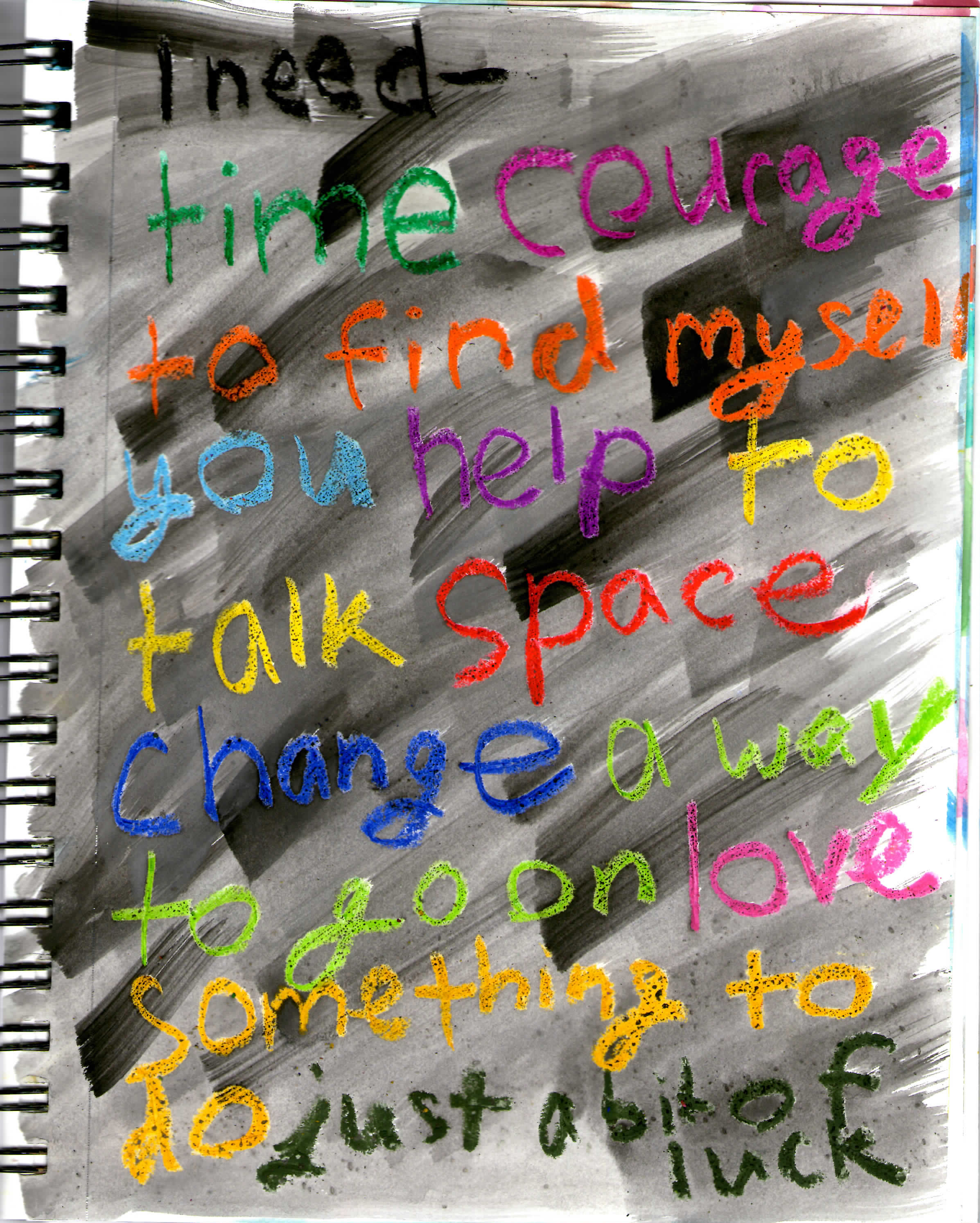
The College Story

See, I'm not the only one.

I wish I could spin you the story everyone wants to hear.

That story has a whole cast of predictable characters, and many trunks’ worth of familiar props. The friends, the neat dorm rooms, the beer, the photo collages, the inside jokes, the cute frat guys, the walks by the lake, the hot chocolate, the study sessions, the mentoring professors, the sorority mixers, the coffee dates, the giggly all-nighters, the risque one-night-stands and the whispered confessions to friends in class the next day.

Sound familiar? That’s the College Story. You’ve seen it in every glossy brochure, TV show, Seventeen magazine article, and back-to-school commercial.

But that’s not my story. It never will be. Because the kind of person I am doesn’t get to live that story.

Halfway through my college career, it’s time to admit this to myself.

My story? Sure, it has some bright moments in it. Most stories do, and mine hasn’t been that awful. But then there’s all the stuff nobody wants me to talk about–the weather, the loneliness, the way guys at Northwestern treat me (to be precise, like a thing), the rich, preppy students that I’ll never resemble, the hours spent laboring over essays that professors barely even read (and then unceremoniously slap a B on without further explanation), the expectation to be a walking, talking, drinking/fucking/studying machine, the not-so-subtle bragging NU teaches us to perform, the bottles of anti-depressants lined up on my shelf, the many nights I spent considering transferring, asking for a quarter off, dropping out of college, or dropping out of life.

I played with my little sister today. I do that every day when I’m home, but today it was different because I was acutely aware of the fact that I’m leaving again in five days. I hugged her and my heart broke all over again. I hate that I’m not here to see her and my brother grow up. I hate that nobody at Northwestern loves me the way these two do. I hate that my little brother took one of my blankets to sleep with because he misses me while I’m at school. It all feels so wrong to me.

I’ll feel better once I’m actually there, I know that. Despite what it may look like, making the best of things is a skill of mine. Once I’m there, it’ll be easier to make myself forget the loving family I’ve left back in Ohio and to pretend that home isn’t where I’d always rather be. Sometimes I’m even able to get myself to believe that I somehow matter at this huge institution of higher learning and that it, or at the very least, the lives of some of the other people in it, would be noticeably different if I had never existed.

The truth is that I’m paying $200,000 and a lot of my own sanity for a stupid piece of paper saying that I’m qualified to go get a PhD and actually learn something relevant to my life, because all I’ve learned these past two years is how to act smarter, richer, and more well-adjusted than I actually am. Call me an idealist, but I hoped that college would be more than this.

I’m compelled to apologize for this. To apologize for hating college, because it goes against everything our culture dictates that I do. I’m supposed to love it.

Well, I’m sorry. I wish I could tell you that I do.

An Indictment of Party Pop

Just when you thought I was finally done writing about alcohol and partying, here I go with yet another post about it!

Before I start talking about party pop, though, I need to clarify what exactly I’m talking about, because apparently some people still don’t get it. Every once in a while someone who doesn’t know me too well says something like “OMG I READ YOUR BLOG AND I GUESS YOU HATE FUN HAHA.” Um no.

So let me explain. I do not hate alcohol. I do not hate parties. I do not hate fun. I do not hate people who drink and party, except when they’re infringing on my personal space. What I hate is something I call “party culture,” which, by my definition, contains the following components:

  • the belief, prevalent among people of all ages, that partying is the one and only acceptable way for young people to spend their free time and socialize
  • the glorification and normalization of binge drinking (formally defined as drinking five or more drinks in a row, but I also use it generally to refer to drinking in a way that jeopardizes one’s health and safety)
  • the use of alcohol as a means to coerce women and excuse sexual assault
  • the idea that people who choose not to party are deficient in some way
  • pressuring people to drink and party (This is truly unique in college. I was never pressured to join clubs, go to football games, explore Chicago, attend dorm events, or do any other social activity quite like I was pressured to party.)
  • the belief that alcohol is something people “need” in order to relax, talk to people, hook up, have fun, etc.
So there’s party culture for you. As for party pop, I read a piece about it in this summer’s issue of Bitch magazine. The piece was actually a really interesting analysis of the changes that this sort of music has gone through; whereas drunk girls in pop culture used to exist basically as a spectacle for men’s benefit, more recently they seem to be partying for themselves (the article mentions Ke$ha and Katy Perry as examples). Anyway, you’d really have to read the whole article to see all of the points it makes, but that’s the gist of it, and the author sees this as a positive development–female empowerment and blahblah.
However, where the article falls short is that it still seems to present party pop as a symbol of rebellion:
Today’s party-girl pop continues down the avenue of non-explicitly politicized, pleasure-focused rebellion against gender norms carved out by flappers and disco divas.
And:
[Party-girl pop] is valuable in its large-scale reflection of changing the meaning of pleasure and autonomy among young women, both to create a culture for girls themselves and to give older people a peek into these changing mores.
Here’s the thing, though. Whereas the music from which party pop presumably draws inspiration, such as the Beastie Boys’ “(You Gotta) Fight for Your Right (To Party!),” was actually made a time when partying was considered a subversive thing for people (especially women) to do, we’ve come quite a ways since then. Party culture has become normative. It’s not partying, rather than partying, that now draws judgment and scorn. Trust me, I’d know.

The truth is, even my socially conservative parents and their white middle-class friends think that partying is just what the kids do these days. For some reason, though, the party lifestyle continues to hold this impenetrable veneer of revolutionary coolness.

When I listen to music that glorifies party culture and hear people ranting about how rebellious and groundbreaking and cool it is, I imagine someone making music about how awesome it is not to live on a farm or to be able to live past age 50. Like, okay, cool, but I thought we were over that by now.

Maybe what we should be talking about instead is the fact that party pop contributes to a culture in which alcohol is viewed as the one and only means to having a worthwhile and enjoyable life, and partying is seen as something “everyone” does. And I’m not even making random unbased claims here: studies have shown that college students overestimate how much their peers drink, and that the more they think others drink, the more they drink themselves. That’s why, when I went through training to be an RA at Northwestern, we were told to provide our residents with the results of surveys done at NU that showed how much students actually drink. Because when you think that everybody is just constantly going out and knocking back six vodkas in a night, you’re more likely to try to do that, too.

Furthermore, I disagree with the Bitch article’s assertion that party pop is helping to redefine gender roles for women. The line of argument here is that because these women party for their own pleasure, they are paving the way for our culture to accept women as autonomous and equal to men. I don’t think it really works that way, though. I think that now, rather than having one function–pleasing men–women have two functions–pleasing men and getting shitfaced. I don’t see how this helps society recognize the right of women to hold positions of power, contribute to scientific research, control their own reproductive health, or generally do much of anything that doesn’t involve getting intimate with a toilet bowl at the end of the night. (As for the shitshow that consists of male-created party pop, I’m not even going to get into that now.)

The very artists that the author of the article considers pioneers in this regard have other songs (which the author conveniently ignored) that completely contradict the supposedly revolutionary message. For instance, here are some lyrics from a recent song by Katy Perry:

Kiss me, ki-ki-kiss me
Infect me with your love and
Fill me with your poison
Take me, ta-ta-take me
Wanna be a victim
Ready for abduction
That’s empowering, alright. As for Ke$ha:
I don’t care what people say
The rush is worth the price I pay
I get so high when you’re with me
But crash and crave you when you are away
Pardon my skepticism, but I really fail to see how this music is promoting women’s autonomy. What I do see, though, is that it promotes the dangerous party culture that has infected basically every college campus–and JUST A REMINDER, by “party culture” I mean the stuff listed with bullet points above. I’m not saying this music is inherently “bad” or that we shouldn’t listen to it (that would not only be a specious argument, but it would also be a hypocritical one since I listen to a lot of this stuff myself). I do think, though, that we should make a big-ass pause before we start painting it with Beastie Boys-esque shades of rebelliousness.
Pop music, and pop culture in general, is the pulse of our society and its values. I think that if we listen closely to it, we can discern the pressures and expectations that people face from the world around them. And right now, pop music is saying that partying is the epitome of what young people should do with their lives. I think that’s an unfortunately narrow-minded view.
So if you’re too school for cool,
And you’re treated like a fool,
You can choose to let it go
We can always, we can always
Party on our own
–P!nk, “Raise Your Glass”

The Art of Looking Good

When I’m applying for jobs or scholarships, I’m often reminded to twist the wording on my resumes, cover letters, and applications (not even to mention interviews) to make myself and my experiences look better than they actually are.

I’ve never really stopped to think about how this makes me feel, but I’ll do so now.

Lying is unethical, in my opinion. So is intentionally misrepresenting the truth, which is what you do when you “word things differently,” as they say. I’ve just realized how shameful it is in my mind that being employable and successful in our society is based on our ability to paint ourselves in brighter hues than we really deserve to be painted in.

This summer, I’ll be volunteering at a summer camp for kids in Washington Heights, a neighborhood in Manhattan, where I’ll probably be doing stuff like arts and crafts with them. The idea of the camp is to promote health and mental wellness, though I don’t see how that’s really what I’m doing. I’ll basically be playing games with some kids from the city. But how will it go on my resume? “Volunteered at a day camp for underprivileged children of recent immigrants in north Manhattan, teaching them about health and mental wellness.”

Yeah, something like that.

And I’ll probably mention something about how I turned down a job that would’ve paid me $2,600 for this opportunity.

And here’s the kicker—nobody’s going to ask me what I actually did with these kids. Nobody’s going to go check five or ten years down the line to see if any of my interventions actually did any good in preventing them from developing illnesses like diabetes and depression. Nobody’s going to ask these kids if they enjoyed their time with me. Chances are, nobody’s even going to ask for a recommendation from my supervisor.

But I still get to put this crap on my resume like it’s such an amazing thing that I did. Me, privileged white girl from Ohio, helping these poor little immigrant children learn how to stay healthy, all for no pay. Commuting an hour there and back each day from Queens! In the summer heat! Oh, and working for my parents for a whole month after that to pay them back for sending me there.

This is what I call the art of looking good. It’s how we get into schools like Northwestern and get the sort of jobs that we’ll all be getting afterwards. Playing this game makes me sick. The thought that I, a person who loves to write and understands the power of words, am twisting them around so casually to get ahead in life, disgusts me.

I’m not naive enough to opt out of this game, because I do want to be successful in life, and clearly that’s what it takes these days. But I play this game halfheartedly, and I protest against it and buckle under its weight every agonizing step of the way.

I wish I could’ve written on my college application that, you know what, the prestigious internship I did in Israel the summer before senior year of high school was awful. I learned nothing except that I hate doing scientific research and I hate religion. I also learned that the sacrifices I made to be able to go there were all for nothing. I didn’t make any friends there. I did learn a bit about my native country, but not much, and nothing I couldn’t have learned by touring the country with my dad, which would’ve been significantly more fun.

But that’s not at all what I wrote on my college application, or else I very well might not be sitting in this Northwestern dorm right now.

Nobody wants to hear about my failures, no matter how much they taught me. Like when they ask you about your weaknesses in a job interview, they don’t really want to know that sometimes the amount of work you have makes you cry, or that sometimes you check Facebook at work, or that several times you accidentally made a comment to a coworker that might be interpreted as racist. They want to know that you have some minuscule barely-significant flaw, but don’t worry, you’re working on it!

Likewise, if I end this summer feeling like I accomplished nothing with these kids, nobody wants to know that, so that’s not what’ll go on my resume. My resume will say that I taught. I helped. I volunteered. Never, ever will it say that I failed. Even if I do.

Some Thoughts on Depression

[TMI Warning]

About five months ago, I wrote a post on Facebook (and on this blog) about my experience with depression and how I came to receive treatment for it. I remember feeling very triumphant as I wrote it, because I felt like my difficulties were finally over.

This turned out to not exactly be the case.

In January, perhaps precipitated by some unfortunate personal circumstances, I relapsed and have been trying, mostly unsuccessfully, to recover ever since. The months since then have been filled with a lot of self-loathing, many random bouts of crying (daily at times), and much speculation on my part as to whether or not I really belong in this world.

This is when I realized that my problems, whatever they may be, don’t simply go away when I’m not depressed. I don’t “invent” the issues that I’m unhappy about. But being healthy makes it easier to ignore the pain in the back of my mind–all the wasted opportunities, lost friends, and scarring memories that have built up over the years like dust on a windowpane. When I’m healthy, I simply don’t think about it, and consequently I’m happier. But the mockery that I’ve made of my life isn’t a figment of my imagination; it’s quite real.

~~~

I also started to realize, perhaps even more than I did when I wrote that post, how little the healthy world knows about depression. Mental illness is truly the last taboo; many people refuse to even consider dating someone who has it. Kinda makes me reconsider being so open about my experience…

Even people who would otherwise be supportive just don’t know enough. For instance, if you know your friend is a diabetic, would you offer her a piece of cake? Probably not. But would you casually make fun of your depressed friend? Unfortunately, many people would, even though teasing and jokes are things that many depressives have a lot of trouble with. (This is because depression often causes a cognitive deficit that makes people take everything–a snappy tone of voice, an odd glance, a sarcastic remark–very personally. Here’s a great guide to cognitive distortions.) I am always analyzing and picking apart things that people say to me to try to figure out if they were just teasing or not. I am terrified of the threat of rejection that these casual utterances may carry, so I am always alert, always on my best behavior.

~~~

Another thing I’m never sure of is which parts of me are depression and which are simply me. I’m a skeptic, a cynic, and generally not too big a fan of things that most people seem to really like (Exhibit A: this). I don’t fit in with my surroundings in many ways. I’m more complex, polite, caring, respectful, quiet, conscientious, serious, passionate, emotional, and sensitive than most. I’m less assertive, flaky, impulsive, cheerful, “chill,” and casual than most. This makes for a great number of personality differences between myself and most people I know. When I’m not feeling depressed, these differences fade into the back of my mind. But when I am, they come right to the front, putting up a wall between me and the rest of the world, making me feel like I’ll be an outcast for life.

~~~

One more realization–Northwestern might be the worst place in the world to be depressed. (Not that there’s really a good place for that, except perhaps the psychiatric ward of a hospital.) It’s isolating, stressful, and miserably cold from October till May. Your peers churn industriously around you like a hive of North Face-clad bumblebees while you vegetate listlessly in your shitty shoebox room and email professors, friends, student group leaders one by one and tell them that you’ve been ill and cannot come to whatever crap you’re supposed to be at that day. You eat Nutella from the jar and wonder why none of your friends care. You wonder why you expect them to care. You sleep, a lot.

Northwestern also happens to have entirely inadequate mental health services, but that’s a topic for another post. My friends and I are working to change that. But for now, this is a really, really unfortunate place to be depressed.

~~~

And that’s it, really. I’m not entirely sure where I’m going now, but hopefully it’s somewhere good.

Dillo Day: Not For Me

This just says it all, no?

[TMI Warning]

Today is Dillo Day, a Northwestern tradition that dates to 1972. It’s a music festival that happens each year on the Saturday of Memorial Day weekend. We get to see several musicians, including some very well-known ones (B.o.B. this year) for free.

Of course, because Northwestern is a college, it is only natural that Dillo Day is more known for being a drunken shitshow than a music festival. The drinking often starts before noon (or even on Friday night) and continues till everyone is semi-conscious in the wee hours of Sunday morning. Actually enjoying the music is nearly impossible, unless you also happen to enjoy being hit on and groped, pushed and stepped on, and presented with some great views of people making out or having sex in public.

And now I’ll make a confession. I find drunkenness, and drunk people, disgusting. It’s not that I merely find drunk people annoying and inconvenient. I find them, and their lifestyle choices, repulsive. I don’t understand why the hell you would want to end your night getting intimate with a toilet bowl, or why you would want to be too far gone to even remember some of the supposed “best” days of your life.

My issue isn’t so much with the alcohol itself, though my relationship with alcohol has always been sort of hard to explain. My parents are social drinkers; they can hold their alcohol well and rarely get drunk. When they do, they’re louder, more social, quicker to laugh. In other words, they’re more fun. I’ve never actually seen them get very drunk, although one summer my dad went to Israel without us to see his friends and apparently had quite a bit to drink one day. It happened to be the same day that our fridge broke down, and my mom, completely clueless in terms of household appliances, called my dad long-distance and hysterically explained the situation, her fears regarding the baby formula going bad, and so on. My dad’s response was, apparently, a hearty “I don’t give a fuck!” and a dial tone.

And that was the worst of it. I’ve never seen my parents stagger, throw up, or hand their car keys over. I’ve never seen them down multiple shots in a row. (In fact, the only time they drink vodka is at dinner parties with friends, when every shot taken comes with a toast of some sort of emotional significance. Meaningless drinking this is not.)

Consequently, my own experience with drinking has been quite different from that of most people my age. I enjoy wine, mixed drinks, flavored vodka, and champagne. I like to drink wine with my parents over dinner and I can’t imagine New Year’s Eve without champagne. I like to be a bit tipsy, enough to make things a bit cheerier, and myself a bit more bubbly. But I have never been drunk, and I don’t plan on it. (In fact, I was furious a few weeks ago when a friend of mine suggested, laughing, that my friends will “make” me get drunk on my 21st birthday. Excuse me? Nobody can “make” me put anything in my body that I don’t want to put there. Any friend who tries to force anything on my body, be it sex or drugs or alcohol or a piercing or what have you, is no friend of mine after that.)

Last night, thinking about the shitshow that today would inevitably be, I found myself wishing that I were normal, that I could have fun in the way that everyone else can. I wished I wanted to do what they do. But I’ve never been that person. I’ve always been serious and I’ve always preferred to be completely in control of myself at all times. My disdain for drinking to excess is as natural a part of me as my preference for Pepsi over Coke, or the fact that I like to sleep on my stomach and not on my back. How do you change these things?

There are no words to describe such a feeling of isolation, which is one of many reasons I don’t talk about it often. I never fails to shock me how easily I’ve accepted everything else “abnormal” about me–my diagnosis of depression, my bisexuality, my foreignness–but I cannot accept this.

And most of all, I just want to understand. I complain about these things and my friends tell me with a shrug, “That’s just how people are.” But why? Why take an opportunity like an all-day free music festival and turn it into a drunken mess you’ll barely remember afterwards? I even understand drinking and partying when you’re bored, but why on a day like this one? Why is this desire as natural for them as my aversion to it is for me? I want to understand this in a sociological and psychological sense. But I don’t.

I sound like a boring, prissy goody-goody with a stick up my ass. I know I do. But the funny thing is, I’m really not. When I’m in a genuinely good mood, which, thanks in part to my shitty environment, is not often, I’m always laughing and making jokes. I love dancing and trying to sing, exploring Chicago with friends, and frequently acting like an idiot. I’m known to occasionally skip class and go tanning on the beach, and to write my papers the night before they’re due because I was too busy hanging out with friends before. I love fun. But I hate partying. The two aren’t one and the same, you know.

So there you have it. Dillo Day is a disgusting boozefest, and it’s not for me. I guess that makes me an outsider as long as I’m at college (and possibly for quite a while longer). I don’t understand why, as a culture, we are fixated on the idea that people should be moronic and depraved until they turn 30.  I want to know why our society believes that being an idiot in your 20s is some sort of prerequisite to having a happy, successful, and meaningful life–and why everyone thinks I’ll “regret it” if I don’t follow this path. I want to know why college students are required as if by law to drink and party and smoke pot and have a lot of casual sex (another thing I really don’t enjoy), or else they’re boring and “lame.”

I’m fucking tired of being judged. It makes me really angry. Stop.