
Feminism is Choice

A friend sent me a link to this piece in the Huffington Post titled “Tough Gals: Do They Still Exist?” The piece is a jeremiad against the supposed “girliness” of today’s women and how we’ve all apparently abandoned the precedent set by our tough, bitchy, bra-burning feminist foremothers:

Women are girly. Again.

Don’t believe me? The proof is in the blogosphere: Women who blog about cupcakes! Women who blog (okay, rant) about gardeningHello Kitty, and knitting! Even BUST magazine is sponsoring a Craft Fair in NYC. Women who blog about cats! And then there are cats who blog, but let’s not get into that just now. Don’t get me wrong, these are all lovely blogs, smart and entertaining. And some blogs, like the wonderful Jezebel, keep us on our toes pointing out what a long way we haven’t come, baby (like in this piece on how female superheroes are sexualized). But.. seriously… cupcakes?

To be frank, this article is so stupid that I was almost reluctant to even respond to it. (My first reaction was, who pays someone to write this shit? And then I remembered that HuffPo doesn’t pay.) Really, there’s so much wrong with it–a false dichotomy (be a feminist OR be feminine), the judgment of lifestyles that differ from the author’s, the assumption that there’s only one way to “do” feminism, and not to mention some good ol’ misogyny–that is, the idea that women are only worth the air they breathe as long as they act like men.

I could respond to this with abundant examples from my own life–the fact that I actually (shocker) enjoy cooking, cleaning, and doing my hair, the fact that some of my best memories are of taking care of my younger siblings, the fact that I knit, crochet, and sew, and…I am still a feminist. Don’t believe me? Take a look at my love life. I can barely date anymore because most men I meet piss me the hell off with their sexism.

So yeah, I could use myself (and my friends) as a counterexample easily enough, but I’m not even gonna go into detail about that because it’s unnecessary. The larger problem with this article isn’t that it doesn’t even begin to describe any of the women I know, it’s that it doesn’t even begin to describe the feminism that I know.

Feminism was (and still is) a response to two basic tenets of human society–one, that women are inferior to men, and two, that there is a right way for women to live. For centuries, this “right way” consisted of what we typically associate with oppression of women–having to stay home to cook, clean, and produce/raise babies.

In the mid-20th century, feminists obliterated this ideal. Or at least, they set us on the path to obliterating it. But the woman who wrote this HuffPo article, like many other so-called feminists–I say “so-called” because I don’t think they really represent feminism–seem to want to replace one ideal with another.

Repeat after me: feminism is choice. There can be no feminism without choice, just as there can’t really be choice (at least, not for women) without feminism. The minute you start dictating how a woman needs to behave in order to be worthy of your respect, you’re destroying decades of progress. Whether it’s that she can’t have too much sex or that she can’t cook and knit her own clothes, you’re still imposing an ideal on women. Women who have different personalities, backgrounds, and ideals than you do.

The comments on this article are awesome because they’re full of women talking about their lives and what they like and what they do, and basically demolishing all of the author’s assumptions. Take this one:

I have guns; a pink .22 and a purple .38 among others. My husband and father made dang sure I could protect myself and my kids when alone. I’d shoot first and ask questions later. I love cupcakes, gardening, knitting and just being a holly homemaker. Having a husband who deploys leaves me to my own devices often enough and screw Army strong I am my own breed of tough. Dare I mention the 3 children I delivered without an epidural? I can fix a flat, change my oil, bake bread from scratch, and sew my own curtains. I have degrees of my own, but being with my children and showing them to be tolerant and productive men in this world trumps proving I’m “feminist” Yes, i get to have my cake and eat it too!

Who’s a bad feminist now?

The author of this article is, in fact, an even more egregious sexist than most of these college guys I’m always bitching about, because she actually believes that the things our culture labels as “feminine” are inherently worse than the things it labels as “masculine.” To get all jargony on you, that’s called “internalized sexism.”

Feminism is not a convenient ideology for you to use to get people to live their lives in a way you approve of. That’s patriarchy. We don’t need more of that.

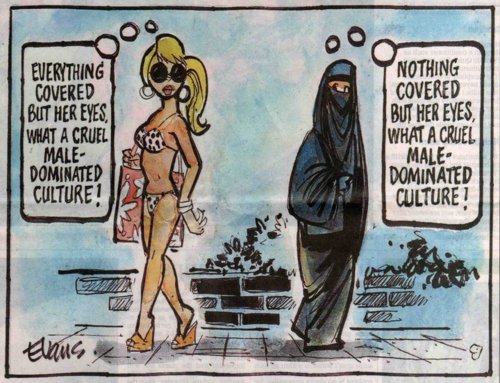
Why I Oppose Banning Burqas

This is not the problem.

And no, my reasoning has nothing to do with racism or any other ism!

Belgian lawmakers recently passed a bill that, if approved in their senate, would make it illegal to wear burqas in public. This comes on the heels of France’s

When justifying banning burqas or similar Islamic garments, people typically make two points–one, that burqas represent and facilitate the oppression of women, and two, that they pose a security risk.

I’ll address the oppression issue first. Some women do indeed wear burqas because they’ve been pressured into it by their culture or by specific men in their lives. But other women do it out of a genuine desire to observe their religion in that way. Some even see it as an empowering gesture. It is fundamentally unjust to oppress the latter group in the name of protecting the former.

But even if I’m being completely naive, and even if not a single Muslim woman willingly chooses to wear a burqa, I conveniently have a second argument. For those women who are being oppressed by the burqa, would banning it really help? The obvious answer, I should hope, is no. In this case, banning the burqa is the legal equivalent of slapping a band-aid over a knife wound–and of treating the symptoms rather than the disease. The disease being, of course, large-scale societal oppression of women. Not something that can be fixed with a single magical law. To use an analogy that’s even closer to my personal experience, banning burqas to promote feminism is like banning suicide to promote mental health.

Not only would banning it not help, but it would probably backfire. If these women’s husbands or fathers are pressuring them into wearing the burqa, they would probably keep right on doing it despite the new law, thus placing these women in a prime position for facing charges, jail time, or plain ol’ harassment by the police. After all, they would be the ones paying the price for breaking the law, not men.

As for the whole security issue, I don’t have too much to say about that because I’m honestly not an expert on the subject, but I’ll say this–Israel has no burqa ban, or any sort of ban on Islamic head coverings, and yet has an incredible security force that manages to stop virtually all potential terrorists within the country’s borders. They don’t release these statistics to the public, but all the time in the Jerusalem Post, you see another story about security guards catching a would-be terrorist. Maybe the security authorities in these European countries should have a big pow-wow with Israeli ones and see what they’ve been missing.

I think it’s very tempting for people (and governments) to believe that issues like the oppression of women by organized religion can be fixed by something as simple as a law banning burqas. But ultimately, you can never really know what’s going on in someone else’s mind. What looks like oppression to us may not feel that way to the women in question. Or maybe it does. In any case, banning burqas won’t help.

I’ll leave you with my favorite cartoon on this subject:

An Indictment of Party Pop

Just when you thought I was finally done writing about alcohol and partying, here I go with yet another post about it!

Before I start talking about party pop, though, I need to clarify what exactly I’m talking about, because apparently some people still don’t get it. Every once in a while someone who doesn’t know me too well says something like “OMG I READ YOUR BLOG AND I GUESS YOU HATE FUN HAHA.” Um no.

So let me explain. I do not hate alcohol. I do not hate parties. I do not hate fun. I do not hate people who drink and party, except when they’re infringing on my personal space. What I hate is something I call “party culture,” which, by my definition, contains the following components:

  • the belief, prevalent among people of all ages, that partying is the one and only acceptable way for young people to spend their free time and socialize
  • the glorification and normalization of binge drinking (formally defined as drinking five or more drinks in a row, but I also use it generally to refer to drinking in a way that jeopardizes one’s health and safety)
  • the use of alcohol as a means to coerce women and excuse sexual assault
  • the idea that people who choose not to party are deficient in some way
  • pressuring people to drink and party (This is truly unique in college. I was never pressured to join clubs, go to football games, explore Chicago, attend dorm events, or do any other social activity quite like I was pressured to party.)
  • the belief that alcohol is something people “need” in order to relax, talk to people, hook up, have fun, etc.
So there’s party culture for you. As for party pop, I read a piece about it in this summer’s issue of Bitch magazine. The piece was actually a really interesting analysis of the changes that this sort of music has gone through; whereas drunk girls in pop culture used to exist basically as a spectacle for men’s benefit, more recently they seem to be partying for themselves (the article mentions Ke$ha and Katy Perry as examples). Anyway, you’d really have to read the whole article to see all of the points it makes, but that’s the gist of it, and the author sees this as a positive development–female empowerment and blahblah.
However, where the article falls short is that it still seems to present party pop as a symbol of rebellion:
Today’s party-girl pop continues down the avenue of non-explicitly politicized, pleasure-focused rebellion against gender norms carved out by flappers and disco divas.
And:
[Party-girl pop] is valuable in its large-scale reflection of changing the meaning of pleasure and autonomy among young women, both to create a culture for girls themselves and to give older people a peek into these changing mores.
Here’s the thing, though. Whereas the music from which party pop presumably draws inspiration, such as the Beastie Boys’ “(You Gotta) Fight for Your Right (To Party!),” was actually made a time when partying was considered a subversive thing for people (especially women) to do, we’ve come quite a ways since then. Party culture has become normative. It’s not partying, rather than partying, that now draws judgment and scorn. Trust me, I’d know.

The truth is, even my socially conservative parents and their white middle-class friends think that partying is just what the kids do these days. For some reason, though, the party lifestyle continues to hold this impenetrable veneer of revolutionary coolness.

When I listen to music that glorifies party culture and hear people ranting about how rebellious and groundbreaking and cool it is, I imagine someone making music about how awesome it is not to live on a farm or to be able to live past age 50. Like, okay, cool, but I thought we were over that by now.

Maybe what we should be talking about instead is the fact that party pop contributes to a culture in which alcohol is viewed as the one and only means to having a worthwhile and enjoyable life, and partying is seen as something “everyone” does. And I’m not even making random unbased claims here: studies have shown that college students overestimate how much their peers drink, and that the more they think others drink, the more they drink themselves. That’s why, when I went through training to be an RA at Northwestern, we were told to provide our residents with the results of surveys done at NU that showed how much students actually drink. Because when you think that everybody is just constantly going out and knocking back six vodkas in a night, you’re more likely to try to do that, too.

Furthermore, I disagree with the Bitch article’s assertion that party pop is helping to redefine gender roles for women. The line of argument here is that because these women party for their own pleasure, they are paving the way for our culture to accept women as autonomous and equal to men. I don’t think it really works that way, though. I think that now, rather than having one function–pleasing men–women have two functions–pleasing men and getting shitfaced. I don’t see how this helps society recognize the right of women to hold positions of power, contribute to scientific research, control their own reproductive health, or generally do much of anything that doesn’t involve getting intimate with a toilet bowl at the end of the night. (As for the shitshow that consists of male-created party pop, I’m not even going to get into that now.)

The very artists that the author of the article considers pioneers in this regard have other songs (which the author conveniently ignored) that completely contradict the supposedly revolutionary message. For instance, here are some lyrics from a recent song by Katy Perry:

Kiss me, ki-ki-kiss me
Infect me with your love and
Fill me with your poison
Take me, ta-ta-take me
Wanna be a victim
Ready for abduction
That’s empowering, alright. As for Ke$ha:
I don’t care what people say
The rush is worth the price I pay
I get so high when you’re with me
But crash and crave you when you are away
Pardon my skepticism, but I really fail to see how this music is promoting women’s autonomy. What I do see, though, is that it promotes the dangerous party culture that has infected basically every college campus–and JUST A REMINDER, by “party culture” I mean the stuff listed with bullet points above. I’m not saying this music is inherently “bad” or that we shouldn’t listen to it (that would not only be a specious argument, but it would also be a hypocritical one since I listen to a lot of this stuff myself). I do think, though, that we should make a big-ass pause before we start painting it with Beastie Boys-esque shades of rebelliousness.
Pop music, and pop culture in general, is the pulse of our society and its values. I think that if we listen closely to it, we can discern the pressures and expectations that people face from the world around them. And right now, pop music is saying that partying is the epitome of what young people should do with their lives. I think that’s an unfortunately narrow-minded view.
So if you’re too school for cool,
And you’re treated like a fool,
You can choose to let it go
We can always, we can always
Party on our own
–P!nk, “Raise Your Glass”

What Does Drinking Have to do with Feminism?

Well, for most feminist bloggers, the answer seems to be absolutely nothing.

An article at the Frisky called Why Being Drunk is a Feminist Issue is causing quite a stir in the blogosphere. The article makes an argument that I have attempted to make numerous times–although rape is always the fault of the rapist and not the person who’s being raped, no matter what that person was wearing or doing or drinking at the time, the unfortunate reality is that we live in a world where rape still happens–and alcohol makes rape more likely. The Frisky article puts it like this:

In an ideal world, rape wouldn’t exist. In an ideal world, it wouldn’t matter how much a woman had to drink, what she was wearing, or what overtures she had given—no man would ever consider sex without explicit consent and would recognize that anyone who is deeply intoxicated is unable to give consent. But we don’t live in that world. Unfortunately, short of some Herculean sensitivity raising effort, we do not have control over what men, drunk or sober, will do when presented with our drunkeness. What we do have control over is our side of the equation—how much we drink.

Of course, this suggestion always has the effect of immediately infuriating virtually all feminists. How dare they suggest that there are things women can do to prevent themselves from getting raped? We should be able to walk alone down a street at 4 AM wearing nothing but stilettos!

Yes. Yes, you should. I absolutely agree. I will wholeheartedly support any initiative that aims to stop rapists from being rapists. And I absolutely agree that rapists should be prosecuted to the full extent of the law regardless of how the victim was acting, what she (or he) was wearing, or how much she (or he) had had to drink.

But the truth is that, as the Frisky article says, you can’t control what other people do. You can only control what you do.

However, I’ll set that entire argument aside for a moment, because I know I really can’t win this one. The feminist blogs have slapped it with the label “victim blaming,” from which there is no coming back. (Which, incidentally, really pisses me off, because the writer says numerous times throughout the post that she does not think it’s a woman’s fault if she’s drunk and gets raped, and that she fully blames the man and that he should be prosecuted. Yet all the responses to this I’ve read insist on claiming that the author blames the victim. People. You cannot respond intelligently to a blog post if you refuse to even take the original blogger at his/her word. That’s just intellectually dishonest. Respond to what’s written, not to what you feel should be written there based on other things the author says. There are nuances, for heaven’s sake.)

Anyway, there is another reason why drinking (by which I mean, drinking to the point that you’re intoxicated) might not be compatible with feminism, and it involves the concept of choice.

To me, feminism has always been all about choice. Feminism is a philosophy that empowers women to choose–choose what job to have, whether to date/marry/have kids, and what to wear, for instance. It follows that choosing who to sleep with is a power that women should also have.

But getting very drunk takes choice away from you. It can make you do things that you wouldn’t do while sober, and that you regret later. It makes you more agreeable, less likely to fight back, less likely to speak up. Sure, a drunk person legally can’t give consent, but who draws the line between can and can’t? Where is that line? What happens when you consent to something that you later realize you shouldn’t have consented to?

Furthermore, it’s a well-known fact that some men actively try to use alcohol as a weapon. Fraternities reserve the “good stuff” for the most attractive girls, and who hasn’t seen a man in a bar enthusiastically buying more and more drinks for a woman he wants to get with?

Not all of these men are rapists. But they know that being drunk can induce someone to think they want something that, deep down, they don’t really want. If alcohol makes you consent to sex that you wouldn’t consent to otherwise, that’s a problem. If being drunk takes the power of choice away from women, then yes, being drunk is absolutely a feminist issue.

Who Has it Worse?

There’s a game we progressives sometimes inadvertently play. I like to call it “Who’s More Oppressed?”

You can probably guess what I’m talking about here. It’s the tendency of social justice-oriented people to engage in lengthy polemics regarding “who has it worse.” Is it Black lesbians? Is it transsexual Hispanic men? Is it lower-class white teenage mothers?

In fact, some (quite liberal) friends and I recently tried to figure out which identities the hypothetical most oppressed person in the world would have. (I’ll leave the conclusion up to your imagination.)

I encountered a less dramatic form of this argument recently on (where else) Tumblr. A male user had responded to a graphic against slut-shaming with the comment, “Try to nail every girl you know? Douchebag. Try to be civil with every girl you know? Fuckin friend-zoned. It works both ways.”

A user named, of course, “stfuconservatives” reblogged the post and added some commentary to it, claiming that being called a slut is worse than being “friend-zoned” and that women have it worse than men. Further comments on that post agreed with stfuconservatives and generally bemoaned the preponderance of sexism in this world.

Let’s step back for a minute. Yes, being called a slut is awful. Nobody should ever call someone that. Period.

Besides which, what this guy wrote and the way in which he wrote it is definitely quite presumptuous and entitled-sounding. However, for the sake of argument, I’ll play devil’s advocate and take his perspective. First of all, he never said that this men’s issue is worse than being called a slut is for a woman, which is what the responders claim he says. But in fact, he specifically says, “It works both ways.” What does that NOT imply? That men have it worse. This man never said that he finds it appropriate to call a woman a slut, or that he doesn’t think this is a problem. Let’s not put words into his mouth.

Furthermore, why this immediate assumption that this man’s claim does not deserve attention? Several commenters immediately point out that they themselves have never “friend-zoned” a guy for being nice. Perhaps not. But this issue is one that I have heard mentioned by guys many, many times, and it strikes at the heart of the conflict between masculinity and sensitivity that most (if not all) American men have to face. This culture glorifies the “Bad Boy,” and men are taught from an early age that being a man means being callous and aloof. Rape culture permeates through our society, teaching men that inducing women to have sex with them is a worthy goal.

On a personal level, every “nice guy” I know has experienced at least one situation in which a girl he liked picked an asshole over him. In fact, when I was younger, I did this all the time. I don’t know why women do it. But it happens. There’s no need to pretend that this isn’t an issue, because it is, and it should be addressed.

Finally–and this relates to a topic I’ll be addressing in a later post–the name “stfuconservatives” (means “shut the fuck up, conservatives,” for those who aren’t familiar with chatspeak) is just so damn wrong. How will progressives benefit from silencing those who disagree with us? Argument and debate not only causes us to strengthen our ability to defend our own views, but it also reminds us that we might not be right about everything, and that many different perspectives exist in the world. These perspectives should be valued, respected, and engaged with.

But back to my original point. What good, exactly, does it do to argue about who has it worse? Why can’t we acknowledge that even groups that we associate with privilege can have issues, and that different kinds of privilege operate in different social contexts? There are so many different kinds of prejudice and stereotypes.

For what it’s worth, I’m glad that I’m a woman, and I can act as kind and generous with men as I want without them relegating me to the status of friend (and nothing more). I’m glad that when it comes to dating, being the person I truly want to be–caring, sensitive, and witty–actually helps me get dates and find relationships, rather than hurting my chances.

Ultimately, I think it’s unfair to make any claims about who has it worse. Each of us sees the world through our particular lens. In terms of things like access to employment opportunities, salaries, historical discrimination, and reproductive justice, women undoubtedly have it worse. But how about being expected to get a job that can provide for a family? How about being drafted to fight in wars? How about being expected to show little emotion, to know how to do practical things around the house, to love sports and be athletic, to propose marriage?

Who has it worse is irrelevant. Let’s fight for social justice without trampling on any group, whether it’s traditionally “privileged” or not. What this comes down to is choosing to speak, write, and argue in ways that are inclusive, rather than exclusive. Like it or not, about half the world is men. There’s no need to make them feel like we don’t care about their viewpoints.