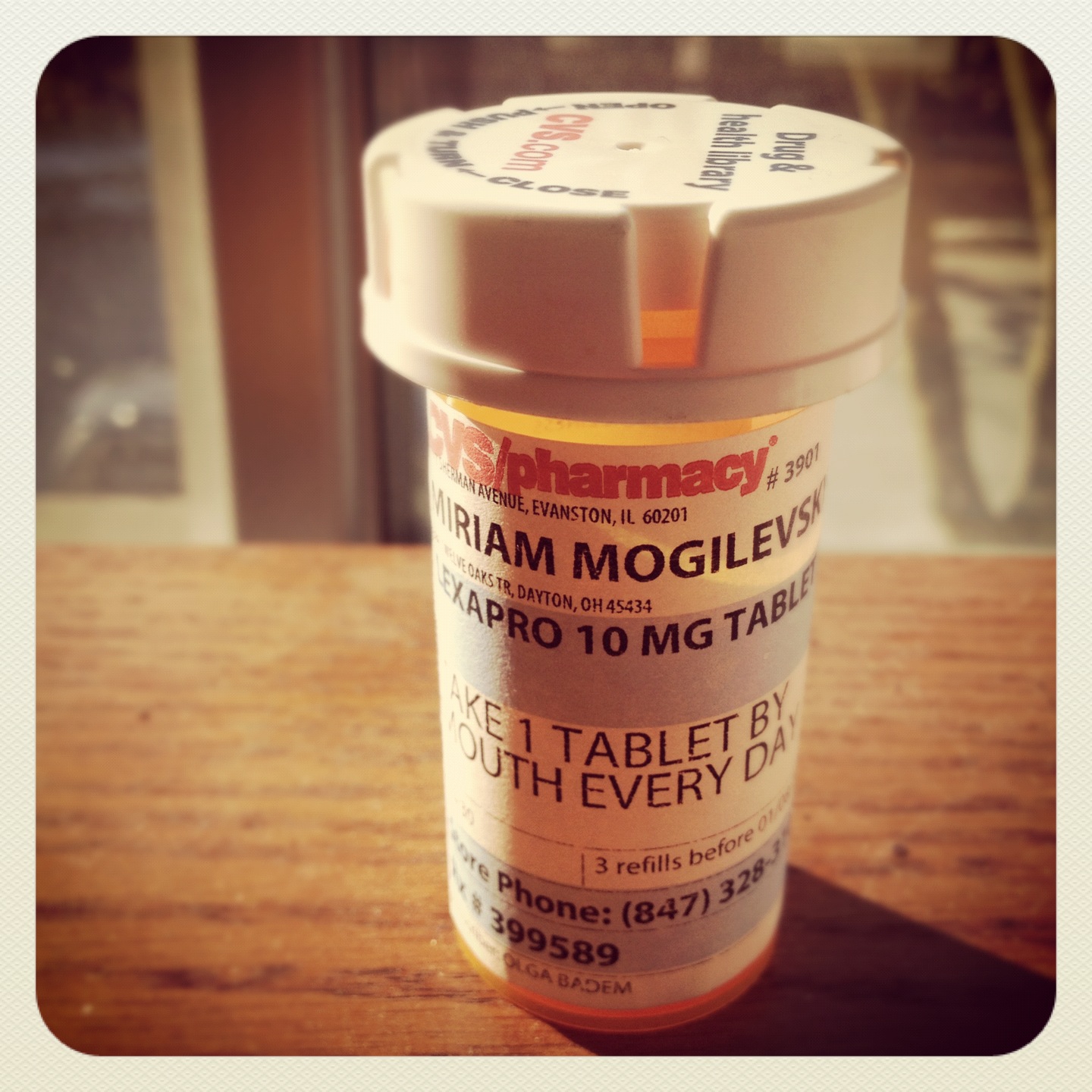
Goodbye Lexapro

[TMI Warning]

Today marks the end of an era of my life.

Today I took my last dose of antidepressants, and tomorrow, for the first time in a year and a half, I will get up in the morning and (purposefully) not take that pill again.

I went on Lexapro as a last resort in July 2010. I won’t go into all those details here since I’ve written about it before, but I’ll say that, at the time, I had no other choice. When a body has been critically injured, it enters a coma. I was in the mental version of that.

Lexapro did a lot of things to me, some expected, some not so much. I stopped crying every day and wanting to kill myself, at least for a while. I also became, according to my friends, more lively, more social, and visibly happier.

But then, there was the other stuff. Lexapro broke up the one meaningful romantic relationship I’ve had in my life. (Was it destined to break up anyway? Now I’ll never know.) It altered my values and beliefs for some time and turned me into the sort of person I would’ve hated a few months before. Now I’m back to my normal self, thankfully.

It was also a cruel helper at times. If I missed just a day of it, I’d be a wreck by nightfall. If I missed two days, the withdrawal symptoms kicked in, and they were horrible. I’d be dizzy, nauseous, barely able to walk, completely unable to explain to people why I was suddenly sick when I’d been fine just that morning. (“Sorry, I’m going through drug withdrawal” isn’t really an effective explanation for most people.) The worst symptom of antidepressant withdrawal has no official name, but depressives refer to it as “brain zaps.” They’re momentary sensations of being shocked or stunned in the head and they happen every few minutes or so, or even more often.

Theoretically, of course, there’s no need to ever miss a day of a prescribed medication, but when you factor in insurance issues, CVS’s constant fuckups, weird sleeping schedules, and other crap, it happens pretty often. I remember one awful time when I forgot to bring my medication back to school from break with me and I had to get my parents to ship it. Those were an unpleasant few days. Another time, my psychiatrist refused to renew my prescription unless I came in to see her, but I’d already be back at school by the time she had her first available appointment slot, and there was no way I could skip classes to drive six hours home to Ohio. She wouldn’t budge.

I’m not going to go into a whole condemnation of psychiatry or the pharmaceutical industry because they gave me back my life. However, I will say this: there is so, so much work to be done.

My psychiatrist prescribed me Lexapro after a nurse practitioner talked to me for ten minutes, and she for about five. She said that “academic stress” was causing my depression and that antidepressants would help me deal with it. She must’ve missed the part where I said that my depression started when I was 12 years old. She also apparently missed the glaring cognitive distortions and emotional issues I was having, and had been having for years and years. She oversimplified my problems and thus prescribed a simple remedy.

It took a while to even begin to sort out what the problem really was, and I’m still not there yet.

Some other things my psychiatrist didn’t tell me: the personality changes. The withdrawal symptoms. The fact that I was more likely than not to have a relapse (which I did). And, of course, the fact that you don’t really recover from depression. You only learn how to avoid it for bursts of time.

That was stuff I shouldn’t have had to learn through experience.

Now I look at that almost-empty bottle and I just can’t look at it with a sense of gratitude. I will never be an enthusiastic advocate of psychiatry, though I will continue fighting for the rights of patients to obtain complete information about medication and to make their own decisions.

I look forward to the end of that daily reminder of what I’ve lost. For the past year and a half, I have started every day by taking Lexapro and remembering that I’m not okay. Now I won’t have that anymore. Now I’ll be able to go half the day, maybe even an entire day, without thinking about that part of myself.

I’m not nearly naive enough to think that this is the end. For all I know, I’ll be back on the medication in a month. I’m almost certain that I’ll be back on it within the next few years.

But for now, at least, I’m done with it.

For now, the only things I’ll be taking in the morning are a multivitamin and a shower.

Normal, just like everybody else.

Depressed on Shabbos

[TMI Warning]

This past weekend, I participated in an overnight retreat with a Jewish education program I’m involved in called the Maimonides Leaders Fellowship. In Jewish parlance, the trip is called a shabbaton as it takes place over the weekly holiday of Shabbat (“Shabbos” is the Ashkenazi variant of the word, in case you’re confused).

On shabbatons, the custom is generally to observe Shabbat in accordance with Jewish law. Although this is commonly interpreted as not doing any “work,” our rabbi pointed out that the actual rule is that you cannot “act” on the physical world. For observant Jews, sundown on Friday to sundown on Saturday is a time when writing, using electricity, driving a car, tearing paper, cooking, exchanging money, and tons of other activities are all forbidden.

Anyway, I won’t go too far into the religious significance of Shabbat, since I’m sure you can read about that elsewhere and I’m not really the best authority on it anyway. But from the discussions we had as a group, I gathered this much about Shabbat, which I didn’t know before: it’s not only a time of rest, but of reflection. The idea is that you don’t do much of anything except be with your friends and family, eat good food, and think about how your life is going.

All of this sounds awesome in theory. Everyone could probably use some time to just think.

However, for people who struggle with depression, as I do, there is literally nothing worse than to have to spend a day doing nothing but eating, socializing, and thinking.

In fact, Shabbat is tragically full of the very things that depressives should generally try to avoid. For instance, like most Jewish holidays, it revolves around eating and drinking. The amount of food that it’s customary to consume at a Shabbat lunch or dinner could probably feed a family for a week. While this does theoretically sound awesome, overeating takes a huge toll on my mental state.

A similar issue is the compulsory socializing. Although not all depressives are introverts, many are, and the disorder sort of turns everyone into a bit of a loner. I wish I could spend hours with people and feel good about that, but I just can’t. After an hour or two, I start to sink into a funk and desperately want to escape. Unfortunately for me, Shabbat meals last for hours.

The prohibition on writing hits me hard, too, because writing is the main outlet I have for channeling my emotions in a positive way. It’s one of the few things that helps when I’m very upset. Reading is an okay substitute, but it’s just not the same.

Thinking, however, is the worst. Depressives can’t really “think,” they can only ruminate–which means endless, circular thoughts about why they’re terrible people unworthy of love. If I had to sit down for a while and think about how my life is going, I would probably become very, very miserable, and that’s exactly why I vastly prefer doing things to sitting around and thinking about them.

And indeed, on Saturday night when Shabbat was over, I didn’t feel refreshed and at ease like I was told I would feel. I didn’t feel stressed, either, but then I rarely do. Rather, I felt vaguely overwhelmed, like my mental capacity had been drained. Later that evening, I burst into tears for literally no discernible reason, and that’s not something that happens to me often anymore.

Unlike certain other religions, Judaism does not want its adherents to suffer or put their health at risk. That’s why, for instance, those who are sick or pregnant are not obligated to fast on the Jewish fast days. That’s why Jews are not only allowed, but obligated to break Shabbat in order to save a life.

However, the entire concept of mental health has only really been around for the past century, whereas the laws of Judaism were written thousands of years ago. I can no more expect Judaism to make allowances for people with clinical depression than I can expect it to, say, condone same-sex marriage.

Religion in general isn’t particularly kind to the mentally ill. When it’s not telling us that we’ve brought this upon ourselves and it’s God’s punishment, it’s telling us that we ought to be able to drag ourselves out of it on our own by praying, repenting, being good wives and husbands, or just sheer willpower. One of my favorite bloggers refers to depression as “spiritually incorrect,” capturing perfectly the way I feel about the intersection between my faith and my mental disorder.

I hope that as I learn more about Judaism, I’ll discover ways to make it work with the person that I am. That person will probably never be able to enjoy a full day of eating and being with people; I’m just not built that way. But I know that Judaism does have much to tell me about living well.

However, I doubt that I will ever be willing to observe Shabbat the “right” way. Spending one-seventh of my life without the ability to do the one thing that always makes me feel good seems like a waste. Ultimately, I don’t believe in God and I don’t believe in an afterlife, so this is the only one I’ve got.

“If You’re Fat, Then What Am I?”

There are a lot of misconceptions out there about body image and eating disorders. I can’t even begin to address all of them here. But there’s one I’ve been thinking about lately–that problems with body image are caused solely by comparing yourself to unrealistic standards, and can be solved by simply comparing yourself to the “real” bodies around you instead.

First, a disclaimer–I’ve never had anorexia or bulimia. However, I’m not entirely out of my depth here. Had I gone to see a psychiatrist at some point prior to this year, he or she would probably have taken note of my obsessive calorie-counting, severe dietary restrictions, compulsive weight-checking and fat-pinching, and general conviction that I was “fat,” and diagnosed me with something called “eating disorder not otherwise specified,” or “EDNOS.” This means that one doesn’t meet the diagnostic criteria for any of the eating disorders, but is definitely disordered nonetheless.

(For the record, I’m much better now.)

Anyway, one thing I remember very vividly from my years of thinking I’m fat was one particular response that I often encountered. Some people (mostly other girls), upon learning how I felt, would respond with this: “If you’re fat, then what am I?”

Now, I understand exactly where this comes from. Many of my peers were probably insecure, too, and it makes sense that they would be reminded of their own insecurity once I mentioned mine. Since I was indeed thinner than many other people, that response makes sense on some level. If I’m fat, they must be obese!

But it doesn’t really work that way. It would certainly be convenient if people’s self-concepts were always rational and based on reality. But the very definition of mental problems is that they’re distortions of reality–they’re unrealistic. That’s why grief after the death of a loved one isn’t considered a mental disorder, but depression is.

And that’s exactly why “If you’re fat then what am I” is not an effective response. At the time, I didn’t give two shits what other people were. It didn’t enter my thought process. In my case, my conviction that I was fat was mostly caused by cultural factors; namely, the fact that Russians are fucking preoccupied with beauty and weight. Absolutely preoccupied. It was also caused by years of ballet lessons, my depressive personality (which magnifies personal flaws), the belief that I could lose 10-20 pounds and still be healthy, fear that guys wouldn’t find me attractive if I had folds on my stomach, and many other causes.

For other people with body image and eating issues, the causes may be different. Some people develop the feeling that they’re unable to control their environment, so they control the only thing they can–their body. Others may start out actually overweight, start to diet and lose weight, and find that they’re addicted to the feeling of getting thinner. Others develop an overwhelming guilt whenever they eat, especially when they eat unhealthily, and they start to purge after eating. Some may have friends who constantly talk about their bodies’ flaws (remember Mean Girls?) and start to think the same way.

Whatever the causes are, these issues are much too complicated to be defeated by a simple glance at someone who weighs more than you.

Of course, “If you’re fat then what am I” also fails one of the most basic requirements of being a good listener–don’t change the subject to yourself. If your friend feels crappy and needs to talk to you, don’t make it about you. If your own issues are making it difficult for you to listen, tell your friend that. Sure, they might be disappointed that you can’t listen to them, but that’s much better than how they’re going to feel when you take their pain and turn it into a conversation about you and your weight.

It’s easy to resent people who, according to you, “should” be perfectly happy with their weight but are not. I can’t say I don’t get a twinge of annoyance whenever I witness a girl much smaller than me freaking out about her weight. But then I remind myself that she’s not me. Poor body image seems almost like a cliche among young women these days, but it’s so much more complex than you might think.

Storytelling

(Or: Massive Annual New Year’s Eve Note, Vol. 5)

[TMI Warning]

Many psychologists believe that it’s not what happens to us that matters, it’s the stories we tell ourselves about what happens.

Some people unfortunately interpret this to mean that we ought to “look on the bright side of life” and “find the silver lining” and all that crap.

I don’t really see things that way. Never have. Life sucks a lot of the time, and anyone who tells you otherwise is either stupid, in denial, or trying to sell you something.

But I have learned, over the past year, how powerful personal storytelling can be. This was the year I took a lot of pain and turned it into a force of energy.

~~~

A year ago, I thought I was done with this whole depression thing forever. That didn’t turn out to be the case. It came back almost as soon as the new year started, worse than ever before, seemingly undefeatable.

This has been a painful year. People hurt me this year. They lied, broke my heart, used me, and took my friendship for granted.

I was alone a lot, more alone than ever before. In fact, I spent most of the summer alone in New York. It was a fantastic experience, but a lonely one nonetheless.

It was hard, a lot of the time, not to think about all the ways depression limits me. If I didn’t have it, everything about my life would be different. I’d be outgoing, I’d go to parties, I could stay up late and take harder classes. I wouldn’t be so tired all the time, I wouldn’t have such a hard time talking to people, and, of course, I wouldn’t be so sad.

But sometime over the course of this year, I stopped thinking about all the things I couldn’t do because of depression, and started thinking instead about all the things I could.

For instance, I would never have started NU Listens, my peer-listening organization, if I hadn’t been depressed. I wouldn’t have the skills that allow me to help people. I wouldn’t write so much, or so well. I wouldn’t be able to fully appreciate my family and the other people I have in my life. I probably wouldn’t know what my calling is.

Some people, knowing that, would assume that I’m “thankful” for the experience of being depressed, or that I consider it “part of God’s plan” for me, or that it was “all for the best.”

Well, sorry to burst your bubble, but no. I don’t think any God would put a person through this, and that’s one of the reasons I don’t believe in God. I’m not thankful and I don’t think it was for the best. I want my adolescence back. I want the first two years of college back.

In our culture, preoccupied as it is with constantly finding the silver lining to everything from rejection to failure to broken hearts, I think it’s bold of me to say that I’m not thankful for what happened. I know I’m expected to offer up some grand lesson to be learned from all this, but I’m sorry to say that there just isn’t one. Sometimes shit happens. It definitely happened to me.

Knowing that, I’ve given up trying to find some sort of grand meaning in my experiences with depression. I sure as hell don’t accept the Judeo-Christian notion that I somehow deserved it, and although it has had some positive consequences, I’d say it did more harm than good. By far.

So how to go on? Well, that’s a complicated question for someone who prefers to see things in complicated ways. The story I’ve decided to tell about my own life isn’t necessarily happy, but it’s empowering for me. It’s about working within my limitations to achieve great things.

After all, the truth is that I’m probably not going to ever fully recover. I live at the mercy of something I can’t fully control, and my entire being–from feelings and moods to thoughts, beliefs, and actions–is tempered by it. Some days it leaves me alone, and some days it barely lets me get out of bed.

It means I have to be on my best behavior all the time. Nine hours of sleep, fruits and veggies, not too much carbs or meat, brisk walking every day, at least. Schoolwork has to be done before 9 PM or so, or else I can’t concentrate on it. I get overwhelmed by information easily, hence all the organization–categorized to-do lists and a calendar, a notebook that I carry everywhere, everything in filing folders in a box under my desk. In class I have to write by hand because it keeps me more alert. Otherwise, I start dozing off after sitting still for five minutes, no matter how much sleep I’ve been getting, because that’s how my body is.

I have to always stay busy, because as soon as I have a moment to myself, my mind starts conjuring up nasty thoughts. You’re such a bitch. Go kill yourself. The reason I take five/six classes, work two jobs, and run two student groups isn’t for my resume. It’s for my health.

~~~

So those are my limitations. Sometimes they seem pretty extreme. Sometimes they seem like a blessing compared to what some people are given.

Regardless, I’m not going to define myself through them anymore.

Instead, I’m going to define myself through the unique gifts that I have, and that I’ve become aware of because of my experience with depression.

When I’m helping someone, my self disappears–and with it, so do all of my fears, insecurities, and dysfunctions. I feel like I’m entering the other person’s being. It’s almost a spiritual experience.

Of course, my ideas about others aren’t always correct, but I start down a path of understanding. I start to see why the love the people they love, why the fear the things they fear, why they do things I would never do, why they believe things that I don’t believe.

I’m not looking for any accolades or sense of moral superiority when I say that my calling is to help people feel better. In a way, I’m just as selfish as anyone else. Some people are happy when they make money, or when they do experiments, or when they play sports; I’m happy when I make others happy.

It’s pretty much that simple.

~~~

It’s been a year since I “came out” as having a mental disorder. Since then, my relationships have only grown stronger and my sense of being valued and respected has only increased. Sometimes people do imply–usually via anonymous comments on my blog, as they know better than to say it to my face–that I’m making people “uncomfortable.” My response to this is always the same: they’ll get over their discomfort. I won’t get over my depression.

The truth is that–and I’m terribly sorry about this–I really don’t give a fuck about your comfort. I just don’t. It’s not my job to make anyone comfortable. I don’t really care about fitting in or being cool or normal. I must be missing that gene, or whatever.

If I sound completely different right now than I did just a few paragraphs before, I wouldn’t blame you for being confused. My life’s work will be to help people find happiness, but never at the expense of my own ability to live and express myself as I see fit. My understanding of psychology is that if you’re so concerned with how I live that you’re made “uncomfortable” by my depression, it’s you who needs to change, not me.

I don’t think most people realize the extent of my lack of fuck-giving because, unlike many other young malcontents, I don’t wear it on my body. My clothes are normal. I talk like a more-or-less average educated person. I don’t have any tattoos or extra piercings and don’t plan on getting any, and my hair is dyed, but only slightly. It’s styled in a mostly average way. I don’t choose to “rebel” by doing lots of drugs or people, and I don’t smoke, drink, or listen to unusual music.

But internally, I feel like an alien in this world. There’s a thick glass wall between me and everyone else. There’s a terrible creature that has its tentacles wrapped around my brain, and every time it squeezes, I want to rip my head off.

That’s what depression is.

~~~

That’s not to say this year has been all bad. It certainly hasn’t. I made many friends this year–not just any friends, but best friends. I started working on two different research projects at school. I found a way to connect with the Jewish community at Northwestern. I made Dean’s List this past quarter, started my own peer listening group, got accepted as a columnist for the Daily Northwestern next quarter, drastically increased my blog’s readership, tried therapy for the first time, successfully navigated my first quarter in my own apartment, went on quite a few dates, learned how to make my own jewelry, was accepted to a quarter-long Jewish education program, and befriended a few professors.

I went to New York three times, growing more and more certain with each time that this is where I want to live someday. I watched my older brother get married and found out that I’ll be an aunt in a couple of weeks. I met distant family members I hadn’t even known about before. I decided to wean myself off antidepressants when the new year starts.

Depression keeps me from being truly happy, but I refuse to let it rewrite the story of my life any longer. What I’ve been able to do despite of (and perhaps because of) my limitations makes me glad to be alive. I hope to recover someday, but even if I don’t, my life is going to be worthwhile.

~~~

A few days ago. I’m walking near Union Square in Manhattan. The sun has nearly set and the wind is chilling. I hear a man begging for money.

“Can you spare some change?” he’s saying, over and over. The passerby walk past him and he says, “That’s okay. Maybe next year.”

I put a dollar bill in his cup and he says, “God bless you, miss. I really mean that.”

He says happy New Year, and I say happy New Year too.

And then I continue on my way.

Maybe next year.