Goodbye Lexapro

[TMI Warning]

Today marks the end of an era of my life.

Today I took my last dose of antidepressants, and tomorrow, for the first time in a year and a half, I will get up in the morning and (purposefully) not take that pill again.

I went on Lexapro as a last resort in July 2010. I won’t go into all those details here since I’ve written about it before, but I’ll say that, at the time, I had no other choice. When a body has been critically injured, it enters a coma. I was in the mental version of that.

Lexapro did a lot of things to me, some expected, some not so much. I stopped crying every day and wanting to kill myself, at least for a while. I also became, according to my friends, more lively, more social, and visibly happier.

But then, there was the other stuff. Lexapro broke up the one meaningful romantic relationship I’ve had in my life. (Was it destined to break up anyway? Now I’ll never know.) It altered my values and beliefs for some time and turned me into the sort of person I would’ve hated a few months before. Now I’m back to my normal self, thankfully.

It was also a cruel helper at times. If I missed just a day of it, I’d be a wreck by nightfall. If I missed two days, the withdrawal symptoms kicked in, and they were horrible. I’d be dizzy, nauseous, barely able to walk, completely unable to explain to people why I was suddenly sick when I’d been fine just that morning. (“Sorry, I’m going through drug withdrawal” isn’t really an effective explanation for most people.) The worst symptom of antidepressant withdrawal has no official name, but depressives refer to it as “brain zaps.” They’re momentary sensations of being shocked or stunned in the head and they happen every few minutes or so, or even more often.

Theoretically, of course, there’s no need to ever miss a day of a prescribed medication, but when you factor in insurance issues, CVS’s constant fuckups, weird sleeping schedules, and other crap, it happens pretty often. I remember one awful time when I forgot to bring my medication back to school from break with me and I had to get my parents to ship it. Those were an unpleasant few days. Another time, my psychiatrist refused to renew my prescription unless I came in to see her, but I’d already be back at school by the time she had her first available appointment slot, and there was no way I could skip classes to drive six hours home to Ohio. She wouldn’t budge.

I’m not going to go into a whole condemnation of psychiatry or the pharmaceutical industry because they gave me back my life. However, I will say this: there is so, so much work to be done.

My psychiatrist prescribed me Lexapro after a nurse practitioner talked to me for ten minutes, and she for about five. She said that “academic stress” was causing my depression and that antidepressants would help me deal with it. She must’ve missed the part where I said that my depression started when I was 12 years old. She also apparently missed the glaring cognitive distortions and emotional issues I was having, and had been having for years and years. She oversimplified my problems and thus prescribed a simple remedy.

It took a while to even begin to sort out what the problem really was, and I’m still not there yet.

Some other things my psychiatrist didn’t tell me: the personality changes. The withdrawal symptoms. The fact that I was more likely than not to have a relapse (which I did). And, of course, the fact that you don’t really recover from depression. You only learn how to avoid it for bursts of time.

That was stuff I shouldn’t have had to learn through experience.

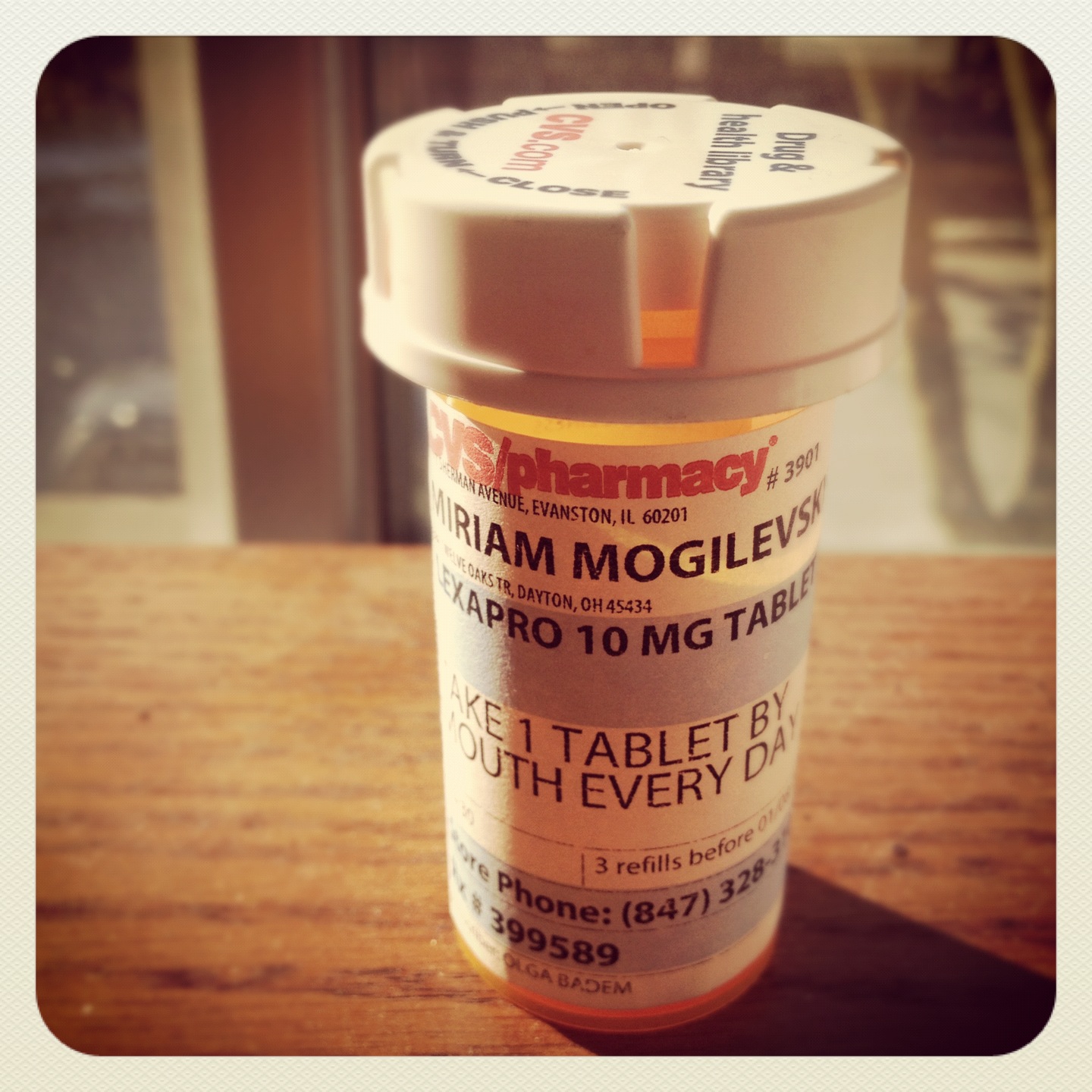
Now I look at that almost-empty bottle and I just can’t look at it with a sense of gratitude. I will never be an enthusiastic advocate of psychiatry, though I will continue fighting for the rights of patients to obtain complete information about medication and to make their own decisions.

I look forward to the end of that daily reminder of what I’ve lost. For the past year and a half, I have started every day by taking Lexapro and remembering that I’m not okay. Now I won’t have that anymore. Now I’ll be able to go half the day, maybe even an entire day, without thinking about that part of myself.

I’m not nearly naive enough to think that this is the end. For all I know, I’ll be back on the medication in a month. I’m almost certain that I’ll be back on it within the next few years.

But for now, at least, I’m done with it.

For now, the only things I’ll be taking in the morning are a multivitamin and a shower.

Normal, just like everybody else.

Don’t Blame it on the Tech

[Snark Warning]

A modified version of this piece also appeared as my column in the Daily Northwestern.

Technology gets a bad rap.

You wouldn’t think so–obviously, we all love it–but in a way it does.

You can’t really go a day anymore without encountering a book, article, or person spewing some variation of the following: “Oh, these days, everyone’s just so plugged in to their laptops/iPods/iPads/iPhones/Kindles/Blackberrys/etc,” always with a tone that combines whininess with nostalgia.

Sometimes it’s in the context of promoting physical activity, face-to-face interaction, getting out into nature, ink-and-paper books, live music, or any other number of virtuous things. Sometimes–paradoxically, since this usually appears online–it’s in an article about some brave soul who has eschewed Facebook, email, or–gasp!–the Internet altogether. Sometimes it’s embedded in smug pieces with titles like “Why I Don’t Have a Smartphone” or “Why I Don’t Text My Boyfriend.”

For a while, I really couldn’t figure out what it is about these remarks that drives me so far up the wall. I thought perhaps it was the repetition and sheer clicheness of such comments, or just my contrarian nature.

However, I think I’ve finally figured it out. These lamentations annoy me because I read them, accurately or otherwise, as attempts to shift responsibility for running our own lives off of ourselves and onto the technology that we willingly invent, purchase, and use.

In other words, it’s not that I can’t be bothered to spend time with my family. It’s that the evil Apple device prevents me.

Of course, I exaggerate. Most people don’t really feel like they can’t control their technological activities (although there are exceptions). But I do get the sense that gadgets get an unfair amount of blame.

I also think that people often choose to cut themselves off from technology, at least temporarily or partially, rather than learning how to achieve some sort of balance in their use thereof. What else explains the preponderance of browser extensions and desktop software that blocks “time-wasting” websites or programs? If the only thing preventing you from typing http://www.facebook.com in the address bar is a special browser add-on, you’re not actually learning how to control your urges in the moment they arise.

I also know of people who literally deactivate their Facebook accounts or have a friend change the password during critical academic periods. Of course, part of me just wants o say, more power to them. But another part wonders why people can’t just restrain themselves from going to the website.

In other words, Facebook doesn’t waste your time. You waste your time.

I’ve been thinking about this a lot in connection with what I wrote about in my last post. When I observed Shabbat this past weekend, that meant I had to spend 24 hours without using any technological device.

Aside from the fact that my nephew was born that day and I really wanted to check in with my family, I can’t say that the obligatory technology fast affected me much. I didn’t die of boredom without the Internet, but neither did I revel in the feeling of being “free” from all that pesky technology.

Ironically, I think this trend started off as a contrarian one. At some point within the last decade or two, some skeptic probably wrote an article to the tune of, “You know all that technology we think is so awesome? Yeah well it’s not.” (In fact, that person is probably Nicholas Carr.)

But now I’d say that this has become a mainstream opinion–one that I don’t necessarily disagree with, but one that seems completely oversimplified to me. I don’t believe that there’s anything special about today’s technology that causes it to sap all of our attention. As with most social trends and problems, I believe that what’s going on here is actually much more complex.

For instance, everyone loves to bemoan the fact that people now communicate mostly through technology. There’s the old cliche about texting or IMing someone who’s just in the next room–or in the same room, and the preponderance of college students who use Facebook to run their entire social lives.

But what’s really happening here? Could it be that the expectation for young people to go away to college, move frequently, and put off making permanent bonds with others until later is driving the increased emphasis on digital communication? Could it be that most people never learn effective communication skills and thus feel more comfortable talking to others from behind a screen? Or, perhaps, that technology takes away the fear of rejection that people face when they try to, say, invite someone to hang out in person or come up and engage them in conversation?

I’m really just throwing out suggestions here, because I don’t know. But I do have a very strong sense that technology is really just the medium through which already-existing problems in our culture and our psychology are being revealed.

For instance, everyone hates the nasty trolls that seem to inhabit every website with open commenting. However, the Internet and the anonymity it provides do not cause trolling; they simply allow it. What probably does cause it are boredom, frustration, and a general inability to empathize and care for people you cannot see or even imagine. And those are problems that reside within ourselves, and not within the technology we’ve constructed.

Technology makes an easy target. It’s new, it’s hard to understand, and it’s changing our culture faster than we can churn out books and articles that analyze it.

But it bothers me that choosing to disconnect from technology has acquired a moral value, and that we bitch and moan about technology instead of some of the larger, deeper problems with our culture.

Those problems are much harder to tease out and analyze. It’s easier to just write a piece blaming everything on iPhones.

But gadgets come and go. Culture usually does not.

Depressed on Shabbos

[TMI Warning]

This past weekend, I participated in an overnight retreat with a Jewish education program I’m involved in called the Maimonides Leaders Fellowship. In Jewish parlance, the trip is called a shabbaton as it takes place over the weekly holiday of Shabbat (“Shabbos” is the Ashkenazi variant of the word, in case you’re confused).

On shabbatons, the custom is generally to observe Shabbat in accordance with Jewish law. Although this is commonly interpreted as not doing any “work,” our rabbi pointed out that the actual rule is that you cannot “act” on the physical world. For observant Jews, sundown on Friday to sundown on Saturday is a time when writing, using electricity, driving a car, tearing paper, cooking, exchanging money, and tons of other activities are all forbidden.

Anyway, I won’t go too far into the religious significance of Shabbat, since I’m sure you can read about that elsewhere and I’m not really the best authority on it anyway. But from the discussions we had as a group, I gathered this much about Shabbat, which I didn’t know before: it’s not only a time of rest, but of reflection. The idea is that you don’t do much of anything except be with your friends and family, eat good food, and think about how your life is going.

All of this sounds awesome in theory. Everyone could probably use some time to just think.

However, for people who struggle with depression, as I do, there is literally nothing worse than to have to spend a day doing nothing but eating, socializing, and thinking.

In fact, Shabbat is tragically full of the very things that depressives should generally try to avoid. For instance, like most Jewish holidays, it revolves around eating and drinking. The amount of food that it’s customary to consume at a Shabbat lunch or dinner could probably feed a family for a week. While this does theoretically sound awesome, overeating takes a huge toll on my mental state.

A similar issue is the compulsory socializing. Although not all depressives are introverts, many are, and the disorder sort of turns everyone into a bit of a loner. I wish I could spend hours with people and feel good about that, but I just can’t. After an hour or two, I start to sink into a funk and desperately want to escape. Unfortunately for me, Shabbat meals last for hours.

The prohibition on writing hits me hard, too, because writing is the main outlet I have for channeling my emotions in a positive way. It’s one of the few things that helps when I’m very upset. Reading is an okay substitute, but it’s just not the same.

Thinking, however, is the worst. Depressives can’t really “think,” they can only ruminate–which means endless, circular thoughts about why they’re terrible people unworthy of love. If I had to sit down for a while and think about how my life is going, I would probably become very, very miserable, and that’s exactly why I vastly prefer doing things to sitting around and thinking about them.

And indeed, on Saturday night when Shabbat was over, I didn’t feel refreshed and at ease like I was told I would feel. I didn’t feel stressed, either, but then I rarely do. Rather, I felt vaguely overwhelmed, like my mental capacity had been drained. Later that evening, I burst into tears for literally no discernible reason, and that’s not something that happens to me often anymore.

Unlike certain other religions, Judaism does not want its adherents to suffer or put their health at risk. That’s why, for instance, those who are sick or pregnant are not obligated to fast on the Jewish fast days. That’s why Jews are not only allowed, but obligated to break Shabbat in order to save a life.

However, the entire concept of mental health has only really been around for the past century, whereas the laws of Judaism were written thousands of years ago. I can no more expect Judaism to make allowances for people with clinical depression than I can expect it to, say, condone same-sex marriage.

Religion in general isn’t particularly kind to the mentally ill. When it’s not telling us that we’ve brought this upon ourselves and it’s God’s punishment, it’s telling us that we ought to be able to drag ourselves out of it on our own by praying, repenting, being good wives and husbands, or just sheer willpower. One of my favorite bloggers refers to depression as “spiritually incorrect,” capturing perfectly the way I feel about the intersection between my faith and my mental disorder.

I hope that as I learn more about Judaism, I’ll discover ways to make it work with the person that I am. That person will probably never be able to enjoy a full day of eating and being with people; I’m just not built that way. But I know that Judaism does have much to tell me about living well.

However, I doubt that I will ever be willing to observe Shabbat the “right” way. Spending one-seventh of my life without the ability to do the one thing that always makes me feel good seems like a waste. Ultimately, I don’t believe in God and I don’t believe in an afterlife, so this is the only one I’ve got.

The Friend Zone is a Myth

This week’s Daily Northwestern column.

As Valentine’s Day approaches, many of us are probably thinking the same thing : Dating is hard.

And it is, especially in college. People who look for serious relationships (as opposed to casual dating or hookups) face plenty of challenges, such as jam-packed schedules, breaks away from campus, study abroad semesters, plenty of temptation, and, of course, the constant specter of graduation.

Some might say that friendship is another one of those challenges. The concept of the “friend zone” isn’t a new one. On UrbanDictionary.com, where it was the “Word of the Day” back in October 2011, “friend zone” is defined as “What you attain after you fail to impress a woman you’re attracted to. Usually initiated by the woman saying, ‘You’re such a good friend.'”

Despite the gendered definition that UD provides, I’ve heard both girls and guys claim that their crush rejected their advances because they were “just such a good friend” or because they “didn’t want to ruin the friendship.”

I think the friend zone concept is mostly bunk. First of all, the fact that many relationships do start off with the couple being good friends shows that friendship itself isn’t exactly a cold shower.

Second, the friend zone seems like a convenient (if well-intended) excuse that people use when a friend whom they see as nothing more expresses romantic interest. After all, it’s never pleasant to have to tell a good friend that, for whatever reason, you just don’t see them as boyfriend/girlfriend material. And often people might not know the reason for that lack of connection: Maybe they just didn’t click with the person, or there wasn’t chemistry, or whatever you want to call it.

In such a situation, it makes sense that someone would say something like, “I just don’t see you as more than a friend.” And it makes sense that the person they’re rejecting would conclude that the friendship is the problem.

But it’s not. The problem is the person just doesn’t like them that way.

Of course, some people do choose not to date a friend they have feelings for because they don’t want to jeopardize the friendship. However, such people are probably simply valuing friendship over romance for the moment, and that’s their choice — it doesn’t mean becoming their friend was a bad idea.

Sometimes the friend zone explanation arises when a person puts a lot of energy into being a good friend to someone they’re interested in and gets frustrated when their emotions aren’t reciprocated. Since humans are wired to find patterns, the natural assumption is that the friendship caused their crush not to like them back.

However, as important as it is, being a good friend doesn’t entitle you to someone’s romantic attention. In fact, nothing entitles you to that.

It makes me sad when I see advice columns in women’s magazines exhorting them not to act like good friends to the men they like for fear of getting “friend zoned.” These columns generally advise women not to do anything overly friendly, such as worrying about a guy’s health or listening to him talk about his problems. Caring actions like these might prompt the dreaded “You’re such a good friend” comment.

However, unless you’re looking for the most casual of flings, friendship first makes a lot of sense — it allows you to get to know the person well before getting too invested, it helps them understand your boundaries, and it allows you to make sure that both of you are looking for the same thing from each other.

Especially at our age, people vary a lot in terms of the sorts of sexual and/or romantic relationships they’re looking for. Some just want to hook up, some want to date several people, some want an exclusive partner until distance forces them to separate, and others are looking for something serious and long-term. Getting to know a potential partner as a friend first is a great way to prevent hurting each other when you discover that your goals diverge.

Besides, if it never develops into anything more, having a new friend never hurts anyone.

This Valentine’s Day, ignore the cliched advice and go with your gut. People are either going to like you, or they’re not. But they’re more likely to like you if you treat them well.

A Holistic Perspective on Bullying

Recently while hanging out at my local Barnes and Noble, I noticed a display near the kids’ section. It was about “No Name-Calling Week,” which happens to be the week of January 23, and had a bunch of books for children about bullying.

At first, I was skeptical, as I usually am about well-meaning but generally misinformed interventions like these. But when I actually checked out the books, I noticed that they weren’t just about bullying. I bought two of them for my little brother, and they were called Stick Up For Yourself and Speak Up and Get Along.

Before you drown in a puddle of gag reflex, let me assure you that I actually read a good amount of both of these books before I bought them, and I’m proud to say that they are absolutely 100% Psych Major/Former Kid/Big Sister-approved.

More specifically, the books basically consisted of kid-friendly cognitive-behavioral therapy. There were chapters about understanding and naming your feelings, expressing yourself effectively, and figuring out what your dreams are. Relatively little of it was actually directly relevant to bullying; the focus seemed to be children’s mental health in general.

As I wrote in a previous post, our culture mostly ignores mental health in children unless they’re already seriously distressed and/or problematic, in which case it attacks the problem furiously, if ineffectively (i.e. ADHD, alcohol/drug use, and delinquency). In that post, I discussed my ten-year-old brother’s skewed worldview and how it’s been shaped by the way he’s treated by other kids, and how his issues probably won’t be taken seriously until/unless they develop into something that’s listed in the DSM.

But these books are brilliant in that they approach the problem of bullying in a holistic way–by illuminating the ways in which kids would be happier and healthier if they were taught more effective and positive ways of thinking and interacting.

I was bullied as a kid. I’m not nearly masochistic enough to start describing exactly how or how much, although I can say that it wasn’t as severe as it was for many other people. I don’t think it affected my life all that much; although I’m sure depression can be a consequence of childhood bullying, I’m pretty sure my genetics and inborn temperament took care of that on their own.

But even from an early age, I was curious about why people act the way they do. Although I’m certainly not always nice, I’ve never felt the urge to ostracize someone, publicly humiliate them, or spread rumors about them. Some people, though, do have that urge. Why?

Of course, parents, teachers, and psychologists have been trying to answer this question for decades now. The common assumption used to be that bullies are awkward, ugly loners who mess with other kids to feel powerful. Nowadays, the explanations have tended towards the sociological side, with Rachel Simmons’ Odd Girl Out hypothesizing that, at least among girls, bullying is caused by a societal stigma against expressing anger openly and is usually done by popular girls with plenty of social capital.

The real answer, I think, lies somewhere between these two perspectives. It’s clear that most bullies are socially skilled and aware, at least to a certain extent, or else they wouldn’t be able to exert such influence. (Would you really feel that hurt if some loser came up and called you ugly? I’d laugh.) However, there has to be something missing from these kids’ lives if they turn to making others miserable.

A happy, self-confident person of any age has no need to put others down. I think it’s time that we recognize that even young children can and do have mental health issues–not necessarily ones that need medication or therapy, but ones that deserve attention and respect from their families.

That’s why I bought my brother those books. I hope that they’ll be a good starting point to help him figure out how to start looking at the world in a healthier way and how to talk to us about how he feels. We can’t help kids without listening to them–and resisting the urge to respond with “Just ignore it,” “Just get over it,” and “Just calm down.”