
The Myth of Everyone

It’s right up there with Santa Claus, the Tooth Fairy, and true love–the Myth of Everyone.

The Myth of Everyone is invoked whenever someone attempts to justify their own or someone else’s shitty actions by saying, “Oh, come on, everyone does that.” For instance, my recent article against the Greek system generated arguments that all people and all groups of people do the sort of stuff I accused the Greek system of perpetuating, so it’s unfair to criticize the Greek system on those grounds. (I should’ve asked these people to find me examples of photography clubs paddling new members, or of a knitting circle forcing people to do keg stands, but I suppose that’s besides the point.)

At other times, the Myth of Everyone is invoked to explain even nastier, more specific examples of human behavior. For instance, a few months ago, a 17-year-old was gang-raped by a group of college men at a party. One of the lawyers representing the group of men stated, “This wasn’t anyone’s finest moment. It was 20-year-olds at a party behaving like 20-year-olds at a party.” Clearly, the lawyer wanted us to believe that gang-raping a teenage girl is what “everyone” would do in this situation.

Who is this mysterious Everyone? Why do they have such a hold over our collective imagination? Luckily, the field of psychology has an answer for that. It’s called the False Consensus Effect.

The false consensus effect is a cognitive bias that most people have that causes them to overestimate the degree to which their particular beliefs, values, goals, and opinions are shared by the majority of people–hence, a false consensus.

Psychologists believe that this effect occurs because people have a need to fit in and to believe that others share their mindsets. Feeling “normal” increases one’s self-esteem.

The effect is particularly prominent among members of a tight-knit group that rarely interacts with non-group members, and therefore is rarely forced to encounter divergent viewpoints. It becomes really easy for members of such a group to assume that their beliefs are shared by the larger population, even when they actually aren’t. An example of this would be, say, members of a sorority or fraternity.

This aspect of human psychology probably evolved to keep people happy and feeling accepted by society. In prehistoric times, it would’ve been adaptive to keep believing you’re pretty normal up until people convinced you otherwise–for instance, by excluding you from the tribe. But today, it’s become all too easy to convince yourself that “Everyone” shares your viewpoints, since our society is fragmented and we can choose people just like us to interact with.

Unfortunately, this is exactly how things like sexual assault, binge drinking, and all sorts of other problems get delegitimized and ignored. I’ve heard my fellow students making ridiculously overgeneralized statements like “Everyone hooks up” and “Everyone goes out and gets drunk” and even “All guys try to pressure girls into having sex with them.”

It would shock many of these students to know some statistics on these things. Namely, at least at my school, nearly 50% of the student body has not had sex in the past year. 23% percent of Northwestern students do not drink alcohol–AT ALL!–and 60% do not binge drink, meaning that they have four or less drinks each time they go out. (This includes the students who don’t drink at all, too.) This puts the percentage of students who do go crazy and get drunk at a little over one-third of the student body–a sizable minority, to be sure, but hardly the overwhelmingly dominant lifestyle people seem to think it is.

I can’t cite these statistics because I received them directly from Northwestern’s Department of Health Promotion and Wellness, which does official surveys on this sort of stuff. (The surveys are distributed to a representative random sample of the undergraduate student body.) If you’re curious, though, I have contacts in that department and I could probably obtain a report for you.

So, who is this mysterious “Everyone” who has tons of sex, drinks tons of alcohol, and pressures everyone into doing the same? It’s not the average Northwestern student, that’s for sure.

The problem of false consensus goes way beyond the college campus. It helps explain why some people think that cheating, shoplifting, accepting bribes, or using drugs isn’t a big deal (“Oh, come on, everyone does that!”), why right-wing politicians think Americans want to stop gay marriage (when, in fact, 53% of Americans believe in full marriage rights for the LGBT community), and why some people persist in telling racist/sexist jokes, believing that everyone’s still living in the 1950s.

Nowadays, when someone tries to tell me that “Everyone” is doing something, I take that with a grain of salt. Such statements probably tell you more about the person making them than about the majority of people, since most people don’t bother to actually go out and find statistics about things like I’ve just done.

Reason: it’s so inconvenient, isn’t it?
Won’t Someone Please Think of the Sluts?

[Snark Warning]

I was bemused recently by the reaction when I mentioned on my Tumblr–in the context of a larger conversation–that I’m proud of the fact that I’m not, for lack of a better term, “promiscuous.”

I was promptly accused of “slut-shaming,” which, according to this blog, is constituted by the following:

the idea of shaming and/or attacking a woman or a girl for being sexual, having one or more sexual partners, acknowledging sexual feelings, and/or acting on sexual feelings.

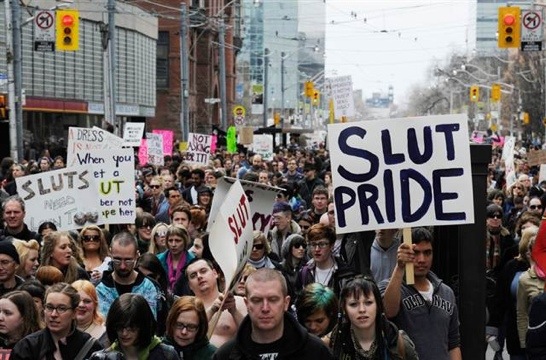
The word “slut” has recently undergone a revival of sort, and was used for the infamous SlutWalks of this past spring and summer. Naive as I am, I’d assumed that the point of this new discourse on slut-shaming was to emphasize that everyone should be free to choose–and to take pride in–whatever sort of sexual life they desire. This would be an idea that I would support till my dying day.

Apparently, though, the hidden side of this message is that it’s no longer fashionable to be sexually abstinent or to reserve sex for serious, loving relationships, and that anyone who takes pride in their decision to do so is necessarily shaming sluts.

Well, needless to say, I don’t subscribe to that notion. Here’s why.

I love my major (psychology). I’m proud of the fact that I’m studying to be a psychologist and would not have it any other way. Does that mean I look down upon everyone who chooses a different major and think that everyone should study psychology? No.

Another example. I’m proud of being Jewish. Although I’m not observant, I take a lot out of the Jewish tradition and would not want to belong to any other faith. Does that mean I look down upon everyone who has another religion? No.

But for some reason, when we’re talking about sexual politics, everyone seriously loses their heads. This entire branch of the social justice movement is subject to the very same dichotomous thinking it despises (i.e. the virgin-whore dichotomy, and others). A bunch of people simply assumed that just because I’m proud of my own decisions about my sex life, I look down upon all other possible decisions and therefore am taking part in slut-shaming.

Sorry to complicate things for you, but no. As I’m constantly posting things on my Tumblr regarding sexual freedom and related topics, and as I’m a member of a campus organization dedicated to, among other things, promoting sex positivity, I think I can safely vouch for the fact that I don’t deplore anybody’s personal choices as long as they do not involve harming others.

But that simply does not mean that I don’t take pride in my own actions and decisions. I think people are assuming that “pride” implies a moral stance, but it doesn’t. I’m not proud of my abstinence from casual sex because I think I’m more moral than others. I’m proud of it for other reasons, such as:

  • it’s a rejection of college social norms, and I’m always happy to reject some social norms;
  • it’s a way of observing my beliefs about sexuality and spirituality–beliefs that are not necessarily religious in nature, but that I hold very strongly (for myself);
  • and, most importantly, it’s the healthiest choice for me, and in a culture where psychological health plays second fiddle (hell, last fiddle) to everything else, I’m proud of doing what’s healthiest for me.

You might have noticed that in the preceding list, I italicized “for myself” and “for me.” This is because I’m acknowledging that the choices I’ve made, and my pride regarding those choices, reflects the fact that this is what’s right for me as an individual, and not necessarily what I’d wish to impose on the rest of the general population.

I realize that this distinction may have been lost on some people–namely, the ones that accused me of “slut shaming”–in my original post, but that’s why I’ve dedicated this entire article to illuminating it.

The end result of all this is that I’m no longer quite so enthusiastic about participating in a movement that denies me the right to take pride in my lifestyle just because it’s not what the cool kids are doing these days. That’s not even considering the fact that, as difficult as “sluts” have it, my decision to abstain from casual sex hasn’t been entirely free of consequences either. Where’s the discourse on virgin-shaming? Or, in my case, people-who-hate-hooking-up-shaming?

(Just recently on Tumblr, I witnessed dozens of people ganging up on a girl who declared in a completely judgment-free way that she wishes to remain a virgin till marriage. To these sexually liberated but mentally stunted morons, I only have this to say–for shame.)

So I’ll end with this: to any self-described sluts who are reading this and feel shamed by my personal lifestyle choices, I offer my sincere apologies. However, I’ll also advise you to learn how to derive your self-esteem from internal pride rather than external approval. I’ll keep advocating for sex-positivity because it’s what I believe in, but I’m sure as hell going to live my life the way I want to and be proud of it, with or without your approval.

20111129-143346.jpg

You Can Leave

[TMI Warning]

You’re allowed to leave. You’re allowed to walk away from things that hurt you.

Nobody ever tells you that, so I will.

~~~

Tonight should’ve been a great night. SHAPE, a campus organization that I’m involved with–it stands for Sexual Health and Assault Peer Educators–was holding an event in which a documentary filmmaker screened and discussed her documentary, which concerns college hookup culture. The event was mandatory for SHAPE members, but I would’ve come anyway because the subject interests me.

I should’ve known what I was getting into, but I didn’t really…

The documentary took a critical view of hookup culture and interviewed various students, as well as some professors and campus health professionals. It also interviewed a few frat guys, who were, of course, allowed to remain anonymous with their faces blacked out in the film.

The things the frat guys said stuck with me.

I can’t remember exact quotes, but it was the typical stuff–about “picking and choosing” girls, about how alcohol makes them less likely to protest, about how a girl who’s slept with at least three of the frat brothers is called a “toaster” because she’s “toast.”

Suddenly, I found myself feeling increasingly uncomfortable and anxious. It was hard to breathe. It made me think about the past.

~~~

“Come on. You know you want it. You let me touch your tits before.”

“No, I don’t. I’ve already told you. I’m interested in someone else and that’s the only person I want to sleep with right now.”

“You know, you’re lucky. Some guys would just…”

Would just what?”

He just smirks at me.

~~~

Nothing happened to me that night. Nothing physical, that is; he left me alone after spending three hours trying to manipulate me.

But emotionally, I was never the same again.

~~~

Another night, many months before that. My first college party. It was “registered” so there wasn’t even any alcohol.

I’m dancing with my friends. None of us have been drinking; we’re just happy to be at college and at a crowded, noisy dance party. He comes up to me and starts dancing with me. He’d clearly pregamed before coming to the house.

You’re such a good dancer. Are you a music major?”

“No, journalism.” I smile.

He nods and we keep dancing.

The song ends, and we dance for another one.

Then he leans in to kiss me. I pull back.

Sorry, I have a boyfriend at another school.”

You have a boyfriend? You should’ve had that written on your forehead!”

He storms off. I’d enjoyed just dancing…

~~~

Another time.

We used to be good friends, or at least so I thought.  We hung out all the time, talked about our lives and about school. We were attracted to each other, so one day we hooked up.

After that, things change. He only texts me at midnight, asking if I want to walk all the way to his frat and “chill.” He never asks me how I’m doing anymore. We stop talking after a while.

Months later, he messages me on Facebook.  “So, honest question. Did I start to annoy you after we hooked up?”

I say, “No, it’s not that. I just got the impression that you were more interested in me for just sex rather than actual conversation or friendship.”

“Alright, fair enough.”

“I mean, is that true?”

“To an extent, yeah.”

~~~

I should consider myself lucky. If the estimates of unreported sexual assault are accurate, the fact that I’ve never been raped puts me in the minority. But, like most women, I’ve been catcalled, groped, followed down the street, pressured for sex, offered unidentified drinks, called a bitch for not acquiescing.

That’s why I don’t go to parties. That’s why I don’t participate in hookup culture. And no, to any radical feminists reading this, it’s not because I think it’s a woman’s responsibility to prevent herself from being raped. It’s because hookup culture makes me want to throw up, cry, hurt myself.

I choose to walk away from it all. You can choose that, too, if that’s what you want to do. Don’t ever let anyone convince you otherwise.

~~~

So I didn’t stay at the film screening tonight. I probably should’ve, because it was mandatory and all. Because my committee was planning to meet afterwards and I don’t want to have to explain why I left. Because, on some level, it was interesting to me. Because I wanted to introduce myself to the filmmaker and ask her for advice about researching this topic.

But in the end, I didn’t stay. I walked away. Because I felt so uncomfortable, because I just wanted to go home so much.

So I stood up, swung my bookbag over my shoulder, and walked right out.

I walked home through the warm night and I felt so free. I wasn’t happy, by any means, but I felt like I’d made the right decision. I listened to my iPod and started to breathe easier.

~~~

I don’t mean to imply that it’s always possible–or even desirable–to just walk away from anything that makes you uncomfortable. Sometimes you need to examine what’s happening and confront your fears.

But I’ve examined this through and through. I can’t change the things that have happened to me, and there’s just no way to make myself believe that those things are okay and that anyone should ever have to go through them. And I don’t see the need to keep reminding myself of them.

Some people might read this and think, “Gee, that’s stupid. What’ll she do, avoid every painful thing in life?”

Obviously, no. Some people think that just because some pain is unavoidable, we should just accept every painful thing in our lives and let it in. Perhaps one can build up an immunity that way.

But I disagree. The fact that there are so many unavoidable painful things in life only proves to me that we should avoid the ones we can. After all, even a psychologically healthy person goes through so much–death of loved ones, illness, financial difficulty, heartbreak–and psychologically unhealthy people have it even worse. Shouldn’t we find a little corner of life that’s happy and fight to defend it?

I think so. That’s why I opted out of hookup culture, and that’s why I opted out of tonight’s film screening. I went home to my beautiful apartment. After I finish writing this, I’m going to make a cup of tea and read my psychology textbook and plan my research project and talk to my friends online and maybe call my mom.

Because, in the end, those are the things that make me want to keep living for as long as I possibly can.

America: Still a Puritan Country

An apology that shouldn't be necessary.

Among the many things that disgust me about American culture, such as the spectacle of parents shoving McNuggets down their kids’ throats and of people desperately trying to get famous by releasing moronic YouTube videos or starring on any one of numerous TV shows meant just for this purpose, one thing that always gets me is the image of a politician or athlete standing in front of a microphone in a room full of reporters and apologizing for his (or her, but it’s almost always a man) personal sexual choices.

I don’t understand this about American culture. I’ve lived here for twelve years now, and I still don’t understand it. Why is it that someone we value for his contributions to politics (or sports or acting or whatever) must also be a pinnacle of human achievement and morality in every possible regard? Why can’t we realize that people are never perfect?

I am completely shocked by the fact that people are now calling for Rep. Weiner’s resignation. Does his sex life affect his ability to make laws? No? Then there’s no reason for him to resign.

Cheating is “bad.” But so is, arguably, driving SUVs, yelling at family members, and being a Buckeyes fan, for instance. Granted, these things are less “bad” then cheating. So how do we decide what’s bad enough to warrant asking someone to resign from their position?

One argument that I hear a lot is that prominent figures are “role models” for our nation’s children and should therefore be held responsible for their personal misdeeds. Well, with Weiner, this may not exactly be relevant, but it certainly applies to other notables whose sex life has become a matter of public record, such as Tiger Woods. As much as I doubt that a little kid who loves sports and strives to imitate Tiger’s dedication to his game would also choose to mimic his dalliances with strippers or whatever they were, I do think this can be a teachable moment. A parent could explain to their kid that sometimes people who are really great at some things make mistakes when it comes to other things, or that sometimes being really talented and famous makes people do bad things. Can we move on now?

Another argument I hear is that the problem isn’t necessarily the sexting thing, but the fact that he lied about it. Well, why shouldn’t he? It’s his business. Saying “no comment” amounts to admitting it’s true, so the only option is to lie. If I did something that I know my friends would disapprove of, and they start asking me if I did that thing or not, I would undoubtedly say no. Because it’s my business.

When it comes to apologies, there is only one person that Weiner should apologize to–his wife. The rest of America should not require an apology from him for something that’s none of their business. I don’t need his apology.

If nothing else, the reaction to the Weiner scandal–actually, the fact that it was even a scandal to begin with–shows that the Puritans who founded this country must be smiling down upon us from heaven, because we’ve proudly continued on their legacy. In this country, if you’re a prominent figure and you do one bad thing, you are a Bad Person, and you must apologize to the entire nation, resign from your position, and live out the rest of your days in quiet solitude, pondering your sins.

If Weiner resigns, I know that I personally will be extremely disappointed. Not only because we’ve lost a member of government who might’ve done some good, but because this sets a precedent–a person who broke no laws and committed no crimes can be forced to lose his job just because we don’t consider him “moral” enough.

What Does Drinking Have to do with Feminism?

Well, for most feminist bloggers, the answer seems to be absolutely nothing.

An article at the Frisky called Why Being Drunk is a Feminist Issue is causing quite a stir in the blogosphere. The article makes an argument that I have attempted to make numerous times–although rape is always the fault of the rapist and not the person who’s being raped, no matter what that person was wearing or doing or drinking at the time, the unfortunate reality is that we live in a world where rape still happens–and alcohol makes rape more likely. The Frisky article puts it like this:

In an ideal world, rape wouldn’t exist. In an ideal world, it wouldn’t matter how much a woman had to drink, what she was wearing, or what overtures she had given—no man would ever consider sex without explicit consent and would recognize that anyone who is deeply intoxicated is unable to give consent. But we don’t live in that world. Unfortunately, short of some Herculean sensitivity raising effort, we do not have control over what men, drunk or sober, will do when presented with our drunkeness. What we do have control over is our side of the equation—how much we drink.

Of course, this suggestion always has the effect of immediately infuriating virtually all feminists. How dare they suggest that there are things women can do to prevent themselves from getting raped? We should be able to walk alone down a street at 4 AM wearing nothing but stilettos!

Yes. Yes, you should. I absolutely agree. I will wholeheartedly support any initiative that aims to stop rapists from being rapists. And I absolutely agree that rapists should be prosecuted to the full extent of the law regardless of how the victim was acting, what she (or he) was wearing, or how much she (or he) had had to drink.

But the truth is that, as the Frisky article says, you can’t control what other people do. You can only control what you do.

However, I’ll set that entire argument aside for a moment, because I know I really can’t win this one. The feminist blogs have slapped it with the label “victim blaming,” from which there is no coming back. (Which, incidentally, really pisses me off, because the writer says numerous times throughout the post that she does not think it’s a woman’s fault if she’s drunk and gets raped, and that she fully blames the man and that he should be prosecuted. Yet all the responses to this I’ve read insist on claiming that the author blames the victim. People. You cannot respond intelligently to a blog post if you refuse to even take the original blogger at his/her word. That’s just intellectually dishonest. Respond to what’s written, not to what you feel should be written there based on other things the author says. There are nuances, for heaven’s sake.)

Anyway, there is another reason why drinking (by which I mean, drinking to the point that you’re intoxicated) might not be compatible with feminism, and it involves the concept of choice.

To me, feminism has always been all about choice. Feminism is a philosophy that empowers women to choose–choose what job to have, whether to date/marry/have kids, and what to wear, for instance. It follows that choosing who to sleep with is a power that women should also have.

But getting very drunk takes choice away from you. It can make you do things that you wouldn’t do while sober, and that you regret later. It makes you more agreeable, less likely to fight back, less likely to speak up. Sure, a drunk person legally can’t give consent, but who draws the line between can and can’t? Where is that line? What happens when you consent to something that you later realize you shouldn’t have consented to?

Furthermore, it’s a well-known fact that some men actively try to use alcohol as a weapon. Fraternities reserve the “good stuff” for the most attractive girls, and who hasn’t seen a man in a bar enthusiastically buying more and more drinks for a woman he wants to get with?

Not all of these men are rapists. But they know that being drunk can induce someone to think they want something that, deep down, they don’t really want. If alcohol makes you consent to sex that you wouldn’t consent to otherwise, that’s a problem. If being drunk takes the power of choice away from women, then yes, being drunk is absolutely a feminist issue.