
The Gym: the Poor Man’s Runway

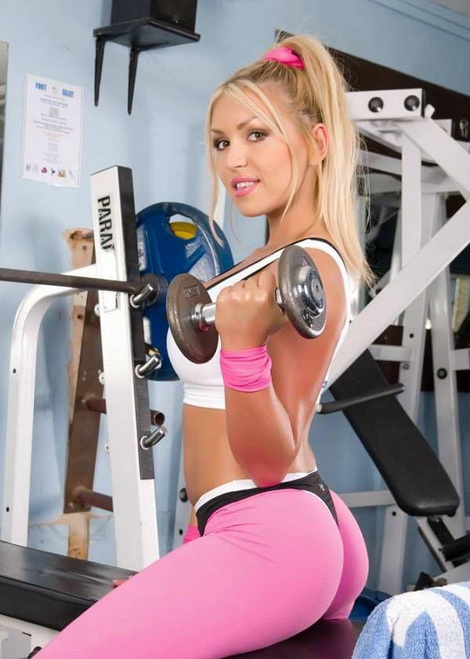
But don't try TOO hard. Like this girl.

Yesterday, one of the main student publications at my illustrious university came out with this gem, titled “Dressing to Impress at the Gym.” After the title and byline, the article takes an unfortunately predictable route:

So the gym might not be the sexiest place on earth. But, who says that it can’t be one of the most social? However unlikely, SPAC, Blomquist and the Evanston Athletic Club are some of the best places to meet guys on campus. Yes, The Keg or a fraternity party would be obvious choices, but those get old quickly. Guys flock to the gym from all corners of the university and, like it or not, they could be on the prowl.

Oh, dear heavens no! Guys could be “on the prowl!”

First of all, I just want to congratulate the author of this article for her implied success in “meeting guys” at the Keg or at a frat party. I have never been able to find decent specimens there, but clearly, this girl is just more skillful than I am.

Anyway. The article goes on to list helpful tips for girls who are super duper concerned with the scant possibility that someone may look at them while they’re working out. Most of the tips involve buying severely overpriced clothing and accessories at places like Lululemon and Gap. One of them involves wearing a bright-colored bra (way to attract attention while also looking completely fucking ridiculous).

The one that really gets me, though, is the last tip:

Don’t be that girl. “You can tell when a girl is trying too hard,” Medill sophomore Antonia Cereijido said. “They’ll wear no clothing and walk on the treadmill rather than actually getting a workout. They just look kind of silly.”

That’s right, ladies–don’t be that girl who “tries so hard” and cares so much about how she looks while working out, but do go ahead and read an entire article that tells you how to look good while working out.

There are so many things wrong with this article. Where to begin?! Well, first of all, with the assumption–never stated in this article, but implied nonetheless–that no matter what a woman happens to be doing, what matters most is always how she looks doing it.

We’ve seen this before with women like Michelle Obama, Hillary Clinton, and Elena Kagan–women who are helping to run the country but find themselves subjected to neverending commentary about their looks.

What I didn’t expect, however, was to find this same principle at work in the student magazine of what I had hoped–before I got here, that is–was a fairly intellectual college. Women, according to this article, exist to be looked at (by men, of course). And this completely ignores the fact that many men find it really sexy when a woman is working out and doesn’t care how she looks.

The second major problem I had with this piece was the implication that even if you’re not at the gym in order to pick up guys, you should still concern yourself with the fact that you may be looked at. As the introduction says, “Guys flock to the gym from all corners of the university and, like it or not, they could be on the prowl.”

Like it or not? Well, I suppose I don’t, but what the hell do I care if they look? It’s not my job to make sure that no man is ever, G-d forbid, offended by my appearance–especially not while I’m at the gym. I don’t owe anyone anything, and if they look at me and don’t like what they see, they are free to look elsewhere.

But no. According to this article, girls should always care that they’re being looked at, which is why they should always look good, even while working out, even if they’re not even looking to meet any guys. How empowering!

A third issue here is the implication that the gym is only for people who are able to fit their bodies into the cute, tight little shorts and tops that the article practically advertises. Um, last I checked, many people go to the gym in order to lose weight and/or become more fit, not to show off their already-perfect bodies.

But then again, the article isn’t really aimed at those people, is it? Because, after all, who on earth would want to look at them, anyway?

And that’s just the thing. Articles like this always imply that gyms are for attractive people only, which is just as ludicrous as saying that French class is for people who speak French fluently, and art class is for people who can already paint.

Finally, even though the article is obviously aimed at women (men, after all, don’t need to concern themselves with such petty issues as appearance), it nevertheless constructs the gym as a man’s space–one that women may occupy only as long as they follow the rules. As a guy quoted in the beginning of the article says, “I think it’s good that girls take care of their bodies and that they’re not afraid to go into the gym where there’s guys lifting heavy weights and stuff.”

Not afraid to go into the gym? Please.

Of course, the fearlessness that this guy finds so incredible comes with strings attached–women must always look good at the gym, or else…well, I don’t know what happens then. Do our memberships get revoked?

What’s really disappointing about all of this is that I’ve always thought of the gym as a great equalizer, of sorts. Anyone can go there, anyone can benefit from going there. It’s the one place where I’ve never felt like my appearance was being scrutinized, and I’ve always felt comfortable letting go and getting into the flow of exercising.

But clearly, some of the people I go to school with don’t see it that way. You’d think that there are few pursuits more self-directed than exercise, but to them, the gym is just another place to “be seen,” and its health benefits are secondary.

Of course, the author would argue with me here. She even writes at one point, “Remember ladies, health is important, so when at the gym you should still be the number one priority.”

But if she really feels that way, why didn’t she write an article about, say, how to figure out what your heart rate should be while exercising? Or how to use all those damn strength training machines I still haven’t figured out how to use? Or how to work out as many different muscle groups as possible in as few different exercises as possible? Or any number of other health-related topics?

I’m very idealistic about journalism. I think that all journalists, even students at a campus publication, are, in a way, setting the agenda for us as a society. Every moment spent writing piece-of-shit articles like this is a moment not spent writing about stuff that actually matters.

Rather than writing an article that practically shits out the same sexist tropes we’ve all grown up with–that women owe it to men to look good, that only thin athletic women are worth looking at, that men are only attracted to women who actively try to look good rather than just doing what they love with abandon–this student could’ve written an article about why it doesn’t fucking matter what you look like when you’re working out.

But she didn’t do that. She chose to promote the sexist tropes instead, thus doing her small part to keep an unfortunate aspect of our culture going strong.

Why I Oppose Banning Burqas

This is not the problem.

And no, my reasoning has nothing to do with racism or any other ism!

Belgian lawmakers recently passed a bill that, if approved in their senate, would make it illegal to wear burqas in public. This comes on the heels of France’s

When justifying banning burqas or similar Islamic garments, people typically make two points–one, that burqas represent and facilitate the oppression of women, and two, that they pose a security risk.

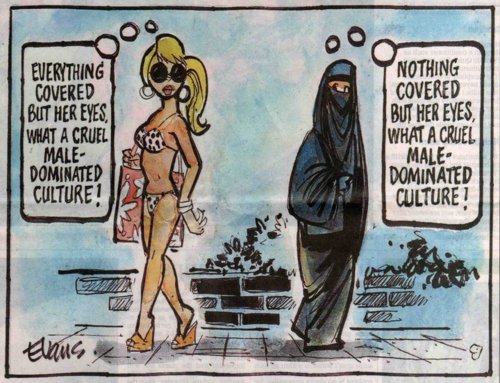
I’ll address the oppression issue first. Some women do indeed wear burqas because they’ve been pressured into it by their culture or by specific men in their lives. But other women do it out of a genuine desire to observe their religion in that way. Some even see it as an empowering gesture. It is fundamentally unjust to oppress the latter group in the name of protecting the former.

But even if I’m being completely naive, and even if not a single Muslim woman willingly chooses to wear a burqa, I conveniently have a second argument. For those women who are being oppressed by the burqa, would banning it really help? The obvious answer, I should hope, is no. In this case, banning the burqa is the legal equivalent of slapping a band-aid over a knife wound–and of treating the symptoms rather than the disease. The disease being, of course, large-scale societal oppression of women. Not something that can be fixed with a single magical law. To use an analogy that’s even closer to my personal experience, banning burqas to promote feminism is like banning suicide to promote mental health.

Not only would banning it not help, but it would probably backfire. If these women’s husbands or fathers are pressuring them into wearing the burqa, they would probably keep right on doing it despite the new law, thus placing these women in a prime position for facing charges, jail time, or plain ol’ harassment by the police. After all, they would be the ones paying the price for breaking the law, not men.

As for the whole security issue, I don’t have too much to say about that because I’m honestly not an expert on the subject, but I’ll say this–Israel has no burqa ban, or any sort of ban on Islamic head coverings, and yet has an incredible security force that manages to stop virtually all potential terrorists within the country’s borders. They don’t release these statistics to the public, but all the time in the Jerusalem Post, you see another story about security guards catching a would-be terrorist. Maybe the security authorities in these European countries should have a big pow-wow with Israeli ones and see what they’ve been missing.

I think it’s very tempting for people (and governments) to believe that issues like the oppression of women by organized religion can be fixed by something as simple as a law banning burqas. But ultimately, you can never really know what’s going on in someone else’s mind. What looks like oppression to us may not feel that way to the women in question. Or maybe it does. In any case, banning burqas won’t help.

I’ll leave you with my favorite cartoon on this subject:

An Indictment of Party Pop

Just when you thought I was finally done writing about alcohol and partying, here I go with yet another post about it!

Before I start talking about party pop, though, I need to clarify what exactly I’m talking about, because apparently some people still don’t get it. Every once in a while someone who doesn’t know me too well says something like “OMG I READ YOUR BLOG AND I GUESS YOU HATE FUN HAHA.” Um no.

So let me explain. I do not hate alcohol. I do not hate parties. I do not hate fun. I do not hate people who drink and party, except when they’re infringing on my personal space. What I hate is something I call “party culture,” which, by my definition, contains the following components:

  • the belief, prevalent among people of all ages, that partying is the one and only acceptable way for young people to spend their free time and socialize
  • the glorification and normalization of binge drinking (formally defined as drinking five or more drinks in a row, but I also use it generally to refer to drinking in a way that jeopardizes one’s health and safety)
  • the use of alcohol as a means to coerce women and excuse sexual assault
  • the idea that people who choose not to party are deficient in some way
  • pressuring people to drink and party (This is truly unique in college. I was never pressured to join clubs, go to football games, explore Chicago, attend dorm events, or do any other social activity quite like I was pressured to party.)
  • the belief that alcohol is something people “need” in order to relax, talk to people, hook up, have fun, etc.
So there’s party culture for you. As for party pop, I read a piece about it in this summer’s issue of Bitch magazine. The piece was actually a really interesting analysis of the changes that this sort of music has gone through; whereas drunk girls in pop culture used to exist basically as a spectacle for men’s benefit, more recently they seem to be partying for themselves (the article mentions Ke$ha and Katy Perry as examples). Anyway, you’d really have to read the whole article to see all of the points it makes, but that’s the gist of it, and the author sees this as a positive development–female empowerment and blahblah.
However, where the article falls short is that it still seems to present party pop as a symbol of rebellion:
Today’s party-girl pop continues down the avenue of non-explicitly politicized, pleasure-focused rebellion against gender norms carved out by flappers and disco divas.
And:
[Party-girl pop] is valuable in its large-scale reflection of changing the meaning of pleasure and autonomy among young women, both to create a culture for girls themselves and to give older people a peek into these changing mores.
Here’s the thing, though. Whereas the music from which party pop presumably draws inspiration, such as the Beastie Boys’ “(You Gotta) Fight for Your Right (To Party!),” was actually made a time when partying was considered a subversive thing for people (especially women) to do, we’ve come quite a ways since then. Party culture has become normative. It’s not partying, rather than partying, that now draws judgment and scorn. Trust me, I’d know.

The truth is, even my socially conservative parents and their white middle-class friends think that partying is just what the kids do these days. For some reason, though, the party lifestyle continues to hold this impenetrable veneer of revolutionary coolness.

When I listen to music that glorifies party culture and hear people ranting about how rebellious and groundbreaking and cool it is, I imagine someone making music about how awesome it is not to live on a farm or to be able to live past age 50. Like, okay, cool, but I thought we were over that by now.

Maybe what we should be talking about instead is the fact that party pop contributes to a culture in which alcohol is viewed as the one and only means to having a worthwhile and enjoyable life, and partying is seen as something “everyone” does. And I’m not even making random unbased claims here: studies have shown that college students overestimate how much their peers drink, and that the more they think others drink, the more they drink themselves. That’s why, when I went through training to be an RA at Northwestern, we were told to provide our residents with the results of surveys done at NU that showed how much students actually drink. Because when you think that everybody is just constantly going out and knocking back six vodkas in a night, you’re more likely to try to do that, too.

Furthermore, I disagree with the Bitch article’s assertion that party pop is helping to redefine gender roles for women. The line of argument here is that because these women party for their own pleasure, they are paving the way for our culture to accept women as autonomous and equal to men. I don’t think it really works that way, though. I think that now, rather than having one function–pleasing men–women have two functions–pleasing men and getting shitfaced. I don’t see how this helps society recognize the right of women to hold positions of power, contribute to scientific research, control their own reproductive health, or generally do much of anything that doesn’t involve getting intimate with a toilet bowl at the end of the night. (As for the shitshow that consists of male-created party pop, I’m not even going to get into that now.)

The very artists that the author of the article considers pioneers in this regard have other songs (which the author conveniently ignored) that completely contradict the supposedly revolutionary message. For instance, here are some lyrics from a recent song by Katy Perry:

Kiss me, ki-ki-kiss me
Infect me with your love and
Fill me with your poison
Take me, ta-ta-take me
Wanna be a victim
Ready for abduction
That’s empowering, alright. As for Ke$ha:
I don’t care what people say
The rush is worth the price I pay
I get so high when you’re with me
But crash and crave you when you are away
Pardon my skepticism, but I really fail to see how this music is promoting women’s autonomy. What I do see, though, is that it promotes the dangerous party culture that has infected basically every college campus–and JUST A REMINDER, by “party culture” I mean the stuff listed with bullet points above. I’m not saying this music is inherently “bad” or that we shouldn’t listen to it (that would not only be a specious argument, but it would also be a hypocritical one since I listen to a lot of this stuff myself). I do think, though, that we should make a big-ass pause before we start painting it with Beastie Boys-esque shades of rebelliousness.
Pop music, and pop culture in general, is the pulse of our society and its values. I think that if we listen closely to it, we can discern the pressures and expectations that people face from the world around them. And right now, pop music is saying that partying is the epitome of what young people should do with their lives. I think that’s an unfortunately narrow-minded view.
So if you’re too school for cool,
And you’re treated like a fool,
You can choose to let it go
We can always, we can always
Party on our own
–P!nk, “Raise Your Glass”

Periods and Misogyny


This is what I hate.

This is from a Tumblr called, appropriately, “Fuck Periods.” It exists solely to bitch about various feminine problems, most notably, periods. As a woman, I’m all in favor of bitching about periods, but the stereotypes that are often expressed are pretty problematic.

First of all, this isn’t even accurate. I don’t know about any other women who may be reading this, but personally, I don’t “sit in one fucking place for fear of leakage” when I’m on my period. I also don’t get pissed the fuck off by “anything with a face.” When I’m on my period, I go to class, do homework, hang out with friends, go shopping, work out, eat, and sleep just like I do when I’m not on my period. Shocker! Women don’t stop functioning just because it’s that time of the month. Life goes on.

Second, this whole public period-bashing thing makes it even more likely that others (notably men) will attribute any negative mood or opinion expressed by a woman as simply a consequence of her menstrual cycle. If you’re female, chances are you’ve said something negative or gotten upset or angry and had a (again, probably male) friend say, “Are you just on your period or something?”

Honestly, there are few things more offensive than that. The idea that a woman has no legitimate, external reasons to ever be angry or upset–only the internal vicissitudes of her hormones–is preposterous.

Third, and most importantly, rants like these only reinforce the stereotype of women as crazy, overemotional beings controlled entirely by their hormonal cycles. People. Give us a bit more credit than that, please. And I understand that that’s difficult to do when women themselves are painting themselves that way.