
“F*ck the Bourgeoisie”: In Which I Infiltrate a Socialist Gathering

Yesterday some friends took me to the annual conference co-sponsored by the Center for Economic Research and Social Change and by the International Socialist Organization. The conference is called, quite simply, Socialism 2012.

Now. I am not in any way, shape, or form a socialist. However, I’ve always been curious why that particular political affiliation carries such a stigma, especially in the United States. I’ve met quite a few people over the years who sympathize with Marx or with other socialist thinkers and keep those sympathies meticulously secret.

In my own life, socialism has been presented to me as Very Very Bad and Very Stupid. I have parents from the former Soviet Union, after all. Whatever value socialism may or may not hold, I will never, ever begrudge them for hating it, because it (however inadvertently) turned so many people’s lives into a living hell all over the world.

(Yes, yes, I know that wasn’t “real” socialism. But it’s pretty hard for people to stay objective when their friends and family are dying, so I’m not going to be the asshole who minimizes their suffering by telling them that.)

That said, I generally prefer to learn and experience things for myself. I don’t buy for a second the argument that one should stay away from these things for fear of being “brainwashed,” which I’ve heard many times before. In fact, I’m actually pretty insulted when people tell me that. I think everyone should know by now that if there’s only one thing I’m good at, it’s thinking for myself.

So, let it be known that I did not come back from this conference a changed woman. I’m not any more a socialist today than I was two days ago.

What I do have is a new appreciation for socialists and for the spaces they create. It must be nice to belong to a collective like socialism. Everyone there seemed to know each other, and I saw people from all walks of life–young people like me, middle-aged respectable-looking people, aging college professors. There were people of all shapes and colors. Tons of queer people. People with various interesting hairstyles. Aside from the issue of their politics, I felt somewhat at home.

I went to a talk on Marxism and queer theory, which, amazingly, I understood most of. While this is nothing all that different from something I might come across in a class at school, there is nonetheless something special about the fact that hundreds of people got together to talk about this on a Friday night. Not for a grade. Not for their resume. Certainly not for social approval, since going to a conference on socialism is pretty far down on the list of things people do to fit in.

The most amazing part of it, to me, was that I had entered the sort of space that I consider sacred–a space in which “serious” discussion is the norm, not the exception. A space in which it’s normal, upon first meeting someone new, to ask them about their views on a particular political issue. A space in which nobody thinks you’re weird if you’re checking out the bookstore and freaking out with your friends about all the great books you’re finding. A space in which politics is something to get emotional about, something to loudly, clearly express your emotions about, whether by cheering, clapping, hissing, booing, shaking your head, snapping your fingers, or putting your fist up in the air.

And I, who have been told ever since childhood to “calm down” and “stop getting so emotional about it” and “go get a life,” felt comfortable among these people with whom I otherwise disagree quite strongly.

That disagreement, which lurked beneath my consciousness for most of the time I was there, surfaced strongly during a break between talks, when people were chanting. Most of the chants were exactly of the sort that you’d expect–one amusing one went like this: “One, two, three! Fuck the bourgeoisie! Four, five, six! Fuck the bourgeoisie!” And so on.

But then there was a chant that repeated the word “Intifada” over and over. I don’t remember exactly how it went because I tend to block these things from memory somewhat. I’m Israeli by birth, and Israel is something I almost never write about for various personal reasons. My stance on the issue is even-keeled and probably in line with that of most American liberals and progressives and so on. That said, I will tell you that it is incredibly alienating and deeply painful to hear a room full of people chanting something that, to you, could mean the deaths of friends and family. I know that’s not what it means to Palestinians. And it’s especially not what it means to white American socialists. But that is what Intifada means to me.

I know where they’re coming from. I’m quite well-versed in the “terrorist as freedom fighter” line of thought. They’re entitled to their opinion as I am to mine. But shouting something like this seems gauche and callous, like chanting “USA! USA!” when America invades another country, or like gathering to watch a public execution as entertainment. I’m choosing to believe, though, that these people are well-intentioned and believe that what they are chanting about is some convoluted form of peace.

This is not a political statement. This is not a statement about equivalency, who’s right and who’s wrong, whose land it is, who committed more war crimes and human rights violations, etc. This is a statement that is entirely moral: I believe it’s wrong to glorify killing innocent people, no matter to what end.

And, just for the record, I’ve been in countless pro-Israel spaces before, including an AIPAC conference, and I’ve never heard an equivalent sort of chant there. I’m sure it happens, but I’ve never seen it. And when it does happen, whatever the setting, I would find it as disgusting and wrong as I found this Intifada chant.

In any case, I was determined not to let that spoil the whole evening. It was a reminder, though, that it’s not only my lack of socialist politics that ultimately makes me unwelcome there. It’s something as incidental as the circumstances of my birth.

It would be nice if, someday, I find a group with this sort of energy and passion that I do actually agree with. But I’ve long given up seeking a spiritual, political, or cultural home anywhere.

For now, it’s enough to occasionally go to things like this–and things like Pride and Occupy Chicago and Friday night Shabbat dinners–and witness other people experiencing that feeling that I want so badly for myself.

How I Learned to Stop Worrying and Love the B’s

College students seem to love this poster, perhaps because it reminds us to calm the fuck down. Did you know it was originally created by the British government during WWII to keep citizens calm in the event of an invasion? How’s that for perspective.

A few weeks ago, our final grades for spring quarter were posted online. This usually happens on the Monday evening after the end of the quarter, and you see people posting Facebook statuses about their grades all night.

I used to be one of the people who’d sit there refreshing Caesar or at least checking my Facebook newsfeed so that I would know my grades the second they were handed down from above like a court decision. When you work for something for ten weeks, you want to know the results immediately.

But this time, I didn’t check my grades right away. In fact, I still haven’t checked them. And I’m not going to until the next time I need to update my resume.

It’s not that they were going to be extra crappy this quarter or anything. It’s not that I need good grades any less than I did before. Nothing changed, except that, one day not long before the quarter ended, I realized that grades had started to rule my life.

This is a long story, and one that will be familiar to anyone who’s attended a school like Northwestern. This story involves panic attacks, hours on the phone with one’s parents, Red Bull, and contrite emails to professors. It involves checking the average GPAs at all the top grad schools and choosing classes based on how likely you are to get an A in them. At times, it involves sacrificing education–true education–for a false feeling of accomplishment.

There are many episodes in this series. There was the time I sat in the snow winter quarter of freshman year and bawled before going back into Tech, finding the computer lab, and dropping a class for the first time. There was the time I told my mom I was going to just become a housewife after graduation (a housewife without a husband?). There was the time I seriously considered just moving to Israel and joining the army. There were the times–yes, unfortunately, that’s plural–when I did something self-destructive.

All that, because of a number.

One of the most insidiously dangerous things about the culture at Northwestern (indeed, probably at most elite schools, but I can only speak for this one) is how driving yourself crazy over grades and schoolwork becomes normalized. If a normal, average, non-Northwestern person saw me a few weeks ago–when I was freaking out and crying because I might do poorly on my Hebrew final which might give me a B in the class which might lower my GPA substantially enough which might prevent me from getting into graduate school which might prevent me from having something to do after I graduate–that person’s reaction would probably be horror and pity.

But a fellow student at Northwestern would just nod their head and smile and perhaps suggest that I get drunk this weekend to forget all about it.

While it’s great to have people who understand what we’re going through, I think it’s hazardous to our mental health that we have such an echo chamber of academic anxiety. Because any informed adult will tell us that this is all ridiculous. You’re not going to be screwed for life just because you failed one class at some point in college. You’re not going to be turned down from every job just because you only got a C in calculus. It just won’t happen. These are lies we sell to ourselves when we’re (understandably) worried and uncertain about the future.

I wish I had a crystal ball that could tell me exactly how it’s all going to work out–whether I’ll go to grad school right after college, which one I’ll go to, which degree I’ll get, where I’ll live, who I will be.

But I don’t. And in the meantime, I want to live my life.

It’s entirely possible that right there in my Caesar account, unbeknownst to me, is a grade so horrendous that I actually will get rejected from grad school. So I’ll go get a job until I can get into grad school. And if I can’t get a real job, I’ll go volunteer and work part-time until I can get a real job. It’ll work out, even if I might have to live paycheck-to-paycheck for a while.

Of course, it’s impossible to aspire to go to grad school and yet completely not care about your grades. I need to care about them and keep them as high as I can, and I think it’s natural to worry occasionally that they’re not good enough.

But this constant catastrophizing of every single exam, paper, and assignment?

That needs to go. I can’t live like that.

More to the point, living in a state of anxiety probably doesn’t do wonders for my academic performance anyway.

Regardless of my grades, everything will be okay and life will eventually work out.

Update: And because I can’t write a post without including something political and sociological, read this.

I Read the Texas Republican Party Platform So You Wouldn’t Have To

The Republican Party of Texas recently released its 2012 platform, a 23-page document that I decided to read because there isn’t enough misery in my life, apparently.

This document is stunning even by Republican standards (sorry, Republicans). I will outline some of its most preposterous points here. (Note, however, that the preposterousness is by no means limited to what I’m including in this post.) Section-by-section, here it is. If you need alcohol, I suggest drinking each time they invoke God as the basis of their policies.

“Preserving American Freedom”

  • “We strongly support the immediate repeal of the Endangered Species Act. We strongly oppose the listing of the dune sage brush lizard either as a threatened or an endangered species. We believe the Environmental Protection Agency should be abolished.” I don’t know about the status of the dune sage brush lizard in particular, but I do know that a world without the EPA would be a pretty terrible world. I mean, unless you want polluted air and water, uncontrolled pesticide sales, etc.
  • “We oppose this act [the Employment Non-Discrimination Act] through which the federal government would coerce religious business owners and employees to violate their own beliefs and principles by affirming what they consider to be sinful and sexually immoral behavior.” What a drastically stupid misunderstanding of ENDA. Nobody’s asking anybody to “affirm” anything. They’re simply asking employers to stay out of their employees’ bedrooms.
  • “We urge Congress to adopt the Constitutional Restoration Act and support the principle of judicial restraint, which requires judges to interpret and apply rather than make the law. We support judges who strictly interpret the law based on its original intent.” I am reminded of a particularly humorous New Yorker cover. I can easily see why these reactionaries take such an issue with judicial activism, as that’s what brought us reproductive rights, desegregated schools, and other such horrid things.
  • “We urge that the Voter Rights Act of 1965 codified and updated in 1973 be repealed and not reauthorized.” Let me rewrite this part of your platform for you: “We support the disenfranchisement of African Americans and the poor while pretending that that’s not what we’re really doing.”
  • “Any form of desecration of the American Flag is an act of disregard for our nation and its people and penalties should be established for such.” Wait, what was the title of this section again? “Preserving American Freedom”? That First Amendment is just so inconvenient sometimes.

“Strengthening Families, Protecting Life and Promoting Health”

  • “We support the definition of marriage as a God-ordained, legal and moral commitment only between a natural man and a natural woman, which is the foundational unit of a healthy society, and we oppose the assault on marriage by judicial activists.” What is a “natural man”? What is a “natural woman”? Do tell.
  • “We urge the Legislature to rescind no-fault divorce laws. We support Covenant Marriage.” This means that people will not be able to get divorced without having to prove that at least one person has done something drastically wrong, such as commit adultery or abuse. However, the other person could plead a recrimination defense (“but so did you”). Even if both people have abused or cheated on each other, this means that a divorce may not be granted.
  • “We support the affirmation of traditional Judeo-Christian family values and oppose the continued assault on those values.” I got nothin’.
  • “We affirm that the practice of homosexuality tears at the fabric of society and contributes to the breakdown of the family unit. Homosexual behavior is contrary to the fundamental, unchanging truths that have been ordained by God….” Thou doth protest too much.
  • “All innocent human life must be respected and safeguarded from fertilization to natural death; therefore, the unborn child has a fundamental individual right to life which cannot be infringed.”From fertilization. This means that an egg which has just united with a sperm is a Human Being and that all abortions would be illegal, in direct contradiction to the Supreme Court’s interpretation of the Constitution. And, because emergency contraception such as Plan B can work after fertilization has taken place, this, too, would be banned.
  • Aaaand who called it. “We oppose sale and use of the dangerous ‘Morning After Pill.’” It is not dangerous. Who just makes statements like these without backing them up with evidence? (Texas Republicans, obviously.)
  • “We strongly support a Parental Rights Amendment to the U.S. Constitution.” I LOL’ed.
  • “We unequivocally oppose the United States Senate’s ratification of the United Nations Convention on the Rights of the Child.” That’s correct, parents have rights but children do not. Among other things, then, the Texas GOP opposes the protection of children from abuse and exploitation, their right to have a relationship with both parents even if the parents have separated, and their right to be free from corporal punishment.
  • “We support eliminating bureaucratic prohibitions on corporal discipline and home schooling in foster homes.” On other words, we support child abuse.
  • “Health care decisions should be between a patient and health care professional and should be protected from government intrusion.” I include this only because of the irony, as the platform unilaterally supports government intrusion into healthcare decisions whenever they involve a woman’s reproductive parts.
  • “All adult citizens should have the legal right to conscientiously choose which vaccines are administered to themselves or their minor children without penalty for refusing a vaccine.” Thereby destroying herd immunity and bringing back lethal, crippling diseases. Makes sense.

“Educating Our Children”

  • “We believe the current teaching of a multicultural curriculum is divisive. We favor strengthening our common American identity and loyalty instead of political correctness that nurtures alienation among racial and ethnic groups.” In other words, we favor imposing our culture onto others because our culture is The Only Correct Culture.
  • “We recommend that local school boards and classroom teachers be given more authority to deal with disciplinary problems. Corporal punishment is effective and legal in Texas.” Corporal punishment is not effective and should not be legal. Dozens of studies conducted by Evil Un-American Scientists suggest this.
  • “We support objective teaching and equal treatment of all sides of scientific theories. We believe theories such as life origins and environmental change should be taught as challengeable scientific theories subject to change as new data is produced.” I suppose that’s better than not teaching them at all, but there is such a thing as scientific consensus. Evolution and man-made global warming, to use the non-euphemistic terms, are not controversial among the people who are educated enough to study them. They are only controversial among the uninformed.
  • “We oppose the teaching of Higher Order Thinking Skills (HOTS) (values clarification), critical thinking skills and similar programs that are simply a relabeling of Outcome-Based Education (OBE) (mastery learning) which focus on behavior modification and have the purpose of challenging the student’s fixed beliefs and undermining parental authority.” Guys, I don’t know how else to say this: they literally oppose thinking. They oppose producing citizens who are capable of critically evaluating information and ideas. They support producing citizens who do what they’re told because God/Pop said so.
  • “We oppose any sex education other than abstinence until marriage.” Congratulations, you support a scientifically discredited form of sex ed.
  • “We support school subjects with emphasis on the Judeo-Christian principles upon which America was founded and which form the basis of America’s legal, political and economic systems.” Okay first of all, stop it with this term “Judeo-Christian.” Most Jews do not want our faith roped into this bullshittery. Second, newsflash, not everybody in the United States (or even in Texas) is Jewish or Christian. Deal with it.
  • “Since education is not an enumerated power of the federal government, we believe the Department of Education (DOE) should be abolished.” Oh vey.

“Promoting Individual Freedom and Personal Safety”

  • “We oppose the monitoring of gun ownership, and the taxation and regulation of guns and ammunition.” *barf* *yawn*
  • “We urge immediate repeal of the Hate Crimes Law.” I don’t even know which law this is talking about and I can’t find out, but on the whole, hate crimes are pretty bad.
  • “We support the Boy Scouts of America and reject any attempt to undermine or fundamentally change the ideals of the organization.” Yo why is this in here?
  • “We believe a person who injures or kills an unborn child should be subject to criminal and civil litigation.” So, a woman who has a miscarriage?

“Strengthening the Economy”

  • “We recommend repeal of the Sixteenth Amendment of the U.S. Constitution, with the goal of abolishing the I.R.S and replacing it with a national sales tax collected by the States.” So how are they going to afford all that intrusion into Americans’ bedrooms? Not to mention the foreign wars? That’s what I want to know.
  • “We support immediate resumption of deep water drilling and production in the Gulf of Mexico.” Because that worked out great last time.
  • “We oppose the abusive use of class action lawsuits.” This would be…what, exactly?
  • “We believe the Minimum Wage Law should be repealed.” This certainly needs no comment.

“Defending Sovereignty At Home and Abroad”

  • “We support the withdrawal of the United States from the United Nations and the removal of U.N. headquarters from U.S. soil.” I’m not a huge fan of the UN for various reasons, but there needs to be some sort of authority that at least attempts to keep the interests of the entire world in mind.
  • “To protect our serviceman and women and ensure that America’s Armed Forces remain the best in the world, we affirm the timelessness of those values, the benefits of traditional military culture and the incompatibility of homosexuality with military service.” WHY. Somebody just tell me WHY.
  • On Israel, presented without further comment: “Our policy is based on God’s biblical promise to bless those who bless Israel and curse those who curse Israel and we further invite other nations and organizations to enjoy the benefits of that promise.”

So there you have it. There are certainly sensical and intelligent positions in this platform, too, but they’re mostly common sense. For instance, prosecute child molesters. Provide healthcare to veterans. Allow police officers to find criminals. You know, that sort of thing.

There are also a notable number of direct contradictions in this document. For instance, they say, “We favor improving the quality of education for all students, including those with special needs,” and then they proceed to outline a curriculum that destroys critical thinking. They say that the government should stay out of healthcare decisions, and yet they not only propose to ban all abortion, but they even decry Plan B as “dangerous” (which it is not). They also indicate specifically what information doctors are required (and, of course, not required) to provide about abortion. And, at one point, they even state, “As America is a nation under God founded on Judeo-Christian principles, we affirm the constitutional right of all individuals to worship in the religion of their choice.” This makes no sense! It is exactly because America is not a religious nation that religious freedom is even possible.

Why should you care about a platform advanced by one state’s Republican party? Even supposing all other Republicans in the country are perfectly reasonable and do not oppose things like voting rights for African Americans and critical thinking skills for children (unlikely), Texas is a large state and Republicans outnumber Democrats by a large margin in both houses of the legislature. So this affects a lot of people.

And, furthermore, the platform itself also states, “Every Republican is responsible for implementing this platform. Party candidates should indicate their positions on platform planks before their acceptance on the ticket and such information should be available on the Party website.” So, for all the crap I occasionally get to the tune of “Yeah well not all Republicans are like that” and “Yeah well many Republicans actually support same-sex unions,” well…in Texas, this is exactly how they are.

For more take-downs, see here, here, and here.

In Defense of Cynicism

I’ve been thinking about cynicism a lot lately, for no particular reason aside from the fact that I am a cynic.

According to the actual definition, a cynic is either an adherent of the Greek philosophical school of cynicism, and/or simply a person who believes that human actions are motivated by selfishness (or rational self-interest, to put it more euphemistically).

While I do happen to believe that, I think the word “cynic” has taken on a slightly different, more general meaning, and that is the one that I usually think of when I call myself that. This general definition is that a cynic is a person who sees the faults in things more clearly than most.

Obviously, this entire blog is an expression of that particular trait of mine, and that’s why people seem to either love it or hate it–for the most part, you either “get” cynicism or you don’t.

I think, though, that at least when it comes to politics and social justice, cynicism isn’t nearly as miserable and self-defeating as people think it is. Most intelligent people, if pressed, will admit that there are some serious problems in our society. However, they will tell you that none of this will ever change, that it’s depressing to even think about, and that it’s best to focus your attention on friends, family, work, hobbies.

But we “cynics,” who point out all these problems and analyze them so enthusiastically, seem to actually enjoy the process of unearthing trouble, even if the things we find often disgust and dismay us. The reason the process is so rewarding is because we know that we’re crawling along towards change, and that the more people we urge to care with our commentary, the faster that crawl will go.

So who’s the real cynic?

Of course, there are certainly people out there who cannot remain informed about societal problems while still holding on to their mental health. To such people, I would obviously say to take care of yourself first.

But I think that most people who protest that being critical is “depressing” are selling themselves short. What’s truly depressing is to feel like you have to deceive yourself into believing that everything’s just awesome because you can’t change it anyway.

Cynicism may not be the right word for my approach, but I don’t think there really is one. For instance, calling myself a “critical” person sends an equally distorted message, because it makes it sound like I criticize things for the sake of criticizing them. I don’t. I criticize them because they need to be criticized, and because we all stand to gain from criticizing them.

Instead, I like to call my philosophy “optimistic cynicism.” Or, you know–hope.

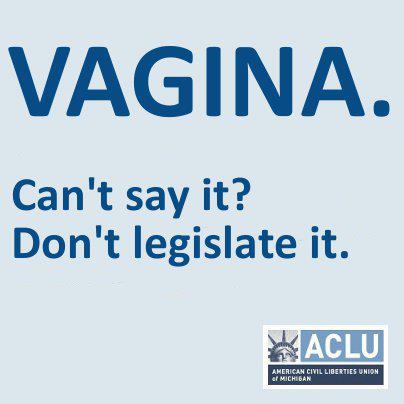
“Vagina” is Not a Four-letter Word

You would be forgiven for assuming that our elected politicians are mature adults who can handle using words that designate genitalia. You would especially be forgiven for assuming that given that many of these politicians are very eager to legislate what can and cannot be done with genitalia.

However, you’d be wrong.

This is old news now for anyone who follows these things, but in case you don’t, here’s a recap. On June 14, the Michigan House of Representatives was debating a new bill that would severely limit a woman’s ability to get an abortion by placing new restrictions on abortion providers. The bill passed the House and will go to the Senate most likely in September. (They were also debating a separate bill, which did not pass, that would’ve restricted all abortions after 20 weeks, with no exception for rape or incest).

In response to this, Representative Lisa Brown (three guesses which party) gave a speech in opposition and said, “I’m flattered that you’re all so interested in my vagina, but ‘no’ means ‘no.'” You can see her speech in its entirety here.

The shock! The horror! Brown was quickly forbidden from speaking on the House floor by Republican leadership of the House. A spokesman for Republican Speaker of the House Jase Bolger said, “House Republicans often go beyond simply allowing debate by welcoming open and passionate discussion of the issues before this chamber…The only way we can continue doing so, however, is to ensure that the proper level of maturity and civility are maintained on the House floor.”

To that end, Republican Representative Mike Callton said that Brown’s remark “was so offensive, I don’t even want to say it in front of women. I would not say that in mixed company.”

What Bolger, Callton, and the rest of these concern trolls apparently do not realize is that language is malleable and entirely based on context. In general, words might be inappropriate to say for three different reasons:

  1. They are derogatory and hurtful slurs (i.e. the n-word, fag, retard)
  2. They have been designated as “profane” by our society (i.e. fuck, piss, shit, cunt)
  3. They refer to things or functions that are generally considered inappropriate for polite conversation (i.e. penis, vagina, feces)
These three categories of Bad Words operate in different ways. The first category is inappropriate to say basically always, unless, in some cases, you belong to the group targeted by the slur, or you are using the word in a conversation about the word (but even that is controversial).

The second category are words that are usually used to make a statement. They are much more frequently okay to use than the words in the first category. That’s why when people curse, they use these words. That’s why many writers, such as myself, use them for effect. They’re generally okay to say around your friends, but many people avoid using them in front of people they don’t know well.

The third category comprises words for things that we usually avoid discussing in polite company without a good reason. You wouldn’t exclaim, “That looks like a penis!” in front of your grandma, and you wouldn’t say, “My vagina feels funny” in front of your boss (I mean…unless you have a very open-minded boss/grandma). It’s not the words themselves that are “bad,” it’s the fact that you usually shouldn’t talk about the things those words refer to if you want to be polite.

But all of this falls apart when the context demands discussion of such topics. If you’re at a doctor’s appointment and the doctor needs to tell you something about your penis or vagina, it would be laughable for him or her to avoid using those words. If you’re negotiating sex with a partner, you shouldn’t have to worry that he or she will be offended if you use those words. And if you’re attempting to legislate what women can and cannot do with their private parts, you’re going to have to face the fact that those parts have names.

The most ironic thing here, though, is Callton’s remark about the word “vagina”: “I don’t even want to say it in front of women.” First of all, that’s patriarchal as hell; women can handle naughty words just as well as men can. Second, it’s not just a naughty word; it’s a word for a thing that (most) women experience on a constant basis.

Some conservatives have apparently made a slightly more legitimate criticism of Brown in that she connects restricting abortion with rape (via her “no means no” allusion). I say “slightly more legitimate” only because, having once been a pro-lifer, I understand how they would take offense.

After all, pro-life politicians do not wake up in the morning thinking, “Yo, I’m gonna take away some rights from women and tell them what to do with their own vaginas today.” They think, “Abortion is murder and I have a duty to stop it just like I would stop the murder of a child or adult.” To them, drawing any parallels whatsoever between restricting abortion and committing sexual assault would naturally seem preposterous. It is only those of us who couch the debate in the language of personal liberty who see the similarities.

That’s why this whole incident really highlighted for me the divisions between liberals and conservatives on the matter of reproductive rights. It’s not even just that they can’t agree on whether or not abortion should be legal; it’s that they can’t agree on what abortion is, and on the terms with which the debate should be framed. Liberals say abortion is a woman’s right over her own body; conservatives say it’s the murder of an unborn human being. How can we ever reach a consensus if we define our terms differently?

I don’t know how to solve this problem–and if I did I would probably be the savior of American politics–but at least this story has a partially-happy ending. Brown and several of her colleagues performed the play The Vagina Monologues with its playwright Eve Ensler on the steps of the statehouse last Monday night as a tribute to our right to speak the names of our own body parts. About 2,500 spectators came to watch.

But as for the bill that the House passed, that’ll go on to marinade in the state Senate, which currently has 26 Republicans and 12 Democrats. I’m not getting my hopes up.