Unknown's avatar

About Miri

Writer, activist, social worker, and huge fan of cats, flowers, and cities.

“Shit Girls Say” Isn’t Funny

Or, perhaps, it’s only funny if you don’t consider the context.

Check it out:

This is the first episode of the wildly popular web series Shit Girls Say, which draws its humor from portraying stereotypical (white) (middle-/upper class) women in quick bursts of cliched speech. And I can definitely see how many people, even many women, would find it funny.

But let’s deconstruct it a bit.

Why do women talk like this and men don’t? No, seriously, try to answer that question. Is it because they have two X chromosomes? Is it because they have more estrogen? Is it because they have tits? Is it because their bodies produce eggs?*

Or is it something cultural?

Except for those of us who had the most progressive of parents, most of us were raised in a viscous sludge of “boys do this/girls do this/boys don’t do this/girls don’t do this” remarks. As my gender studies professor recently remarked, hang out near a parent with a toddler at a store sometime and you’ll hear a barrage of comments to the tune of “You’re not getting that, that’s for girls!” and “Don’t you want to wear something prettier?”

Right, so. Part of the education that most of us receive is how to properly relate to both same-sex friends and to members of the opposite sex. The basic lesson is, of course, “Boys don’t cry,” which can be extrapolated to mean that girls can cry, if they want to. From this basis, the entire structure of normative ways of interacting develops–women can be very emotional with each other; men cannot.

Eventually, girls who don’t display this “relational” style of behavior come to realize that they’re acting wrong somehow. I would know, because I was once such a girl. From early childhood onward, it was always “You’re so insensitive. Why can’t be you be more considerate? Why can’t you think about someone besides yourself? Why can’t you realize that I need your help? That wasn’t very nice of you to say that to your friend. Have you thought about what present to get her for her birthday? You really think she’d like that? Don’t say things like that, you’ll hurt someone’s feelings.”

I don’t think many little boys are told such things.

What the women in the Shit Girls Say videos are saying are more evolved forms of the things I was expected to say as a little girl. They relate to each other. They ask each others’ opinion. They want to share the details of their lives with each other. They want to commiserate, open up, engage. I could analyze the language of the videos in detail if anyone were interested in hearing it, but I think it will suffice to say that the stereotypical ways in which women behave–the gossiping, the complaining, the requests for help–are all designed to help them connect with each other.

(As for one of the girls’ constant need for help with the computer, I would hope I don’t need to explain how women’s supposed lack of technological expertise is not only a huge overgeneralization, but also entirely attributable to a culture that still values girls who play with dolls over those who tinker with electronics.)

Recently I noted that in our society, women are considered ugly if they don’t maintain their appearance, and vain if they do–unless, of course, they manage to wind up in that magical sweet spot where they always look flawless but make it seem like they haven’t expended any effort to look that way.

Well, this is similar. Our culture trains women to be relational, and then pokes fun at and belittles them for being so. Shit Girls Say succeeds in its comedic endeavors by noting and exaggerating stereotypes about how women behave, but women don’t behave that way because they’re women. They behave that way because they’re taught to behave that way.

You can’t really win as a woman. If you don’t act in a relational way, you’ll be a loner, like I was for many years before I learned how to wear a mask of friendliness and approachability. But if you do act in a relational way, you’ll find yourself the target of jokes about how frivolous women’s conversations supposedly are, how overexcited they are when they see each other, and how they apparently ask their boyfriends to do everything for them (don’t even get me started on the fact that many men still buy into antiquated ideas about how they’re supposed to be the “providers” and whatnot).

So I don’t think Shit Girls Say is funny. Now, I wouldn’t go so far as to call it sexist or misogynistic. But I would say that it’s ignorant in that it ignores the cultural origins and meanings of women’s behavior, and it’s insensitive in that it disregards the burden placed on women to act in those ways.

Cheap-shot comedy like this favors easy caricatures over meaningful critiques and analysis of our culture. (Try this for a still-funny but socially conscious parody of Shit Girls Say.) Go ahead and laugh–it’s funny in a way–but educate yourself, too.

*I’m defining “men” and “women” very generally here for the purposes of making a point. Needless to say, I don’t believe that any of the traits I listed are necessary for being a man or a woman.
The Complete Idiot’s Guide to Breast Cancer Awareness

If you have ever seen a bunch of women posting Facebook statuses with a random color, or a location where they “like it,” and felt a mix of confusion and frustration, you are not alone.

These memes are part of an effort for breast cancer “awareness,” a word that I use cynically here and only in quotation marks. The color meme referred to women’s bra color, and the location one referred to where they like to put their purses. Of course, they made it sound sexual to attract more attention: “X likes it by the bed”, “Y likes it in the closet,” etc.

Now, an acquiantance of mine (who also happens to be the Director of Health Promotion and Wellness at Northwestern University, and therefore isn’t entirely ignorant about these things) has reported that this stupid trend still has not died.

Perhaps even less sensically, the latest iteration of this meme is people posting stuff like “is going to New York for five months” or “is going to Las Vegas for twelve months,” and this, too, is supposed to elicit friends’ queries and be met with the response that it’s for breast cancer “awareness.”

As anyone with even a modicum of critical thinking skills can tell you, such a status, when finally deciphered, tells you exactly one thing: “There is a thing called breast cancer and you should know about it.”

Yes, yes there is. But could we finally get beyond that?

For instance, here are some actual facts about breast cancer:

If you’d like to do some actual good, why not spread this information around?

Besides that, here are some other ways you can help:

  • Volunteer to provide support for people battling breast cancer. (This is even easier if you know of such a person. You can help by driving them to doctor’s appointments, making them meals if they’re too tired, babysitting their kids, or just being there to listen.)
  • Donate to charities that provide such support, or to organizations that fund research on breast cancer. Here are some to get your started: Susan G. Komen for the Cure, the National Breast Cancer Foundation, and the National Breast Cancer Coalition. With a quick Google search, you could find local charities, charities that cater towards a particular demographic that you belong to, and so on.
  • If you want to go beyond simply giving money, participate in charities’ fundraising events, such as Susan G. Komen’s Race for the Cure. That way you get to raise money while meeting other people who care and physically showing your support for survivors and people battling breast cancer.
  • If you’re politically liberal, be an activist for government initiatives that fund cancer research, education initiatives, support for cancer patients, expanded insurance coverage, etc. One good place to start: ask your representative to support H.R. 3067, the Accelerating the End of Breast Cancer Act of 2011, which proposes an initiative to end breast cancer by 2020.
  • If you’re studying medicine or biomedical engineering, consider making cancer research your focus. Or work as a research assistant in a lab that studies cancer.
  • Buy products from companies that donate to breast cancer research (but beware of pinkwashing).
  • Similarly, if you happen to own a business or want to start one (and I know many of you Northwestern students do), consider donating a percentage of your profits to breast cancer research.
  • If you’re going into journalism and you’re interested in health, consider writing about breast cancer. Not everyone has enough knowledge to decipher academic articles; you can be the one who makes that information accessible to those who need it.

As you can see, some of these require your time and money. Others do not. The few seconds that it takes you to type your stupid status could be better spent posting a link to an important recent article about breast cancer.

And now, I get it. Cancer is a terrifying thing. The amount of information available about it could fill books upon books, and some of it is constantly going obsolete or being revised. Even I felt a bit overwhelmed just looking at the few websites I looked at to research this article.
I also get that when your friends are posting oh-so-funny things on Facebook, you want to join in the fun. Trust me, I was in middle school once, I know.

But I have some unfortunate news for some of you: neither I, nor breast cancer survivors, nor families of breast cancer victims give a flying fuck what color your bra is or where you like to put your purse, cutesy sexual innuendo notwithstanding.

If you’re old enough to make sexual innuendo, you’re old enough to educate yourself and others about breast cancer (and, for that matter, anything else you think people should be educated about). Let’s stop selling ourselves short here.

*edit* Another reason I just thought of to hate these memes–they are generally restricted to women only, and women aren’t “supposed” to tell men what they mean, thus constructing breast cancer as a “girl thing.” Not only do men witness their friends, girlfriends, wives, mothers, daughters, sisters, etc. fighting breast cancer, but some men actually get breast cancer, so it’s not only a women’s problem.

Anyway, there is enough of a stigma placed on men who get breast cancer without its promotion through this meme.

Update (2/2/2012): In case anyone’s going through my archives and reading old posts, let it be known that I officially withdraw my support for the Susan G. Komen Foundation in light of its defunding of Planned Parenthood.

“I really want to screw you, but you have so much baggage.”

A guy actually said that to me once.

He may have been the only person I’ve ever encountered who was willing to verbalize his shallowness and ignorance, but he’s far from the only one who thinks that people need to be perfect before you can get involved with them.

That idea runs rampant in our culture, and it’s not only men who are to blame. Advice columns for women under 30 often exhibit what I call the “Dump His Ass” effect–anytime a woman writing a letter mentions virtually any imperfection in her crush or boyfriend, the advice columnist usually responds with some form of “dump his ass.” Still has feelings for his ex? Dump his ass. He’s insecure? Dump his ass. Doesn’t like your friends? Dump his ass.

(Of course, there are plenty of offenses for which a person of any gender should almost certainly be dumped, such as sexual harassment or assault, emotional manipulation, being a flaming racist/sexist/etc, and so on. I’m talking about much more minor sorts of flaws.)

Common wisdom seems to suggest that before one can get involved with another person in a healthy and stable way, they need to do things like “work on themselves” and “learn to love themselves” and “figure out who they are.” Leaving aside the fact that for most people, working on yourself and figuring out who you are is a lifelong process, there are some people who are never going to “love” or be comfortable with themselves. I am one such person. Do I not deserve to ever have a partner?

Similarly, people are expected to be “happy on their own” before they can be dateable. That’s preposterous. If you’re 100% happy being single, why would you need a serious partner in the first place? Why is it considered unhealthy to really, really want someone to share your life with?

As someone who has had “baggage” virtually since birth, I have never not been aware of the fact that American culture considers people like me undateable. However, the idea that we’re also unfuckable is a pretty new one to me.

Why? Why do people need to be perfect before we’ll have anything to do with them?

It might surprise some people to know that everyone has flaws and psychological baggage; it’s just a matter of getting to know them well enough to figure that out. And yes, other people’s baggage can sometimes cause you trouble. You know what? Tough titties. You have two options: grow up and deal with it, or avoid getting to know anyone.

Incidentally, the guy I quoted in this post’s title eventually overcame his reservations and spent quite some time harassing me for sexual favors. After I refused, he looked at me and said, “You know, I couldn’t ever see you as my girlfriend. I’d need a girl who’s sweet and kind.”

Now who’s the one with the baggage?

Learning Racism on the NYC Subway

I spent this past week in New York City with my mom and little siblings, who are six and nine years old, respectively. Aside from a few times that they were too young to remember, this was their first time in the city and they had a great time.

On our last day in New York, however, they were confronted with a situation that they would never have encountered back home in Ohio.

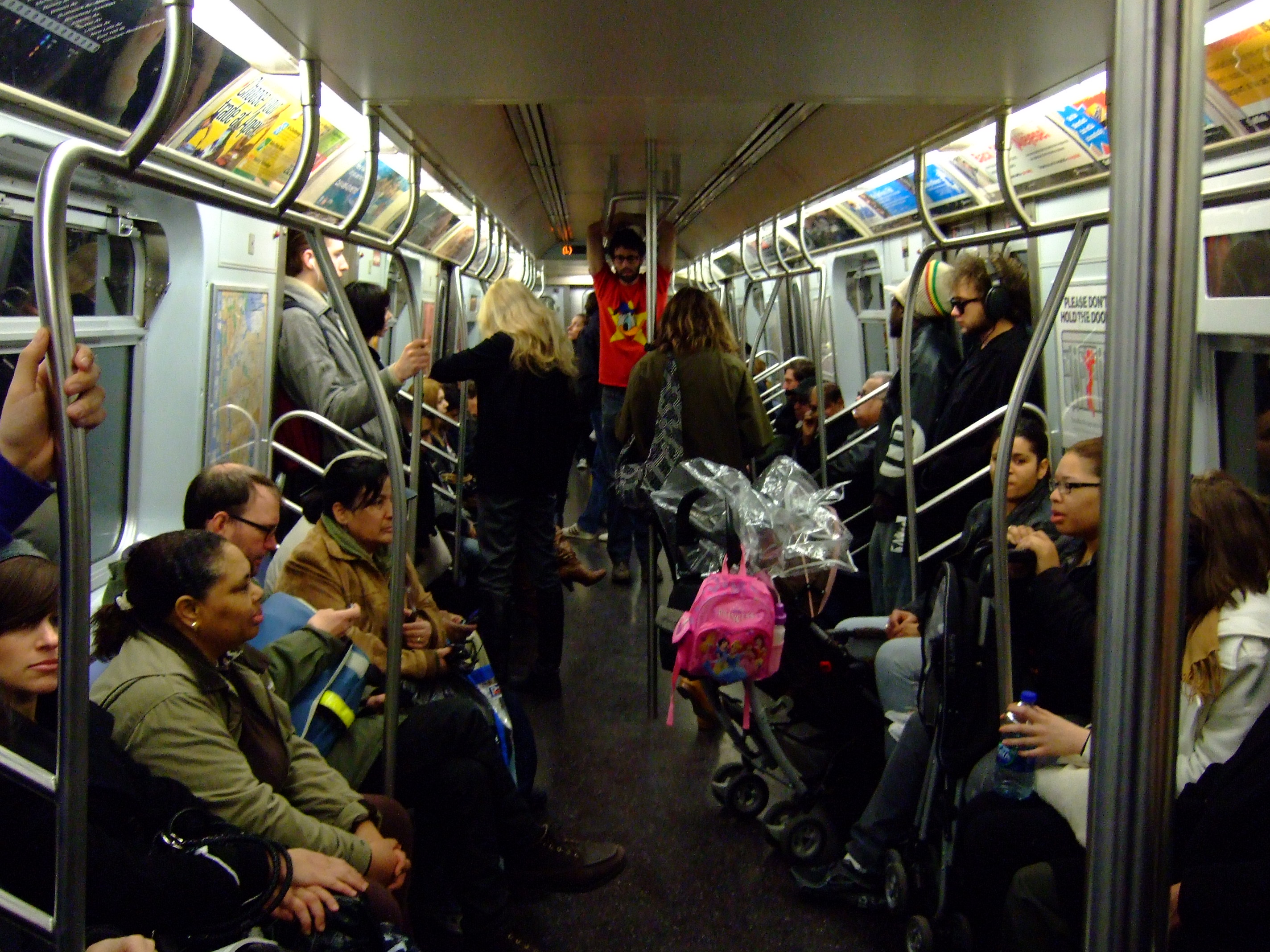
We had just gotten on the subway in Queens to go to Manhattan. The train was full, but my  brother and sister found seats next to an older lady. My mom and I, meanwhile, stood facing them.

As my siblings sat down, the older lady mumbled something in their general direction. “I’m watching you,” she growled at them.

None of us paid much attention to this at first. I took out my phone and started reading on it, just as many other commuters on the train were doing.

And then the older lady started saying something that made me consciously notice her race–African American–for the first time.

“Are you takin’ pictures of me? You takin’ pictures of me? I can call the police on you for that. I’ll blow your brains out. Look at your ugly white face.”

I calmly ignored the diatribe, as is the unspoken code of conduct on the New York City subway. It’s impossible to spend even a day in the city without encountering at least one person who is drunk, high, schizophrenic, or otherwise in a state that makes them spew nonsense. The thing to do is to just let it go.

My mom and my siblings took note as the lady kept going.

“You bunch of white trash. I’m watchin’ all of you. You and you and you.” She gestured at my brother and sister.

She kept going in this vein right up until the train reached her station. She stood up and picked up her purse. “Finally I never have to see your ugly white faces again,” she said, and left the train.

I sat down in her seat next to my siblings, glanced out the window, and saw the lady walk off. I turned back around and relaxed. As the train was about to pull out of the station, I heard a thud on the window behind me. My siblings and I, startled, turned around and saw that the lady had come back and hit the window where we were sitting.

This experience made quite an impression on my brother and sister. They talked about it to all the friends and family we saw that day, and they were still talking about it on the plane home the next day. I tried to tell them that some people are strange or disturbed and say weird things, but that these people are not the majority. I’m not sure what they thought about it, but I’m afraid that they’re too young to consciously, coherently think about it at all.

As a young adult who purposefully tries to stay educated about race relations and the history thereof, I can’t say that this experience changed my opinion about anything. I’ve met and been close to enough black people to know that most would never say such things–just as most white people would never say such things to them.

But my siblings have not. In the leafy Ohio suburb where my family lives, diversity is almost nonexistent. We’re one of very few Jewish families here, for instance, and when I Iived here I knew only a handful of black people and no Latino/a people. (Asians are probably the only minority that’s well-represented here.)

This trip to New York was probably my siblings’ first experience with seeing such a tremendous diversity of races and ethnicities (not to mention orientations and gender identifications). The fact that one of their only verbal interactions with a stranger in New York happened this way can’t be a good thing.

Furthermore, unlike my little siblings, I’ve read enough about race relations to understand the circumstances that cause people to develop the views that the lady on the subway had. Perhaps she’s watched friends and family members being unjustly stopped and searched by the police. Perhaps she’s been denied housing or other needs because of her skin color. Perhaps she’s witnessed white people refusing to sit down next to her on the subway at all. Perhaps her calling us “ugly” is a response to a mass media that depicts whiteness as the only variety in which beauty can come.

I know all of this and more, but my siblings don’t, and they’re way too young for me to try to explain it to them. With all the difficulties they face because of learning English as a second language, having a culturally nonconforming family, and, sometimes, even simply being Jewish, the idea that someone might view them the way they view kids who taunt them for their accent or curly hair, is probably a confusing one. They don’t know what it means to be “white” in America. I don’t think they’ll know for a long time.

And that’s the real tragedy. If these two kids develop the unjustified fear of black people that many white people have (even if it’s only subconscious), it won’t be from the surrounding culture, as many would assume. It’ll be from a concrete experience that happened when they visited New York City for the first time and encountered people who don’t look like them. They’ll remember feeling trapped on the subway as a woman they don’t know threatened to “blow their brains out.” They’ll remember being told that their skin color makes them ugly. They’ll remember that the woman was black, because she pointed out that they were not.

And so, racism is perpetuated. Even if my siblings end up forgetting this particular experience, there may be others, and there will be many other kids who encounter a situation like this one. My brother and sister weren’t to blame for this woman’s distress, but to expect her to “rise above” it would be presumptuous. Whatever happened that made her say those things is real.

For once, I have no solution to propose. My purpose in sharing this story was only to illuminate the importance of teaching children how to empathize and how to keep themselves from forming stereotypes–much easier said than done.

They should also be taught more than just that slavery “happened” and is now over (if only race relations were really that simple). The woman on the subway was a racist and she was wrong, but people don’t become racists in a vacuum.

I can only hope that when my siblings are old enough to understand all of this, they will still be open-minded enough to learn it.

Storytelling

(Or: Massive Annual New Year’s Eve Note, Vol. 5)

[TMI Warning]

Many psychologists believe that it’s not what happens to us that matters, it’s the stories we tell ourselves about what happens.

Some people unfortunately interpret this to mean that we ought to “look on the bright side of life” and “find the silver lining” and all that crap.

I don’t really see things that way. Never have. Life sucks a lot of the time, and anyone who tells you otherwise is either stupid, in denial, or trying to sell you something.

But I have learned, over the past year, how powerful personal storytelling can be. This was the year I took a lot of pain and turned it into a force of energy.

~~~

A year ago, I thought I was done with this whole depression thing forever. That didn’t turn out to be the case. It came back almost as soon as the new year started, worse than ever before, seemingly undefeatable.

This has been a painful year. People hurt me this year. They lied, broke my heart, used me, and took my friendship for granted.

I was alone a lot, more alone than ever before. In fact, I spent most of the summer alone in New York. It was a fantastic experience, but a lonely one nonetheless.

It was hard, a lot of the time, not to think about all the ways depression limits me. If I didn’t have it, everything about my life would be different. I’d be outgoing, I’d go to parties, I could stay up late and take harder classes. I wouldn’t be so tired all the time, I wouldn’t have such a hard time talking to people, and, of course, I wouldn’t be so sad.

But sometime over the course of this year, I stopped thinking about all the things I couldn’t do because of depression, and started thinking instead about all the things I could.

For instance, I would never have started NU Listens, my peer-listening organization, if I hadn’t been depressed. I wouldn’t have the skills that allow me to help people. I wouldn’t write so much, or so well. I wouldn’t be able to fully appreciate my family and the other people I have in my life. I probably wouldn’t know what my calling is.

Some people, knowing that, would assume that I’m “thankful” for the experience of being depressed, or that I consider it “part of God’s plan” for me, or that it was “all for the best.”

Well, sorry to burst your bubble, but no. I don’t think any God would put a person through this, and that’s one of the reasons I don’t believe in God. I’m not thankful and I don’t think it was for the best. I want my adolescence back. I want the first two years of college back.

In our culture, preoccupied as it is with constantly finding the silver lining to everything from rejection to failure to broken hearts, I think it’s bold of me to say that I’m not thankful for what happened. I know I’m expected to offer up some grand lesson to be learned from all this, but I’m sorry to say that there just isn’t one. Sometimes shit happens. It definitely happened to me.

Knowing that, I’ve given up trying to find some sort of grand meaning in my experiences with depression. I sure as hell don’t accept the Judeo-Christian notion that I somehow deserved it, and although it has had some positive consequences, I’d say it did more harm than good. By far.

So how to go on? Well, that’s a complicated question for someone who prefers to see things in complicated ways. The story I’ve decided to tell about my own life isn’t necessarily happy, but it’s empowering for me. It’s about working within my limitations to achieve great things.

After all, the truth is that I’m probably not going to ever fully recover. I live at the mercy of something I can’t fully control, and my entire being–from feelings and moods to thoughts, beliefs, and actions–is tempered by it. Some days it leaves me alone, and some days it barely lets me get out of bed.

It means I have to be on my best behavior all the time. Nine hours of sleep, fruits and veggies, not too much carbs or meat, brisk walking every day, at least. Schoolwork has to be done before 9 PM or so, or else I can’t concentrate on it. I get overwhelmed by information easily, hence all the organization–categorized to-do lists and a calendar, a notebook that I carry everywhere, everything in filing folders in a box under my desk. In class I have to write by hand because it keeps me more alert. Otherwise, I start dozing off after sitting still for five minutes, no matter how much sleep I’ve been getting, because that’s how my body is.

I have to always stay busy, because as soon as I have a moment to myself, my mind starts conjuring up nasty thoughts. You’re such a bitch. Go kill yourself. The reason I take five/six classes, work two jobs, and run two student groups isn’t for my resume. It’s for my health.

~~~

So those are my limitations. Sometimes they seem pretty extreme. Sometimes they seem like a blessing compared to what some people are given.

Regardless, I’m not going to define myself through them anymore.

Instead, I’m going to define myself through the unique gifts that I have, and that I’ve become aware of because of my experience with depression.

When I’m helping someone, my self disappears–and with it, so do all of my fears, insecurities, and dysfunctions. I feel like I’m entering the other person’s being. It’s almost a spiritual experience.

Of course, my ideas about others aren’t always correct, but I start down a path of understanding. I start to see why the love the people they love, why the fear the things they fear, why they do things I would never do, why they believe things that I don’t believe.

I’m not looking for any accolades or sense of moral superiority when I say that my calling is to help people feel better. In a way, I’m just as selfish as anyone else. Some people are happy when they make money, or when they do experiments, or when they play sports; I’m happy when I make others happy.

It’s pretty much that simple.

~~~

It’s been a year since I “came out” as having a mental disorder. Since then, my relationships have only grown stronger and my sense of being valued and respected has only increased. Sometimes people do imply–usually via anonymous comments on my blog, as they know better than to say it to my face–that I’m making people “uncomfortable.” My response to this is always the same: they’ll get over their discomfort. I won’t get over my depression.

The truth is that–and I’m terribly sorry about this–I really don’t give a fuck about your comfort. I just don’t. It’s not my job to make anyone comfortable. I don’t really care about fitting in or being cool or normal. I must be missing that gene, or whatever.

If I sound completely different right now than I did just a few paragraphs before, I wouldn’t blame you for being confused. My life’s work will be to help people find happiness, but never at the expense of my own ability to live and express myself as I see fit. My understanding of psychology is that if you’re so concerned with how I live that you’re made “uncomfortable” by my depression, it’s you who needs to change, not me.

I don’t think most people realize the extent of my lack of fuck-giving because, unlike many other young malcontents, I don’t wear it on my body. My clothes are normal. I talk like a more-or-less average educated person. I don’t have any tattoos or extra piercings and don’t plan on getting any, and my hair is dyed, but only slightly. It’s styled in a mostly average way. I don’t choose to “rebel” by doing lots of drugs or people, and I don’t smoke, drink, or listen to unusual music.

But internally, I feel like an alien in this world. There’s a thick glass wall between me and everyone else. There’s a terrible creature that has its tentacles wrapped around my brain, and every time it squeezes, I want to rip my head off.

That’s what depression is.

~~~

That’s not to say this year has been all bad. It certainly hasn’t. I made many friends this year–not just any friends, but best friends. I started working on two different research projects at school. I found a way to connect with the Jewish community at Northwestern. I made Dean’s List this past quarter, started my own peer listening group, got accepted as a columnist for the Daily Northwestern next quarter, drastically increased my blog’s readership, tried therapy for the first time, successfully navigated my first quarter in my own apartment, went on quite a few dates, learned how to make my own jewelry, was accepted to a quarter-long Jewish education program, and befriended a few professors.

I went to New York three times, growing more and more certain with each time that this is where I want to live someday. I watched my older brother get married and found out that I’ll be an aunt in a couple of weeks. I met distant family members I hadn’t even known about before. I decided to wean myself off antidepressants when the new year starts.

Depression keeps me from being truly happy, but I refuse to let it rewrite the story of my life any longer. What I’ve been able to do despite of (and perhaps because of) my limitations makes me glad to be alive. I hope to recover someday, but even if I don’t, my life is going to be worthwhile.

~~~

A few days ago. I’m walking near Union Square in Manhattan. The sun has nearly set and the wind is chilling. I hear a man begging for money.

“Can you spare some change?” he’s saying, over and over. The passerby walk past him and he says, “That’s okay. Maybe next year.”

I put a dollar bill in his cup and he says, “God bless you, miss. I really mean that.”

He says happy New Year, and I say happy New Year too.

And then I continue on my way.

Maybe next year.