
Unknown's avatar

About Miri

Writer, activist, social worker, and huge fan of cats, flowers, and cities.

An Indictment of Party Pop

Just when you thought I was finally done writing about alcohol and partying, here I go with yet another post about it!

Before I start talking about party pop, though, I need to clarify what exactly I’m talking about, because apparently some people still don’t get it. Every once in a while someone who doesn’t know me too well says something like “OMG I READ YOUR BLOG AND I GUESS YOU HATE FUN HAHA.” Um no.

So let me explain. I do not hate alcohol. I do not hate parties. I do not hate fun. I do not hate people who drink and party, except when they’re infringing on my personal space. What I hate is something I call “party culture,” which, by my definition, contains the following components:

  • the belief, prevalent among people of all ages, that partying is the one and only acceptable way for young people to spend their free time and socialize
  • the glorification and normalization of binge drinking (formally defined as drinking five or more drinks in a row, but I also use it generally to refer to drinking in a way that jeopardizes one’s health and safety)
  • the use of alcohol as a means to coerce women and excuse sexual assault
  • the idea that people who choose not to party are deficient in some way
  • pressuring people to drink and party (This is truly unique in college. I was never pressured to join clubs, go to football games, explore Chicago, attend dorm events, or do any other social activity quite like I was pressured to party.)
  • the belief that alcohol is something people “need” in order to relax, talk to people, hook up, have fun, etc.
So there’s party culture for you. As for party pop, I read a piece about it in this summer’s issue of Bitch magazine. The piece was actually a really interesting analysis of the changes that this sort of music has gone through; whereas drunk girls in pop culture used to exist basically as a spectacle for men’s benefit, more recently they seem to be partying for themselves (the article mentions Ke$ha and Katy Perry as examples). Anyway, you’d really have to read the whole article to see all of the points it makes, but that’s the gist of it, and the author sees this as a positive development–female empowerment and blahblah.
However, where the article falls short is that it still seems to present party pop as a symbol of rebellion:
Today’s party-girl pop continues down the avenue of non-explicitly politicized, pleasure-focused rebellion against gender norms carved out by flappers and disco divas.
And:
[Party-girl pop] is valuable in its large-scale reflection of changing the meaning of pleasure and autonomy among young women, both to create a culture for girls themselves and to give older people a peek into these changing mores.
Here’s the thing, though. Whereas the music from which party pop presumably draws inspiration, such as the Beastie Boys’ “(You Gotta) Fight for Your Right (To Party!),” was actually made a time when partying was considered a subversive thing for people (especially women) to do, we’ve come quite a ways since then. Party culture has become normative. It’s not partying, rather than partying, that now draws judgment and scorn. Trust me, I’d know.

The truth is, even my socially conservative parents and their white middle-class friends think that partying is just what the kids do these days. For some reason, though, the party lifestyle continues to hold this impenetrable veneer of revolutionary coolness.

When I listen to music that glorifies party culture and hear people ranting about how rebellious and groundbreaking and cool it is, I imagine someone making music about how awesome it is not to live on a farm or to be able to live past age 50. Like, okay, cool, but I thought we were over that by now.

Maybe what we should be talking about instead is the fact that party pop contributes to a culture in which alcohol is viewed as the one and only means to having a worthwhile and enjoyable life, and partying is seen as something “everyone” does. And I’m not even making random unbased claims here: studies have shown that college students overestimate how much their peers drink, and that the more they think others drink, the more they drink themselves. That’s why, when I went through training to be an RA at Northwestern, we were told to provide our residents with the results of surveys done at NU that showed how much students actually drink. Because when you think that everybody is just constantly going out and knocking back six vodkas in a night, you’re more likely to try to do that, too.

Furthermore, I disagree with the Bitch article’s assertion that party pop is helping to redefine gender roles for women. The line of argument here is that because these women party for their own pleasure, they are paving the way for our culture to accept women as autonomous and equal to men. I don’t think it really works that way, though. I think that now, rather than having one function–pleasing men–women have two functions–pleasing men and getting shitfaced. I don’t see how this helps society recognize the right of women to hold positions of power, contribute to scientific research, control their own reproductive health, or generally do much of anything that doesn’t involve getting intimate with a toilet bowl at the end of the night. (As for the shitshow that consists of male-created party pop, I’m not even going to get into that now.)

The very artists that the author of the article considers pioneers in this regard have other songs (which the author conveniently ignored) that completely contradict the supposedly revolutionary message. For instance, here are some lyrics from a recent song by Katy Perry:

Kiss me, ki-ki-kiss me
Infect me with your love and
Fill me with your poison
Take me, ta-ta-take me
Wanna be a victim
Ready for abduction
That’s empowering, alright. As for Ke$ha:
I don’t care what people say
The rush is worth the price I pay
I get so high when you’re with me
But crash and crave you when you are away
Pardon my skepticism, but I really fail to see how this music is promoting women’s autonomy. What I do see, though, is that it promotes the dangerous party culture that has infected basically every college campus–and JUST A REMINDER, by “party culture” I mean the stuff listed with bullet points above. I’m not saying this music is inherently “bad” or that we shouldn’t listen to it (that would not only be a specious argument, but it would also be a hypocritical one since I listen to a lot of this stuff myself). I do think, though, that we should make a big-ass pause before we start painting it with Beastie Boys-esque shades of rebelliousness.
Pop music, and pop culture in general, is the pulse of our society and its values. I think that if we listen closely to it, we can discern the pressures and expectations that people face from the world around them. And right now, pop music is saying that partying is the epitome of what young people should do with their lives. I think that’s an unfortunately narrow-minded view.
So if you’re too school for cool,
And you’re treated like a fool,
You can choose to let it go
We can always, we can always
Party on our own
–P!nk, “Raise Your Glass”

Got Sexism?

I apologize for the complete lack of posts lately; I’ve been busy volunteering and exploring New York City, where I am currently located. However, I’ve decided to crawl out of my Russian-food-and-thincrust-pizza-filled cave in order to comment upon this:

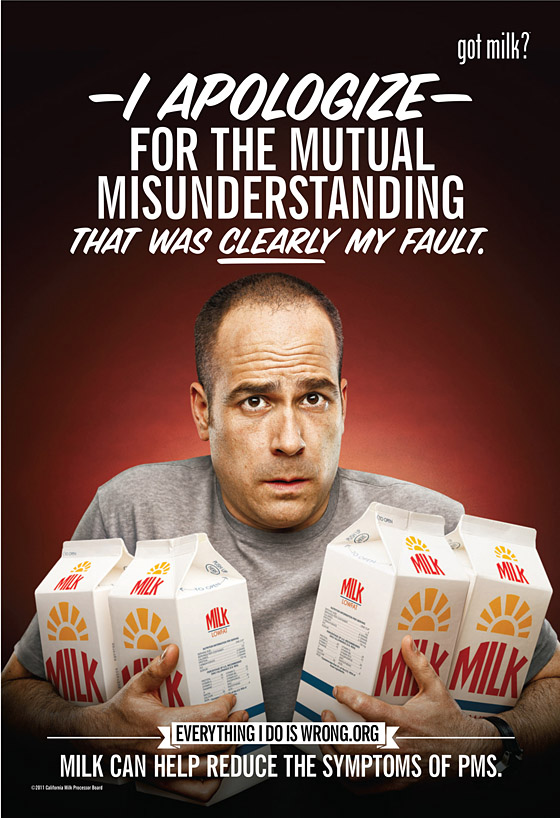
What are we looking at here? Silly-looking men holding cartons of milk? Not so simple. These are a series of new ads released by the Got Milk? advertising campaign. The ads showcase the fact that milk can supposedly help reduce symptoms of premenstrual syndrome (PMS) and feature men making pseudo-sarcastic statements that reference the fact that women are supposedly very moody while on their periods.

The ads point to a website, EverythingIDoIsWrong.com, which is a slick, sardonic guide for men to help placate their bitchy wives and girlfriends during that time of the month. The tagline of the site is, “Your home for PMS management.”

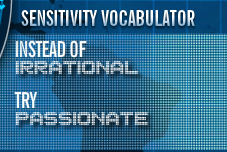
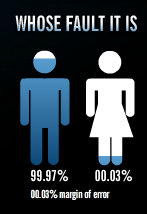
Here are some revealing screencaps from the site, helpfully annotated with my comments:

Attention, men! Because you are from Mars and women are from Venus, you need a special vocabulary to speak with them.
I find this one especially ironic given that women’s concern with their weight has much more to do with societal pressure to be thin than it does with PMS or with making their partners’ lives miserable.
Sorry, men, you’re just going to have to deal with the Evil Women in your life always blaming you for everything.
Because clearly, the only things women care about are gold, silver, and chocolate.

I’ve written about this peculiar menstruation-related misogyny before, except that in my previous post about it, it was being perpetuated by and for women. This ad campaign, on the other hand, targets specifically men and sets up a “yeah bro I know what you’re going through” vibe with its audience.

I won’t repeat what I said in the previous post with regards to the validity of this whole PMS = bitch business, but I will add that these ads rise to a new level of chutzpah, because they somehow manage to turn PMS into a men’s issue. How do they do this, you might ask? After all, it is women, not men, who must deal with the inconvenience of bleeding out of their private parts every month, getting cramps, and feeling fatigued and nauseous. Right?

Wrong! The crappy thing about periods, apparently, is how difficult they make life for men. I mean, duh.

Furthermore, if these fictional men’s concerns do actually contain a semblance of truth in them, maybe it’s time that we recognize the fact that menstruation isn’t to blame here. Rather, the culprits are bad communication skills and a general lack of ability to promote healthy relationships. After all, the relationships hinted at by the men in the ads are anything but functional. Maybe the cure isn’t milk, but a good couples’ therapist.

But of course, it’s much easier to chalk such issues up to women being Complex Demanding Creatures who will never be satisfied by anything their partners do for them, especially not when it’s That Time of Month.

Honestly, this may come as a surprise to you, but most intelligent women find themselves much more pissed off about crap like these ads than about being on their period (or about their partner not taking out the trash/putting the toilet seat down, as the case may be). After all, this is so reductionist. The message to women is, You are your hormones. The message to men is, Deal with her PMS and you’re home free. In the end, advertising campaigns stand to gain from portraying men and women in this way, because the less people understand what really causes conflict in relationships, the more they’ll attempt to buy Stuff to solve all the problems.

And no; just like diamonds, flowers, and chocolate, milk is no panacea.

[Well, now I have two entire posts tagged with “menstruation” on this blog. I’m proud. Also, if you happen to really miss my writing, here’s my short-form blog, which I update much more frequently.]

More posts on this topic, if you’re interested:

OK, I’m done. Promise.

Why Are Adults So Negative?

[Snark Warning, TMI Warning]

No, really, that’s a legitimate question. Why are people older than me–even by just a few years–so eager to put down all of my hopes and dreams?

Let me give a few nonspecific examples of Things Older People Have Said recently to me:

  • “You know, guys really don’t go for complex women.” (Women like me, that is, in the context of that conversation.)
  • “Oh, trust me, by the time you have a job, you’re not going to care about making a difference. It’ll just be about how you hate your boss and can’t wait to go home by the end of the day.”
  • “You’re never going to be successful if you don’t learn how to be pushy.”
  • “It’s going to be even harder to make friends after college, you know.”
  • “You’re gonna go for a PhD? You do realize how much work that is, right?”
  • “Psychologists don’t make that much money. You should try to get an MD instead.”

Perhaps you Well-Meaning Adults are all under the impression that I have excessively high expectations and need a Dose of Healthy Realism to prevent myself from getting disappointed later on. Perhaps you just don’t realize what weight your words can carry for someone who is younger and looking for someone to help them find their way.

Well, this might be news to you, but I have a mental disorder that basically means that my expectations are already unhealthily low. That’s what depression does. It robs you of all the hope and optimism you used to have. Every bit of genuine excitement that I have for the future is something I’ve worked very, very hard to muster up. And guess what you’re doing. You’re taking it away from me.

People. My disorder does a perfectly fine job of putting me down all on its own. It really doesn’t need any help from you. I don’t need to be reminded of how hard it’s going to be to make friends, get a job, find a partner. Trust me, I’ve been over this in my mind over and over and over again Many, many sleepless nights. I’ve been over it until I’ve cried my head off and wanted to kill myself. Really. I do not need your help.

You know what, I appreciate that maybe your life didn’t turn out the way you wanted. And that sucks. I’m sorry you have a shit job, I’m sorry  you have an awful time meeting people and dating. If you’d like, feel free to tell me about that. Or go tell a therapist. Or whatever. But your experiences do not give you the right to take my hope away from me. Especially when you’re some measly three or four years older! Jesus Christ! You’re still finding your own way. You’re not dead yet. At least wait till you get your own kids before you start dispensing your Divine Wisdom to someone else.

I’m seriously considering kicking these people out of my life, because as much as I’ve always believed that friendship with people older than me is important and extremely valuable, I can’t have these people making me feel crappy all the time.

Why does this happen? I think we have a cultural stereotype of young adults as exceedingly cocky, optimistic, and entitled. Well, guys, you know what they say about people who assume. First of all, as I’m pretty sure everyone I’m acquainted with knows, I’m not even from this country. Take everything you know about “American Young Adults” and toss it the fuck out, because I grew up with a different cultural background, one in which humbleness and realism are prized qualities.

Second, even supposing I were the most typical American girl you can imagine, you should still quit it with the damn stereotypes already. Everyone has their quirks and idiosyncrasies. Some people come from broken families. Some people grew up poor. Some people have a disability, maybe one you can’t see. Some people read a ton of books when they were kids. Some people grew up being bullied in school. Some people have depression, anxiety, OCD, ADHD, a substance abuse disorder, autism or Asperger’s, or some other condition. Some people are just plain different!

So throw out those silly magazine articles about “Today’s Entitled Bratty Self-righteous Cocky Inept Stupid Young Adults” and see what’s right in front of you. Some of us are just trying to get by. Some of us are just trying to scrounge up every last shred of hope we have and keep on living. Just because I’m young doesn’t mean I think it’s all rainbows and butterflies ahead. I work hard to keep my chin up. Don’t you dare take that away from me.

Abortion: OK for Others, Not for Me

I used to be a rabid social conservative. This was due mostly to spending most of my childhood in a suburb in Ohio surrounded by other rabid social conservatives. Consequently, I used to think that abortion should be illegal except in cases of rape because I equated it with murder and thought that everyone else should too.

As anyone who regularly reads this blog knows, I am now pretty much as progressive as they come and think that abortion should be legal in basically any circumstance.

However, this is not to say that my views on the subject are simple. Personally, for reasons that I’m unsure of and am still examining, I believe that life begins at conception, and I define a fetus as a living human being. By my definition, abortion is murder.

So how could I support a woman’s right to choose to abort her fetus, especially given that I do not condone murdering anybody once they’ve been born?

The simple answer is: ambiguity. Nobody really knows when life begins. I feel like it begins at conception, but this is a belief, not an educated opinion. This is why I emphasize the fact that I “feel” or “believe” this; I do not think it or know it. Others may feel or believe differently, and I cannot impose my feelings and beliefs on others.

In contrast, there’s really no doubt that a human being that has left the womb is alive, and that killing such a person is murder (with exceptions, of course, for assisted suicide and removal of life support). This is why, contrary to pro-lifers’ ridiculous arguments, legalizing abortion is not tantamount to legalizing murder. Since no amount of scientific research can tell us when life technically begins, this is all open to interpretation by individuals, which means that abortion should be something people are free to choose.

As for my own views, I’m still trying to figure out where they come from. My family is very much pro-choice, and we are not religious, so it’s nothing to do with that. People who are more liberal than myself might suggest that I’ve been brainwashed by the surrounding culture, but that’s a spurious claim given that the surrounding culture has largely failed to brainwash me on any other subject.

That said, if I ever do become unintentionally pregnant, I will probably have to choose abortion, because destroying my entire life is at least as unpalatable a prospect as is killing a fetus. And then I’ll have to live with a huge amount of cognitive dissonance and probably force myself to change my views on when life begins in order to resolve it.

In any case, I guess this makes me the complete opposite of all those social conservatives who claim that abortion is okay for them/their wives, but not for others. I think it’s okay for others but not for me, because it conflicts with my beliefs. Maybe that will change someday.

“Why Are You So Serious All the Time?”

[TMI Warning]

If you’ve ever asked me that question, or wanted to, read this.

And watch out, because I’m about to get very, very real here for a few minutes.

Continue reading