[Guest Post] An open letter to the woman who said I wasn’t skinny enough to have an eating disorder

Another guest post, this time by my friend Kate.

You are the mother of my greatest friend. Your house was my refuge in high school. I wanted to surprise you and share my happiness with you when I got into my dream college. By my senior year, I spent almost every day after school at your house. You offered to cover for me, to be a hiding place when I simply could not deal with my family…and you became someone I trusted. You knew me in the worst throes of my starvation. I was skinny then. I was too skinny, and faint and malnourished and mentally ill. You didn’t know it then, but your son guessed, and for that, he has my eternal gratitude. Without him, I do not know that I would have survived to this point. That is not hyperbole.

You saw me this summer, back home for the worst summer I’ve had. I have gone off therapy for these three months, because you see, my parents don’t use modern medicine, and I cannot trust them to care for me. I am dependent on the kindness of my university to have treatment in the first place. This summer, all I have are friends, and my own will to do anything to keep from slipping back into a hell of calorie counting and obsessive thoughts and the nightmare of reflective surfaces. I used to hate myself, you know. It still creeps up on me and strangles and pulls at loose skin, until all I can do is hold off from screaming and curl up in bed.

You don’t know this. I would have told you, had you asked. I speak about my cesspit of destructive behavior, because you can’t tell when you look at me. That is true of most eating disorders, and someone has to talk about it. I will be that person.

You can’t tell that some days I realize all I’ve had is a cup of coffee in twenty-four hours, and I am blisteringly happy. You can’t tell because I force myself to hold a normal weight. I have for four years, and on especially good days, that is a source of pride.

That number on the scale isn’t the weight I want, but it is healthy. It is perfectly in the range for my height, a muscular build that runs and leaps and cartwheels, but it isn’t skinny. It isn’t skinny, and that is all you see. I am not starving, and so I cannot possibly suffer. I should get over it.

I’d like to, but if the past six years are any lesson, I won’t. I will always depend on alarms to remind me when to eat. I will plan my workouts ahead of time, because when I don’t, I become obsessive, and exercise until I cannot see straight. I will never eat with abandon. Meals will be planned for. Eating out will be stressful. I will have an uneasy truce with food.

And there will be people like you. I hate saying that because, until yesterday, when I said that I meant people who would care, and make me laugh, and be one of the solid ones. There will be people like you, who think I’m making a fuss, playing victim. You were one of the good ones, once, so I’d like to set the record straight.

I am recovering from an eating disorder. For two years, I averaged less than 800 calories per day. I danced intensively, as much as four hours a day. I lost too much weight. I was starving and bony. I did permanent harm to my body.

I have bradycardia. That means my heart beats too slowly; it doesn’t speed up enough when I exercise. If I push too far? I’ll faint. I do not trust myself to exercise outside of a gym. I cannot know when my vision will narrow, but in a building, I at least know that if I stay unconscious, someone will be there. I want you to consider that my safety net is the kindness of strangers to notice if I do not wake up.

The rate for attempted suicide in those with eating disorders is as high as three times that of the general population. Everyone quotes statistics, but I want you to take a hard look at that one. If you combine the neurotypical people out there with those who have PTSD, with those who have major depression, with everyone else who has considered their life not worth living, they attempt suicide at one third the rate of those with eating disorders. You know what makes me hurt so badly I want nothing more than to make it stop any way I can? When people I trust decide some number on a scale measures the weight of my claims, when they reinforce the horrible things I believe about myself. I just never thought one of them would be you.

I want you to know something important about your son. Your son cared for me without knowing any of those facts or statistics or numbers. He just thought I was worth time. He thought I was too skinny, that I was maybe hurting myself, and so he did what he could. He held me and took me to dinner and made sure I ate. He never demanded justification—he waited until I told him I had an eating disorder—the first person I ever confessed to. He smiled, and said he knew, and then we went back to life as normal. We talk every day, because we take care of each other.

I want you to understand something, more than anything else in this letter. You
said I didn’t really have an eating disorder. But that wasn’t the worst thing. You also told my greatest friend, your son, that he should back away from me. You said he shouldn’t ‘have’ to take care of me. You wanted him to back off, because I was being whiny. I cannot forgive that.

I can forgive your careless misunderstanding of my eating disorder. You won’t be the last. You hurt me badly, but it’s ignorance like the words you spoke that keep me speaking up. I cannot forgive your wish to destroy my support.

You spoke selfishly. It is the selfless spirit of your son, and his love that quite literally, saved my life. I’m sorry you can’t see that. I’m sorry I don’t want to see any more of you.

Relevant citations: here and here.

Kate Donovan is a junior studying psychology and human development at Northwestern University. She is the president of Northwestern’s Secular Student Alliance and a writer at Teen Skepchick and the Friendly Atheist blog.
Depression is Not Sadness

Yesterday I came across the story of Junior Seau, an NFL linebacker who committed suicide on May 2. He shot himself in the chest and was found in his home by his girlfriend. Although little is known of Seau’s mental health leading up to his death, he had apparently suffered from insomnia for the last seven years of his life.

Sportswriter Chris McCosky wrote a beautiful column in the Detroit News about Seau’s death and continuing ignorance about depression and suicide. In the column, McCosky shares his own experiences with depression and suicidal thoughts and laments how difficult it is to explain them to people. He notes, as I’ve noted before, that one common reaction that non-depressed people have is to wonder what the hell we have to be so sad about. He writes, “It’s almost impossible to talk about it to regular people (bosses, spouses, friends). They can’t fathom how somebody in good physical health, with a good job, with kids who love them, who seems relatively normal on the outside, can be terminally unhappy.”

The unbearable frequency at which McCosky and I and probably everyone else who tries to talk about depression get this response could be a testament to the fact the most visible symptom of depression is usually sadness. So that’s the one people latch on to: “What do you have to be so sad about?” “Cheer up!” “You have to decide to be happy!”

Because of the sheer obviousness of our sadness, we’re often forced to try to use it to describe depression. We say that we’re just extremely sad, or unhealthily sad, or a different kind of sad. It’s sadness that never goes away like sadness is supposed to. It’s sadness that’s out of proportion to the troubles that we face in our lives. It’s sadness that we can’t stop thinking about. For those of us with bipolar or cyclothymic disorder, it’s sadness that comes and goes much too quickly.

And it is. But the truth is that sadness actually has very little to do with depression, except that it is one of its many possible symptoms.

Based on the diagnostic criteria for depression, you don’t even need to be chronically sad to be considered “depressed.” Anhedonia, which means losing the ability to feel pleasure from things that you used to enjoy, could be present instead. Under the formal DSM-IV definition, you must have at least five of nine possible symptoms to have major depression–and one of the five must be either depressed mood or anhedonia–and only one of those symptoms involves sadness. (If you so some very basic math, you will notice that this means that two people, both of whom officially have major depression, might only have one symptom in common. Weird, huh?)

So, even if your particular depression does include sadness, it’ll only be one of many other symptoms. The others might be much more painful and salient for you than the sadness is. Some people can’t sleep, others gain weight, some think constantly about death, others can’t concentrate or remember anything. Many lose interest in sex, or food, or both. Almost everyone, it seems, experiences a crushing fatigue in which your limbs feel like stone and no amount of sleep ever helps. Then there are headaches, stomachaches, and so on.

So, depression doesn’t necessarily mean sadness to us. (And, a gentle reminder to non-depressed folks: being sad doesn’t mean you’re “depressed,” either.)

Depression is not sadness; it’s an illness that often, though not always, involves sadness. No amount of happy things will make a depressed person spontaneously recover, and, usually, no amount of sad things will make a well-adjusted person with good mental health suddenly develop depression. (Grief, of course, is another matter.) And sadness, on its own, does not cause suicide.

We need to start talking about mood disorders as disorders, not as emotional states. McCosky writes:

Junior Seau wasn’t sad when he pointed that gun to his chest. He wasn’t being a coward. He wasn’t being selfish. He was sick. I wasn’t sad when I thought about swerving into on-coming traffic on Pontiac Trail some 20 years ago. I was sick.

What he’s saying is that people don’t kill themselves because they’re sad. They kill themselves because they have an illness that, among other things, makes them feel sad. It also makes them feel like their life is worthless, like they’re a burden to others, like death would be easier, and all the other beliefs that lead people down the path to suicide.

There is a tendency, I think, to assume that people are depressed because they are sad. A better way to look at it is that people are sad because they are depressed. That’s why, even if we could “turn that frown upside down!” and “just look on the sunny side!” for your benefit, it would do absolutely no good. The depression would still be there, but in a different form.

Junior Seau did not leave a suicide note, so only God knows what he was thinking when he died. I would guess, though, that he was thinking about much more than just being sad.

Anonymity and Mental Illness

The stigma of mental illness has many negative consequences, such as decreased access to employment and housing, barriers to seeking treatment, and many broken friendships and relationships.

What it also does, unfortunately, is make it much harder for people who’ve suffered from mental illness to speak about it publicly, using their real names.

I’ve been thinking about this because North by Northwestern, our campus magazine, ran a feature in its spring issue about mental illness at Northwestern. Overall, the piece was great and discussed how our academic system may be contributing to unhealthy levels of stress. The author of the piece interviewed two students who spoke about their experiences with depression and anxiety.

But both of the students’ names were changed for the article, and it bothered me.

For the record, I would never begrudge an individual for choosing to speak about his or her mental illness under a pseudonym. We all have different priorities, and not everyone has decided to spend their life advocating for those with mental illnesses (as, for instance, I have). Even those who do may decide that using a pseudonym is in their best interest–for instance, this blogger whom I greatly respect.

The magazine, however, could have chosen to find sources who would be willing to let their real names be printed. I know it could’ve, because those people exist on our campus. I’m one of them. Many of my friends are, too.

This is important for several reasons, some short-term and some long-term.

The short-term reason is that seeing fellow students speak publicly about their experiences with mental illness can make a huge difference in the life of someone who’s just starting to acknowledge and deal with their own illness. It lets them know they’re not alone and gives them hope for the future.

It can also give them a specific person to reach out to. After I started writing about depression, friends, acquaintances, and even strangers started writing to me, sharing their stories, and asking for advice. I heard from friends that I knew were struggling and friends who seemed to have everything together. I heard from a guy who’d told me once that he’d had depression briefly but pulled himself out of it on his own. I felt humbled to know the truth.

A friend of mine who spoke in a panel about her eating disorder once told me that she had the same experience. She was quoted in an article about the panel, and afterwards people reached out to her about it.

There’s a bigger picture, though, as well. Every time someone “goes public” about a mental illness, they chip away at the culture of secrecy that surrounds it. And the more of us do it, the harder it’ll be to deny us jobs, cut off friendships with us, continue believing that we’re weak and lazy, and be ashamed of us.

I’m glad those two students spoke to NBN, and I know it was hard for them to do even knowing that their names would not be in print. But NBN had a chance to do something really important, and they missed that chance.

As I was writing this post, I found out that there’s someone pretty powerful who recently took that chance. During his speech for people who have lost family members in the military, Vice President Biden talked about the deaths of his wife and daughter in 1972. Then, he said, “I probably shouldn’t say this with the press here, but it’s more important–you’re more important.” Then he went on:

For the first time in my life, I understood how someone could consciously decide to commit suicide. Not because they were deranged, not because they were nuts, but because they had been to the top of the mountain and they just knew in their heart they’d never get there again.

Biden’s not the only one, of course. Plenty of well-known people have spoken about mental illness, such as Rachel Maddow, William Styron, and Demi Lovato.

In his seminal book on depression, The Noonday Demon (which I have coincidentally just finished reading), Andrew Solomon intentionally avoids using pseudonyms whenever possible. On the first page of the book, he writes,

I asked my subjects to allow me to use their actual names, because real names lend authority to real stories. In a book one of the aims of which is to remove the burden of stigma from mental illness, it is important not to play to that stigma by hiding the identities of depressed people.

I believe that when writing about mental illness, one must be cautious of the status quo. With regards to mental illness, as with regards to just about everything else, the status quo can be a dangerous thing. You cannot think and write about the tragedy of mental illness without also acknowledging the tragedy of stigma, which pushes so many of us to stay silent for too long. In my case, it was eight years. For others, it’s a lifetime.

Accepting the use of pseudonyms in one’s work just because that’s what’s always been done, or because finding interview subjects who are willing to use their real names might be difficult, does an injustice to everyone who suffers from the continuing presence of stigma.

What You’re Really Saying When You Say that Suicide is “Selfish”

I’m still thinking about the Chet Hanks suicide thing from last week and the various responses to it that I saw online. Specifically, I cited two comments that referred to suicide as “selfish.”

“Selfish” has to be one of the most common adjectives people think of when thinking about suicide. Those of us who are involved in mental health advocacy could probably rant at you for hours about how this word perpetuates the stigma that mental illness and suicide carry in our society, how useless and counterproductive it is to accuse a suicidal person of being “selfish,” and so on. In fact, if you get nothing else out of this post, I hope you reconsider using that word to describe suicide if you’ve done so before.

But I can understand where this sentiment comes from. While everyone loses loved ones at some point in their lives, relatively few people experience suicidality first-hand. For this reason, people understand the latter situation much less than the former. Faced with the thought that someone you love might kill themselves and put you through all the resulting grief just because of some inner turmoil that you can’t see or understand, it makes sense that you might feel that suicide is selfish.

At the same time, though, conceptualizing suicide as a “selfish act” sends the message that people somehow “owe it” to their loved ones to stay alive despite immense emotional pain. When you say that suicide is “selfish,” you’re implying–even if you don’t mean to–that the individual’s pain, as well as their potential to improve, isn’t what matters. What matters is how they’ll make the people around them feel.

I don’t mean to discount the grief that people feel when someone they love commits suicide–that’s real, valid, and deserves attention. And, obviously, I believe that people should not commit suicide. But I believe that because I also believe that people can recover from the pain that’s causing them to consider suicide, not because they owe it to others to live.

What all of this comes down to is that most people do not (and perhaps cannot) understand what actually goes through a suicidal person’s mind. Maybe they assume that suicidal people are just sad the way all of us sometimes get sad, except maybe a bit more so. (I honestly don’t know how mentally healthy people think about suicide because I haven’t been one for a while.) It would indeed be rather selfish to put your friends and family through so much pain just because you felt sad one day.

But that’s not how suicide works.

The way I see it, the tragedy of suicide is not (or is not only) the fact that an individual’s suicide also hurts others. Rather, it’s that the individual could have found a way to heal, be happy, and live out the rest of his or her life. Calling suicide a “selfish” thing to do erases that latter tragedy and implies that our primary purpose in life is not to create a meaningful and worthwhile life for ourselves, but to keep our friends and family happy at all costs.

Our first priority should be to convince those who want to take their own lives that those lives are intrinsically valuable and should be preserved for their own sake. Only when they’ve accepted that premise can they even begin to think clearly about their obligations and interactions with other people.

Telling a suicidal person that suicide is “selfish” only reinforces the guilt they already feel. People should choose to live because their lives feel worth living to them, not out of a sense of obligation towards others.

Note: Since this is quite a sensitive topic both for me and probably for many readers, please try to be especially careful with your comments. I reserve the right to delete any comments that I feel may trigger people, even if they’re completely on-topic.

Chet Hanks, Victim Blaming, and the “Weakness” of Suicide

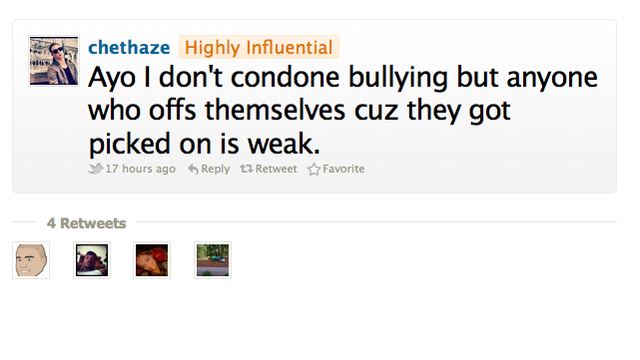
Chet Hanks, son of Tom Hanks and a student here at Northwestern, has this to say about victims of bullying:

Chet's tweet: "Ayo I don't condone bullying but anyone who offs themselves cuz they got picked on is weak."

Credit: Gawker

And then, perhaps in response to people who responded to him (including yours truly), Chet tweeted these followups:

“I say real shit and I always speak my mind if you don’t like it I could give a fuck less.”

“Lol…Haters: I am sorry I do not cater to your demographic: shlubby dudes that don’t get laid enough it’s ok go back to your Internet porn”

“G’head check my feed, all the people hatin are mediocre Lames and cute girls show me love #whatdoesthattellyou

How mature.

Sometimes I wish someone would invent a technology that allows you to connect to someone else’s brain and actually feel what they feel. Because language is a poor substitute.

Maybe if we had such a technology, people would finally understand that mental illness and suicide do not happen to people because they are “weak.”

However, since we don’t have such a technology, the best we can do is educate ourselves about other people, something that college provides a great opportunity to do. It’s too bad that Chet Hanks seems not to be taking advantage of it.

Some of the comments on the Gawker piece I linked to, while generally dismissive of Chet Hanks, are hardly any better:

His expression of emotion is misguided and a bit douche-y, but I second the sentiment. Suicide is a horrible option to exercise as a bullying deterrent. It’s a permanent solution to a potentially temporary problem. It exchanges the pain you feel for the pain of those around you who love you and is essentially a selfish act.
Suicide is selfish and hurts people who care about you, but calling people who are potentially thinking about doing it weak is only going to make things worse. He could have expressed this sentiment in a way that was constructive and helped people, instead of highlighting what an asshat he is.

It’s probably true that some people are psychologically more susceptible to suicide than others, but that difference has nothing to do with “strength” or “weakness.” It also has nothing to do with “willpower” and “selfishness.” To put it broadly, suicide is what happens when a person no longer wants to live–which isn’t necessarily the same thing as wanting to die.

Tragically, most people who commit suicide do so at least in part because they don’t feel like anyone will miss them, and contrary to what the self-righteous commenters above seem to think, not everyone does have friends or family who care about them. It’s also worth noting that, with the exception of people like me who were bullied for being nerdy, kids who get bullied tend to already be marginalized by society in numerous ways–because of fatness or ugliness, mental or physical disability, perceived or real homosexuality, noncompliance with gender roles, and so on. Sometimes, these are the very children who are least likely to have supportive parents, siblings, teachers, and friends cheering them on through their trials.

What Chet seems to miss is that the causal relationship between bullying and suicide isn’t just that a kid goes to school one day and gets called a fag and comes home and tries to kill himself. Bullying is almost never a one-time thing; it can continue over months or years. It’s a constant wearing down of an individual’s self-worth and belief that he/she belongs in this world. Bullies don’t simply call you names and beat you up–they convince you that nobody wants you here.

While supportive friends and family can alleviate these tragic effects somewhat, as I mentioned, not everyone has supportive friends and family. And even if they do, that may not be enough. Children don’t have the freedom that adults have–they’re completely powerless to escape the situation by moving or dropping out of school. The only recourse they generally have is telling an authority figure at school, and that tends to do nothing at best or backfire at worst.

But of course, pretty much everyone reading this blog probably already knows all that. What they probably don’t know is how it actually feels to seriously consider suicide, and how little it has to do with concepts like “weakness” and “selfishness.” If you’d like to hear about it from someone who knows of what she speaks, feel free to ask me personally. Otherwise, I’d recommend this amazing book.

After we read about Chet’s tweet, some of my friends and I started talking about the whole concept of victim blaming and how pervasive it is in our society. Although it’s usually talked about in the context of sexual assault, there really isn’t a single shitty human experience that doesn’t routinely get blamed on its victims: mental illness, bullying, poverty, racism, sexual harassment, you name it. If you have depression, it’s because you’re just not looking on the bright side of life. If you’re getting bullied, it’s because you stick out too much or “react” too much. If you’re poor, it’s because you’re too lazy to get a job. If you’re fat, it’s because you eat crap and don’t exercise. If you feel discriminated against, it’s because you’re “too sensitive.” If you’re getting harassed on the street, your skirt’s too short. And so on and so forth.

(In fact, as Barbara Ehrenreich notes in her brilliant book Bright-sided, even cancer, that ultimate of tragedies, is increasingly getting blamed on its victims. Why? Because they didn’t “think positively” enough.)

Sometimes, it’s really difficult and unpleasant to acknowledge the fact that, even in our pull-yourself-up-by-the-bootstraps, when-there’s-a-will-there’s-a-way sort of culture, sometimes life just screws people. Sometimes it just does.

It’s easier to blame the victim than to make the sort of cultural changes we would need to make sure that people get screwed over as little as possible. Much easier than to figure out how to teach compassion to kids, how to eradicate racism, how to get people to realize that there’s never an excuse for raping people.

But just because we may not yet know how to do those things does not mean we should just throw up our hands and say, “Yeah well, if they off themselves, it’s just cuz they’re weak.”

The more I study psychology, bullying, and the many challenges faced by people that society continually marginalizes, the more I think: If only it were that simple.

*edit* Also, I’m going to try really hard to believe that underneath all that idiocy is some actual intelligence, and that that’s why Chet Hanks got into this school–not because of who his father is.

And, here’s an awesome blog post about this from my friend Derrick.