Yes, We Need Psychiatric Labels

Recently I stumbled upon a Huffington Post article by one Dr. Peter Breggin, who lists himself on HuffPo as a “reformed psychiatrist.”

This should’ve told me everything I needed to know, but I read on.

The article is titled “Our Psychiatric Civilization” and tries to make the tired point that in this day and age, we are defining ourselves by our psychiatric diagnoses and not by anything else. It’s difficult to fully dissemble this argument because Breggin unceremoniously shoves so many unrelated arguments into the same sad little article, but his main points seem to be:

  • Psychotropic medication is overprescribed.
  • Psychiatric diagnoses (i.e. major depression, bipolar disorder, ADHD, etc.) oversimplify the human condition.
  • Back in the good ol’ days, people apparently did a lot of spiritual soul-searching rather than resorting to all those damn pills.
  • The way people connect in our culture is through their psychiatric diagnoses.

I honestly don’t know which planet Breggin is living on, but it’s certainly not mine. I’ve addressed the overprescription crap elsewhere so I won’t talk about that now.

As for the second point, this is, to a certain extent, true. Psychiatric diagnoses DO oversimplify one’s psychological state, but that’s because you have to have a starting point. If you’re diagnosed with ADHD, you know that, some way–whether it’s through medication, therapy, or some combination of the two–you need to learn how to focus your attention better. If you’re diagnosed with major depression, you know that you need to somehow learn how to fix your cognitive distortions and become more active. If you’re diagnosed with seasonal affective disorder, you know that you need to do things that counteract the shortening of the days–use a full-spectrum lamp, take vitamin D supplements, etc.

Just as knowing that I have, say, asthma or the flu doesn’t describe the full state of my entire body, a psychiatric diagnosis isn’t meant to describe my entire psychological condition. Breggin seems to think that we live in a world where all we know about each other is what pills we’re popping, and nothing else. This is ludicrous. In fact, that’s something we don’t often know, given the stigma that still exists regarding mental illness.

Breggin goes on to claim in a condescending way that there’s no reason for people to connect with each other based on psychiatric diagnoses at all:

Patients ask me, “Should I join a bipolar support group?” If I were flippant, which I never am with patients, I could respond, “Only if you want support in believing you’re bipolar and need to take psychiatric drugs.”

My first thought upon reading this drivel was, Thank G-d he doesn’t say this to patients. My second was more like, What the fuck?

The idea that seeking support from others who face similar issues as you is somehow disempowering and promotes seeing oneself as a victim is quite possibly the most batshit stupid thing I’ve ever heard from someone whose profession is helping the mentally disordered. Shockingly enough, people like to feel like they’re not the only ones with problems. Perhaps this has truly never occurred to Dr. Breggin.

Quite the contrary, I have benefited immensely from connecting to other people who have depression and other mental disorders. Many of my friends have one, and together we’ve formed a sort of support network. All of us can always count on having someone to talk to, and those of us who aren’t as far along in the process of recovery as others can ask friends for advice. I don’t know where I’d be right now without that.

(Maybe in a perfect world, we could just have support groups called “Fucked-up People Support Group,” but somehow this seems counterintuitive.)

Anyway, psychiatric diagnoses can also be immensely helpful in explaining to healthy friends and family what the deal is. While Breggin seems to think that “depressed” is some sort of insulting, disempowering label I ought to reject, let me tell you some of the labels that my close friends and family described me with before they knew I had depression:

  • overdramatic
  • overemotional
  • bitchy
  • attention whore
  • immature
  • insensitive
  • selfish
  • crazy
  • weird
  • fucked up

Yeah um, I’d take “depressed” over that any day.

Not surprisingly, you don’t make a particularly strong case for yourself when you try to insist to people that, no, it’s not that you’re really overdramatic, it’s just that you have this problem with, well, being overdramatic, and you’re trying to work on it, you promise!

Trust me, that doesn’t work. What does work is saying, “I have a disorder called depression that distorts my thinking and sometimes makes me act in a way that seems overdramatic. With therapy and medication, it’ll improve.”

Apparently, though, Dr. Breggin is much too intent on destroying his own profession to allow those with mental illnesses even that small comfort. After all, he makes it pretty obvious that the reason he hates psychiatric labels so much is because they make it possible to prescribe medication, and that, of course, is a big no-no.

If I got a dollar every time some well-meaning fool tried to inform me that the medication that saved my life is unnecessary, I would have enough money to actually afford a therapist.
How to “Be There” for a Depressed Person

So. I’ve talked about things not to say to a depressed person before. People have often asked me how, then, one should go about it instead.

One of the nicest things that ever happen to depressed people is when one of our close friends or family members tells us emphatically that they want to “be there” for us. This is great. Depressives aren’t easy to deal with, and anyone who chooses to do so deserves respect.

However.

There are right ways to go about being supportive, and there are wrong ways to go about it. I’m going to try to illuminate some of the right ways here. Don’t worry, it’s not hard.

  • Be honest and specific about the extent to which you are able and willing to help.
  • If you’re not, one out of two things will happen–the depressed person won’t take you seriously and won’t come to you for help anyway, or they will overestimate the extent to which you can help them, and this leads to extreme frustration for both of you.
  • If you’re very busy most of the time, tell them a specific time when you’re free to talk. This is important because depressed people often feel even worse at the thought of there being nobody available to talk to them, or of people being busier than they are.
  • If you’re available to listen but have no idea what to say in response, tell them that. They might be able to suggest ways to respond, or they might tell you that just listening helps.
  • If you don’t really like hearing depressing things for personal reasons but still want to help, explain that, and offer to help them do things to take their mind off of their depression, such as watch movies or cook together. Sometimes, that helps as much or more than just listening to someone.
  • Be a bit kinder than you would normally be.
    • Depressed people are, for lack of a better word, very fragile. They get upset by things that “normal” people don’t get upset by.
    • This is not the time to make “constructive criticism” or point out mistakes that the person has made. For instance, some depressed people have substance abuse problems. Do not say “You need to stop drinking or else you’ll only get worse.” All that does is make the person feel guilty and ashamed. First of all, you’re (I’m assuming) not a therapist, so you’re not an expert on how to cure depression. Second, if you’d like to make suggestions for improvement, frame them them very carefully. Perhaps, “I’ve noticed that you tend to feel worse after you’ve been drinking. Have you thought about trying to stop?”
    • If this sounds like sugarcoating or handling people with kid gloves, maybe it is. Maybe it seems silly to you. But remember that this isn’t about you. It’s about someone else.
    • In relation to the first point I made, be really sensitive about how you tell the person that you’re busy/otherwise unavailable and can’t talk to them or help them. Don’t just be like, “I have to go to bed now. Bye.” Say something like, “I need to go to bed because I’m really tired, but I hope you feel better and I’ll talk to you again soon.” Remember that unless you specify that you’re tired but that you wish you could help, a depressed person is likely to assume that you’re just trying to give them the slip. Try not to be offended by this. It’s not because you haven’t been a good enough friend; it’s just how their brain works.
  • Remember that there are many ways to help.
    • If you’re not comfortable listening to someone talk on and on about really sad things, that’s perfectly understandable and okay. If you still want to help them, there are other ways.
    • As I mentioned earlier, one thing that really helps depressed people is getting them out of bed/off the couch and doing something. Offer a pleasant but engaging activity that doesn’t require too much social interaction or new situations–watching movies, cooking, exercising, going to see a lecture or exhibit, going to a small social gathering (NOT a huge party with lots of drinking), taking a walk, going shopping, etc. If you’re both students and have a lot of homework/studying to do, you can invite the person to do that with you. Even if you’re not actually interacting, it’s nice to be around people.
    • You can also help in very small but practical ways. Get notes for them if they miss class (but encourage them to try to go next time), tell mutual friends that they’re going through a hard time and need extra support, help them search for a therapist or psychiatrist, that type of stuff.
  • Don’t make it about you.
    • I can’t stress this enough. Honestly, the shit that can come out of a depressed person’s mouth is pretty ridiculous at times. I’m obviously not proud to admit this, but I have occasionally been known to scream (electronically or otherwise) things like “FINE GO AHEAD AND HATE ME” and “I GUESS YOU WON’T CARE IF I DIE” at people.
    • This, I’m sorry to say, is just part of the package. Depression really fucks with people’s ability to process things rationally. Although there are things you can do to avoid such a reaction (see “Be a bit kinder than you would normally be,” above), it may still happen, and it’s not your fault. Don’t make this about yourself, don’t react defensively, don’t accuse the person of not appreciating your friendship.
    • If they say something that really does bother you, it’s perfectly fine to bring it up when they’re calmer and less upset. But don’t do it while they’re freaking out about something.
  • Be really careful if you’re communicating via texting or the internet.
    • The reason I say this is because this is where I’ve most often seen things go terribly wrong. Written communication has a way of seeming much more curt, rude, and inconsiderate than it really is. Depressed people are already overly sensitive to things like this, so communicating in writing can make it even worse.
    • That’s not to say that you should rule texting and the internet out entirely. Just take care to make up for the lack of body language. You can’t smile reassuringly, touch someone on the shoulder, or hold their hand over the internet. So if you’re saying something that can be interpreted ambiguously, be very cautious. With depressed people, there’s a certain Murphy’s Law–if it can be interpreted negatively, it will be.
    • Some ways to combat this are to use emoticons to help convey emotion, to express things more clearly, and to ask the person how he or she is interpreting what you’re saying as a way of checking in.
  • Try not to offer advice unless they ask for it.
    • This is a big one. I’ve written before about the tendency of people to want to “fix” others by immediately offering them advice, but this really fails when it comes to depressed people.
    • First of all, depression is different from ordinary sadness in a qualitative, not quantitative, way. In other words, it’s not “more” sadness, it’s a “different” sadness. What works for you when you’re feeling a bit down probably isn’t going to be what works for someone with a clinical disorder. This is why all those entreaties to “just put yourself out there!” and “just smile!” and “just get some sleep!” really, really fall on deaf ears when it comes to depressed people. Trust me, we’ve tried all of that, and much more.
    • Second, advice probably isn’t what they’re looking for (unless they tell you so). When people are upset, not only are they not in the right frame of mind to evaluate your suggestions accordingly, but what they probably really want is for someone to agree that things are hard for them and to sympathize with that. In other words, don’t be like, “Oh, that’s no big deal, you can just try x, y, and z.” Try “Wow, that must be really hard for you, but I believe that you’ll get better.”
  • Never ever make the person feel guilty or indebted for needing your help.
    • This is rarely done maliciously; I think it’s usually by accident. Sometimes people who are close to a depressed person become frustrated or resentful, which is natural. However, just because it’s natural doesn’t mean you should necessarily express it–at least not in the way that most people do.
    • If you find that helping the person is taking up too much of your time and energy, that’s absolutely a fair conclusion to come to. But that doesn’t mean you have the right to blame the depressed person for it. You choose how to spend your time, not they.
    • The correct way to address this, in my opinion, is to explain calmly that you feel like you’ve been putting too much of yourself into helping this person. Explain that, since you’re not a therapist, you can’t devote as much time and energy as the person might need. Clarify that you still care about them, but that you need to focus on yourself more.
    • The reason this is so important is twofold. First of all, depressed people can’t help the fact that they need support. They just do. Making them feel ashamed of that does no good. Second, some depressed people are suicidal, and one of the biggest causes of suicidality is feeling like a burden to others. This is why you should try not to make a depressed person feel like a burden to you.

    So there you go. I’m sure there will be a followup post to this because it’s such a big issue for me. Feel free to ask if you have any questions!

    Antidepressants and Strength of Character

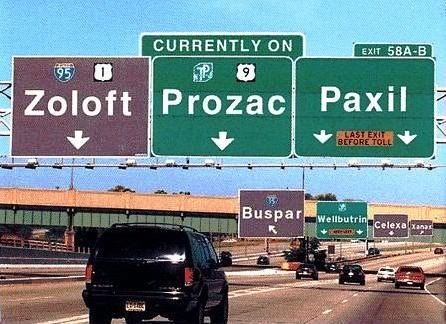
    You're not a bad person if you take any of these roads. I promise.

    Spoiler alert: They have nothing whatsoever to do with each other.

    There are different levels of stigma surrounding mental illness. There’s the stigma of having a disorder in itself, the stigma of being in treatment for a disorder, and, perhaps most of all, the stigma of that treatment being pharmacological.

    People love to hate psychopharmacology, especially antidepressants, the efficacy of which is constantly being questioned (often for good reason). However, I’ve noticed that drugs like antidepressants receive a special type of scorn, one that cannot be based solely on the efficacy mystery.

    I’ve found that where mental treatment is concerned, therapy holds some sort of moral superiority over drugs in many people’s eyes. I think many people still feel that mental disorders are spiritual illnesses, not medical ones, and that treating them with a pill is some sort of cop-out. (Imagine the public furor if researchers came up with a pill to, say, erase the feeling of guilt.)

    This would explain why, though therapy is still stigmatized–after all, the Ideal Person works out these issues on his or her own–it is considerably less looked down upon than psychotropic medication. Our culture values struggle and hard work so much that even recovering from an illness should be mentally effortful.

    What people don’t realize is that there are plenty of perfectly legitimate reasons why someone might choose medication over therapy, at least in the short term. Consider, for instance, the situation I found myself in a month before I began my sophomore year of college. Having spent my entire freshman year growing progressively more depressed, I’d thought that coming home for the summer would magically fix everything. It didn’t. With a month to go, I realized that I felt like I’d rather die than go back to school.

    That was when I was first diagnosed with depression, and I think my psychiatrist realized, as did I, that I just didn’t have time to muck around with my feelings–I had to get better quickly, or else going back to school would be more upsetting and stressful than I could handle. So I started taking antidepressants and quickly improved enough to feel like I could deal with being in school. The mucking around with my feelings came later.

    Aside from that, I can think of many other reasons medication can at times make more sense than therapy. For example:

    • Financial concerns. Antidepressants cost me $30 a month, while therapy costs $80 for four weekly sessions. That’s a pretty big difference for many people.
    • Time. Some people are at a point in their lives where they literally can’t spare an hour or more a week for therapy. That might sound ludicrous to you, but if you’re a college student, a new parent, or a low-income worker, it probably doesn’t.
    • Availability. Unfortunately, not everyone lives in an area where good therapists are available and accessible (and bad therapists will do more harm than good). This is especially true for members of marginalized communities, who may have a hard time finding therapists who are sensitive to their issues. Not all therapists are as open and accepting as they should be.
    • Insurance. I’m lucky to have a fantastic insurance policy that covers basically everything I’ve ever needed. However, many policies are very picky with regards to therapy (as opposed to medication, which does require a prescription from a person with an MD). For instance, some policies refuse to cover therapy unless there’s an official diagnosis, and you don’t necessarily need to have a diagnosable mental disorder in order to need help. Besides, you can’t be diagnosed without going to a specialist to begin with.
    • Nature of the disorder. Although most mental illnesses obviously involve a psychological component, some do not. For example, many people in temperate climates get Seasonal Affective Disorder (SAD) during the winter months, which is characterized by a low-grade depression as well as various physical symptoms. It’s usually treated with antidepressants or light therapy, which actually has people sit in front of full-spectrum light.
    • Language. Therapy requires people to talk pretty extensively about themselves and their lives, something that would be very difficult for, say, a new immigrant who’s just learning English. Unless such people are able to find a therapist who speaks their native language, it would be pretty hard for them to get anything out of therapy.
    • Comfort. As a future therapist, I obviously wish that everyone were comfortable with the idea of therapy. But not everyone is. That could be because of cultural factors, family attitudes, personality, or negative experiences with therapy in the past. I think that using medication to improve your quality of life while working up the courage to see a therapist is perfectly okay.

    I hope that this list shows that making decisions about mental health isn’t that different from making decisions about physical health–it has more to do with personal preferences and practical concerns than with the strength (or lack thereof) of one’s character.

    Of course, I do believe that therapy is really important and generally awesome, which is why one of my upcoming posts will be about why I think that everyone (or almost everyone) should see a therapist. Stay tuned.

    Mental Illness Is Not a Punchline

    Damn, I’m certainly on a crusade against humor these days.

    That was sarcasm, by the way. I love humor. I just think it should be deployed carefully.

    A few days ago in my Psychology of Personality class, the following happened:

    Some people were having their own conversations while the professor was trying to give a lecture. The professor cracked a joke–“Hey guys, I have ADD so I can’t focus if other people are talking, so please stop!” followed by “I don’t really have ADD, but still.”

    Now, for the record, I totally get that it sucks for a teacher when people are talking in class. But I also feel that there are other ways to address that situation without making a joke about having a mental illness that you don’t actually have. Especially, you know, if you’re a person who has a PhD in psychology and conducts research on people with actual mental illnesses.

    The sad thing is, before he followed his comment up with that disclaimer, I was actually really touched. I thought it was wonderful that a professor of psychology would take a stand against the stigma of mental illness by stating in class that he has one. But then, you know, it turned out to just be a joke.

    ~~~

    Last spring, I took a class on Cognitive Behavioral Therapy. It was an advanced class, with just around ten students or so, taught by one of the most esteemed professors in the department. We got to the chapter on Borderline Personality Disorder, which, as you may know, is considered one of the most frustrating mental disorders–both for clinicians and for the patient’s friends and family. So naturally, no discussion of it could be complete without my professor’s bombastic explanations about how she tries to avoid treating BPD patients because they’re just SUCH a pain and about how she once had a friend with BPD who was just SO hard to deal with. Everyone gasped and laughed at her descriptions.

    Then, of course, the other students had to start raising their hands and talking about their own friends that they’d taken the liberty of diagnosing with BPD, and how  horrific those people were.

    This was a time in my life when I was seriously wondering if I had BPD myself, so, yeah, that was pretty unpleasant.

    ~~~

    Last fall, I took a class on psychopathology. It was my second psychology course ever, and my first that related specifically to mental disorders–a topic very close to my heart at the time since I’d been diagnosed with major depression only a month before.

    Before the course started, the professor sent out an anonymous survey to the entire class about our experiences with mental illness. On the first day of class, she disclosed the stunning results–more than half of us said we’d been diagnosed with one.

    So we got to the chapter on depression and the professor started talking about depressive cognitive distortions, using specific examples. The professor started listing them off in such a way that the whole class started laughing. And laughing, and laughing.

    Now, I totally get that it sounds funny. Consider this dialogue:

    X: I’m getting a B in calculus. I’m a total failure.

    Y: You’re not a failure at all! You have straight As in the rest of your classes.

    X: Well, those don’t count. They’re easy anyway.

    Y: Yes, and calculus is pretty hard, so it makes sense that you wouldn’t do as well. Besides, a B is a pretty good grade.

    X: No, it’s a shitty grade. Everything I do is shitty and I’m always going to be a failure.

    That is an example of several cognitive distortions, including overgeneralization, disqualifying the positive, magnification, and labeling. And, when read aloud in a particular tone of voice, I can see how it might sound kind of funny.

    But having been through it myself and studied it extensively, I can also hear the pain behind what X is saying. It’s not a punchline. It’s a cry for help from a person trapped inside their malfunctioning mind.

    ~~~

    Here’s the thing. I get it. People with PhDs in psychology have spent years and years reading, writing, and talking about stuff like this. I’m sure that it’s completely normal for two psychologists to crack jokes about mental illness to each other.

    Knowing that many people who pursue degrees in psychology are spurred to do so by their own experiences with mental illness (I’m an example of this), I understand the urge to joke about it because I joke about it myself. It helps alleviate the fear and pain of living with mental illness.

    That doesn’t mean I’d joke about it to a room full of 100 people who don’t know me well and who may be dealing with their own issues, though.

    Case in point–at the time I took the aforementioned psychopathology class, I was still learning how to recognize cognitive distortions in myself, and I was beginning to realize the extent to which they’d ruined all of my previous interactions, friendships, and relationships. To have a room full of 100 people laughing uproariously about something that nearly brought you to suicide just three short months before is, well, no laughing matter.

    ~~~

    I’m not saying there’s no room for humor about mental illness. There definitely is, and humor has been one of several strategies that have helped me process what happened to me. But humor must be used carefully.

    I’ve written before about the complex relationship between humor and mental illness–here, here, here, here, and here. But this time, the situation is very different because the off-color jokes are coming not from comedians, television writers, novelists, or clueless friends of mine, but from people who know more about psychology than 99% of the population.

    Unfortunately, I still haven’t quite worked up the courage to tell a person with a PhD that they’ve offended me.

    But I’m working on it.

    How Depression Feels

    I feel like there’s a disease in my head. I want to excise the brain parts that it lives in, the parts responsible for loneliness, worthlessness, apathy, cynicism, seriousness, sensitivity, and all the other ways in which I could be described.

    I feel like a book lying open on the grass. The wind blows the pages around and one can’t help but read them. Nothing that’s written can ever be forgotten.

    I feel like I’ve wound up my body’s pocket watch all wrong. It doesn’t go at the same pace as everyone else’s. Sometimes it ticks when it shouldn’t. Sometimes it doesn’t when it should. Where is that damn watchmaker?

    I feel like a sinking ship. All of my most beautiful parts are underwater now, my framework waterlogged and rotting. Up on the tilting deck, an orchestra plays for anyone who dares to listen.

    I feel like there’s a darkness following me wherever I go. Some call it a black dog, others call it a raincloud, others call it the noonday demon. Sometimes we sit on a bench next to each other, just gazing out into the world through our foggy, listless eyes. When it’s with me, I see in black and white.

    I feel like a piece of driftwood on a beach. Why am I here, and not there? Is this sandy spot any better than that one?

    I feel like there’s another spirit inside me and it’s more compassionate and optimistic and hopeful than I’ve ever been able to be.

    I feel like there’s a flood slamming against the levee walls of my brain.

    I feel like there’s a screeching phoenix beating in my heart, trying to burn a hole in the scarred tissue and escape.

    I feel like I’m moments, or days, or years away from coming alive. It’ll happen, someday.