More Than Just a Body With a Broken Brain: Why I’m Choosing Social Work

It would be nice to be called “Doctor.”

It would be nice to be paid a very high salary and have a stable job, and to be able to produce an official piece of paper proving that I am Smart.

It would be nice to be published in prestigious journals, to receive emails from others curious about my work. It would be nice to be quoted in newspapers and magazines as an Expert.

It would be nice to be part of the elite–the less than 1% of Americans who have a doctorate.

It would be nice, but it won’t be me. At least, not for a while.

Until recently, I left unquestioned the notion that I want a PhD in clinical psychology. I just wanted it. Why? Well, it would allow me to be a therapist, which is what I want. I would get paid a lot. It would carry prestige.

But gradually my resolve started to break down and I started to wonder, Why?

I discovered that I disliked research. When I told people this, they were often shocked. But aren’t you curious? Don’t you care why people think and feel the way they do? Don’t you want to understand?

Yes, I am, and I do. I’m deeply curious. That’s why I read voraciously. And I am more than happy to read all the answers to my questions when they’re published rather than to work long days in a basement lab somewhere.

I can do research, I’m sure. But it’s not what I love, and there are others who want this much more.

The turning point came when I attended a panel of graduate students in psychology, along with an admissions person for a doctoral program in clinical psych. They all told us that when we apply for grad school, our entire resume and personal statement should discuss nothing but our research experience. Everything else I’ve done wouldn’t even matter–not the year I spent as an RA, not the three years I’ve spent as a member (and, then, a leader) in a sexual health and assault peer education group, not the summer I volunteered at a camp for at-risk kids in New York, not the initiative I started to implement a peer listening program at Northwestern, not my internship at the National Alliance on Mental Illness.

I shouldn’t even include it, they told me, because it would annoy the admissions people.

The work that I love, the lives that I hope I’ve changed–it would be an annoyance.

At first, I thought it wasn’t a big deal. Who cares what I put on my application as long as I get in?

But then I learned more. I learned that I probably wouldn’t be accepted if I admitted that my goal is to be a therapist, because they want to spend their money on someone who would bring prestige to their institution by publishing research. I realized that I would have nobody to turn to for support–no mentors–because I’d have to hide my dreams from them. I learned that clinical training in clinical psych programs is mostly lacking (ironically), so I wouldn’t be learning the practical skills that I need to help people.

And, most of all, I understood that my time in graduate school would be miserable beyond belief, because I would be living a lie, facing extreme pressure to publish or perish, and wasting at least five or six years of my life. During that time, my life would be completely on hold–I wouldn’t be able to move, work, or start a family, if the opportunity presented itself.

The future that I had once dreamed about turned into a nightmare.

It was then that I finally stopped listening to my professors–who, of course, all have PhDs–and listened instead to the friends and family I have who actually are therapists, or hoping to get there. And increasingly I understood that a masters in social work would be a better option.

MSW programs emphasize learning practical skills, and many of them have you start a clinical internship as soon as you start the program, because the best way to learn is by experience. They understand that people aren’t just isolated brains inside bodies, that circumstances affect individuals and that psychological problems aren’t always caused by faulty brain chemistry. They emphasize understanding societal inequality, working with marginalized groups, and picking up where clinical psychology leaves off.

I’ve been told that I’m “too smart” for a masters in social work, that I will be “offended” when I see how little they pay me. People who say these things must not know me very well. Although I wanted a PhD before, I’ve never really needed my career to make me feel important. I don’t need to be important. I just need to be helpful.

As for “too smart,” that’s ridiculous. The helping professions need more smart people.

The truth is that, in my hour of need, it wasn’t a man with a white lab coat and a doctorate who saved me. It was–as corny as this is going to sound–the social justice movement. That was what finally taught me that my feelings are justified, that my thoughts have merit, that my words matter.

I finally learned to see myself as more than just a body with a broken brain. I’m a whole person enmeshed in particular circumstances, and the interaction between the two has made me who I am now.

I still agree with what I’ve written before. Medication can be useful. Therapy works. Psychiatric labels are important.

But my strengths and goals require a different sort of education than what I could receive in a doctoral program, and they point me to a different sort of career than a PhD would prepare me for.

True, I’ll earn less money. There will be hard times. There will, I’m sure, be bureaucracy, budget cuts, and crappy bosses.Β  There will be days when I don’t love it.

But there will not be days when I’m living a lie. There will not be days when I’m sitting in an expensive lab at a prestigious university, doing work that may be meaningful, that may get published, that may be improved upon, that may someday, maybe, help someone. Maybe.

And I have nothing but respect for people who want to do that. I admire that, and maybe someday I’ll return to school for a PhD. But at this stage in my life, it’s just not for me. After all, I can always get a PhD; what I can’t do is unget one and unwaste all that time.

I don’t expect every single day to be productive, every session to help every client. But I do expect that at the end of my life I will be able to look back and know beyond a doubt that, in my own way, I changed things for the better.

That’s why I’m choosing social work.

P.S. A little disclaimer–I’m not looking for any comments on how I’m wrong about the doctoral route or why I should reconsider my decision. There’s a lot more than went into it than I could even discuss here, and there are enough Older and Wiser People trying to tell me how to live as is. Thanks. πŸ™‚

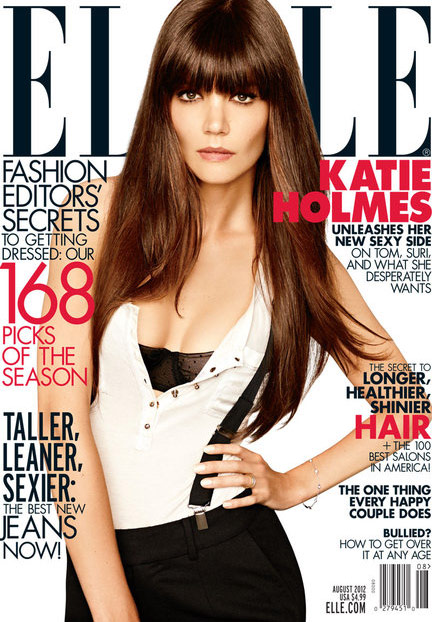
Surprise! Elle Magazine Editor Doesn’t Really Care About Eating Disorders

Nope, no Photoshopping. Nothing to see here, move along now.

Confession: sometimes I read women’s magazines. They’re fun to make critique and laugh at.

This time, though, I didn’t even get past the magazine’s front matter before finding something objectionable. In her opening letter for Elle magazine’s August issue, Editor-in-Chief Roberta Myers discusses the recent legislation in the U.K. that would require digitally altered photographs of models to be labeled as such. You can practically feel the derision and dismissal dripping off the page:

So now the National Academy of Sciences is getting into the act, trying to define what ‘impossibly beautiful’ means. In response to legislation pending in the UK to require digitally altered photos to be labeled out of concern for public health, as well as the American Medical Association’s campaign against changing pictures ‘in a manner that could promote unrealistic expectations of appropriate body image,’ two Dartmouth computer scientists proposed a ‘metric’ at a recent NAS meeting designed to rate how much retouched photos have ‘strayed from reality.’ The authors noted that ‘highly idealized’ images have been associated with eating disorders, such as anorexia.

Scare quotes aside, I have the feeling that Myers knows exactly what “impossibly beautiful” means, even if the idea of defining it operationally seems a bit silly. I do think that regulatory measures like these should be approached with a certain degree of healthy skepticism, because government regulation should not be undertaken lightly and without good evidence. But Myers isn’t critiquing it skeptically. She’s sticking her head in the sand and denying that a problem exists.

Furthermore, the regulations don’t even propose to ban severely Photoshopped images, but merely to place labels on them. Is putting an extra little bit of text on the bottom of an image really such a burden for Myers? I think not. Note that some countries are going even further–Israel, for instance, banned the use of underweight models in advertising entirely.

Myers continues:

Yet according to David Scott Rosen, MD…eating disorders are as old as the Bible. They cropped up in popular literature 200 years ago–long before Photoshop but right around the time when John Singer Sargent painted his famous Madame X (Madame Pierre Gautreau), a most flattering oil-on-canvas portrait that left out many a “flaw.”

I couldn’t find a citation for this, but it’s probably true. However, nobody’s claiming that eating disorders exist solely because of unrealistic beauty standards in the media. It’s not like a perfectly healthy young woman (or man, but that’s a slightly different conversation) opens up Elle magazine, sees a picture of a thin model, and immediately starts starving herself. Eating disorders arise from a complicated interaction of genetics, family life, and the surrounding culture. They involve complex cognitive processes, such as the ones described in this study. As another example, research shows that people determine attractiveness based on what they have seen the most. So if you’ve been looking at images of impossibly thin women for your entire life, that may be what you’re going to find attractive–and that’s what you may aspire to be.

We can’t prevent genes that predispose one to eating disorders from being passed down, and we can’t make it illegal for parents to teach their daughters that their appearance is the most important thing and that one should use unhealthy means to maintain it (though, with more education, we might be able to prevent that). We can, however, place restrictions on the images that permeate our media.

Furthermore, Myers conveniently ignores the fact that eating disorders have been growing more and more prevalent over the past century, especially among young women. Studies have also shown possible links between media that promotes thinness and eating disorders. It is impossible to establish a causative link with certainty, but that’s because 1) nothing is ever certain in science, and 2) we live within a culture that promotes and glorifies thinness. You can’t really evaluate phenomena like this accurately when you exist within the system that you’re trying to evaluate.

But luckily, studies done with non-Western cultures are very revealing. One extremely compelling study showed that girls in Fiji, who previously had little exposure to Western media, became much more likely to show signs of disordered eating after watching Western television shows for the first time.

Several Google searches brought up countless studies like these. Myers seems to consider them irrelevant here. She continues:

My point is that trying to define “impossible beauty,” and then regulate its dissemination by putting warning labels on retouched images, seems rather preposterous. You know, my chocolate bar never looks quite as creamy as it does in the ads; cars are never quite that sexy and sleek; and the milk in my cereal bowl never looks quite that white. Oh, wait! It’s not milk at all! It’s some gelatinous concoction meant to look like milk while it stays sturdy under hours of hot lights. Shall we label those photos, too?

This passage is as laughable as it is offensive. First of all, cool slippery slope fallacy, bro. Second, while one may argue over the sleekness of a car or the whiteness of a bowl of milk, it is completely unmistakable when magazines alter photos of models such that they appear to thin to actually be alive.

Third, and most importantly, the comparisons Myers makes are flippant to the point of inanity. The worst thing that can happen in her examples is that one’s chocolate bar isn’t creamy enough. The worst thing that can happen when magazines use Photoshop to excess is that, you know, someone develops anorexia and dies.

As I mentioned, the link between digitally altered images and eating disorders probably isn’t simple. But research is increasingly showing that it is there. It is worth noting that Myers never makes any comments about her own magazine’s use of Photoshop, which tells me that she’s fully aware of what she’s doing and is just willfully playing dumb. She knows. And she’s threatened by it, because things are starting to change.

But she’s not done. She goes on to cite an article in this month’s issue:

I wonder what the National Academy would have to say about the photograph we ran in this issue of novelist and essayist Ann Bauer, who writes so eloquently about growing up “ugly”–bearing a steady stream of abuse about her looks from classmates, strangers, and even lovers.

This bit confirms for me what I already suspected–that magazines like Elle print articles like this solely from the purpose of distracting people from the role they play in upholding our society’s beauty standards. These magazines can trot these articles out as examples of their commitment to portraying “women of all shapes and sizes,” when, in fact, they use these women as tokens.

The article in question is indeed a beautiful article. But what’s ironic is that Myers doesn’t even realize how magazines like her own have contributed to the bullying and abuse that women like Bauer face. Of course, people have always valued beauty and mistreated those who are deemed “ugly.” But lately, the box into which women must fit in order to be considered beautiful has been shrinking, whereas the “ugly” box has been growing. Magazines likeΒ Elle may not be the only (or even the main) causes of this trend, but it would be naive not to implicate them in it.

Furthermore, that photo of Bauer that Myers is so proud to have featured? It takes up one corner of a page and measures about two by three inches. Compare this to the dozens of full-page Photoshopped models in the magazine.

The most telling (and touching) part of Bauer’s piece, to me, is the end, in which she describes visiting Hungary with her husband and going to the opera in Budapest:

I turned and found myself looking into a full-length mirror. And I saw something I’d never seen before: myself, in a sea of women who looked just like me.

[…]Everywhere I looked in that lighted glass, there were women with large features, deep-set eyes, rounded cheeks, riotous hair, and delicate-yet-meaty little bodies. We were, in other words, an army of ugly people.

Only, for the first time in my memory, we weren’t. I wasn’t. I was normal, even conventionally attractive. Stylish. Interesting. Sexy. Simply that.

I stood in front of that mirror in the Hungarian State Opera House, watching couples mill. Men holding the arms and hands of dozens of women who could’ve been my sisters, mother, and daughters, tipping their heads back, kissing them lightly, gazing with naked admiration at faces like mine.

Bauer shows, ultimately, that she is not ugly. It is American culture that makes her out to be so. In Hungary, women who look like her areΒ notΒ bullied. They are not sent anonymous emails about how ugly they are. They are not denied jobs or pressured to lose weight and get plastic surgery.

This makes Myers’ stubborn refusal to examine the potential effects of her magazine even more ironic (and upsetting). Magazine editors seem to feel that they are being solely blamed for the devastating experiences of many women (and, increasingly, men), but no informed researcher or critic would say that magazines directly cause eating disorders. We have to examine this phenomenon as a system of interacting elements–the mass media, politics, families, and individual brains and bodies–in order to begin to understand how to prevent unhealthy beauty standards, poor body image, and eating disorders.

We can’t start without making sure that everyone knows that the images they see around them every day of their lives are not realistic. They’re not something to aspire to, because they cannot be obtained–except perhaps at a very high cost.

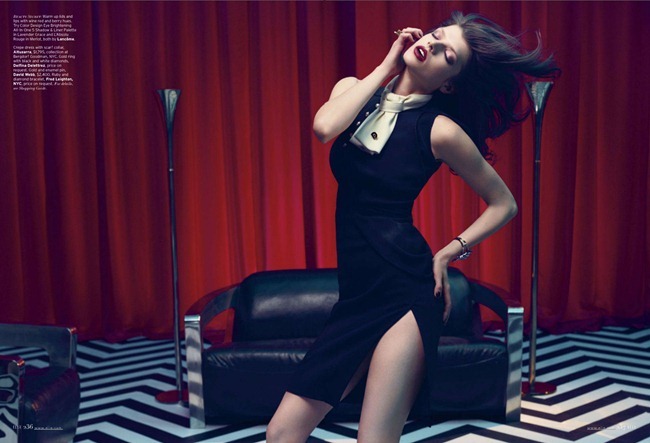
The editorial this photo belongs to is totally unironically called “The Surreal World.” Photo credit: Elle August 2012

When I Knew It Was Over

When I was a little kid, my favorite dreams were the ones in which I got something new–a toy I’d been wanting, some really cool gadget. (Kids are acquisitive that way.) I would wake up grasping for my new possession and feeling a tremendous sense of injustice at the fact that I couldn’t keep it after the dream was over.

Right now, I’m still dreaming the dream, hoping I never wake up and lose what I’ve just gotten.

My depression kind of has its own saga. I’ve had it since I was 12. It got much worse when I went to college. I got diagnosed and started taking anti-depressants and it got better. Then it got worse again despite the anti-depressants. Then I said fuck it to the anti-depressants and went off of them. There were a few good days in there in spite of that, to be sure, but it was always there.

That is, until a few days ago.

It’s well-known that depression can spontaneously remit sometimes, but I wasn’t expecting it to happen to me. Just a few short weeks ago I was strongly considering going back on anti-depressants and dreading the long, lonely summer ahead. I’d had many bad episodes recently, too many.

But then they started decreasing in frequency. I didn’t even notice what had happened until, ironically, an evening when I was sad. I had put on some sad music and was sitting around lamenting the uselessness of one of my romantic endeavors. There’s no chance in hell it’ll go anywhere, but I really like the person in question, and this sucks.

And then it suddenly hit me–I was sad like normal people are sad. I wasn’t crying, I wasn’t wondering why I’m such a failure in life and why everybody hates me and why I’m so ugly and useless. I wasn’t planning a lifetime alone and lonely. I wasn’t going down the list of every single person I’ve spoken to recently, analyzing our last conversation, and scanning it for clues showing that they actually secretly hate me.

I was just sitting around, kind of blue, listening to sad music, regretting the fact that this Thing isn’t going to work out, but hoping that someone else will come along soon. Like a normal person. A healthy person.

And that’s when I knew it was over.

The weekend after that–this past weekend–felt entirely new to me. All the colors were brighter, my senses were sharper. Little hurts rolled right off of my skin like water. I woke up in the morning looking forward to the day, whereas for the past year and a half, I’ve woken up every day thinking, “Fuck, another day.”

I could be happy sometimes when I was depressed, but only if I had a concrete, immediate reason. Now I don’t need one. I can be happy just because, sometimes. I can be happy just because I’m alive.

There are a few reasons why this might’ve happened now. Summer started and the academic stress went away. The weather is good. I can be outside now, go to the beach, take walks, explore the city, have a life outside of my tiny room. My friends freed up, too, and suddenly I started having plans with them all the time. It became possible to text someone in a moment when I was feeling down and have plans an hour later.

Besides that, I fell for someone for the first time in ages. Although that person is completely unavailable to me in more ways than one, it was a reminder that there really are people out there with whom I can feel a connection, despite my cynicism about these things. Nothing’s going to happen here, but I’ve already learned more from one unrequited crush than I have from the past year and a half of dating.

The final thing is that I started writing again. By which I mean, really writing–writing fiction–and not just these blog posts and the various other expository pieces that I do. I restarted a novel that I thought up two years ago but then stopped writing because I thought I wasn’t mature enough to write it. It’s a lofty project; its themes include grief, depression, suicide, marital discord, friendship, betrayal, love, and figuring out what the hell to do with your life. It doesn’t seem like an uplifting thing to write, but it is, and writing it once again has made all the difference.

For the first time in a while, I can be at ease alone. Whereas before I hated myself so much that I dreaded being left alone with myself for more than an hour or two, now my mind is a welcome presence. It writes stories for me, it promises me a bright and happy future. It points out birds and clouds and other things I used to ignore. It steers me towards my cheerful playlists, not my brooding ones.

I’m writing this now not just to share it with others, but because, as with coveted toys of my childhood dreams, I’m trying desperately to hold onto this feeling before the dream ends. Because it will. It always does. And when it does, I’ll no longer be able to understand how I could’ve ever written this.

And I’ll reread it and try to understand. I’ll remember to see my friends and to write more and to stay open to the possibility that someone will come along and change my entire life.

I’ll read this and remember.

So goodbye, depression. Until next time.

[Guest Post] An open letter to the woman who said I wasn’t skinny enough to have an eating disorder

Another guest post, this time by my friend Kate.

You are the mother of my greatest friend. Your house was my refuge in high school. I wanted to surprise you and share my happiness with you when I got into my dream college. By my senior year, I spent almost every day after school at your house. You offered to cover for me, to be a hiding place when I simply could not deal with my family…and you became someone I trusted. You knew me in the worst throes of my starvation. I was skinny then. I was too skinny, and faint and malnourished and mentally ill. You didn’t know it then, but your son guessed, and for that, he has my eternal gratitude. Without him, I do not know that I would have survived to this point. That is not hyperbole.

You saw me this summer, back home for the worst summer I’ve had. I have gone off therapy for these three months, because you see, my parents don’t use modern medicine, and I cannot trust them to care for me. I am dependent on the kindness of my university to have treatment in the first place. This summer, all I have are friends, and my own will to do anything to keep from slipping back into a hell of calorie counting and obsessive thoughts and the nightmare of reflective surfaces. I used to hate myself, you know. It still creeps up on me and strangles and pulls at loose skin, until all I can do is hold off from screaming and curl up in bed.

You don’t know this. I would have told you, had you asked. I speak about my cesspit of destructive behavior, because you can’t tell when you look at me. That is true of most eating disorders, and someone has to talk about it. I will be that person.

You can’t tell that some days I realize all I’ve had is a cup of coffee in twenty-four hours, and I am blisteringly happy. You can’t tell because I force myself to hold a normal weight. I have for four years, and on especially good days, that is a source of pride.

That number on the scale isn’t the weight I want, but it is healthy. It is perfectly in the range for my height, a muscular build that runs and leaps and cartwheels, but it isn’t skinny. It isn’t skinny, and that is all you see. I am not starving, and so I cannot possibly suffer. I should get over it.

I’d like to, but if the past six years are any lesson, I won’t. I will always depend on alarms to remind me when to eat. I will plan my workouts ahead of time, because when I don’t, I become obsessive, and exercise until I cannot see straight. I will never eat with abandon. Meals will be planned for. Eating out will be stressful. I will have an uneasy truce with food.

And there will be people like you. I hate saying that because, until yesterday, when I said that I meant people who would care, and make me laugh, and be one of the solid ones. There will be people like you, who think I’m making a fuss, playing victim. You were one of the good ones, once, so I’d like to set the record straight.

I am recovering from an eating disorder. For two years, I averaged less than 800 calories per day. I danced intensively, as much as four hours a day. I lost too much weight. I was starving and bony. I did permanent harm to my body.

I have bradycardia. That means my heart beats too slowly; it doesn’t speed up enough when I exercise. If I push too far? I’ll faint. I do not trust myself to exercise outside of a gym. I cannot know when my vision will narrow, but in a building, I at least know that if I stay unconscious, someone will be there. I want you to consider that my safety net is the kindness of strangers to notice if I do not wake up.

The rate for attempted suicide in those with eating disorders is as high as three times that of the general population. Everyone quotes statistics, but I want you to take a hard look at that one. If you combine the neurotypical people out there with those who have PTSD, with those who have major depression, with everyone else who has considered their life not worth living, they attempt suicide at one third the rate of those with eating disorders. You know what makes me hurt so badly I want nothing more than to make it stop any way I can? When people I trust decide some number on a scale measures the weight of my claims, when they reinforce the horrible things I believe about myself. I just never thought one of them would be you.

I want you to know something important about your son. Your son cared for me without knowing any of those facts or statistics or numbers. He just thought I was worth time. He thought I was too skinny, that I was maybe hurting myself, and so he did what he could. He held me and took me to dinner and made sure I ate. He never demanded justificationβ€”he waited until I told him I had an eating disorderβ€”the first person I ever confessed to. He smiled, and said he knew, and then we went back to life as normal. We talk every day, because we take care of each other.

I want you to understand something, more than anything else in this letter. You
said I didn’t really have an eating disorder. But that wasn’t the worst thing. You alsoΒ told my greatest friend, your son, that he should back away from me. You said heΒ shouldn’t β€˜have’ to take care of me. You wanted him to back off, because I was beingΒ whiny. I cannot forgive that.

I can forgive your careless misunderstanding of my eating disorder. You won’t beΒ the last. You hurt me badly, but it’s ignorance like the words you spoke that keep meΒ speaking up. I cannot forgive your wish to destroy my support.

You spoke selfishly.Β It is the selfless spirit of your son, and his love that quite literally, saved my life. I’mΒ sorry you can’t see that. I’m sorry I don’t want to see any more of you.

Relevant citations: here and here.

Kate Donovan is a junior studying psychology and human development at Northwestern University. She is the president of Northwestern’s Secular Student Alliance and a writer at Teen Skepchick and the Friendly Atheist blog.

Depression is Not Sadness

Yesterday I came across the story of Junior Seau, an NFL linebacker who committed suicide on May 2. He shot himself in the chest and was found in his home by his girlfriend. Although little is known of Seau’s mental health leading up to his death, he had apparently suffered from insomnia for the last seven years of his life.

Sportswriter Chris McCosky wrote a beautiful column in the Detroit News about Seau’s death and continuing ignorance about depression and suicide. In the column, McCosky shares his own experiences with depression and suicidal thoughts and laments how difficult it is to explain them to people. He notes, as I’ve noted before, that one common reaction that non-depressed people have is to wonder what the hell we have to be so sad about. He writes, “It’s almost impossible to talk about it to regular people (bosses, spouses, friends). They can’t fathom how somebody in good physical health, with a good job, with kids who love them, who seems relatively normal on the outside, can be terminally unhappy.”

The unbearable frequency at which McCosky and I and probably everyone else who tries to talk about depression get this response could be a testament to the fact the most visible symptom of depression is usually sadness. So that’s the one people latch on to: “What do you have to be so sad about?” “Cheer up!” “You have to decide to be happy!”

Because of the sheer obviousness of our sadness, we’re often forced to try to use it to describe depression. We say that we’re just extremely sad, or unhealthily sad, or a different kind of sad. It’s sadness that never goes away like sadness is supposed to. It’s sadness that’s out of proportion to the troubles that we face in our lives. It’s sadness that we can’t stop thinking about. For those of us with bipolar or cyclothymic disorder, it’s sadness that comes and goes much too quickly.

And it is. But the truth is that sadness actually has very little to do with depression, except that it is one of its many possible symptoms.

Based on the diagnostic criteria for depression, you don’t even need to be chronically sad to be considered “depressed.” Anhedonia, which means losing the ability to feel pleasure from things that you used to enjoy, could be present instead. Under the formal DSM-IV definition, you must have at least five of nine possible symptoms to have major depression–and one of the five must be either depressed mood or anhedonia–and only one of those symptoms involves sadness. (If you so some very basic math, you will notice that this means that two people, both of whom officially have major depression, might only have one symptom in common. Weird, huh?)

So, even if your particular depression does include sadness, it’ll only be one of many other symptoms. The others might be much more painful and salient for you than the sadness is. Some people can’t sleep, others gain weight, some think constantly about death, others can’t concentrate or remember anything. Many lose interest in sex, or food, or both. Almost everyone, it seems, experiences a crushing fatigue in which your limbs feel like stone and no amount of sleep ever helps. Then there are headaches, stomachaches, and so on.

So, depression doesn’t necessarily mean sadness to us. (And, a gentle reminder to non-depressed folks: being sad doesn’t mean you’re “depressed,” either.)

Depression is not sadness; it’s an illness that often, though not always, involves sadness. No amount of happy things will make a depressed person spontaneously recover, and, usually, no amount of sad things will make a well-adjusted person with good mental health suddenly develop depression. (Grief, of course, is another matter.) And sadness, on its own, does not cause suicide.

We need to start talking about mood disorders as disorders, not as emotional states. McCosky writes:

Junior Seau wasn’t sad when he pointed that gun to his chest. He wasn’t being a coward. He wasn’t being selfish. He was sick. I wasn’t sad when I thought about swerving into on-coming traffic on Pontiac Trail some 20 years ago. I was sick.

What he’s saying is that people don’t kill themselves because they’re sad. They kill themselves because they have an illness that, among other things, makes them feel sad. It also makes them feel like their life is worthless, like they’re a burden to others, like death would be easier, and all the other beliefs that lead people down the path to suicide.

There is a tendency, I think, to assume that people are depressed because they are sad. A better way to look at it is that people are sad because they are depressed. That’s why, even if we could “turn that frown upside down!” and “just look on the sunny side!” for your benefit, it would do absolutely no good. The depression would still be there, but in a different form.

Junior Seau did not leave a suicide note, so only God knows what he was thinking when he died. I would guess, though, that he was thinking about much more than just being sad.