Anonymity and Mental Illness

The stigma of mental illness has many negative consequences, such as decreased access to employment and housing, barriers to seeking treatment, and many broken friendships and relationships.

What it also does, unfortunately, is make it much harder for people who’ve suffered from mental illness to speak about it publicly, using their real names.

I’ve been thinking about this because North by Northwestern, our campus magazine, ran a feature in its spring issue about mental illness at Northwestern. Overall, the piece was great and discussed how our academic system may be contributing to unhealthy levels of stress. The author of the piece interviewed two students who spoke about their experiences with depression and anxiety.

But both of the students’ names were changed for the article, and it bothered me.

For the record, I would never begrudge an individual for choosing to speak about his or her mental illness under a pseudonym. We all have different priorities, and not everyone has decided to spend their life advocating for those with mental illnesses (as, for instance, I have). Even those who do may decide that using a pseudonym is in their best interest–for instance, this blogger whom I greatly respect.

The magazine, however, could have chosen to find sources who would be willing to let their real names be printed. I know it could’ve, because those people exist on our campus. I’m one of them. Many of my friends are, too.

This is important for several reasons, some short-term and some long-term.

The short-term reason is that seeing fellow students speak publicly about their experiences with mental illness can make a huge difference in the life of someone who’s just starting to acknowledge and deal with their own illness. It lets them know they’re not alone and gives them hope for the future.

It can also give them a specific person to reach out to. After I started writing about depression, friends, acquaintances, and even strangers started writing to me, sharing their stories, and asking for advice. I heard from friends that I knew were struggling and friends who seemed to have everything together. I heard from a guy who’d told me once that he’d had depression briefly but pulled himself out of it on his own. I felt humbled to know the truth.

A friend of mine who spoke in a panel about her eating disorder once told me that she had the same experience. She was quoted in an article about the panel, and afterwards people reached out to her about it.

There’s a bigger picture, though, as well. Every time someone “goes public” about a mental illness, they chip away at the culture of secrecy that surrounds it. And the more of us do it, the harder it’ll be to deny us jobs, cut off friendships with us, continue believing that we’re weak and lazy, and be ashamed of us.

I’m glad those two students spoke to NBN, and I know it was hard for them to do even knowing that their names would not be in print. But NBN had a chance to do something really important, and they missed that chance.

As I was writing this post, I found out that there’s someone pretty powerful who recently took that chance. During his speech for people who have lost family members in the military, Vice President Biden talked about the deaths of his wife and daughter in 1972. Then, he said, “I probably shouldn’t say this with the press here, but it’s more important–you’re more important.” Then he went on:

For the first time in my life, I understood how someone could consciously decide to commit suicide. Not because they were deranged, not because they were nuts, but because they had been to the top of the mountain and they just knew in their heart they’d never get there again.

Biden’s not the only one, of course. Plenty of well-known people have spoken about mental illness, such as Rachel Maddow, William Styron, and Demi Lovato.

In his seminal book on depression, The Noonday Demon (which I have coincidentally just finished reading), Andrew Solomon intentionally avoids using pseudonyms whenever possible. On the first page of the book, he writes,

I asked my subjects to allow me to use their actual names, because real names lend authority to real stories. In a book one of the aims of which is to remove the burden of stigma from mental illness, it is important not to play to that stigma by hiding the identities of depressed people.

I believe that when writing about mental illness, one must be cautious of the status quo. With regards to mental illness, as with regards to just about everything else, the status quo can be a dangerous thing. You cannot think and write about the tragedy of mental illness without also acknowledging the tragedy of stigma, which pushes so many of us to stay silent for too long. In my case, it was eight years. For others, it’s a lifetime.

Accepting the use of pseudonyms in one’s work just because that’s what’s always been done, or because finding interview subjects who are willing to use their real names might be difficult, does an injustice to everyone who suffers from the continuing presence of stigma.
What You’re Really Saying When You Say that Suicide is “Selfish”

I’m still thinking about the Chet Hanks suicide thing from last week and the various responses to it that I saw online. Specifically, I cited two comments that referred to suicide as “selfish.”

“Selfish” has to be one of the most common adjectives people think of when thinking about suicide. Those of us who are involved in mental health advocacy could probably rant at you for hours about how this word perpetuates the stigma that mental illness and suicide carry in our society, how useless and counterproductive it is to accuse a suicidal person of being “selfish,” and so on. In fact, if you get nothing else out of this post, I hope you reconsider using that word to describe suicide if you’ve done so before.

But I can understand where this sentiment comes from. While everyone loses loved ones at some point in their lives, relatively few people experience suicidality first-hand. For this reason, people understand the latter situation much less than the former. Faced with the thought that someone you love might kill themselves and put you through all the resulting grief just because of some inner turmoil that you can’t see or understand, it makes sense that you might feel that suicide is selfish.

At the same time, though, conceptualizing suicide as a “selfish act” sends the message that people somehow “owe it” to their loved ones to stay alive despite immense emotional pain. When you say that suicide is “selfish,” you’re implying–even if you don’t mean to–that the individual’s pain, as well as their potential to improve, isn’t what matters. What matters is how they’ll make the people around them feel.

I don’t mean to discount the grief that people feel when someone they love commits suicide–that’s real, valid, and deserves attention. And, obviously, I believe that people should not commit suicide. But I believe that because I also believe that people can recover from the pain that’s causing them to consider suicide, not because they owe it to others to live.

What all of this comes down to is that most people do not (and perhaps cannot) understand what actually goes through a suicidal person’s mind. Maybe they assume that suicidal people are just sad the way all of us sometimes get sad, except maybe a bit more so. (I honestly don’t know how mentally healthy people think about suicide because I haven’t been one for a while.) It would indeed be rather selfish to put your friends and family through so much pain just because you felt sad one day.

But that’s not how suicide works.

The way I see it, the tragedy of suicide is not (or is not only) the fact that an individual’s suicide also hurts others. Rather, it’s that the individual could have found a way to heal, be happy, and live out the rest of his or her life. Calling suicide a “selfish” thing to do erases that latter tragedy and implies that our primary purpose in life is not to create a meaningful and worthwhile life for ourselves, but to keep our friends and family happy at all costs.

Our first priority should be to convince those who want to take their own lives that those lives are intrinsically valuable and should be preserved for their own sake. Only when they’ve accepted that premise can they even begin to think clearly about their obligations and interactions with other people.

Telling a suicidal person that suicide is “selfish” only reinforces the guilt they already feel. People should choose to live because their lives feel worth living to them, not out of a sense of obligation towards others.

Note: Since this is quite a sensitive topic both for me and probably for many readers, please try to be especially careful with your comments. I reserve the right to delete any comments that I feel may trigger people, even if they’re completely on-topic.

Empathy and Leadership: Why Romney Would be a Terrible President

What do we look for in a presidential candidate? Political experience, intelligence, charisma, and confidence are probably high up on the list. Good looks and an adherence to Christianity clearly don’t hurt either.

But what about empathy?

What terrifies me the most about the scant possibility of a Romney presidency is not the fact that I disagree with his political ideology. Rather, it’s Romney’s seemingly complete lack of empathy.

This thought first occurred to me back when the “Seamus incident” made the news a few months ago. But one can easily argue that the incident doesn’t exactly prove that Romney is a heartless robot–after all, the victim in question was a dog, not a human, and who really knows how the dog felt anyway?

Slightly less ambiguous is this new bit of insight into Romney’s past:

Friedemann entered Stevens Hall off the school’s collegiate quad to find Romney marching out of his own room ahead of a prep school posse shouting about their plan to cut Lauber’s hair. Friedemann followed them to a nearby room where they came upon Lauber, tackled him and pinned him to the ground. As Lauber, his eyes filling with tears, screamed for help, Romney repeatedly clipped his hair with a pair of scissors.

This is what Mitt Romney did to a classmate at his boarding school when he was a senior. The classmate, John Lauber, was presumed to be gay and wore his bleached-blond hair long–at least, until Romney decided to do something about it.

According to the Washington Post, this story was remembered and corroborated independently by five of Romney’s former classmates. Romney’s response:

“Back in high school, I did some dumb things and if anybody was hurt by that or offended, obviously I apologize for that…I don’t remember that incident,” Romney said, laughing. “I certainly don’t believe that I thought the fellow was homosexual. That was the furthest thing from our minds back in the 1960s, so that was not the case.”

I think it’s interesting that, despite claiming not to remember this incident, Romney nevertheless seems to file it into that large category of Dumb Things Teenagers Do. We all have those things, of course. For me, it was writing bad poetry and crushing on unattainable guys. For more typical teenagers, it’s probably something like getting really drunk when their parents are out of town and throwing up all over the Persian rug.

For the teenage Romney, though, it’s assaulting a fellow student because he’s (ostensibly) gay.

(Incidentally, Romney’s campaign has apparently been trying to get other former classmates of his to speak up in support of him. Good luck with that.)

It’s easy to make the argument that this happened decades ago and that Romney is probably a Completely Different Person now. Perhaps. But one writer on Mother Jones, discussing what “Romney the teenager” can tell us about “Romney the man,” says:

Romney the man has denied, and repeatedly denied yesterday, even remembering this incident. Sure, it was half a century ago, but he led a posse of his friends, tackled John Lauber in a hallway, dragged him into a bathroom, and then chopped off his hair while he struggled in terror. Even if you grant that this kind of extreme behavior was more common in a 1960s prep school than it is today, it’s really not the kind of thing you’d forget.


At least, you shouldn’t. So either Romney has done this kind of thing so often that the Lauber incident just blends into all the others, which suggests a far more vicious childhood than he’s owned up to, or else he remembers it just fine and is simply lying about it.

Furthermore, Romney has made his position on LGBT people clear more recently, too. As Governor of Massachusetts, he abolished a group looking into the issue of bullying and suicide in LGBT teenagers. One of his spokespeople outed a transgender woman running for political office in the same state, ending her career. Romney has also signed the National Organization for Marriage’s pledge, stating that he would support a constitutional amendment defining marriage as between a man and a woman, and donated $10,000 to that organization to support Proposition 8 in California. Of his stance on gay marriage as governor of Massachusetts, Romney has said, “On my watch, we fought hard and prevented Massachusetts from becoming the Las Vegas of gay marriage.”

So, while we can be reasonably sure that Romney wouldn’t physically bully anyone these days, I’m not so sure that his ability to empathize with people different from him has evolved at all.

Unfortunately for us–if Romney gets elected–empathy is essential for good leadership. (A U.S. Army Colonel makes that case very persuasively in this Washington Post column.) By definition, leaders are in a place of privilege compared to those they lead, so if they want to know how best to serve the people who elected them, they must be able to understand them and their lives.

For instance, take bullying. It’s one thing to take a stand against bullying because you were once bullied yourself, and another thing entirely to understand the harm that bullying does to individuals, families, communities, and society as a whole, without having experienced it firsthand. Since presidential candidates tend to be male, white, wealthy, Christian, straight, cisgender, able-bodied, and so on, they are unlikely to have experienced things like bullying firsthand. That is why having empathy is essential if they are to understand this increasingly politicized issue.

For a politician, being empathic doesn’t necessarily mean you have to be a bleeding-heart liberal; it just means you have to be able to understand how people different from you actually think, feel, and choose. You could still, for instance, choose to limit government spending for economic reasons while acknowledging and genuinely regretting the fact that your choices may hurt some people. You could propose and support ways of solving issues like social inequality without increasing government spending.You could understand that poor people are not always to blame for their own predicament, even if you don’t think that bringing them out of it is the government’s job.

You could recognize that you disagree with gay marriage because of your religious beliefs, but understand that not everyone shares your beliefs and not everyone should have to live by them. You could disagree with gay marriage because of your religious beliefs, but realize that gay and lesbian teenagers still deserve protection from bullying.

You could, in other words, be a Republican with a heart.

In short, having empathy doesn’t mean being politically liberal. There are plenty of liberals who seem to lack empathy, and there are–hopefully–conservatives who have it. But Romney isn’t one of them. And that, much more so than his politics, is why I really hope he’ll never be President.

Chet Hanks, Victim Blaming, and the “Weakness” of Suicide

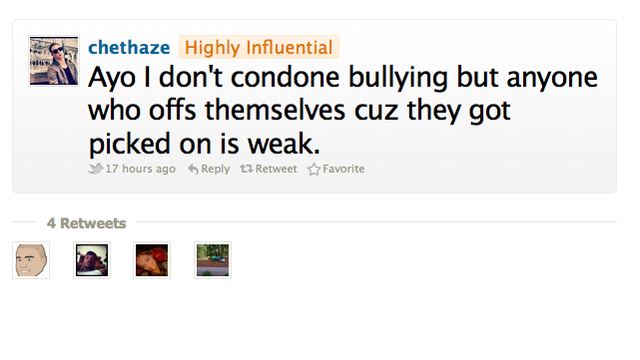
Chet Hanks, son of Tom Hanks and a student here at Northwestern, has this to say about victims of bullying:

Chet's tweet: "Ayo I don't condone bullying but anyone who offs themselves cuz they got picked on is weak."

Credit: Gawker

And then, perhaps in response to people who responded to him (including yours truly), Chet tweeted these followups:

“I say real shit and I always speak my mind if you don’t like it I could give a fuck less.”

“Lol…Haters: I am sorry I do not cater to your demographic: shlubby dudes that don’t get laid enough it’s ok go back to your Internet porn”

“G’head check my feed, all the people hatin are mediocre Lames and cute girls show me love #whatdoesthattellyou

How mature.

Sometimes I wish someone would invent a technology that allows you to connect to someone else’s brain and actually feel what they feel. Because language is a poor substitute.

Maybe if we had such a technology, people would finally understand that mental illness and suicide do not happen to people because they are “weak.”

However, since we don’t have such a technology, the best we can do is educate ourselves about other people, something that college provides a great opportunity to do. It’s too bad that Chet Hanks seems not to be taking advantage of it.

Some of the comments on the Gawker piece I linked to, while generally dismissive of Chet Hanks, are hardly any better:

His expression of emotion is misguided and a bit douche-y, but I second the sentiment. Suicide is a horrible option to exercise as a bullying deterrent. It’s a permanent solution to a potentially temporary problem. It exchanges the pain you feel for the pain of those around you who love you and is essentially a selfish act.
Suicide is selfish and hurts people who care about you, but calling people who are potentially thinking about doing it weak is only going to make things worse. He could have expressed this sentiment in a way that was constructive and helped people, instead of highlighting what an asshat he is.

It’s probably true that some people are psychologically more susceptible to suicide than others, but that difference has nothing to do with “strength” or “weakness.” It also has nothing to do with “willpower” and “selfishness.” To put it broadly, suicide is what happens when a person no longer wants to live–which isn’t necessarily the same thing as wanting to die.

Tragically, most people who commit suicide do so at least in part because they don’t feel like anyone will miss them, and contrary to what the self-righteous commenters above seem to think, not everyone does have friends or family who care about them. It’s also worth noting that, with the exception of people like me who were bullied for being nerdy, kids who get bullied tend to already be marginalized by society in numerous ways–because of fatness or ugliness, mental or physical disability, perceived or real homosexuality, noncompliance with gender roles, and so on. Sometimes, these are the very children who are least likely to have supportive parents, siblings, teachers, and friends cheering them on through their trials.

What Chet seems to miss is that the causal relationship between bullying and suicide isn’t just that a kid goes to school one day and gets called a fag and comes home and tries to kill himself. Bullying is almost never a one-time thing; it can continue over months or years. It’s a constant wearing down of an individual’s self-worth and belief that he/she belongs in this world. Bullies don’t simply call you names and beat you up–they convince you that nobody wants you here.

While supportive friends and family can alleviate these tragic effects somewhat, as I mentioned, not everyone has supportive friends and family. And even if they do, that may not be enough. Children don’t have the freedom that adults have–they’re completely powerless to escape the situation by moving or dropping out of school. The only recourse they generally have is telling an authority figure at school, and that tends to do nothing at best or backfire at worst.

But of course, pretty much everyone reading this blog probably already knows all that. What they probably don’t know is how it actually feels to seriously consider suicide, and how little it has to do with concepts like “weakness” and “selfishness.” If you’d like to hear about it from someone who knows of what she speaks, feel free to ask me personally. Otherwise, I’d recommend this amazing book.

After we read about Chet’s tweet, some of my friends and I started talking about the whole concept of victim blaming and how pervasive it is in our society. Although it’s usually talked about in the context of sexual assault, there really isn’t a single shitty human experience that doesn’t routinely get blamed on its victims: mental illness, bullying, poverty, racism, sexual harassment, you name it. If you have depression, it’s because you’re just not looking on the bright side of life. If you’re getting bullied, it’s because you stick out too much or “react” too much. If you’re poor, it’s because you’re too lazy to get a job. If you’re fat, it’s because you eat crap and don’t exercise. If you feel discriminated against, it’s because you’re “too sensitive.” If you’re getting harassed on the street, your skirt’s too short. And so on and so forth.

(In fact, as Barbara Ehrenreich notes in her brilliant book Bright-sided, even cancer, that ultimate of tragedies, is increasingly getting blamed on its victims. Why? Because they didn’t “think positively” enough.)

Sometimes, it’s really difficult and unpleasant to acknowledge the fact that, even in our pull-yourself-up-by-the-bootstraps, when-there’s-a-will-there’s-a-way sort of culture, sometimes life just screws people. Sometimes it just does.

It’s easier to blame the victim than to make the sort of cultural changes we would need to make sure that people get screwed over as little as possible. Much easier than to figure out how to teach compassion to kids, how to eradicate racism, how to get people to realize that there’s never an excuse for raping people.

But just because we may not yet know how to do those things does not mean we should just throw up our hands and say, “Yeah well, if they off themselves, it’s just cuz they’re weak.”

The more I study psychology, bullying, and the many challenges faced by people that society continually marginalizes, the more I think: If only it were that simple.

*edit* Also, I’m going to try really hard to believe that underneath all that idiocy is some actual intelligence, and that that’s why Chet Hanks got into this school–not because of who his father is.

And, here’s an awesome blog post about this from my friend Derrick.

Leaving Medill

I knocked on the office door promptly at noon. She opened the door and said, “Can you just wait a few minutes? Our teleconference is running late.” I nodded. The door shut. I waited.

Twenty minutes later, I was sitting at a round table in a large, airy office full of plants. It had two windows, one of which faced my freshman year dorm.

“So, you’re thinking about transferring out of Medill?”

“Definitely transferring.” Her eyebrows go up. “I mean, I’m a junior, and I actually decided quite a while ago, so…”

“Can you tell me a little bit about your decision? I’m not trying to dissuade you.”

~~~

I remember all those nights. Clutching my camera or my notepad or both. Trying to find a way–any way–to escape the situation.

The worst time was when I was doing my final project for the last journalism class I ever took. I went to a gathering at my brother’s apartment–an event for young adults of Jewish/Russian descent. I had to interview people–not my brother, obviously. I couldn’t do it. I couldn’t make myself talk to anybody. My throat started closing up.

My brother’s apartment was on the sixteenth floor. Would that be high enough?

I ran outside and collapsed on a bench in a park, crying and trying to catch my breath. I felt ridiculous. The Medill School of Journalism had accepted just ten percent of its applicants the year I got in. There were nine other people who had desperately wanted my spot. And now I was bawling like an idiot because I had a terrible fear of talking to strangers.

They told me it gets easier with time, that you have to just make yourself do it. They said you would stop feeling self-conscious after a while. They explained how important it is to my future career that I learn to be pushy.

It never got easier. I always ended up gasping for breath and crying.

I don’t remember how I finished that project, but somehow I did. Not long after I started having weird neurological symptoms and became more or less numb to everything. I spent the summer at home, doing almost nothing. The one thing I accomplished was starting antidepressants to undo what being in Medill had, for whatever reason, done to me.

~~~

And today, two years later, I sat in her office and answered her question.

“It just wasn’t my thing,” I said.

~~~

Two years have passed, and I’m only now filling out this paperwork, going to this meeting, and making sure that the university knows whether to give me a BS in journalism or a BA in psychology.

Part of reason for the delay was my own laziness and lack of fondness for formalities like this, but another part of it was avoidance.

I hate going into the Medill buildings. Both of them. One is very new, all sleek and shiny, with high ceilings and plush chairs and new technology. The other is its opposite, old and creaky, with a rusty fire escape winding up the back. I once climbed all the way to the top of it and sat there late at night.

They’re both beautiful. I hate them both.

In these buildings I learned how to write a lede and use AP style. I learned how to use Adobe Flash and InDesign, Final Cut Pro, and Audacity. I learned how to shoot video and record audio. I learned how to harass people who didn’t want to answer my questions until they did it anyway.

Mostly, though, I learned what it feels like to fail.

I don’t mean what they call a “Medill F,” which is what happens when you make a factual error in a piece and receive a grade of 50%. That did happen to me, as it did to virtually everyone else.

But that’s not failure. That’s just screwing up. Failure is when your mind conspires against you and keeps you from doing something you desperately want to do.

I wanted to be a journalist, but I couldn’t stop the panic attacks that I got whenever I had to actually be one.

~~~

She signed my form and made sure I knew where to take it next.

“And know that we’re always here for you, even though you’re leaving. If you ever have any questions, I’m always happy to help–even you!” She smiled and I had to smile back.

She congratulated me again for my acceptance to the psychology honors program, and I thanked her kindly.

“Good luck, my dear,” she said.

And then, less than five minutes later, it was over. I left the building and I left Medill.

~~~

It’s been two years since I took a journalism class. My video camera, voice recorder, and microphone lie abandoned in my closet back home. I still use my tripod for my own photography.

My external hard drive died suddenly over a year ago, and with it died all the articles and projects I did. If there’s a heaven for vain attempts, that’s where they are.

My new chosen profession is similar to journalism in some ways. Both journalists and therapists do a certain amount of investigation and excavation. Both live and work by a code of ethics, and both must keep secrets. Therapists, like journalists, ask questions and listen and take notes.

But that’s basically where the similarities end. Therapists don’t get to attach their names to their successes. I don’t get to point out a person who came to me barely able to get through the day and now lives happily, and say, “This is my work.” They don’t award Pulitzers to therapists. If a therapist’s name is in the newspaper, it’s probably for something bad.

And yet. My freshman year, one of my journalism professors told me a story about something she saw as a young reporter. A horrific plane crash had just happened and many were injured or dead. She was assigned to cover the story and showed up at the local hospital along with all the other reporters. The hospital staff told the reporters that there was a special room for grieving friends and family and that they must not attempt to interview the people inside.

Then someone came out of the room and sat on the floor, next to the door, with her head in her hands. My professor couldn’t bring herself to do it, but another reporter walked right up and said, “So, who’d you lose?”

I retell this story whenever people ask me why I chose psychology over journalism. It illustrates so pointedly the differences between these professions. Journalists do important work, work without which our society couldn’t function. But their allegiance is to “the people,” who “need to know.” The allegiance of a therapist is always, always to her client.

~~~

But I won’t pretend that this is a happy choice. I’m glad to have found my calling in life, but when I tell people that I “chose” psychology instead of journalism, as I told you just now, I’m not really telling it like it is.

“Choosing” means picking one thing when you are equally free to do either.

I was never free to be a journalist, because my broken brain wouldn’t let me.

Maybe if I had been, I would still have chosen psychology. Maybe not. Either way, now I’ll never know.

Most of us were raised with the idea that we can be whatever we want to be. Well, maybe that isn’t always true.