Why Dan Savage Shouldn’t Use Hate Speech Against Gay Republicans

I’ve got a post up at In Our Words today! Here’s a preview.

A few weeks ago, an organization of conservative LGBT folks and their allies called GOProud endorsed Mitt Romney for president. Surprise, surprise: a conservative group endorsing a conservative presidential nominee.

Dan Savage, however, was apparently irritated enough by this to comment on it. He tweeted, “The GOP’s house f*****s grab their ankles, right on cue…” with a link to the story, followed by the word “pathetic.” Except that he didn’t use the asterisks.

One could hardly design a more controversial and, in my view, offensive message. First of all, the phrase “house f*****s” is a blatant allusion to another offensive term, one laden with historical meaning: “house Negros” (or “n*****s”). In the antebellum South, slaves were divided between those who worked in the fields and those who worked in the plantation owner’s house. The house slaves were typically lighter-skinned and received better clothing and food, and the type of work they did was less physically taxing than that of the field slaves.

A century later, Malcolm X characterized the “house Negro” as a slave who is more likely than a “field Negro” to support—at least tacitly—the institution of slavery, because it has afforded him or her an easier life than it did to the field slave. Similarly, he described African Americans who wanted to quietly live and work among whites as “house Negros,” and himself and his fellow activists as “field Negros.”

[…]This is the complex and painful analogy—which I have probably oversimplified here—that Savage has, for some unknown reason, chosen to invoke. To him, LGBT folks who support conservative politicians are like “house Negros” because they are willing to support a power structure that others (rightfully) consider oppressive.

Read the rest!

In Case You Haven’t Heard, Rape Isn’t Funny

“Rape is funny and so am I! Right? …Right?”

Some comedian I’ve never even heard of before–but now have–is under fire right now for a “joke” he made in one of his shows. I use the word “joke” (just as I will use the word “humor”) broadly here.

In the words of a woman who attended a show by comedian Daniel Tosh, this is what happened:

So Tosh then starts making some very generalizing, declarative statements about rape jokes always being funny, how can a rape joke not be funny, rape is hilarious, etc. I don’t know why he was so repetitive about it but I felt provoked because I, for one, DON’T find them funny and never have. So I didnt appreciate Daniel Tosh (or anyone!) telling me I should find them funny. So I yelled out, “Actually, rape jokes are never funny!”

[…]After I called out to him, Tosh paused for a moment. Then, he says, “Wouldn’t it be funny if that girl got raped by like, 5 guys right now? Like right now? What if a bunch of guys just raped her…” and I, completely stunned and finding it hard to process what was happening but knowing i needed to get out of there, immediately nudged my friend, who was also completely stunned, and we high-tailed it out of there. It was humiliating, of course, especially as the audience guffawed in response to Tosh, their eyes following us as we made our way out of there. I didn’t hear the rest of what he said about me.

So, what we have here is a (male) comedian insisting that rape jokes are funny (in itself a barely defensible position), getting called out for it by a female audience member, and insisting that it would be “funny” if she got gang-raped.

Naturally, Tosh made a typical non-apology:

Credit: Feministing

I just love how he claims, as usual, that his comments were taken “out of context.” Is there any context in which, “Wouldn’t it be funny if that girl got raped by like, 5 guys right now?” is an acceptable thing to say?

While I’m pretty sure that most decent people would see this “humor” for the crap that it is, a number of online conversations I’ve had the misfortune of having today suggest otherwise. For the record, every single person who has defended Tosh in this situation is 1) a man, and 2) someone who admitted to having previously watched and enjoyed Tosh’s show. So something tells me that there’s a little bit of “But I like this guy and I need to convince everyone that I’m still a good person!” psychological trickery going on here. In technical parlance, we call that “cognitive dissonance,” and it helps explain why some people defend assholes like Tosh so rabidly.

Here are some Actual Arguments that I’ve seen.

But humor relies on offensive jokes!

Now, that’s just false. My favorite comedians, such as Jon Stewart and Tina Fey, may make fun of people, but they don’t need to try to crack jokes about rape to be “funny.” And, as I’ll discuss later, there are different ways to be offensive.

But that’s just his Thing!

Um, so…get a new Thing, then? If you need to remind people of some of the most terrible things they’ve ever experienced in order to earn a living, you might want to consider getting a different career. Just sayin’.

But joking about terrible things makes it easier to get past them!

Why don’t you ask the survivors of said terrible things? Most rape survivors would disagree with you. Also, while there are definitely ways to incorporate sexual assault into a comedy routine that are sensitive and useful (Donald Glover has one that I can’t find the link to right now), joking about the gang-rape of an audience member is emphatically not one of those ways.

But FREE SPEECH!

Words cannot describe how tired I am of this argument. Anyone who makes it lacks even the most basic understanding of our Constitution. All the First Amendment means in this context is that the government can’t restrict Tosh’s right to include offensive material in his routines. It can’t censor videos of his routines, it can’t impose any fines or penalties on him for doing his routines, it can’t make it illegal to joke about rape, and so on.

But that’s it. The rest of us can still speak out when someone says something terrible. A company that employs that person or syndicates that person’s material can still fire the person or stop syndicating the material.

Yes, you have a God-given, constitutional right to be an asshole. But why, why must you exercise it?

But people should know what they’re getting into if they’re going to his show!

Well, that sounds awfully victim-blamey, doesn’t it? Should women also “know what they’re getting into” if they go to a bar alone? Should people going to prison “know what they’re getting into” if they get sexually assaulted there?

First of all, this isn’t always practical. The woman in question here was going to see a show that included several comedians, some of whom she knew of and others that she did not. It’s unreasonable to ask everyone going to a comedy show to research the comedian’s entire oeuvre to make sure that it’s free of rape jokes.

Second, Tosh has a show on Comedy Central. One of my friends pointed out that it’s often playing at the gym when she goes. Should she just avoid the gym, then? Should she call every gym she’s considering going to ahead of time to make sure that none of their TVs are currently playing Tosh’s show?

Third, jokes about rape have an effect that goes far beyond their potential to trigger and terrify an individual audience member. I’ll quote Melissa McEwan from Shakesville, complete with links to relevant pieces on her blog: “Rape jokes are not funny. They potentially trigger survivors, and they uphold the rape culture. They tacitly convey approval of rape to rapists, who do not appreciate “rape irony.” There is no neutral in rape culture, and jokes that diminish or normalize rape empower rapists. Rape jokes are pro-rape.

But other Comedy Central shows are offensive too! Why focus on this one?

This argument generally refers to South Park, which is well-known for being offensive. But there are different kinds of offensive. South Park, for the most part, is “offensive” because it covers taboo subjects and uses strong language. Such things can be shocking and unpleasant if you’re not expecting them, but they’re not outright prejudiced and harmful. And in fact, this type of “offensive” material can actually break down stigmas and encourage more openness around these subjects, which is great.

Joking about rape, as I mentioned above, is different from joking about religion or bodily functions or sex. It’s not merely “offensive,” it’s actually harmful to individuals and to society as a whole.

But other comedians are offensive too! Why focus on this one?

This is a stupid argument. I can’t speak for every single person offended by this incident, but I speak out every time I encounter something like this. Nobody is singling out poor Tosh, so calm down.

But she “heckled” him!

Am I to assume that interrupting a comedian’s show makes one deserving of rape?

First of all, as this woman makes clear in her blog post, we have a responsibility to speak out when something isn’t right. Could she have waited till afterwards? Sure. Could she have written Tosh a nice, polite, friendly letter that never made it past his secretary? Sure. But she wanted to be heard, and she had the right to be.

Second, even assuming that she was acting improperly (not something you’d ever accuse a man of, is it?), that still doesn’t make it okay to announce in front of an audience how “funny” it would be if she were gang-raped. I honestly have trouble believing that there are really people who would justify Tosh’s behavior this way, but I saw them with my own eyes on Facebook earlier this afternoon.

But you’re just taking it too personally!

Congratulations, you’ve now completely failed at being a decent person. Yes, there is such a thing as taking an insult too personally. If a comedian made a joke about brunettes or writers or psychology majors or other such mundane groups that I belong to, and I exploded at him, then yes, I would probably be “taking it too personally.”

But sexual assault is not something that can be “taken too personally.” It is personal. It’s personal even if you haven’t personally experienced it, because I guarantee you that someone you care about has.

It’s personal because a woman who accuses a man of sexual assault is still questioned about what she was wearing at the time. It’s personal because a man who accuses a woman of sexual assault is still laughed at and considered less of a man. It’s personal because a man who accuses a man of sexual assault is still called a f*****. It’s personal, people.

Perhaps there will come a day when sexual assault is treated exactly the same as other crimes. When it does not disproportionally affect women, people of color, young people, poor people, and others who are already marginalized. When we can all agree that there’s nothing anyone can do to “ask” for rape.

Perhaps when that day comes, it’ll be possible to joke about sexual assault and wonder how it could ever have been that people didn’t treat it seriously.

But I doubt it.

*Edit* Sign the petition!

*Second Edit* New arguments!

But Nobody Cares™! That’s Just How Things Are™! Nothing Will Ever Change™!

You’re creating a self-fulfilling prophecy. The more people care, the faster things will change. Because they’re already changing. If you’re not interested in helping, bugger off while the rest of us change things.

But he said he’s sorry!

First of all, no, he really didn’t. He said, “All of the out of context misquotes aside, I’d like to sincerely apologize.” Out of context? Misquotes? Honey, stop. Here’s what should be a primer on how to actually apologize for something you’ve publicly said.

Second, even if he had made a genuine-sounding apology, I don’t understand this requirement that we have in our culture to accept any and all apologies and then never speak of the Matter again. What if I don’t accept your apology? What if the words “I’m sorry” are simply not sufficient to make up for what you did?

Nobody owes forgiveness to anyone, and even if Tosh had actually apologized, that doesn’t mean we should stop analyzing his words and making sure that others understand why he was wrong. You don’t get to be like “Yeah well I said I was sorry so why can’t you just get over it already!” Sorry, nope.
In Defense of Cynicism

I’ve been thinking about cynicism a lot lately, for no particular reason aside from the fact that I am a cynic.

According to the actual definition, a cynic is either an adherent of the Greek philosophical school of cynicism, and/or simply a person who believes that human actions are motivated by selfishness (or rational self-interest, to put it more euphemistically).

While I do happen to believe that, I think the word “cynic” has taken on a slightly different, more general meaning, and that is the one that I usually think of when I call myself that. This general definition is that a cynic is a person who sees the faults in things more clearly than most.

Obviously, this entire blog is an expression of that particular trait of mine, and that’s why people seem to either love it or hate it–for the most part, you either “get” cynicism or you don’t.

I think, though, that at least when it comes to politics and social justice, cynicism isn’t nearly as miserable and self-defeating as people think it is. Most intelligent people, if pressed, will admit that there are some serious problems in our society. However, they will tell you that none of this will ever change, that it’s depressing to even think about, and that it’s best to focus your attention on friends, family, work, hobbies.

But we “cynics,” who point out all these problems and analyze them so enthusiastically, seem to actually enjoy the process of unearthing trouble, even if the things we find often disgust and dismay us. The reason the process is so rewarding is because we know that we’re crawling along towards change, and that the more people we urge to care with our commentary, the faster that crawl will go.

So who’s the real cynic?

Of course, there are certainly people out there who cannot remain informed about societal problems while still holding on to their mental health. To such people, I would obviously say to take care of yourself first.

But I think that most people who protest that being critical is “depressing” are selling themselves short. What’s truly depressing is to feel like you have to deceive yourself into believing that everything’s just awesome because you can’t change it anyway.

Cynicism may not be the right word for my approach, but I don’t think there really is one. For instance, calling myself a “critical” person sends an equally distorted message, because it makes it sound like I criticize things for the sake of criticizing them. I don’t. I criticize them because they need to be criticized, and because we all stand to gain from criticizing them.

Instead, I like to call my philosophy “optimistic cynicism.” Or, you know–hope.

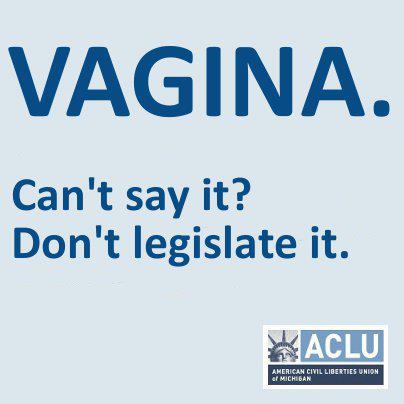
“Vagina” is Not a Four-letter Word

You would be forgiven for assuming that our elected politicians are mature adults who can handle using words that designate genitalia. You would especially be forgiven for assuming that given that many of these politicians are very eager to legislate what can and cannot be done with genitalia.

However, you’d be wrong.

This is old news now for anyone who follows these things, but in case you don’t, here’s a recap. On June 14, the Michigan House of Representatives was debating a new bill that would severely limit a woman’s ability to get an abortion by placing new restrictions on abortion providers. The bill passed the House and will go to the Senate most likely in September. (They were also debating a separate bill, which did not pass, that would’ve restricted all abortions after 20 weeks, with no exception for rape or incest).

In response to this, Representative Lisa Brown (three guesses which party) gave a speech in opposition and said, “I’m flattered that you’re all so interested in my vagina, but ‘no’ means ‘no.'” You can see her speech in its entirety here.

The shock! The horror! Brown was quickly forbidden from speaking on the House floor by Republican leadership of the House. A spokesman for Republican Speaker of the House Jase Bolger said, “House Republicans often go beyond simply allowing debate by welcoming open and passionate discussion of the issues before this chamber…The only way we can continue doing so, however, is to ensure that the proper level of maturity and civility are maintained on the House floor.”

To that end, Republican Representative Mike Callton said that Brown’s remark “was so offensive, I don’t even want to say it in front of women. I would not say that in mixed company.”

What Bolger, Callton, and the rest of these concern trolls apparently do not realize is that language is malleable and entirely based on context. In general, words might be inappropriate to say for three different reasons:

  1. They are derogatory and hurtful slurs (i.e. the n-word, fag, retard)
  2. They have been designated as “profane” by our society (i.e. fuck, piss, shit, cunt)
  3. They refer to things or functions that are generally considered inappropriate for polite conversation (i.e. penis, vagina, feces)
These three categories of Bad Words operate in different ways. The first category is inappropriate to say basically always, unless, in some cases, you belong to the group targeted by the slur, or you are using the word in a conversation about the word (but even that is controversial).

The second category are words that are usually used to make a statement. They are much more frequently okay to use than the words in the first category. That’s why when people curse, they use these words. That’s why many writers, such as myself, use them for effect. They’re generally okay to say around your friends, but many people avoid using them in front of people they don’t know well.

The third category comprises words for things that we usually avoid discussing in polite company without a good reason. You wouldn’t exclaim, “That looks like a penis!” in front of your grandma, and you wouldn’t say, “My vagina feels funny” in front of your boss (I mean…unless you have a very open-minded boss/grandma). It’s not the words themselves that are “bad,” it’s the fact that you usually shouldn’t talk about the things those words refer to if you want to be polite.

But all of this falls apart when the context demands discussion of such topics. If you’re at a doctor’s appointment and the doctor needs to tell you something about your penis or vagina, it would be laughable for him or her to avoid using those words. If you’re negotiating sex with a partner, you shouldn’t have to worry that he or she will be offended if you use those words. And if you’re attempting to legislate what women can and cannot do with their private parts, you’re going to have to face the fact that those parts have names.

The most ironic thing here, though, is Callton’s remark about the word “vagina”: “I don’t even want to say it in front of women.” First of all, that’s patriarchal as hell; women can handle naughty words just as well as men can. Second, it’s not just a naughty word; it’s a word for a thing that (most) women experience on a constant basis.

Some conservatives have apparently made a slightly more legitimate criticism of Brown in that she connects restricting abortion with rape (via her “no means no” allusion). I say “slightly more legitimate” only because, having once been a pro-lifer, I understand how they would take offense.

After all, pro-life politicians do not wake up in the morning thinking, “Yo, I’m gonna take away some rights from women and tell them what to do with their own vaginas today.” They think, “Abortion is murder and I have a duty to stop it just like I would stop the murder of a child or adult.” To them, drawing any parallels whatsoever between restricting abortion and committing sexual assault would naturally seem preposterous. It is only those of us who couch the debate in the language of personal liberty who see the similarities.

That’s why this whole incident really highlighted for me the divisions between liberals and conservatives on the matter of reproductive rights. It’s not even just that they can’t agree on whether or not abortion should be legal; it’s that they can’t agree on what abortion is, and on the terms with which the debate should be framed. Liberals say abortion is a woman’s right over her own body; conservatives say it’s the murder of an unborn human being. How can we ever reach a consensus if we define our terms differently?

I don’t know how to solve this problem–and if I did I would probably be the savior of American politics–but at least this story has a partially-happy ending. Brown and several of her colleagues performed the play The Vagina Monologues with its playwright Eve Ensler on the steps of the statehouse last Monday night as a tribute to our right to speak the names of our own body parts. About 2,500 spectators came to watch.

But as for the bill that the House passed, that’ll go on to marinade in the state Senate, which currently has 26 Republicans and 12 Democrats. I’m not getting my hopes up.

Why I Abandoned Conservatism

To most people who don’t know it already, here’s something that will probably come as a surprise: until about two years ago, I was a far-right conservative.

No, really, I was. Here are some things that I believed when I was a conservative. I believed that there is no real racism or sexism anymore. A Black man is president and women can work outside the home, so none of that. I thought same-sex couples should not be able to get married because that’s not what marriage means. And they definitely shouldn’t be able to adopt children because then the children would also become gay and we can’t have that.

I thought that the government has no right to tell people how to live, except when it does. It has no right to take our taxes and use them to help poor people, because poor people just don’t try hard enough. I thought that lowering taxes makes people spend more, always. I thought that affirmative action is exactly the same thing as racism, because after all, you’re doing things based on people’s skin color.

I believed that the United States has the responsibility to spread democracy throughout the world, by use of force if necessary. Needless to say, I applauded both of our recent wars. I thought that global warming was either a lie or at least an exaggeration, and even if it wasn’t, the government has no right to dictate what we do with the environment, anyway.

I pitied the women who went out carelessly and got themselves raped. I thought the justice system generally does its job, so if rapists weren’t getting convicted, that probably means they didn’t really do it. I thought false rape accusations were a much bigger problem, in fact.

I adored Clarence Thomas, George Bush, Antonin Scalia, Ann Coulter, and, of course, Ronald Reagan. I reserved a particular hatred for Al Gore and Barack Obama.

I believed that abortion was murder, and that it should be illegal in almost all cases.

I figure I’m supposed to be terribly ashamed and contrite about all of this, but truthfully, I’m not. I was a teenager, first of all, and second, I don’t know what I could’ve done to find any other narrative. There are a number of reasons why I was a conservative, and they were chiefly these:

  • because my family was
  • because I grew up in suburban Ohio
  • because our K-12 education teaches us that the American government is Good, that laws are Just, that the justice system Works, and so on
  • because children tend to believe that their values and morals should be everyone’s values and morals
  • because I didn’t have access to the sort of critical analysis that encourages examination of one’s politics–until I got to college

So there you have it. Once I got to college, I took some sociology classes and quickly became a moderate. Then I took more classes, read more, made more friends, read much more, got involved in sexual health activism, got involved in other types of activism, started to see how everything in our society interacts with each other, read some more, and developed the ideology that I have now.

That ideology is something I call progressivism because I favor change in a positive direction. I don’t think that things are fine as they are. I don’t think we should just calm down and stop whining. I don’t think humanity has reached its potential and I don’t think it’ll reach it for a very, very long time. I think our intellect and our compassion are two human qualities that do not get used nearly enough.

People always ask me how I made such a 180-degree shift in politics. I don’t really know how it happened, perhaps because it happened while I was in the midst of a major depression, which means I don’t remember anything too well. But everyone asks that–my friends, my readers, my professors. My therapist asked me today.

I think the way I changed is that I started looking beneath the surface more. Why are there so many Black men in prison? Is it because Black men are naturally predisposed to crime? Apparently not. For instance, in California in 2011, African Americans were 12 times more likely than non-African Americans to be imprisoned on drug-related felony charges, but studies show that African Americans are no more likely to use and sell drugs than anyone else (in fact, they may be less likely to). What’s going on?

That’s just one small example. I learned dozens upon dozens of such examples over the past few years, about everything. About women, people of color, the environment, food policy, agriculture, mental health, disability, LGBT folks, the poor, drug policy, city planning, wars, guns, education, sexual assault, business, discrimination laws, religion, the media, language, abortion, sex ed, obesity, scientific research, healthcare, elections, the Supreme Court, college, advertising, fashion, feminism, queer theory, money.

My head is overflowing with this information and yet I learn more and more of it every day. Whereas I used to think that each person is an individual who makes choices that are absolutely his or her own, I now know that we are acted upon by countless societal forces at every moment. I still do believe that people should strive for independence, but that can’t happen without gaining a deep understanding of these forces.

Do I have a solution for all of this? No. And frankly, I’m kind of tired of people demanding me to provide them with solutions. If I thought I could save the world, I’d be a politician. And I’d be wrong.

But sooner or later, we as a society will stumble upon solutions, slowly but surely.

Everything is connected. Everything is politics. Everything affects you, even in some little way, somehow.

That’s why I am no longer a conservative.

That’s why this is not “just a phase,” “youthful idealism,” or “naivete.”

My exact views on specific issues will change throughout my life, but what won’t is my awareness of the fact that none of us live inside a bubble, no matter how much we may wish that we did.

The graphing calculator I used in high school had a big ol’ John McCain 2008 sticker on it. I rocked that damn sticker. Now I have stickers from Planned Parenthood, the Human Rights Campaign, and Occupy Chicago. It’s kind of both fun and sad to look back at who I used to be. But I’m not ashamed. We all did stupid things in high school, and honestly, I could’ve done worse than plaster McCain stickers on things and rant about how evil feminism is.