
The Myth of Everyone

It’s right up there with Santa Claus, the Tooth Fairy, and true love–the Myth of Everyone.

The Myth of Everyone is invoked whenever someone attempts to justify their own or someone else’s shitty actions by saying, “Oh, come on, everyone does that.” For instance, my recent article against the Greek system generated arguments that all people and all groups of people do the sort of stuff I accused the Greek system of perpetuating, so it’s unfair to criticize the Greek system on those grounds. (I should’ve asked these people to find me examples of photography clubs paddling new members, or of a knitting circle forcing people to do keg stands, but I suppose that’s besides the point.)

At other times, the Myth of Everyone is invoked to explain even nastier, more specific examples of human behavior. For instance, a few months ago, a 17-year-old was gang-raped by a group of college men at a party. One of the lawyers representing the group of men stated, “This wasn’t anyone’s finest moment. It was 20-year-olds at a party behaving like 20-year-olds at a party.” Clearly, the lawyer wanted us to believe that gang-raping a teenage girl is what “everyone” would do in this situation.

Who is this mysterious Everyone? Why do they have such a hold over our collective imagination? Luckily, the field of psychology has an answer for that. It’s called the False Consensus Effect.

The false consensus effect is a cognitive bias that most people have that causes them to overestimate the degree to which their particular beliefs, values, goals, and opinions are shared by the majority of people–hence, a false consensus.

Psychologists believe that this effect occurs because people have a need to fit in and to believe that others share their mindsets. Feeling “normal” increases one’s self-esteem.

The effect is particularly prominent among members of a tight-knit group that rarely interacts with non-group members, and therefore is rarely forced to encounter divergent viewpoints. It becomes really easy for members of such a group to assume that their beliefs are shared by the larger population, even when they actually aren’t. An example of this would be, say, members of a sorority or fraternity.

This aspect of human psychology probably evolved to keep people happy and feeling accepted by society. In prehistoric times, it would’ve been adaptive to keep believing you’re pretty normal up until people convinced you otherwise–for instance, by excluding you from the tribe. But today, it’s become all too easy to convince yourself that “Everyone” shares your viewpoints, since our society is fragmented and we can choose people just like us to interact with.

Unfortunately, this is exactly how things like sexual assault, binge drinking, and all sorts of other problems get delegitimized and ignored. I’ve heard my fellow students making ridiculously overgeneralized statements like “Everyone hooks up” and “Everyone goes out and gets drunk” and even “All guys try to pressure girls into having sex with them.”

It would shock many of these students to know some statistics on these things. Namely, at least at my school, nearly 50% of the student body has not had sex in the past year. 23% percent of Northwestern students do not drink alcohol–AT ALL!–and 60% do not binge drink, meaning that they have four or less drinks each time they go out. (This includes the students who don’t drink at all, too.) This puts the percentage of students who do go crazy and get drunk at a little over one-third of the student body–a sizable minority, to be sure, but hardly the overwhelmingly dominant lifestyle people seem to think it is.

I can’t cite these statistics because I received them directly from Northwestern’s Department of Health Promotion and Wellness, which does official surveys on this sort of stuff. (The surveys are distributed to a representative random sample of the undergraduate student body.) If you’re curious, though, I have contacts in that department and I could probably obtain a report for you.

So, who is this mysterious “Everyone” who has tons of sex, drinks tons of alcohol, and pressures everyone into doing the same? It’s not the average Northwestern student, that’s for sure.

The problem of false consensus goes way beyond the college campus. It helps explain why some people think that cheating, shoplifting, accepting bribes, or using drugs isn’t a big deal (“Oh, come on, everyone does that!”), why right-wing politicians think Americans want to stop gay marriage (when, in fact, 53% of Americans believe in full marriage rights for the LGBT community), and why some people persist in telling racist/sexist jokes, believing that everyone’s still living in the 1950s.

Nowadays, when someone tries to tell me that “Everyone” is doing something, I take that with a grain of salt. Such statements probably tell you more about the person making them than about the majority of people, since most people don’t bother to actually go out and find statistics about things like I’ve just done.

Reason: it’s so inconvenient, isn’t it?
Won’t Someone Please Think of the Sluts?

[Snark Warning]

I was bemused recently by the reaction when I mentioned on my Tumblr–in the context of a larger conversation–that I’m proud of the fact that I’m not, for lack of a better term, “promiscuous.”

I was promptly accused of “slut-shaming,” which, according to this blog, is constituted by the following:

the idea of shaming and/or attacking a woman or a girl for being sexual, having one or more sexual partners, acknowledging sexual feelings, and/or acting on sexual feelings.

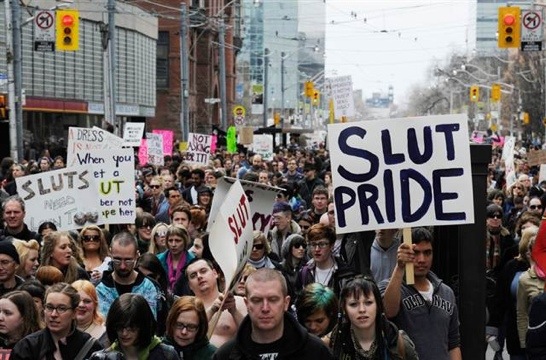
The word “slut” has recently undergone a revival of sort, and was used for the infamous SlutWalks of this past spring and summer. Naive as I am, I’d assumed that the point of this new discourse on slut-shaming was to emphasize that everyone should be free to choose–and to take pride in–whatever sort of sexual life they desire. This would be an idea that I would support till my dying day.

Apparently, though, the hidden side of this message is that it’s no longer fashionable to be sexually abstinent or to reserve sex for serious, loving relationships, and that anyone who takes pride in their decision to do so is necessarily shaming sluts.

Well, needless to say, I don’t subscribe to that notion. Here’s why.

I love my major (psychology). I’m proud of the fact that I’m studying to be a psychologist and would not have it any other way. Does that mean I look down upon everyone who chooses a different major and think that everyone should study psychology? No.

Another example. I’m proud of being Jewish. Although I’m not observant, I take a lot out of the Jewish tradition and would not want to belong to any other faith. Does that mean I look down upon everyone who has another religion? No.

But for some reason, when we’re talking about sexual politics, everyone seriously loses their heads. This entire branch of the social justice movement is subject to the very same dichotomous thinking it despises (i.e. the virgin-whore dichotomy, and others). A bunch of people simply assumed that just because I’m proud of my own decisions about my sex life, I look down upon all other possible decisions and therefore am taking part in slut-shaming.

Sorry to complicate things for you, but no. As I’m constantly posting things on my Tumblr regarding sexual freedom and related topics, and as I’m a member of a campus organization dedicated to, among other things, promoting sex positivity, I think I can safely vouch for the fact that I don’t deplore anybody’s personal choices as long as they do not involve harming others.

But that simply does not mean that I don’t take pride in my own actions and decisions. I think people are assuming that “pride” implies a moral stance, but it doesn’t. I’m not proud of my abstinence from casual sex because I think I’m more moral than others. I’m proud of it for other reasons, such as:

  • it’s a rejection of college social norms, and I’m always happy to reject some social norms;
  • it’s a way of observing my beliefs about sexuality and spirituality–beliefs that are not necessarily religious in nature, but that I hold very strongly (for myself);
  • and, most importantly, it’s the healthiest choice for me, and in a culture where psychological health plays second fiddle (hell, last fiddle) to everything else, I’m proud of doing what’s healthiest for me.

You might have noticed that in the preceding list, I italicized “for myself” and “for me.” This is because I’m acknowledging that the choices I’ve made, and my pride regarding those choices, reflects the fact that this is what’s right for me as an individual, and not necessarily what I’d wish to impose on the rest of the general population.

I realize that this distinction may have been lost on some people–namely, the ones that accused me of “slut shaming”–in my original post, but that’s why I’ve dedicated this entire article to illuminating it.

The end result of all this is that I’m no longer quite so enthusiastic about participating in a movement that denies me the right to take pride in my lifestyle just because it’s not what the cool kids are doing these days. That’s not even considering the fact that, as difficult as “sluts” have it, my decision to abstain from casual sex hasn’t been entirely free of consequences either. Where’s the discourse on virgin-shaming? Or, in my case, people-who-hate-hooking-up-shaming?

(Just recently on Tumblr, I witnessed dozens of people ganging up on a girl who declared in a completely judgment-free way that she wishes to remain a virgin till marriage. To these sexually liberated but mentally stunted morons, I only have this to say–for shame.)

So I’ll end with this: to any self-described sluts who are reading this and feel shamed by my personal lifestyle choices, I offer my sincere apologies. However, I’ll also advise you to learn how to derive your self-esteem from internal pride rather than external approval. I’ll keep advocating for sex-positivity because it’s what I believe in, but I’m sure as hell going to live my life the way I want to and be proud of it, with or without your approval.

20111129-143346.jpg

Antidepressants and Strength of Character

You're not a bad person if you take any of these roads. I promise.

Spoiler alert: They have nothing whatsoever to do with each other.

There are different levels of stigma surrounding mental illness. There’s the stigma of having a disorder in itself, the stigma of being in treatment for a disorder, and, perhaps most of all, the stigma of that treatment being pharmacological.

People love to hate psychopharmacology, especially antidepressants, the efficacy of which is constantly being questioned (often for good reason). However, I’ve noticed that drugs like antidepressants receive a special type of scorn, one that cannot be based solely on the efficacy mystery.

I’ve found that where mental treatment is concerned, therapy holds some sort of moral superiority over drugs in many people’s eyes. I think many people still feel that mental disorders are spiritual illnesses, not medical ones, and that treating them with a pill is some sort of cop-out. (Imagine the public furor if researchers came up with a pill to, say, erase the feeling of guilt.)

This would explain why, though therapy is still stigmatized–after all, the Ideal Person works out these issues on his or her own–it is considerably less looked down upon than psychotropic medication. Our culture values struggle and hard work so much that even recovering from an illness should be mentally effortful.

What people don’t realize is that there are plenty of perfectly legitimate reasons why someone might choose medication over therapy, at least in the short term. Consider, for instance, the situation I found myself in a month before I began my sophomore year of college. Having spent my entire freshman year growing progressively more depressed, I’d thought that coming home for the summer would magically fix everything. It didn’t. With a month to go, I realized that I felt like I’d rather die than go back to school.

That was when I was first diagnosed with depression, and I think my psychiatrist realized, as did I, that I just didn’t have time to muck around with my feelings–I had to get better quickly, or else going back to school would be more upsetting and stressful than I could handle. So I started taking antidepressants and quickly improved enough to feel like I could deal with being in school. The mucking around with my feelings came later.

Aside from that, I can think of many other reasons medication can at times make more sense than therapy. For example:

  • Financial concerns. Antidepressants cost me $30 a month, while therapy costs $80 for four weekly sessions. That’s a pretty big difference for many people.
  • Time. Some people are at a point in their lives where they literally can’t spare an hour or more a week for therapy. That might sound ludicrous to you, but if you’re a college student, a new parent, or a low-income worker, it probably doesn’t.
  • Availability. Unfortunately, not everyone lives in an area where good therapists are available and accessible (and bad therapists will do more harm than good). This is especially true for members of marginalized communities, who may have a hard time finding therapists who are sensitive to their issues. Not all therapists are as open and accepting as they should be.
  • Insurance. I’m lucky to have a fantastic insurance policy that covers basically everything I’ve ever needed. However, many policies are very picky with regards to therapy (as opposed to medication, which does require a prescription from a person with an MD). For instance, some policies refuse to cover therapy unless there’s an official diagnosis, and you don’t necessarily need to have a diagnosable mental disorder in order to need help. Besides, you can’t be diagnosed without going to a specialist to begin with.
  • Nature of the disorder. Although most mental illnesses obviously involve a psychological component, some do not. For example, many people in temperate climates get Seasonal Affective Disorder (SAD) during the winter months, which is characterized by a low-grade depression as well as various physical symptoms. It’s usually treated with antidepressants or light therapy, which actually has people sit in front of full-spectrum light.
  • Language. Therapy requires people to talk pretty extensively about themselves and their lives, something that would be very difficult for, say, a new immigrant who’s just learning English. Unless such people are able to find a therapist who speaks their native language, it would be pretty hard for them to get anything out of therapy.
  • Comfort. As a future therapist, I obviously wish that everyone were comfortable with the idea of therapy. But not everyone is. That could be because of cultural factors, family attitudes, personality, or negative experiences with therapy in the past. I think that using medication to improve your quality of life while working up the courage to see a therapist is perfectly okay.

I hope that this list shows that making decisions about mental health isn’t that different from making decisions about physical health–it has more to do with personal preferences and practical concerns than with the strength (or lack thereof) of one’s character.

Of course, I do believe that therapy is really important and generally awesome, which is why one of my upcoming posts will be about why I think that everyone (or almost everyone) should see a therapist. Stay tuned.

Sleep: Forgotten Martyr of College Life

See? It's even on a shirt.

Academicssocial life, and sleeppick two.” -popular advice given to college freshmen

I’m sure you’ve heard that one before. Most college students, it seems, pick the first two.

What surprises me isn’t so much the fact that they do, but the fact that sleep deprivation is considered such a routine part of college life. Nobody seems to see anything wrong with this idea that getting through college necessitates depriving oneself of sleep.

I have a different way of looking at things because I have a different body. More specifically, living with depression means that sleep takes on a central significance in my daily life. Get too little, even by an hour, and I’m facing the sort of fatigue most people experience only after an all-nighter. Get too little too often, and I’m significantly increasing my chances of relapsing.

Most people don’t have depression (though many do, especially in college), but everyone knows, in the backs of their minds, that sleep is really, really important. Lack of sleep is implicated in all sorts of health problems, from susceptibility to stuff like colds and flu, to obesity, diabetes, attention and memory problems, and, of course, depression. Fatigue also makes the other two items on that list, academics and social life, nearly impossible to handle.

What’s strange is that sleep is probably unique in its complete invisibility as a college health issue. Dining halls increasingly provide healthy options, including full salad bars at each of Northwestern’s. Campus medical centers provide free condoms and cheap STI testing. Campus gyms are open from 6 AM to 11 PM each day and provide plenty of free (or cheap) classes, intramural sports teams, and what have you. Counseling centers provide free counseling and stress management workshops (though of course there’s much to be desired in that department). Anti-binge drinking initiatives abound.

But sleep is that subject that nobody ever seems to touch. After all, exercise makes you look good and can be fun, grabbing a free condom is easy, and getting a salad instead of a pizza is no big deal. Getting enough sleep, meanwhile, requires actual lifestyle changes–and, sometimes, actual sacrifices.

Ultimately, though, I think that the whole “pick two” joke is a false dichotomy (trichotomy??). I know that having all three is possible, because I have all three. I have great grades, I have great friends, and I sleep a solid 8-9 hours a night.

(A few weeks ago, frustrated by the fact that I’m usually exhausted by the time I come home from classes at 6 or 7 PM, I called my mom to complain. She said, “Of course you’re tired. It’s normal to be tired after a long day of classes.” Until she told me this, I’d never realized that. Because the campus culture I’m steeped in tells me that I should come home in the evening, go to meetings and do homework until midnight, and then engage in a social life until 2 or 3 or later–or, if I’ve been procrastinating with my homework, I should just stay up all night.)

What worries me most is that people wear their sleepless nights like badges of pride. You never hear anyone say, “Dude, I’ve legit been eating three slices of pizza EVERY DAY this week,” or “Man, guess how long I’ve managed to go without working out!” or “Guess what, guess what? I totally didn’t use a condom last night!”

But they make those comments about their lack of sleep. The only comparison is the way people talk about binge drinking.

Why is sleep deprivation cool? Probably for similar reasons as binge drinking is. It’s a mark of physical endurance, in a way, and it’s a way of displaying that you have the “right” priorities–socializing, usually–and not the “lame” ones.

Yet colleges actively try to combat the culture of binge drinking, but they ignore the problem of sleep deprivation. Why?

The Gym: the Poor Man’s Runway

But don't try TOO hard. Like this girl.

Yesterday, one of the main student publications at my illustrious university came out with this gem, titled “Dressing to Impress at the Gym.” After the title and byline, the article takes an unfortunately predictable route:

So the gym might not be the sexiest place on earth. But, who says that it can’t be one of the most social? However unlikely, SPAC, Blomquist and the Evanston Athletic Club are some of the best places to meet guys on campus. Yes, The Keg or a fraternity party would be obvious choices, but those get old quickly. Guys flock to the gym from all corners of the university and, like it or not, they could be on the prowl.

Oh, dear heavens no! Guys could be “on the prowl!”

First of all, I just want to congratulate the author of this article for her implied success in “meeting guys” at the Keg or at a frat party. I have never been able to find decent specimens there, but clearly, this girl is just more skillful than I am.

Anyway. The article goes on to list helpful tips for girls who are super duper concerned with the scant possibility that someone may look at them while they’re working out. Most of the tips involve buying severely overpriced clothing and accessories at places like Lululemon and Gap. One of them involves wearing a bright-colored bra (way to attract attention while also looking completely fucking ridiculous).

The one that really gets me, though, is the last tip:

Don’t be that girl. “You can tell when a girl is trying too hard,” Medill sophomore Antonia Cereijido said. “They’ll wear no clothing and walk on the treadmill rather than actually getting a workout. They just look kind of silly.”

That’s right, ladies–don’t be that girl who “tries so hard” and cares so much about how she looks while working out, but do go ahead and read an entire article that tells you how to look good while working out.

There are so many things wrong with this article. Where to begin?! Well, first of all, with the assumption–never stated in this article, but implied nonetheless–that no matter what a woman happens to be doing, what matters most is always how she looks doing it.

We’ve seen this before with women like Michelle Obama, Hillary Clinton, and Elena Kagan–women who are helping to run the country but find themselves subjected to neverending commentary about their looks.

What I didn’t expect, however, was to find this same principle at work in the student magazine of what I had hoped–before I got here, that is–was a fairly intellectual college. Women, according to this article, exist to be looked at (by men, of course). And this completely ignores the fact that many men find it really sexy when a woman is working out and doesn’t care how she looks.

The second major problem I had with this piece was the implication that even if you’re not at the gym in order to pick up guys, you should still concern yourself with the fact that you may be looked at. As the introduction says, “Guys flock to the gym from all corners of the university and, like it or not, they could be on the prowl.”

Like it or not? Well, I suppose I don’t, but what the hell do I care if they look? It’s not my job to make sure that no man is ever, G-d forbid, offended by my appearance–especially not while I’m at the gym. I don’t owe anyone anything, and if they look at me and don’t like what they see, they are free to look elsewhere.

But no. According to this article, girls should always care that they’re being looked at, which is why they should always look good, even while working out, even if they’re not even looking to meet any guys. How empowering!

A third issue here is the implication that the gym is only for people who are able to fit their bodies into the cute, tight little shorts and tops that the article practically advertises. Um, last I checked, many people go to the gym in order to lose weight and/or become more fit, not to show off their already-perfect bodies.

But then again, the article isn’t really aimed at those people, is it? Because, after all, who on earth would want to look at them, anyway?

And that’s just the thing. Articles like this always imply that gyms are for attractive people only, which is just as ludicrous as saying that French class is for people who speak French fluently, and art class is for people who can already paint.

Finally, even though the article is obviously aimed at women (men, after all, don’t need to concern themselves with such petty issues as appearance), it nevertheless constructs the gym as a man’s space–one that women may occupy only as long as they follow the rules. As a guy quoted in the beginning of the article says, “I think it’s good that girls take care of their bodies and that they’re not afraid to go into the gym where there’s guys lifting heavy weights and stuff.”

Not afraid to go into the gym? Please.

Of course, the fearlessness that this guy finds so incredible comes with strings attached–women must always look good at the gym, or else…well, I don’t know what happens then. Do our memberships get revoked?

What’s really disappointing about all of this is that I’ve always thought of the gym as a great equalizer, of sorts. Anyone can go there, anyone can benefit from going there. It’s the one place where I’ve never felt like my appearance was being scrutinized, and I’ve always felt comfortable letting go and getting into the flow of exercising.

But clearly, some of the people I go to school with don’t see it that way. You’d think that there are few pursuits more self-directed than exercise, but to them, the gym is just another place to “be seen,” and its health benefits are secondary.

Of course, the author would argue with me here. She even writes at one point, “Remember ladies, health is important, so when at the gym you should still be the number one priority.”

But if she really feels that way, why didn’t she write an article about, say, how to figure out what your heart rate should be while exercising? Or how to use all those damn strength training machines I still haven’t figured out how to use? Or how to work out as many different muscle groups as possible in as few different exercises as possible? Or any number of other health-related topics?

I’m very idealistic about journalism. I think that all journalists, even students at a campus publication, are, in a way, setting the agenda for us as a society. Every moment spent writing piece-of-shit articles like this is a moment not spent writing about stuff that actually matters.

Rather than writing an article that practically shits out the same sexist tropes we’ve all grown up with–that women owe it to men to look good, that only thin athletic women are worth looking at, that men are only attracted to women who actively try to look good rather than just doing what they love with abandon–this student could’ve written an article about why it doesn’t fucking matter what you look like when you’re working out.

But she didn’t do that. She chose to promote the sexist tropes instead, thus doing her small part to keep an unfortunate aspect of our culture going strong.