I ♥ NY

Consider this a love letter to my favorite city.

Looking down 5th Avenue towards southern tip of Manhattan, from the top of the Empire State Building

New York City was the first bit of America that I ever saw, fourteen years ago when my family immigrated from Israel. I can only imagine how my parents felt. They had escaped from social and religious oppression when they’d left Russia, and now, two casualties of Israel’s faltering economy, they looked to America for help. New York welcomed them with open arms.

And now, it welcomes me. Growing up wedged between four cultures, I never learned to speak the language of just one. I’m always some combination of Russian, Jewish, American, and Israeli. I’ve never felt at home anywhere. Except New York.

I don’t have to identify myself here, perhaps because there are plenty of people here just like me, who grew up in one culture, speaking the language of another, observing the religion of a third, and finally settling into a fourth. Here I don’t have to get into a car and drive far away to find the food I grew up with or a place to practice my religion. I don’t feel awkward when I pick up the phone to talk to my parents and a dozen sets of eyes immediately turn to stare at me. (You’d have to try pretty damn hard to get people to look at you in New York, and speaking Russian–there are 300,000 Russians there–definitely won’t do it.)

I’ve lived in six cities on three continents, and New York is the only one in which I’ve felt comfortable and accepted. I feel like it speaks my language.

Abandoned lot near Rockaway Beach, in Queens

It seems that achieving the American Dream means living in a way that you can forget your fellow dreamers even exist. My parents’ house in Ohio is located in one of the best neighborhoods in town. Backyards sprawl around their houses; often they’re larger than the house itself. They are usually surrounded by a fence,

You don’t really see many people out and about. You don’t have to; you have your own backyard to hide in. My mom and I are instantly recognized by many residents of our neighborhood because we take lots of walks. On the rare occasion that I actually talk to someone, they often point this out.

Interaction with people is minimized in many parts of the U.S., and that’s considered the ideal. There’s no super to pay the rent to, no neighbors to stomp on the ceiling above you, no musicians on the street corners or on the subway cars (since there aren’t any subways), no bus stops full of people, no beggars asking you for change. People move to the suburbs and count their blessings that they no longer have to deal with all these pesky people.

I don’t like it that way. I like it the New York way.

There’s nothing worse for me than silence and aloneness. In New York, you are never alone. Look down the street at night and you see hundreds of glowing windows peering back at you. People sit on porches, stoops, benches, balconies, and railings. They lean on buildings, cars, and fences. They eat, smoke, talk, read, play chess, embrace, make music, or do nothing.

When you’re feeling lonely, which is most of the time for me, there’s nothing more powerful than this reminder that you’re never really alone. Even if it feels that way.

The Manhattan Municipal Building

So yeah, I’ve done all the tourist stuff. I’ve been to the Met, the MoMA, the Lincoln Center, and the Museum of Natural History. I’ve walked all the way through Central Park and been to the Bronx Zoo. I’ve been to the top of the Rockefeller Center, the Empire State Building, and the Twin Towers, when they were still standing. After they weren’t, I went to Ground Zero. I’ve been to Wall Street and seen every inch of Broadway from Battery Park to Columbus Circle. I’ve been in Times Square, Washington Square, Madison Square, Union Square, and probably a lot of other important squares. I’ve been to both the Strand and Macy’s, Columbia and NYU, Chinatown and Greenwich Village, Brighton Beach and the Upper East Side. And I know I’m still not even close to being done.

But my favorite thing to do in New York is just to walk. You can lose yourself in the streets of Manhattan without ever really being lost, because getting lost in Manhattan would require not knowing how to count. It’s easy–the avenues go up and down the length of the island, and the number of the avenue increases as you go from east to west. The streets go perpendicular to the avenues, counting upwards as you go north. Below Houston Street things get a bit tricky, but you still can’t really get lost.

The reason I can’t do this anywhere but New York is because no other city has such a vast amount of walkable territory. In Chicago, you can find the nicest neighborhood you’ve ever seen, but walk a mere ten blocks in any direction and you’ll start to see housing projects.

Anything that chocolate, music, and sex can’t heal, walking can. New Yorkers know this, which might be why they’ve built a city that makes walking so easy.
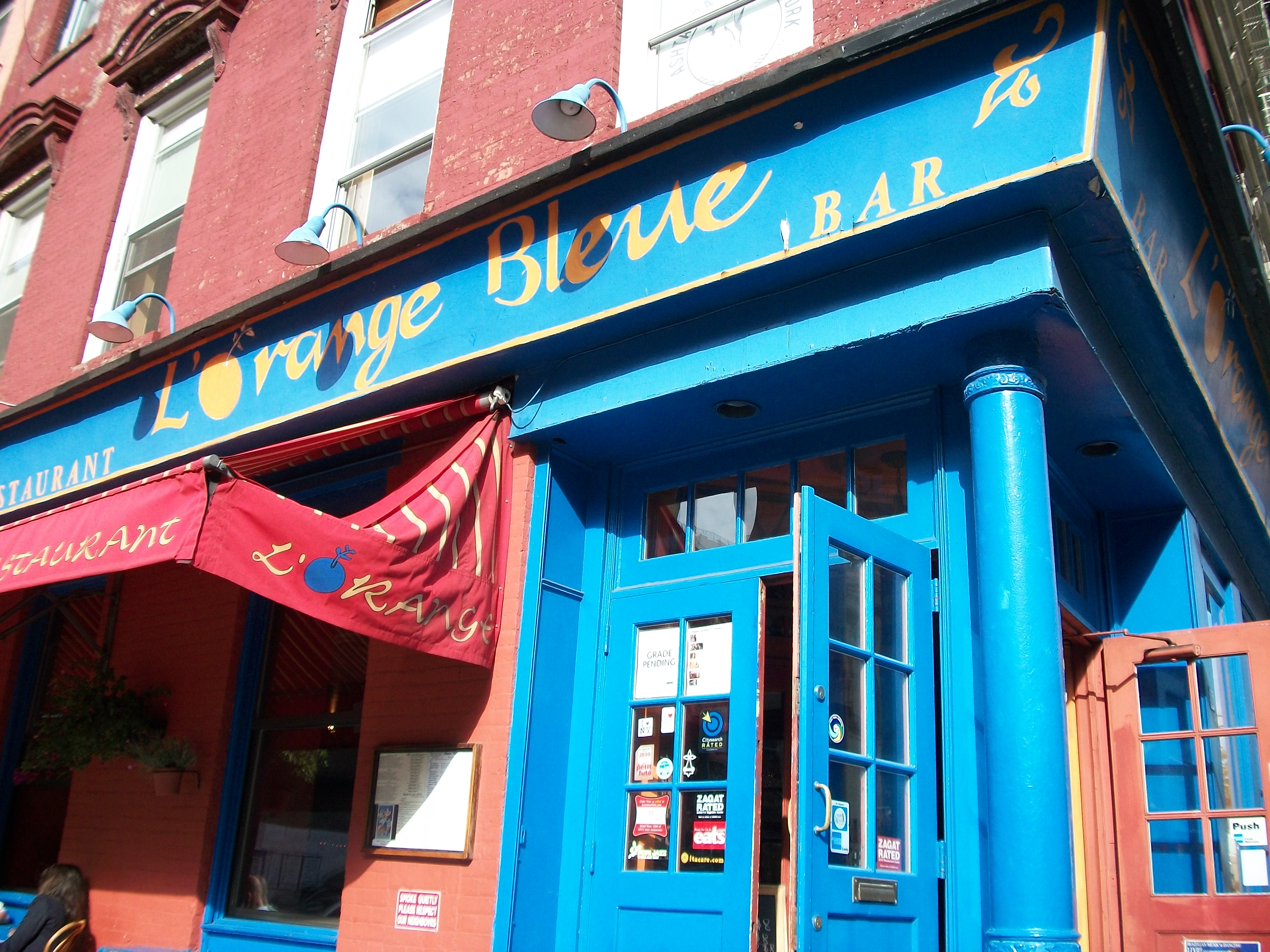
L'orange Bleue, a French restaurant in SoHo

My parents have a friend who works two blocks away from my aunt’s apartment, where I stayed for the past five weeks. When I told her that I’m planning to become a psychologist, she said, “Come to New York! There’s no better place to be a psychologist.” She said that elsewhere, people still believe that psychotherapy is something for crazy people to do. In New York, however, people understand that it can be a valuable tool for attaining self-knowledge and becoming happier. My impromptu adviser proudly pointed out that she herself has an excellent therapist.

Of course, psychology isn’t the only subject on which New Yorkers, generally speaking, have progressive views. In New York, it’s legal for a woman to go topless in public. Chain restaurants were required to provide calorie counts for all of their menu items even before Obama’s healthcare bill made that mandatory nationwide, and trans fats are illegal in restaurants. Homeless people don’t sleep on the streets anymore now that the city has a network of homeless shelters. Smoking is illegal not only in restaurants and bars, but also in parks, public squares (i.e. Times Square),  sports stadiums, and beaches. Cars are almost entirely unnecessary thanks to the constantly-improving public transit system. Gay marriage is legal.

When I hear about all the things that New York has and Chicago (let alone Dayton, Ohio) do not, I feel like this is a city that takes care of its people. It’s one more reason to feel welcome there.

Underneath a bridge in Central Park

Leaving New York sucked. On my last evening there, after I came down from the Empire State Building, I kept hanging around in Herald Square because I didn’t want to get on the subway and go home. That would put a note of finality into it.

On the plane the next day, I kept thinking about all the people I’d interacted with in New York. Not just my friends and family, but the nameless people–the Russian lady who asked me for help in CVS on my first night there, the stewardess I talked to while I was in line to buy snacks at the airport, the Spanish-speaking woman who offered to take my picture on top of the Empire State Building, the Bukharian Jew working for the Russian car service I used to get to the airport (we talked about family and the places we’ve lived), the giggly 40-year-old woman who approached me in Barnes & Noble in Union Square to ask me for help loading music onto her new laptop, the 16-year-old high school student from Florida who started talking to me about books in the Strand, the U of Iowa student I talked to about football in Washington Square, the street cart owner who chatted me up while making my chicken and rice on my first day out in the city, the gentleman with salt-and-pepper hair wearing a really nice suit who talked to me as we looked at male sex toys in the Museum of Sex.

I was so worried when I first set off for New York that I would be terribly lonely there. Everyone warned me that people are cold, that they ignore you, so I wasn’t at all prepared for the incredible variety of interesting and complex people I would meet there. And, despite having been in New York before, I had no idea of how the loneliness melts away when you find yourself actually walking through those streets.

Now I do, and now, more than anything, I just want to be back in those streets again.

Midtown and the Empire State Building, from the top of the Rockefeller Center
Got a Job? No Fun For You

[Snark Warning]

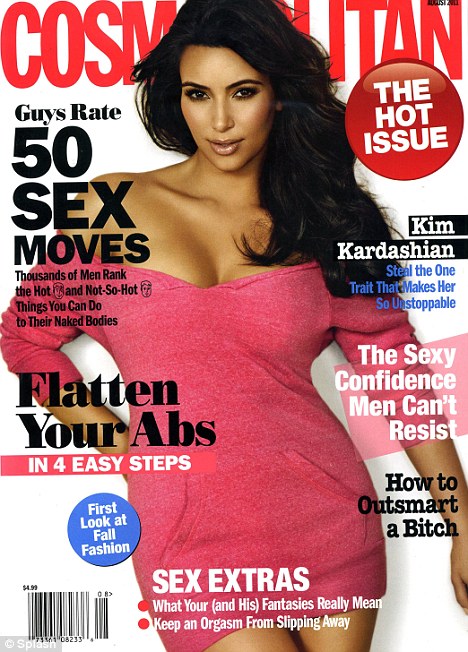
I read one of the advice columns in this month’s Cosmo. A woman was writing in and asking if it would be okay to wear a top that reveals her tan lines to work, provided the top was modest and work-appropriate. The response was, no, it wouldn’t. Why? Because you wouldn’t want your boss to think that you spend your free time lying around at the beach:

Even though the best of us can fall victim to zebra skin by accident, exposing your sun stripes at work would be flaunting your bad judgement (baking does lead to skin cancer, after all). Perhaps worse, as far as your boss is concerned, it suggests you spend lots of your free time being at one with your beach towel–not exactly impressive.

“Not exactly impressive?” What does that even mean? Apparently, you shouldn’t let your boss know that you actually have fun on your days off. Oh, heavens no! You ought to be at home, catching up on emails.

(As for the skin cancer thing, I’d just like to point out that even if you wear sunscreen, you’re eventually going to get a tan if you spent a lot of time outside. Trust me, my mom slathers my little brother and sister with sunscreen obsessively, yet at the end of the summer they still have those cute little freckles and tan lines.)

Naturally, I immediately thought back to an earlier post I wrote about why adults are always so miserable and try to make me as miserable as they are. Now I’m not surprised. Apparently, once you’re all grown up and have a job, you’re not even allowed to have a good time when you’re off work. No wonder adults are always in such a crappy mood, and no wonder they want to warn me that in a few years I’ll be in a crappy mood too.

What shocks me is that Cosmo isn’t exactly a serious, business-y magazine. It’s mostly read by people who like to enjoy themselves every now and then (or every day/night, as the case may be). If even Cosmo is saying that you can’t have fun once you’re a grown-up (or, at the very least, that you have to do it in secret), what’s the world coming to?

This doesn’t even make sense to me, because I would hope that my boss would want me to come to work refreshed and in a good mood. I would want him/her to know that I’m not going to be asking for time off to go see a therapist about how miserable I am because I never have fun.

(I’m hoping, perhaps in vain, that since I’m going into the mental healthcare field, things will be different for me. After all, if there’s anyone who knows that relaxing and having fun is absolutely necessary, it’s a therapist. In my opinion, therapists should be able to model healthy behavior for their clients. If a client casually asks me what I did over the weekend and I’m forced to either lie or confess that I spent the entire time huddling over my laptop in a corner, crying, and biting my nails off while my husband played with the kids, that’s not good.)

Where did we go wrong? Why is it that in other countries and cultures, it’s perfectly normal to take a nap after lunch before coming back to work? Why is it that the United States is the only country I could find that does not mandate a minimum amount of paid vacation time for all employees? Why is the United States one of the only developed countries that does not offer paid maternity leave (to say nothing of paternity leave)?

One thing that never fails to surprise me about American culture is how fixated it is on work.  Russians, for instance, seem to view work mostly as a means to an end (money, security, providing for one’s family), whereas for Americans, it’s an end in itself. I rarely hear my parents talking about work when they’re home, and the only time I’ve seen them doing work-related things at home is when my dad starts maniacally writing some sort of equations on a napkin. My parents don’t have smartphones or tablets. If you send an email to their work address on Friday evening, you won’t receive a response till Monday. And yes, they go to the pool on weekends, and evenings, and any other time they fucking feel like it. That, in my opinion, is how it should be.

Bullying as a Social Regulator

If only it worked this way.

I came across a post by Tea Party Nation blogger Dr. Rich Swier called “Bullying, Peer Pressure and Gulf Coast Gives.” (You need a TPN account to see it, unfortunately.) I won’t describe the way in which the contents of my stomach forcibly exited my body upon my reading this, and I will also ignore the homophobia in this article because it’s obvious and there’s no need to comment on it. Rather, I’m going to simply explore an interesting idea that Swier brings up.

In this article, Swier is opposing Gulf Coast Gives, a charity foundation that, among many other things, advocates against LGBT-related bullying. He opposes this foundation because he disagrees with its stance on this issue:

This is not bullying. It is peer pressure and is healthy. There are many bad behaviors such as smoking, under age drinking and drug abuse that are behaviors that cannot be condoned. Homosexuality falls into this category. Homosexuality is simply bad behavior that youth see as such and rightly pressure their peers to stop it…

I agree with Gulf Coast Gives that “LGBT youth are up to five times more likely to attempt suicide than their straight counterparts”. Homosexuality, like drugs, harms young people if they experement with it. That is the greatest tragedy.

Again, I’m going to just ignore the self-evident homophobia and dissect Swier’s concept of bullying as some sort of social regulator. He reframes bullying as “peer pressure” and claims that it prevents young people from engaging in unsafe behaviors, in this case, homosexuality.

Leaving aside for now the fact that, unlike the other behaviors listed here, homosexuality is not a choice, I am left to wonder if Swier somehow managed to completely miss the reasoning behind all the anti-drugs and alcohol campaigns that public school kids are subjected to these days. Peer pressure isn’t typically a force that promotes healthy behavior. If it were, we wouldn’t need all these “just say no” lessons to teach kids how to resist it.

It seems that bullying and peer pressure serve more to encourage “normalcy” than anything else. Luckily for Swier’s argument, heterosexuality happens to be normative. But so are underage drinking and, in some circles, smoking and drug use. People don’t get bullied for doing things that are unsafe; they get bullied for doing things that are “weird.” Contrary to Swier’s argument, kids and teens don’t see homosexuality as “bad behavior.” They see it as weird.

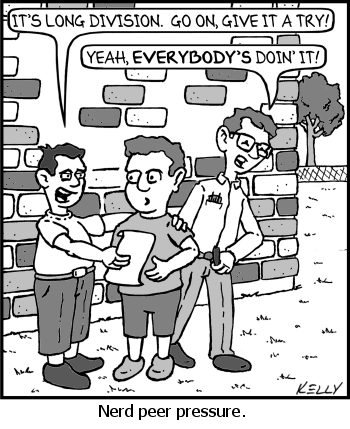
Not only do kids not bully each other for doing things that are actually unsafe, but they frequently bully each other for doing things that most adults would see as positive. I’m sure that even social conservatives would agree with me that reading books is good for kids. Yet every avid reader I know, myself included, was made fun of for it in grade school. To quote the great Bill O’Reilly, you can’t explain that.

Of course, norms change. Homosexuality is becoming increasingly accepted in American society, so it’s only a matter of time before that acceptance starts trickling down to kids and teens and Swier’s argument starts falling apart, like all Tea Party arguments inevitably do.

Got Sexism?

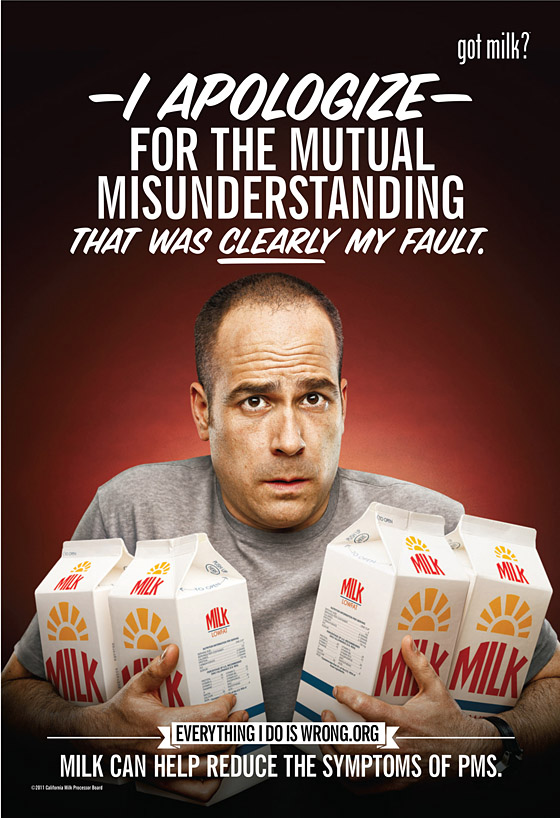
I apologize for the complete lack of posts lately; I’ve been busy volunteering and exploring New York City, where I am currently located. However, I’ve decided to crawl out of my Russian-food-and-thincrust-pizza-filled cave in order to comment upon this:

What are we looking at here? Silly-looking men holding cartons of milk? Not so simple. These are a series of new ads released by the Got Milk? advertising campaign. The ads showcase the fact that milk can supposedly help reduce symptoms of premenstrual syndrome (PMS) and feature men making pseudo-sarcastic statements that reference the fact that women are supposedly very moody while on their periods.

The ads point to a website, EverythingIDoIsWrong.com, which is a slick, sardonic guide for men to help placate their bitchy wives and girlfriends during that time of the month. The tagline of the site is, “Your home for PMS management.”

Here are some revealing screencaps from the site, helpfully annotated with my comments:

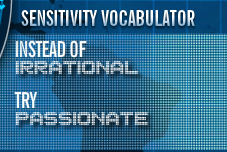
Attention, men! Because you are from Mars and women are from Venus, you need a special vocabulary to speak with them.
I find this one especially ironic given that women’s concern with their weight has much more to do with societal pressure to be thin than it does with PMS or with making their partners’ lives miserable.
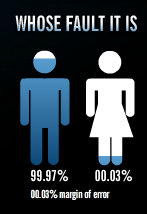
Sorry, men, you’re just going to have to deal with the Evil Women in your life always blaming you for everything.
Because clearly, the only things women care about are gold, silver, and chocolate.

I’ve written about this peculiar menstruation-related misogyny before, except that in my previous post about it, it was being perpetuated by and for women. This ad campaign, on the other hand, targets specifically men and sets up a “yeah bro I know what you’re going through” vibe with its audience.

I won’t repeat what I said in the previous post with regards to the validity of this whole PMS = bitch business, but I will add that these ads rise to a new level of chutzpah, because they somehow manage to turn PMS into a men’s issue. How do they do this, you might ask? After all, it is women, not men, who must deal with the inconvenience of bleeding out of their private parts every month, getting cramps, and feeling fatigued and nauseous. Right?

Wrong! The crappy thing about periods, apparently, is how difficult they make life for men. I mean, duh.

Furthermore, if these fictional men’s concerns do actually contain a semblance of truth in them, maybe it’s time that we recognize the fact that menstruation isn’t to blame here. Rather, the culprits are bad communication skills and a general lack of ability to promote healthy relationships. After all, the relationships hinted at by the men in the ads are anything but functional. Maybe the cure isn’t milk, but a good couples’ therapist.

But of course, it’s much easier to chalk such issues up to women being Complex Demanding Creatures who will never be satisfied by anything their partners do for them, especially not when it’s That Time of Month.

Honestly, this may come as a surprise to you, but most intelligent women find themselves much more pissed off about crap like these ads than about being on their period (or about their partner not taking out the trash/putting the toilet seat down, as the case may be). After all, this is so reductionist. The message to women is, You are your hormones. The message to men is, Deal with her PMS and you’re home free. In the end, advertising campaigns stand to gain from portraying men and women in this way, because the less people understand what really causes conflict in relationships, the more they’ll attempt to buy Stuff to solve all the problems.

And no; just like diamonds, flowers, and chocolate, milk is no panacea.

[Well, now I have two entire posts tagged with “menstruation” on this blog. I’m proud. Also, if you happen to really miss my writing, here’s my short-form blog, which I update much more frequently.]

More posts on this topic, if you’re interested:

OK, I’m done. Promise.

Why Are Adults So Negative?

[Snark Warning, TMI Warning]

No, really, that’s a legitimate question. Why are people older than me–even by just a few years–so eager to put down all of my hopes and dreams?

Let me give a few nonspecific examples of Things Older People Have Said recently to me:

  • “You know, guys really don’t go for complex women.” (Women like me, that is, in the context of that conversation.)
  • “Oh, trust me, by the time you have a job, you’re not going to care about making a difference. It’ll just be about how you hate your boss and can’t wait to go home by the end of the day.”
  • “You’re never going to be successful if you don’t learn how to be pushy.”
  • “It’s going to be even harder to make friends after college, you know.”
  • “You’re gonna go for a PhD? You do realize how much work that is, right?”
  • “Psychologists don’t make that much money. You should try to get an MD instead.”

Perhaps you Well-Meaning Adults are all under the impression that I have excessively high expectations and need a Dose of Healthy Realism to prevent myself from getting disappointed later on. Perhaps you just don’t realize what weight your words can carry for someone who is younger and looking for someone to help them find their way.

Well, this might be news to you, but I have a mental disorder that basically means that my expectations are already unhealthily low. That’s what depression does. It robs you of all the hope and optimism you used to have. Every bit of genuine excitement that I have for the future is something I’ve worked very, very hard to muster up. And guess what you’re doing. You’re taking it away from me.

People. My disorder does a perfectly fine job of putting me down all on its own. It really doesn’t need any help from you. I don’t need to be reminded of how hard it’s going to be to make friends, get a job, find a partner. Trust me, I’ve been over this in my mind over and over and over again Many, many sleepless nights. I’ve been over it until I’ve cried my head off and wanted to kill myself. Really. I do not need your help.

You know what, I appreciate that maybe your life didn’t turn out the way you wanted. And that sucks. I’m sorry you have a shit job, I’m sorry  you have an awful time meeting people and dating. If you’d like, feel free to tell me about that. Or go tell a therapist. Or whatever. But your experiences do not give you the right to take my hope away from me. Especially when you’re some measly three or four years older! Jesus Christ! You’re still finding your own way. You’re not dead yet. At least wait till you get your own kids before you start dispensing your Divine Wisdom to someone else.

I’m seriously considering kicking these people out of my life, because as much as I’ve always believed that friendship with people older than me is important and extremely valuable, I can’t have these people making me feel crappy all the time.

Why does this happen? I think we have a cultural stereotype of young adults as exceedingly cocky, optimistic, and entitled. Well, guys, you know what they say about people who assume. First of all, as I’m pretty sure everyone I’m acquainted with knows, I’m not even from this country. Take everything you know about “American Young Adults” and toss it the fuck out, because I grew up with a different cultural background, one in which humbleness and realism are prized qualities.

Second, even supposing I were the most typical American girl you can imagine, you should still quit it with the damn stereotypes already. Everyone has their quirks and idiosyncrasies. Some people come from broken families. Some people grew up poor. Some people have a disability, maybe one you can’t see. Some people read a ton of books when they were kids. Some people grew up being bullied in school. Some people have depression, anxiety, OCD, ADHD, a substance abuse disorder, autism or Asperger’s, or some other condition. Some people are just plain different!

So throw out those silly magazine articles about “Today’s Entitled Bratty Self-righteous Cocky Inept Stupid Young Adults” and see what’s right in front of you. Some of us are just trying to get by. Some of us are just trying to scrounge up every last shred of hope we have and keep on living. Just because I’m young doesn’t mean I think it’s all rainbows and butterflies ahead. I work hard to keep my chin up. Don’t you dare take that away from me.