For the Last Time, You Can’t “Turn” People Gay

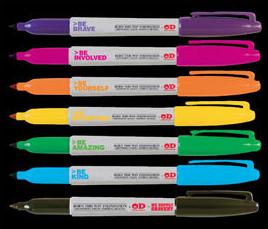
Credit: Office Depot

Of all the pernicious myths about homosexuality that just won’t die in our society, the idea that it’s a “choice”–and, consequently, that it’s possible to “turn” people gay–is one of the most frustrating.

That myth got trotted out again in response to the announcement that Lady Gaga’s Born This Way Foundation is partnering with Office Depot to create a line of back-to-school products that feature empowering messages. Part of the proceeds from the sales will go to the foundation, and Office Depot has also donated $1 million to it.

The products will be stuff like post-it notes, sharpies, and bracelets that say things like “Be Brave,” “Be Yourself,” “Be Involved,” “Be Accepting,” and so on. But for the Florida Family Association, which obviously had to take a stand against this because it has the word “family” in its name, they might as well say “Be Gay,” “Be Lesbian,” and “Be a Flaming Homosexual”:

Thousands of kids who might have otherwise worked through their pubescent sexual identity issues will be inspired to accept the wrong choice based upon this unscientific, emotionally charged propaganda.

What’s brave or kind about telling thousands of sexually frustrated teens that they were Born This Way when a high percentage of them would have ended up taking the straight heterosexual path for life?

Please urge Office Depot to rescind their one million dollar pledge to Lady Gaga’s Born this Way Foundation.

Let that sink in for a moment.

First of all, I would just love to know how telling kids to “be brave” and “be yourself” is somehow telling them to be gay. Are gay people more kind, brave, accepting, involved, and amazing? If so, sign me up!

Second, when are these people going to stop clinging to the idea that homosexuality is a choice? It’s ironic that they fling around words like “unscientific” when it is precisely their stance that is unscientific. Although some people have claimed that they choose homosexuality (for instance, the so-called political lesbians of the second-wave feminist movement and, more recently, Cynthia Nixon), most LGB folks seem to disagree.

In addition, the American Psychological Association–which may know a thing or two about psychology, I’m guessing–has written that “no findings have emerged that permit scientists to conclude that sexual orientation is determined by any particular factor or factors. Many think that nature and nurture both play complex roles; most people experience little or no sense of choice about their sexual orientation.”

A corollary to the idea that homosexuality is a choice is that homosexuality can therefore be “cured.” Gay conversion therapy is touted by many anti-gay conservatives, but it has been thoroughly discredited by science. Not only does it not work, but it can also be deeply harmful. The father of modern psychiatry himself has apologized for once backing it.

So, homosexuality is not a choice. It cannot be cured. Therefore, it follows that you cannot convince someone to become gay. Even if the Office Depot products did literally command kids to be gay like I joked, and even if they wanted to be, they still couldn’t just make themselves gay.

Third, I’m not sure why groups like FFA persist in believing that there’s any reason for anyone to choose to be gay. Have they looked around lately? Same-sex couples can’t get married in most states. LGBT people are still discriminated against in countless ways as they go about their daily lives. Crap like this is still believed by many people (it hurts to link to that page). Oh, and hey, read about this horrific assault on a gay woman in Nebraska, whose attackers carved slurs into her skin.

Fourth, the fact that these conservatives oppose not only same-sex rights but also anti-bullying measures, empowering campaigns like this one, and teaching kids that gay people aren’t Evil is very telling. Extremely telling. Specifically, what this tells me is that they believe that if bullying and hate crimes are a deterrent to homosexuality, then the ends justify the means.

This viewpoint should terrify you.

That is why, when an anti-bullying bill came up in Michigan, Republicans insisted that “religiously motivated” bullying be excluded. That is why Mitt Romney has consistently opposed anti-bullying legislation. They not only think that homosexuality is a choice, but that it is such a terrible choice that whatever verbal and physical abuse you suffer as a result is justified.

On a lighter note, if homosexuality is really something that “sexually frustrated teens” choose despite the prevailing stigma and discrimination that they will face (and despite, you know, the fact that they can’t choose it), perhaps there is something very awesome about homosexuality that the Republicans just won’t admit.

That, or they’re really just grasping at straws now.

For what it’s worth, I’ll be going to Office Depot as soon as I can and buying up as many of these things as would be reasonable.

P.S. Like this blog’s page on Facebook if you haven’t already!
More Than Just a Body With a Broken Brain: Why I’m Choosing Social Work

It would be nice to be called “Doctor.”

It would be nice to be paid a very high salary and have a stable job, and to be able to produce an official piece of paper proving that I am Smart.

It would be nice to be published in prestigious journals, to receive emails from others curious about my work. It would be nice to be quoted in newspapers and magazines as an Expert.

It would be nice to be part of the elite–the less than 1% of Americans who have a doctorate.

It would be nice, but it won’t be me. At least, not for a while.

Until recently, I left unquestioned the notion that I want a PhD in clinical psychology. I just wanted it. Why? Well, it would allow me to be a therapist, which is what I want. I would get paid a lot. It would carry prestige.

But gradually my resolve started to break down and I started to wonder, Why?

I discovered that I disliked research. When I told people this, they were often shocked. But aren’t you curious? Don’t you care why people think and feel the way they do? Don’t you want to understand?

Yes, I am, and I do. I’m deeply curious. That’s why I read voraciously. And I am more than happy to read all the answers to my questions when they’re published rather than to work long days in a basement lab somewhere.

I can do research, I’m sure. But it’s not what I love, and there are others who want this much more.

The turning point came when I attended a panel of graduate students in psychology, along with an admissions person for a doctoral program in clinical psych. They all told us that when we apply for grad school, our entire resume and personal statement should discuss nothing but our research experience. Everything else I’ve done wouldn’t even matter–not the year I spent as an RA, not the three years I’ve spent as a member (and, then, a leader) in a sexual health and assault peer education group, not the summer I volunteered at a camp for at-risk kids in New York, not the initiative I started to implement a peer listening program at Northwestern, not my internship at the National Alliance on Mental Illness.

I shouldn’t even include it, they told me, because it would annoy the admissions people.

The work that I love, the lives that I hope I’ve changed–it would be an annoyance.

At first, I thought it wasn’t a big deal. Who cares what I put on my application as long as I get in?

But then I learned more. I learned that I probably wouldn’t be accepted if I admitted that my goal is to be a therapist, because they want to spend their money on someone who would bring prestige to their institution by publishing research. I realized that I would have nobody to turn to for support–no mentors–because I’d have to hide my dreams from them. I learned that clinical training in clinical psych programs is mostly lacking (ironically), so I wouldn’t be learning the practical skills that I need to help people.

And, most of all, I understood that my time in graduate school would be miserable beyond belief, because I would be living a lie, facing extreme pressure to publish or perish, and wasting at least five or six years of my life. During that time, my life would be completely on hold–I wouldn’t be able to move, work, or start a family, if the opportunity presented itself.

The future that I had once dreamed about turned into a nightmare.

It was then that I finally stopped listening to my professors–who, of course, all have PhDs–and listened instead to the friends and family I have who actually are therapists, or hoping to get there. And increasingly I understood that a masters in social work would be a better option.

MSW programs emphasize learning practical skills, and many of them have you start a clinical internship as soon as you start the program, because the best way to learn is by experience. They understand that people aren’t just isolated brains inside bodies, that circumstances affect individuals and that psychological problems aren’t always caused by faulty brain chemistry. They emphasize understanding societal inequality, working with marginalized groups, and picking up where clinical psychology leaves off.

I’ve been told that I’m “too smart” for a masters in social work, that I will be “offended” when I see how little they pay me. People who say these things must not know me very well. Although I wanted a PhD before, I’ve never really needed my career to make me feel important. I don’t need to be important. I just need to be helpful.

As for “too smart,” that’s ridiculous. The helping professions need more smart people.

The truth is that, in my hour of need, it wasn’t a man with a white lab coat and a doctorate who saved me. It was–as corny as this is going to sound–the social justice movement. That was what finally taught me that my feelings are justified, that my thoughts have merit, that my words matter.

I finally learned to see myself as more than just a body with a broken brain. I’m a whole person enmeshed in particular circumstances, and the interaction between the two has made me who I am now.

I still agree with what I’ve written before. Medication can be useful. Therapy works. Psychiatric labels are important.

But my strengths and goals require a different sort of education than what I could receive in a doctoral program, and they point me to a different sort of career than a PhD would prepare me for.

True, I’ll earn less money. There will be hard times. There will, I’m sure, be bureaucracy, budget cuts, and crappy bosses.  There will be days when I don’t love it.

But there will not be days when I’m living a lie. There will not be days when I’m sitting in an expensive lab at a prestigious university, doing work that may be meaningful, that may get published, that may be improved upon, that may someday, maybe, help someone. Maybe.

And I have nothing but respect for people who want to do that. I admire that, and maybe someday I’ll return to school for a PhD. But at this stage in my life, it’s just not for me. After all, I can always get a PhD; what I can’t do is unget one and unwaste all that time.

I don’t expect every single day to be productive, every session to help every client. But I do expect that at the end of my life I will be able to look back and know beyond a doubt that, in my own way, I changed things for the better.

That’s why I’m choosing social work.

P.S. A little disclaimer–I’m not looking for any comments on how I’m wrong about the doctoral route or why I should reconsider my decision. There’s a lot more than went into it than I could even discuss here, and there are enough Older and Wiser People trying to tell me how to live as is. Thanks. 🙂

Surprise! Elle Magazine Editor Doesn’t Really Care About Eating Disorders

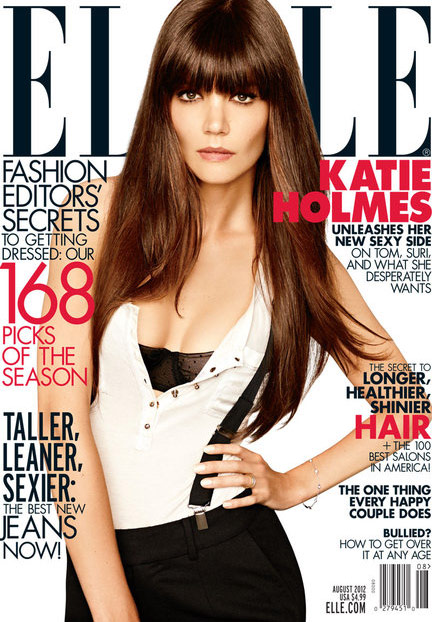
Nope, no Photoshopping. Nothing to see here, move along now.

Confession: sometimes I read women’s magazines. They’re fun to make critique and laugh at.

This time, though, I didn’t even get past the magazine’s front matter before finding something objectionable. In her opening letter for Elle magazine’s August issue, Editor-in-Chief Roberta Myers discusses the recent legislation in the U.K. that would require digitally altered photographs of models to be labeled as such. You can practically feel the derision and dismissal dripping off the page:

So now the National Academy of Sciences is getting into the act, trying to define what ‘impossibly beautiful’ means. In response to legislation pending in the UK to require digitally altered photos to be labeled out of concern for public health, as well as the American Medical Association’s campaign against changing pictures ‘in a manner that could promote unrealistic expectations of appropriate body image,’ two Dartmouth computer scientists proposed a ‘metric’ at a recent NAS meeting designed to rate how much retouched photos have ‘strayed from reality.’ The authors noted that ‘highly idealized’ images have been associated with eating disorders, such as anorexia.

Scare quotes aside, I have the feeling that Myers knows exactly what “impossibly beautiful” means, even if the idea of defining it operationally seems a bit silly. I do think that regulatory measures like these should be approached with a certain degree of healthy skepticism, because government regulation should not be undertaken lightly and without good evidence. But Myers isn’t critiquing it skeptically. She’s sticking her head in the sand and denying that a problem exists.

Furthermore, the regulations don’t even propose to ban severely Photoshopped images, but merely to place labels on them. Is putting an extra little bit of text on the bottom of an image really such a burden for Myers? I think not. Note that some countries are going even further–Israel, for instance, banned the use of underweight models in advertising entirely.

Myers continues:

Yet according to David Scott Rosen, MD…eating disorders are as old as the Bible. They cropped up in popular literature 200 years ago–long before Photoshop but right around the time when John Singer Sargent painted his famous Madame X (Madame Pierre Gautreau), a most flattering oil-on-canvas portrait that left out many a “flaw.”

I couldn’t find a citation for this, but it’s probably true. However, nobody’s claiming that eating disorders exist solely because of unrealistic beauty standards in the media. It’s not like a perfectly healthy young woman (or man, but that’s a slightly different conversation) opens up Elle magazine, sees a picture of a thin model, and immediately starts starving herself. Eating disorders arise from a complicated interaction of genetics, family life, and the surrounding culture. They involve complex cognitive processes, such as the ones described in this study. As another example, research shows that people determine attractiveness based on what they have seen the most. So if you’ve been looking at images of impossibly thin women for your entire life, that may be what you’re going to find attractive–and that’s what you may aspire to be.

We can’t prevent genes that predispose one to eating disorders from being passed down, and we can’t make it illegal for parents to teach their daughters that their appearance is the most important thing and that one should use unhealthy means to maintain it (though, with more education, we might be able to prevent that). We can, however, place restrictions on the images that permeate our media.

Furthermore, Myers conveniently ignores the fact that eating disorders have been growing more and more prevalent over the past century, especially among young women. Studies have also shown possible links between media that promotes thinness and eating disorders. It is impossible to establish a causative link with certainty, but that’s because 1) nothing is ever certain in science, and 2) we live within a culture that promotes and glorifies thinness. You can’t really evaluate phenomena like this accurately when you exist within the system that you’re trying to evaluate.

But luckily, studies done with non-Western cultures are very revealing. One extremely compelling study showed that girls in Fiji, who previously had little exposure to Western media, became much more likely to show signs of disordered eating after watching Western television shows for the first time.

Several Google searches brought up countless studies like these. Myers seems to consider them irrelevant here. She continues:

My point is that trying to define “impossible beauty,” and then regulate its dissemination by putting warning labels on retouched images, seems rather preposterous. You know, my chocolate bar never looks quite as creamy as it does in the ads; cars are never quite that sexy and sleek; and the milk in my cereal bowl never looks quite that white. Oh, wait! It’s not milk at all! It’s some gelatinous concoction meant to look like milk while it stays sturdy under hours of hot lights. Shall we label those photos, too?

This passage is as laughable as it is offensive. First of all, cool slippery slope fallacy, bro. Second, while one may argue over the sleekness of a car or the whiteness of a bowl of milk, it is completely unmistakable when magazines alter photos of models such that they appear to thin to actually be alive.

Third, and most importantly, the comparisons Myers makes are flippant to the point of inanity. The worst thing that can happen in her examples is that one’s chocolate bar isn’t creamy enough. The worst thing that can happen when magazines use Photoshop to excess is that, you know, someone develops anorexia and dies.

As I mentioned, the link between digitally altered images and eating disorders probably isn’t simple. But research is increasingly showing that it is there. It is worth noting that Myers never makes any comments about her own magazine’s use of Photoshop, which tells me that she’s fully aware of what she’s doing and is just willfully playing dumb. She knows. And she’s threatened by it, because things are starting to change.

But she’s not done. She goes on to cite an article in this month’s issue:

I wonder what the National Academy would have to say about the photograph we ran in this issue of novelist and essayist Ann Bauer, who writes so eloquently about growing up “ugly”–bearing a steady stream of abuse about her looks from classmates, strangers, and even lovers.

This bit confirms for me what I already suspected–that magazines like Elle print articles like this solely from the purpose of distracting people from the role they play in upholding our society’s beauty standards. These magazines can trot these articles out as examples of their commitment to portraying “women of all shapes and sizes,” when, in fact, they use these women as tokens.

The article in question is indeed a beautiful article. But what’s ironic is that Myers doesn’t even realize how magazines like her own have contributed to the bullying and abuse that women like Bauer face. Of course, people have always valued beauty and mistreated those who are deemed “ugly.” But lately, the box into which women must fit in order to be considered beautiful has been shrinking, whereas the “ugly” box has been growing. Magazines like Elle may not be the only (or even the main) causes of this trend, but it would be naive not to implicate them in it.

Furthermore, that photo of Bauer that Myers is so proud to have featured? It takes up one corner of a page and measures about two by three inches. Compare this to the dozens of full-page Photoshopped models in the magazine.

The most telling (and touching) part of Bauer’s piece, to me, is the end, in which she describes visiting Hungary with her husband and going to the opera in Budapest:

I turned and found myself looking into a full-length mirror. And I saw something I’d never seen before: myself, in a sea of women who looked just like me.

[…]Everywhere I looked in that lighted glass, there were women with large features, deep-set eyes, rounded cheeks, riotous hair, and delicate-yet-meaty little bodies. We were, in other words, an army of ugly people.

Only, for the first time in my memory, we weren’t. I wasn’t. I was normal, even conventionally attractive. Stylish. Interesting. Sexy. Simply that.

I stood in front of that mirror in the Hungarian State Opera House, watching couples mill. Men holding the arms and hands of dozens of women who could’ve been my sisters, mother, and daughters, tipping their heads back, kissing them lightly, gazing with naked admiration at faces like mine.

Bauer shows, ultimately, that she is not ugly. It is American culture that makes her out to be so. In Hungary, women who look like her are not bullied. They are not sent anonymous emails about how ugly they are. They are not denied jobs or pressured to lose weight and get plastic surgery.

This makes Myers’ stubborn refusal to examine the potential effects of her magazine even more ironic (and upsetting). Magazine editors seem to feel that they are being solely blamed for the devastating experiences of many women (and, increasingly, men), but no informed researcher or critic would say that magazines directly cause eating disorders. We have to examine this phenomenon as a system of interacting elements–the mass media, politics, families, and individual brains and bodies–in order to begin to understand how to prevent unhealthy beauty standards, poor body image, and eating disorders.

We can’t start without making sure that everyone knows that the images they see around them every day of their lives are not realistic. They’re not something to aspire to, because they cannot be obtained–except perhaps at a very high cost.

The editorial this photo belongs to is totally unironically called “The Surreal World.” Photo credit: Elle August 2012

[Guest Post] What is Sensible Drug Policy?

It’s another guest post! In this one, my friend and fellow activist Frances discusses the parallels between good sex education and sensible drug policy, and why we need more of both.

Ever since you’re young, you’re taught that sex and drugs are just plain “bad.” Many high school health classes teach you that if you engage in these activities before (or even after) a certain age or point in your life, you are a weak, scumbag failure who will die with a spoiled reputation.

But where the hell is the other side of the story? Why don’t people ever seriously talk about sex and pleasure? Or drugs and fun? Why is it okay for the media to wave it in our face but crazy for our own parents and teachers to give us a healthy dose of balanced information? Our goal is to teach adolescents to “be responsible,” but they’re learning from irresponsible educators.

I founded SSDP (Students for Sensible Drug Policy) and joined SHAPE (Sexual Health and Assault Peer Educators) my first year at Northwestern University to try to get a more holistic view of these taboo topics. Sex and drugs both share intense politicization, widespread ignorance, and unforgiving stigma, but you know what I eventually learned?

Sex and drugs, in and of themselves, are NOT bad! A certain amount of irresponsibility is necessary to turn sex and drugs bad.

Before you start freaking out because you think I’m promoting sexual activity and drug use, let’s get this straight. There are certain “objective ideals” that we, as a society have created based on common sense and cold hard facts. Ideally, teenagers wouldn’t engage in sexual activity before the age of consent (16-18 in the U.S.), due to the fact that becoming sexually active requires a whole lot of responsibility, healthy communication, self-awareness, and maturity—characteristics that a lot of adolescents under the age of 18 haven’t acquired yet. And objectively, the best drug use is no drug use, given that every drug—whether legalized, criminalized, or medicinal—has the power to cause some sort of negative physical, mental, emotional, or developmental effect. Responsibility is key.

However, just because abstinence from sex and drugs is the “objective ideal” in many cases, does not mean that abstinence only is the objectively ideal way to educate people about sex and drugs. “Abstinence only” or “Just Say No” education is bad and irresponsible, because when we say BAD! or NO!, we never teach kids to think for themselves, or give them the proper tools to deal with these situations should they ever arise. Instead, when teens have questions like, “Can I get STIs from oral sex?” or “If Tommy can drink 9 shots in an hour, it should be fine for me, right?” their friends will answer, “I don’t know.”

Irresponsible sex education is what leads to the spread of STIs, unplanned pregnancies, sexual assault, teen-dating violence, unhealthy communication and our slut-shaming, victim-blaming, homophobic, rape culture. An adequate sex education is more than just about putting on a condom and getting tested. It’s about teaching teens to love their bodies, moving past stigma and encouraging an honest discussion so that we can reduce the possible harms of sexual activity. Simply labeling sexual activity as the root cause of all sex-related problems is too simple an approach with such a complex issue.

The same can be said for drugs. We have GOT to stop blaming drugs for drug addiction, DUIs, overdose deaths, academic failure, gang violence, rape, teenage drug dealers, and violent illegal drug trafficking. A “Just Say No” drug education based on scare tactics is too simple an approach with such a complex issue. The more extreme the scare tactics, the less likely it is that teens will respect what the words of their health teacher. The nastier the words we use to label and stigmatize drug users and abusers, less likely it is that people will proactively seek treatment. Alcohol itself is not hurting people, but people who use alcohol irresponsibly and decide to drive? That’s what destroys lives. Heroin itself is not responsible for overdose deaths, but a lack of education and respect for the powerful effects of the drug are fatal. A drug education that eliminates the stigma of drug use, emphasizes moderation and responsibility, offers a balanced “pros and cons” list on recreational drugs, and is truthful about the social norms of drug use is what will actually reduce the overall cost of drug use to society. This is known as “harm reduction,” the idea that with any harmful activity, there are necessary precautions we can take to make it “safer” and reduce harm, like fastening your seat belts before a drive!

Education rather than blame is crucial to changing risky behaviors and the policies that facilitate risky behaviors. Sex and drug education and sex and drug policies have a reciprocal relationship. Sex education that teaches women to “protect themselves from rape” makes it harder for rape victims to achieve justice in the court of law, because women learn to take on the burden of avoiding rape, while men are alleviated from the burden to not rape. As our gay rights policies slowly change, the movement will very likely go on to influence sex education surrounding LGBT issues. Our laws change our attitudes, and our attitudes change the way we educate. With drugs, it’s even more obvious. Drug education promoting the idea that drugs are “just plain bad” reinforces the public belief that drugs should be illegal forever. The criminalization of drugs creates the violent drug market that sucks adolescents into drug addiction and the criminal justice system. And when adolescents are addicted to drugs, engaging in violence, barred from higher education, unable to find treatment, and ultimately a way out of this lifestyle? We teach that drugs are bad.

I became the Drug Policy Dealer on YouTube to serve as the bridge between drug education and drug policy activism, integrating the skills of a peer sex educator, the lessons from countless articles I’ve read regarding drugs and drug policy, and just plain common sense. Northwestern University’s SSDP Chapter and The Drug Policy Dealer will be unique in that the main message we send is that sensible drug policy relies on the assumption that the majority of people will be sensible with their drug use. Like I said, it is irresponsible to only preach the negatives of drug use, without accounting for the fact that safe, responsible drug use does occur everyday. By the same logic, it is irresponsible to advocate for drug legalization without fighting for a more well-rounded, all-inclusive of drug and drug policy education as well.

Stay Sensible!

Continue reading

Chikin With a Side of Homophobia: Why You Should Boycott Chick-Fil-A

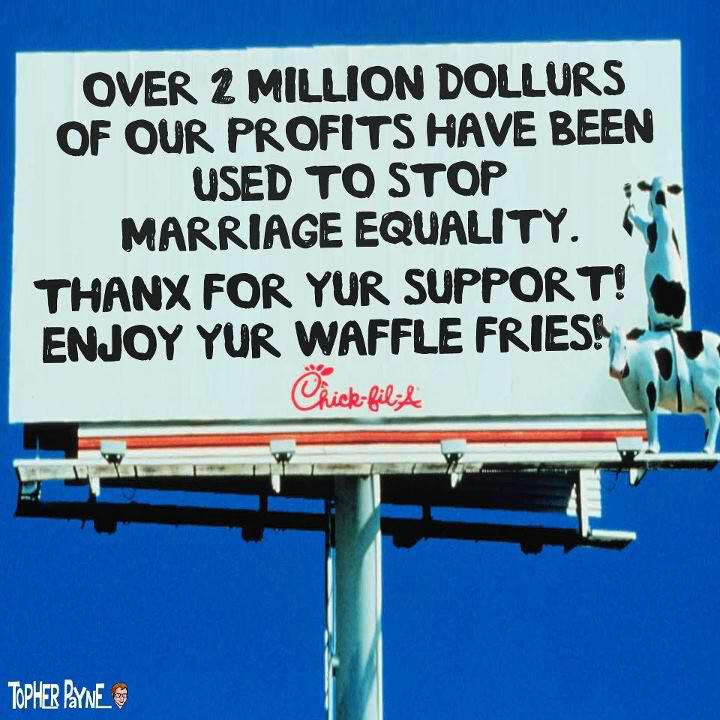
The president of Chick-Fil-A, Dan Cathy, recently confirmed what most of us have known for a while–the company is virulently homophobic.

I mean, he didn’t come right out and say, “We’re a homophobic company.” But he did say, “Well, guilty as charged” when asked about Chick-Fil-A’s position on LGBT rights. He went on:

“We are very much supportive of the family — the biblical definition of the family unit. We are a family-owned business, a family-led business, and we are married to our first wives. We give God thanks for that…we know that it might not be popular with everyone, but thank the Lord, we live in a country where we can share our values and operate on biblical principles.”

There are several interesting things about this statement. First of all, Cathy claims to support “the biblical definition of the family unit.” The Religious Right seems to believe that the Bible defines marriage as a union between a man and a woman. But in fact, as this graphic humorously points out, there are various other configurations that the Bible deems acceptable, such as men having multiple wives or keeping concubines in addition to their wives. In addition, rape victims and female prisoners of war can be required to marry their rapists/captors, and a childless widow is required to marry her late husband’s brother.

So if we’re going to support “the biblical definition of the family unit” in this country, why aren’t we going all-out?

Second, Cathy proclaims that “we are married to our first wives.” Does the company discriminate against divorcees in hiring decisions? What would happen to an employee who decides to get a divorce? Is Cathy aware that divorce is a legal, accepted facet of American culture? On that last question, apparently not.

Third, Cathy seems to at least recognize that his position will draw a lot of ire when he says that “it might not be popular with everyone.” But I despise the use of the word “popular” in this context. Denying rights to people on the basis of their sexual orientation–which is what the organizations to which Chick-Fil-A donates promote, as I’ll discuss later–isn’t merely “unpopular.” It’s, you know, discriminatory. Unpopular is tie-dye and ponchos. Unpopular is crappy 70s music. When people like Cathy claim that they’re doing something “unpopular,” they make it sound like they’re bravely going against the grain, flaunting their nonconformity, in order to…deny rights to people on the basis of their sexual orientation. Edgy.

Finally, it is interesting to note that, up until now, Chick-Fil-A has denied its anti-gay position. As I’m about to show, these were just blatant lies, which ought to make you even angrier. If you’re going to be a homophobe, at the very least own it. And then, you know, change.

Now, as for Chick-Fil-A’s actual anti-gay advocacy, the facts are quite condemning. In 2009, WinShape, the charitable arm of the company, donated nearly $2 million to anti-gay groups like Marriage & Family Legal Fund (started by Chick-Fil-A senior VP Donald Cathy), Focus on the Family, and Eagle Forum.

In case you need any convincing that these are really terrible organizations, I will provide some evidence. The founder of Focus on the Family, James Dobson, supported the Federal Marriage Amendment, which, had it passed, would have made same-sex marriage unconstitutional. Besides its stance against LGBT rights, Focus on the Family also supports school prayer, corporal punishment, and creationism, and opposes abortion (duh). It also donates to the campaigns of anti-gay politicians, and it started a ministry called Love Won Out, which supports scientifically-discredited gay conversion therapy, and sold it to Exodus International, another one of Chick-Fil-A’s charity recipients.

Eagle Forum is a conservative interest group founded by noted anti-feminist and professional asshole Phyllis Schafly. Eagle Forum does way too much terrible creepy stuff for me to list here, but you can read all about it on the wiki page. Its (and Schafly’s) main claim to fame, though, is that they led the effort to defeat the Equal Rights Amendment. Although the ERA is mainly known as a women’s rights amendment, Schafly believed that it would pave the way for legalized same-sex marriage:

“ERA would make all federal and state laws sex neutral. If two men show up and say we want a marriage license and [the person] says ‘you’re both men, I’m not giving it to you,’ that would be discriminatory.”

So, two things are clear: Chick-Fil-A has given a LOT of money to these organizations (probably more in that single year than I will earn in a lifetime), and these organizations do plenty of tangible things that prevent LGBT rights from being fully realized in the United States. And not only gay rights, really–in virulently opposing abortion and supporting corporal punishment, for instance, these organizations also seek to infringe upon the rights of women and children. Actually, given their anti-divorce claptrap, they’ve managed to do the impossible and infringe upon the rights of straight white men, too. They’re equal-opportunity rights infringers!

All of this is why I think that you–yes, you–should never set foot in Chick-Fil-A again.

Now, I’m generally quite skeptical about boycotts. Unless it’s very well-organized and happens on a large scale (see: Montgomery Bus Boycott), it’s unlikely to work. One individual withdrawing their business from a company won’t make it improve its labor practices, stop stocking an offensive product, and so on.

Indeed, if we boycotted every company that does shitty things, we’d probably have to live off the grid. I buy Apple and Coca-Cola products even though I have much to criticize them for, because honestly, refusing to buy them wouldn’t do anything, and you have to pick your battles.

However, with Chick-Fil-A we have a very different situation. This is a company that gives large sums of money–money provided to it by consumers–to organizations that actively work to oppose social justice, full stop. So when you give money to Chick-Fil-A, you can be certain beyond a doubt that some of that money is going to these organizations. Collectively, we as a nation helped Chick-Fil-A send nearly $2 million to these organizations in a single year. If you support equality, you should not be okay with that.

I haven’t eaten at Chick-Fil-A in years. In high school, I wasn’t old enough to care about things like this, and besides–embarrassingly enough–my high school band had a monthly fundraiser night there. As I was raising money for my own band, I was also raising money for wingnut politicians’ campaigns and for harmful conversion therapy.

I don’t miss eating there. The food was pretty good, but the knowledge that not a cent of those two million dollars came from me is better.

P.S. If you need any more incentive to ditch Chick-Fil-A for good, I present you with this:

*Edit* This is just too good not to link to.