In Defense of Cynicism

I’ve been thinking about cynicism a lot lately, for no particular reason aside from the fact that I am a cynic.

According to the actual definition, a cynic is either an adherent of the Greek philosophical school of cynicism, and/or simply a person who believes that human actions are motivated by selfishness (or rational self-interest, to put it more euphemistically).

While I do happen to believe that, I think the word “cynic” has taken on a slightly different, more general meaning, and that is the one that I usually think of when I call myself that. This general definition is that a cynic is a person who sees the faults in things more clearly than most.

Obviously, this entire blog is an expression of that particular trait of mine, and that’s why people seem to either love it or hate it–for the most part, you either “get” cynicism or you don’t.

I think, though, that at least when it comes to politics and social justice, cynicism isn’t nearly as miserable and self-defeating as people think it is. Most intelligent people, if pressed, will admit that there are some serious problems in our society. However, they will tell you that none of this will ever change, that it’s depressing to even think about, and that it’s best to focus your attention on friends, family, work, hobbies.

But we “cynics,” who point out all these problems and analyze them so enthusiastically, seem to actually enjoy the process of unearthing trouble, even if the things we find often disgust and dismay us. The reason the process is so rewarding is because we know that we’re crawling along towards change, and that the more people we urge to care with our commentary, the faster that crawl will go.

So who’s the real cynic?

Of course, there are certainly people out there who cannot remain informed about societal problems while still holding on to their mental health. To such people, I would obviously say to take care of yourself first.

But I think that most people who protest that being critical is “depressing” are selling themselves short. What’s truly depressing is to feel like you have to deceive yourself into believing that everything’s just awesome because you can’t change it anyway.

Cynicism may not be the right word for my approach, but I don’t think there really is one. For instance, calling myself a “critical” person sends an equally distorted message, because it makes it sound like I criticize things for the sake of criticizing them. I don’t. I criticize them because they need to be criticized, and because we all stand to gain from criticizing them.

Instead, I like to call my philosophy “optimistic cynicism.” Or, you know–hope.

“Vagina” is Not a Four-letter Word

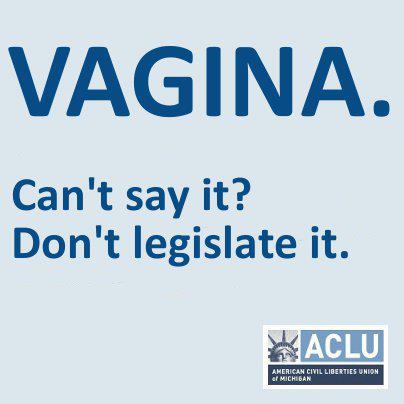
You would be forgiven for assuming that our elected politicians are mature adults who can handle using words that designate genitalia. You would especially be forgiven for assuming that given that many of these politicians are very eager to legislate what can and cannot be done with genitalia.

However, you’d be wrong.

This is old news now for anyone who follows these things, but in case you don’t, here’s a recap. On June 14, the Michigan House of Representatives was debating a new bill that would severely limit a woman’s ability to get an abortion by placing new restrictions on abortion providers. The bill passed the House and will go to the Senate most likely in September. (They were also debating a separate bill, which did not pass, that would’ve restricted all abortions after 20 weeks, with no exception for rape or incest).

In response to this, Representative Lisa Brown (three guesses which party) gave a speech in opposition and said, “I’m flattered that you’re all so interested in my vagina, but ‘no’ means ‘no.'” You can see her speech in its entirety here.

The shock! The horror! Brown was quickly forbidden from speaking on the House floor by Republican leadership of the House. A spokesman for Republican Speaker of the House Jase Bolger said, “House Republicans often go beyond simply allowing debate by welcoming open and passionate discussion of the issues before this chamber…The only way we can continue doing so, however, is to ensure that the proper level of maturity and civility are maintained on the House floor.”

To that end, Republican Representative Mike Callton said that Brown’s remark “was so offensive, I don’t even want to say it in front of women. I would not say that in mixed company.”

What Bolger, Callton, and the rest of these concern trolls apparently do not realize is that language is malleable and entirely based on context. In general, words might be inappropriate to say for three different reasons:

  1. They are derogatory and hurtful slurs (i.e. the n-word, fag, retard)
  2. They have been designated as “profane” by our society (i.e. fuck, piss, shit, cunt)
  3. They refer to things or functions that are generally considered inappropriate for polite conversation (i.e. penis, vagina, feces)
These three categories of Bad Words operate in different ways. The first category is inappropriate to say basically always, unless, in some cases, you belong to the group targeted by the slur, or you are using the word in a conversation about the word (but even that is controversial).

The second category are words that are usually used to make a statement. They are much more frequently okay to use than the words in the first category. That’s why when people curse, they use these words. That’s why many writers, such as myself, use them for effect. They’re generally okay to say around your friends, but many people avoid using them in front of people they don’t know well.

The third category comprises words for things that we usually avoid discussing in polite company without a good reason. You wouldn’t exclaim, “That looks like a penis!” in front of your grandma, and you wouldn’t say, “My vagina feels funny” in front of your boss (I mean…unless you have a very open-minded boss/grandma). It’s not the words themselves that are “bad,” it’s the fact that you usually shouldn’t talk about the things those words refer to if you want to be polite.

But all of this falls apart when the context demands discussion of such topics. If you’re at a doctor’s appointment and the doctor needs to tell you something about your penis or vagina, it would be laughable for him or her to avoid using those words. If you’re negotiating sex with a partner, you shouldn’t have to worry that he or she will be offended if you use those words. And if you’re attempting to legislate what women can and cannot do with their private parts, you’re going to have to face the fact that those parts have names.

The most ironic thing here, though, is Callton’s remark about the word “vagina”: “I don’t even want to say it in front of women.” First of all, that’s patriarchal as hell; women can handle naughty words just as well as men can. Second, it’s not just a naughty word; it’s a word for a thing that (most) women experience on a constant basis.

Some conservatives have apparently made a slightly more legitimate criticism of Brown in that she connects restricting abortion with rape (via her “no means no” allusion). I say “slightly more legitimate” only because, having once been a pro-lifer, I understand how they would take offense.

After all, pro-life politicians do not wake up in the morning thinking, “Yo, I’m gonna take away some rights from women and tell them what to do with their own vaginas today.” They think, “Abortion is murder and I have a duty to stop it just like I would stop the murder of a child or adult.” To them, drawing any parallels whatsoever between restricting abortion and committing sexual assault would naturally seem preposterous. It is only those of us who couch the debate in the language of personal liberty who see the similarities.

That’s why this whole incident really highlighted for me the divisions between liberals and conservatives on the matter of reproductive rights. It’s not even just that they can’t agree on whether or not abortion should be legal; it’s that they can’t agree on what abortion is, and on the terms with which the debate should be framed. Liberals say abortion is a woman’s right over her own body; conservatives say it’s the murder of an unborn human being. How can we ever reach a consensus if we define our terms differently?

I don’t know how to solve this problem–and if I did I would probably be the savior of American politics–but at least this story has a partially-happy ending. Brown and several of her colleagues performed the play The Vagina Monologues with its playwright Eve Ensler on the steps of the statehouse last Monday night as a tribute to our right to speak the names of our own body parts. About 2,500 spectators came to watch.

But as for the bill that the House passed, that’ll go on to marinade in the state Senate, which currently has 26 Republicans and 12 Democrats. I’m not getting my hopes up.

Sunday Link Roundup

Soooo I haven’t done one of these for a while because I’ve been lazy. Just kidding, it’s because I’ve been busy interning for a mental health advocacy organization and suntanning and reading Anna Karenina. So there may be a lot of links here. And now that I’ve recovered from Pride weekend, here it is. Enjoy!

1. This week the European Union released a snazzy video full of pink and high heels and men staring lustfully at women, for the purpose of…encouraging women to pursue scientific careers. After the Internet exploded, the video was taken down, but here’s a great blog post over at Teen Skepchick that explains why this was so gross and inappropriate.

2. At In Our Words, a beautiful post on what depression has taught one writer. “Depression has taught me quality over quantity.  I am a very busy, sometimes self involved, flighty person.  The handful of people I consider good friends know these things about me.  What’s really crazy is that they also love me in spite of them.”

3. On the challenges of disclosing mental illness.

4. On loving your parents even though they can’t accept you for who they are. “I know this isn’t social justice orthodoxy. Social justice orthodoxy is, as Andrew Ti from Yo Is This Racist, would say, “Yo, you tell them they’re fucking racists and then you don’t talk to them. You really need someone that fucking awful in your life?” But the thing is…I kind of do.”

5. Margarita Tartakovsky, one of my favorite mental health writers, explains how not dieting is a sort of freedom.

6. How academic grades become a measure of self-worth, and all the problems inherent in that. As someone who has literally bawled on many occasions because of a random letter that was written on something I produced, I loved this.

7. More on talking about mental health. “I inevitably start to feel like I’m throwing a woe-is-me, isn’t-life-awful, tell-me-about-how-damaged-you-are-so-we-can-cry-together Pity Party. It’s embarrassing….But you know what? I think it’s time for us to have a Pity Party. We need to air our dirty mental health laundry and get a real dialogue going. Because truly, when I started actually acknowledging my depression, letting others in on how much I was struggling, and looking for a reason and a cure, a whole world of compassion opened itself to me.”

8. You don’t need to be in a relationship in order to live romantically. “I enjoy long walks on the beach as much as anyone else; I just like to do them alone.”

9. A friend of mine wrote about how we alternatively demonize and glorify technology. It sounded a lot like a post I’d written once, except better. 🙂

10. You don’t have to be thankful for your mental illness. You don’t have to see “the good” in it. Sometimes there isn’t any.

11. People are more likely to compromise with groups they disagree with if they believe those groups are capable of changing their views. Not a huge surprise, but it’s nice to see research confirm these things.

12. Some really helpful advice on how to flirt with people without making them uncomfortable, as per the recent atheist con controversy.

13. On crying in public, and the sense of shame and embarrassment many of us feel when we cry.

14. What it’s like in a mental hospital, from someone who’s been there. Read it and lay the stereotypes to rest.

15. On the myth of the “good old days.” “But my question is this: if morals have been declining in this day and age, when was it ever higher? Can we really name a time when there was less injustice, criminality, and corruption?” Nope!

16. And my favorite post ever: on self-disclosure and genuineness as a mental health professional who is also a writer. “They told me to lie to you, but I knew you could handle the truth.

Finally, the Crap Post of the Week Award goes to this article from Psychology Today, which attempts to justify cheating on your spouse because good things can apparently come of it. Such as…you’ll talk about the state of your marriage! You’ll spice up your sex life! You’ll get your needs met if your spouse is disabled and physically cannot meet them! Yes, that’s in there. And worse yet, the author calls this a “healthy affair.”

Also, a bit of news–my short-form blog, on which I write and post stuff about basically the same subjects I cover here, has recently received its 500th follower! That must mean it’s good, so go check it out.

Have a good week!

Why I Abandoned Conservatism

To most people who don’t know it already, here’s something that will probably come as a surprise: until about two years ago, I was a far-right conservative.

No, really, I was. Here are some things that I believed when I was a conservative. I believed that there is no real racism or sexism anymore. A Black man is president and women can work outside the home, so none of that. I thought same-sex couples should not be able to get married because that’s not what marriage means. And they definitely shouldn’t be able to adopt children because then the children would also become gay and we can’t have that.

I thought that the government has no right to tell people how to live, except when it does. It has no right to take our taxes and use them to help poor people, because poor people just don’t try hard enough. I thought that lowering taxes makes people spend more, always. I thought that affirmative action is exactly the same thing as racism, because after all, you’re doing things based on people’s skin color.

I believed that the United States has the responsibility to spread democracy throughout the world, by use of force if necessary. Needless to say, I applauded both of our recent wars. I thought that global warming was either a lie or at least an exaggeration, and even if it wasn’t, the government has no right to dictate what we do with the environment, anyway.

I pitied the women who went out carelessly and got themselves raped. I thought the justice system generally does its job, so if rapists weren’t getting convicted, that probably means they didn’t really do it. I thought false rape accusations were a much bigger problem, in fact.

I adored Clarence Thomas, George Bush, Antonin Scalia, Ann Coulter, and, of course, Ronald Reagan. I reserved a particular hatred for Al Gore and Barack Obama.

I believed that abortion was murder, and that it should be illegal in almost all cases.

I figure I’m supposed to be terribly ashamed and contrite about all of this, but truthfully, I’m not. I was a teenager, first of all, and second, I don’t know what I could’ve done to find any other narrative. There are a number of reasons why I was a conservative, and they were chiefly these:

  • because my family was
  • because I grew up in suburban Ohio
  • because our K-12 education teaches us that the American government is Good, that laws are Just, that the justice system Works, and so on
  • because children tend to believe that their values and morals should be everyone’s values and morals
  • because I didn’t have access to the sort of critical analysis that encourages examination of one’s politics–until I got to college

So there you have it. Once I got to college, I took some sociology classes and quickly became a moderate. Then I took more classes, read more, made more friends, read much more, got involved in sexual health activism, got involved in other types of activism, started to see how everything in our society interacts with each other, read some more, and developed the ideology that I have now.

That ideology is something I call progressivism because I favor change in a positive direction. I don’t think that things are fine as they are. I don’t think we should just calm down and stop whining. I don’t think humanity has reached its potential and I don’t think it’ll reach it for a very, very long time. I think our intellect and our compassion are two human qualities that do not get used nearly enough.

People always ask me how I made such a 180-degree shift in politics. I don’t really know how it happened, perhaps because it happened while I was in the midst of a major depression, which means I don’t remember anything too well. But everyone asks that–my friends, my readers, my professors. My therapist asked me today.

I think the way I changed is that I started looking beneath the surface more. Why are there so many Black men in prison? Is it because Black men are naturally predisposed to crime? Apparently not. For instance, in California in 2011, African Americans were 12 times more likely than non-African Americans to be imprisoned on drug-related felony charges, but studies show that African Americans are no more likely to use and sell drugs than anyone else (in fact, they may be less likely to). What’s going on?

That’s just one small example. I learned dozens upon dozens of such examples over the past few years, about everything. About women, people of color, the environment, food policy, agriculture, mental health, disability, LGBT folks, the poor, drug policy, city planning, wars, guns, education, sexual assault, business, discrimination laws, religion, the media, language, abortion, sex ed, obesity, scientific research, healthcare, elections, the Supreme Court, college, advertising, fashion, feminism, queer theory, money.

My head is overflowing with this information and yet I learn more and more of it every day. Whereas I used to think that each person is an individual who makes choices that are absolutely his or her own, I now know that we are acted upon by countless societal forces at every moment. I still do believe that people should strive for independence, but that can’t happen without gaining a deep understanding of these forces.

Do I have a solution for all of this? No. And frankly, I’m kind of tired of people demanding me to provide them with solutions. If I thought I could save the world, I’d be a politician. And I’d be wrong.

But sooner or later, we as a society will stumble upon solutions, slowly but surely.

Everything is connected. Everything is politics. Everything affects you, even in some little way, somehow.

That’s why I am no longer a conservative.

That’s why this is not “just a phase,” “youthful idealism,” or “naivete.”

My exact views on specific issues will change throughout my life, but what won’t is my awareness of the fact that none of us live inside a bubble, no matter how much we may wish that we did.

The graphing calculator I used in high school had a big ol’ John McCain 2008 sticker on it. I rocked that damn sticker. Now I have stickers from Planned Parenthood, the Human Rights Campaign, and Occupy Chicago. It’s kind of both fun and sad to look back at who I used to be. But I’m not ashamed. We all did stupid things in high school, and honestly, I could’ve done worse than plaster McCain stickers on things and rant about how evil feminism is.
“There are no hot girls at Northwestern.”

The other day at a certain user-submitted news website, a new Northwestern student was asking for advice about “the party scene” at our school. He also inquires about the attractiveness of the “females” at our school (I think he means “women”), and several dudebros inform him not to get his hopes up. One writes, “No offense to the girls, but Northwestern is just not an attractive campus overall; guys and girls complain about it all the time.”

Lest you think this is just Reddit stupidity, it’s not. The alleged unattractiveness of Northwestern students is something that I’ve heard referenced many times. There’s even a related term: “Northwestern Goggles.” Urban Dictionary says that “Northwestern Goggles” is “when a female student from Northwestern University is considered “hot” only because most of her fellow students are ugly.” Dictionary db has a lengthy explanation of it too, except it references men rather than women. (Northwestern Goggles is, apparently, an equal-opportunity phenomenon.)

A student review of Northwestern at Vault.com states, “And if you’re looking for attractive male students, look elsewhere. Students develop “Northwestern Goggles” where people who, outside of NU, wouldn’t be considered dating material quickly become eligible and desirable bachelors or bachelorettes.” Campus media references the term, too. A few years back one of Daily’s sex columnists pondered this issue. And, of course, there’s a GIF.

I don’t believe the Myth of the Ugly NU Student. First of all, it just doesn’t jive with my experience at Northwestern and that of the friends that I’ve talked to. I know that’s circumstantial, but I think it’s still worthwhile to point out that some of us disagree. Some of us think that there are plenty of people at NU who look like they could be models. I can think of a number of qualities that are lacking on this campus–for instance, compassion–but attractiveness is not one of them.

Second, I’m somewhat disinclined to even consider the validity of this myth until someone designs a reliable, scientific measure of human attractiveness, applies it to representative populations of a number of universities, and shows me that Northwestern’s Attractiveness Quotient is lower than average.

And “I visited my friend at a state school once and the girls/guys there were so much hotter” does not count. That’s circumstantial evidence, and it’s also confirmation bias: we’ve all heard the Myth of the Ugly NU Student since we got here, so as soon as we get off campus we’re probably eager to try to find attractive specimens to validate our expectations.

Third, I’m not exactly sure what people hope to accomplish by constantly restating the Myth of the Ugly NU Student. While I’m not a huge believer in karma, I’m still pretty sure that it doesn’t exactly do wonders for your love life if you go around moaning about how ugly everyone at Northwestern is. And since most people do realize that beauty is subjective, “There are no hot girls/guys here” is really more a statement of “Look how Cool and Picky I am” than of any actual lack of beautiful people at Northwestern. Congratulations, you’re really Cool and Picky.

Ultimately, whether or not you find attractive members of your preferred gender(s) at Northwestern is entirely up to you. I think it’s pretty judgmental and shallow to dismiss our school with terms like “Northwestern Goggles.” If anything on this campus is ugly, it’s that.