
Insecurity

[TMI Warning]

About five years ago, we read Nathaniel Hawthorne’s The Scarlet Letter in my 10th grade English class. In order to facilitate our understanding of what it must’ve been like for Hester Prynne to walk around with a letter “A” pinned to her clothing, our teacher had us come up with our own biggest flaws and spend a day wearing a decorated letter to represent them. When people inevitably asked what the letters were for, we could explain in as much or as little detail as we wanted.

Of course, most of the kids in my class chose fairly innocuous “flaws”–perfectionism, laziness, stuff like that.

But I chose insecurity.

I wouldn’t be diagnosed with depression for nearly three more years, but all the bits and pieces of my forthcoming diagnosis were already starting to fall into place. Just a week before our letter-wearing assignment, I’d been somewhat unceremoniously dumped by my first real boyfriend, whom I’d told several weeks before that, in tears, that I can’t be happy if I don’t like myself. (The poor guy had no idea how to respond to that–it wouldn’t be until my sophomore year of college that I found a group of friends who did–and I suppose I can’t blame him for running away from my teenage self like a man on fire.)

Although I didn’t know it at the time, I’d accidentally stumbled upon a huge predictor of poor mental health–an unstable sense of self. I had no idea who “I” was apart from what people told me. My friends thought I was overdramatic and overemotional, so I was. My parents thought I was immature, so I was. A guy at school made fun of my big ass, so I was fat. I was pretty and intelligent only because (and only as long as) my friends and family told me so.

Lacking my own independent and stable ideas of who I was, I ran to people for affirmation. They would provide it, and I’d feel satisfied for a short time. I thought that that’s how life was meant to be.

When someone comes to you expressing thoughts of insecurity, it’s natural to want to “fix” everything for them by assuring them that their fears are baseless. What are you talking about, you’re so thin! Of course you’re smart! Guys would be lucky to date you!

But here’s the problem–even if your assertions are absolutely correct, you’re not really doing the person any favors by making them. Rather than making their self-concept subject to the people who bring them down, you’re only making it subject to you and your affirmation.

My advice? Challenge your insecure friends or loved ones to define themselves through their actions, not through arbitrary labels like “pretty,” “smart,” and “mature.” If they’re insecure about a societally-imposed value like skinniness or coolness, help them see that they’re no less of a person even if they don’t fulfill these expectations.

That’s how I ultimately conquered my own insecurity. To this day, I really have no idea if I’m “smart enough” or “friendly enough” or whatever. I’m constantly trying to learn new things and make new friends, and that’s pretty much all I need. If I’m asked to describe myself, I try to use actions rather than adjectives. After all, one can argue whether or not I’m really “kind,” but one can’t argue with the fact that I started a campus organization dedicated to helping people.

My blue letter “I” is still lying somewhere in my closet along with all the other high school crap I’ve been too lazy to throw away. It’s hard to believe now that I was once the sort of person who would’ve worn it.
Antidepressants and Strength of Character

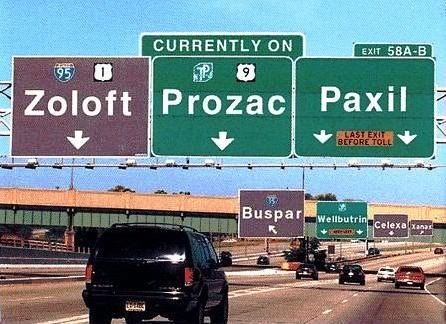
You're not a bad person if you take any of these roads. I promise.

Spoiler alert: They have nothing whatsoever to do with each other.

There are different levels of stigma surrounding mental illness. There’s the stigma of having a disorder in itself, the stigma of being in treatment for a disorder, and, perhaps most of all, the stigma of that treatment being pharmacological.

People love to hate psychopharmacology, especially antidepressants, the efficacy of which is constantly being questioned (often for good reason). However, I’ve noticed that drugs like antidepressants receive a special type of scorn, one that cannot be based solely on the efficacy mystery.

I’ve found that where mental treatment is concerned, therapy holds some sort of moral superiority over drugs in many people’s eyes. I think many people still feel that mental disorders are spiritual illnesses, not medical ones, and that treating them with a pill is some sort of cop-out. (Imagine the public furor if researchers came up with a pill to, say, erase the feeling of guilt.)

This would explain why, though therapy is still stigmatized–after all, the Ideal Person works out these issues on his or her own–it is considerably less looked down upon than psychotropic medication. Our culture values struggle and hard work so much that even recovering from an illness should be mentally effortful.

What people don’t realize is that there are plenty of perfectly legitimate reasons why someone might choose medication over therapy, at least in the short term. Consider, for instance, the situation I found myself in a month before I began my sophomore year of college. Having spent my entire freshman year growing progressively more depressed, I’d thought that coming home for the summer would magically fix everything. It didn’t. With a month to go, I realized that I felt like I’d rather die than go back to school.

That was when I was first diagnosed with depression, and I think my psychiatrist realized, as did I, that I just didn’t have time to muck around with my feelings–I had to get better quickly, or else going back to school would be more upsetting and stressful than I could handle. So I started taking antidepressants and quickly improved enough to feel like I could deal with being in school. The mucking around with my feelings came later.

Aside from that, I can think of many other reasons medication can at times make more sense than therapy. For example:

  • Financial concerns. Antidepressants cost me $30 a month, while therapy costs $80 for four weekly sessions. That’s a pretty big difference for many people.
  • Time. Some people are at a point in their lives where they literally can’t spare an hour or more a week for therapy. That might sound ludicrous to you, but if you’re a college student, a new parent, or a low-income worker, it probably doesn’t.
  • Availability. Unfortunately, not everyone lives in an area where good therapists are available and accessible (and bad therapists will do more harm than good). This is especially true for members of marginalized communities, who may have a hard time finding therapists who are sensitive to their issues. Not all therapists are as open and accepting as they should be.
  • Insurance. I’m lucky to have a fantastic insurance policy that covers basically everything I’ve ever needed. However, many policies are very picky with regards to therapy (as opposed to medication, which does require a prescription from a person with an MD). For instance, some policies refuse to cover therapy unless there’s an official diagnosis, and you don’t necessarily need to have a diagnosable mental disorder in order to need help. Besides, you can’t be diagnosed without going to a specialist to begin with.
  • Nature of the disorder. Although most mental illnesses obviously involve a psychological component, some do not. For example, many people in temperate climates get Seasonal Affective Disorder (SAD) during the winter months, which is characterized by a low-grade depression as well as various physical symptoms. It’s usually treated with antidepressants or light therapy, which actually has people sit in front of full-spectrum light.
  • Language. Therapy requires people to talk pretty extensively about themselves and their lives, something that would be very difficult for, say, a new immigrant who’s just learning English. Unless such people are able to find a therapist who speaks their native language, it would be pretty hard for them to get anything out of therapy.
  • Comfort. As a future therapist, I obviously wish that everyone were comfortable with the idea of therapy. But not everyone is. That could be because of cultural factors, family attitudes, personality, or negative experiences with therapy in the past. I think that using medication to improve your quality of life while working up the courage to see a therapist is perfectly okay.

I hope that this list shows that making decisions about mental health isn’t that different from making decisions about physical health–it has more to do with personal preferences and practical concerns than with the strength (or lack thereof) of one’s character.

Of course, I do believe that therapy is really important and generally awesome, which is why one of my upcoming posts will be about why I think that everyone (or almost everyone) should see a therapist. Stay tuned.

Sleep: Forgotten Martyr of College Life

See? It's even on a shirt.

Academicssocial life, and sleeppick two.” -popular advice given to college freshmen

I’m sure you’ve heard that one before. Most college students, it seems, pick the first two.

What surprises me isn’t so much the fact that they do, but the fact that sleep deprivation is considered such a routine part of college life. Nobody seems to see anything wrong with this idea that getting through college necessitates depriving oneself of sleep.

I have a different way of looking at things because I have a different body. More specifically, living with depression means that sleep takes on a central significance in my daily life. Get too little, even by an hour, and I’m facing the sort of fatigue most people experience only after an all-nighter. Get too little too often, and I’m significantly increasing my chances of relapsing.

Most people don’t have depression (though many do, especially in college), but everyone knows, in the backs of their minds, that sleep is really, really important. Lack of sleep is implicated in all sorts of health problems, from susceptibility to stuff like colds and flu, to obesity, diabetes, attention and memory problems, and, of course, depression. Fatigue also makes the other two items on that list, academics and social life, nearly impossible to handle.

What’s strange is that sleep is probably unique in its complete invisibility as a college health issue. Dining halls increasingly provide healthy options, including full salad bars at each of Northwestern’s. Campus medical centers provide free condoms and cheap STI testing. Campus gyms are open from 6 AM to 11 PM each day and provide plenty of free (or cheap) classes, intramural sports teams, and what have you. Counseling centers provide free counseling and stress management workshops (though of course there’s much to be desired in that department). Anti-binge drinking initiatives abound.

But sleep is that subject that nobody ever seems to touch. After all, exercise makes you look good and can be fun, grabbing a free condom is easy, and getting a salad instead of a pizza is no big deal. Getting enough sleep, meanwhile, requires actual lifestyle changes–and, sometimes, actual sacrifices.

Ultimately, though, I think that the whole “pick two” joke is a false dichotomy (trichotomy??). I know that having all three is possible, because I have all three. I have great grades, I have great friends, and I sleep a solid 8-9 hours a night.

(A few weeks ago, frustrated by the fact that I’m usually exhausted by the time I come home from classes at 6 or 7 PM, I called my mom to complain. She said, “Of course you’re tired. It’s normal to be tired after a long day of classes.” Until she told me this, I’d never realized that. Because the campus culture I’m steeped in tells me that I should come home in the evening, go to meetings and do homework until midnight, and then engage in a social life until 2 or 3 or later–or, if I’ve been procrastinating with my homework, I should just stay up all night.)

What worries me most is that people wear their sleepless nights like badges of pride. You never hear anyone say, “Dude, I’ve legit been eating three slices of pizza EVERY DAY this week,” or “Man, guess how long I’ve managed to go without working out!” or “Guess what, guess what? I totally didn’t use a condom last night!”

But they make those comments about their lack of sleep. The only comparison is the way people talk about binge drinking.

Why is sleep deprivation cool? Probably for similar reasons as binge drinking is. It’s a mark of physical endurance, in a way, and it’s a way of displaying that you have the “right” priorities–socializing, usually–and not the “lame” ones.

Yet colleges actively try to combat the culture of binge drinking, but they ignore the problem of sleep deprivation. Why?

On People Who Think They’re so Damn Funny

[Snark Warning]

Like many depressives, I have a love-hate relationship with humor. A well-crafted joke, anecdote, or cartoon can cheer me up during the worst times, but because of the various cognitive deficits associated with depression, I have a lot of trouble processing humor when it’s directed at me or my life.

Enter another thing I have a love-hate relationship with: Facebook. As one of those rare people who’s “out” about having a mental illness (to shamelessly borrow terminology from the LGBT community), I occasionally post something related to my current troubles on my Facebook. Most of the people who bother reading it are fairly good friends of mine who know what’s going on and often stop by and leave a nice comment or a simple “<3” on those posts.

But then there are people who insist on trying to force a joke about the situation. These well-intentioned but insufferably clueless people are the bane of any depressive’s life. They’re our friends, sometimes even pretty good ones, and as much as we know that they mean well, it can be very painful to have a really difficult aspect of your life reduced to a dumb joke like that. And it’s nearly impossible to find a way to respond–any suggestion that the joke was out of place is inevitably met with “but I was just trying to lighten the mood” or “I just wanted to cheer you up.”

Here’s the thing, though–you can’t fix a depressed person anyway. (Sometimes, you can’t even fix a depressed person if you’re a psychiatrist or psychologist.) The most you can do is offer a message of support and refrain from trying to turn a depressed person’s misery into a big huge joke.

Honestly, I doubt that even healthy people are actually “cheered up” by jokes made at their expense. I can’t imagine that’s pleasant for anyone who’s already in kind of a bad mood. But it’s especially unpleasant for a depressed person and can trigger all sorts of nasty stuff.

I think people have a huge fear of others’ unhappiness. The moment you see a sad person, you immediately want to drag them, kicking and screaming, out of their sadness, whether they asked you to or not. This is understandable, but it should be avoided, not only because there’s so little you can really do, but because you should try to understand people before you try to help them.

If anyone ever bothered to ask me what they could do to help me feel better, you can guarantee I wouldn’t say “crack a dumb joke at my expense.” And, don’t worry, I wouldn’t say “sit here for hours and listen to me cry,” either. I would probably ask you to have a conversation about something interesting, like politics or culture, with me. Or I’d ask you to come over and bring a good movie. Or I’d ask you to bake some cookies with me. Or, I’d say, “Nothing, but thanks for asking.”

What people don’t understand about depression is that it’s different from normal sadness not only in quantity, but in quality. To put it more simply, it’s just a different kind of sadness. When someone has a depressive episode, they go to a really dark place that healthy people don’t go to ever. Not even when their significant other breaks up with them or something like that. It’s a darkness that can’t be lit up by a stupid joke. Really, it can’t be fully lit up by anything. But human connection, love, and support can sometimes help.

Obviously, not everybody is willing to provide that for everybody else. That’s fine, and that’s how it should be. But if you can’t give me what I need to feel better, don’t give me something that makes me feel worse, either.

Like many problems that I come across in my life, this turns out to be something that’s actually a much larger issue. I believe that the reason people are so desperate to immediately try to “lighten the mood” the instant they see something unpleasant is because our culture has an extreme fear of negative emotion. We avoid it like the plague, and it comes as no surprise to me that most of our culture’s solutions for achieving happiness seem to focus on eliminating things like fear, sadness, and anger entirely, rather than incorporating them into one’s life in a normal, healthy way. Clearly, what I have isn’t healthy, but it’s only the extreme end of spectrum. I see this sort of blind and terrified avoidance of anything that’s sad, whether it’s severe like depression or totally normal, everywhere I look.

If you’ve just read this and realized that what I’m describing sounds exactly like you, I hope you’re not offended. If you are, my apologies. But I hope you trust that behind all this snark is a lot of pain.

And, if you’re still reading, I have a challenge for you. Next time you come across a post from a friend that’s unhappy in some way, don’t rush to make a joke about it. Don’t try to drag your friend away from what they’re feeling. If you absolutely need to comment on it somehow, say “I’m sorry, that really sucks,” or “I hope you feel better.” I guarantee that unless you happen to be Jon Stewart, that’ll work better than any joke.

I’ll leave you with a quote by Dutch priest and writer Henri Nouwen:

“The friend who can be silent with us in a moment of despair or confusion… that is a friend who cares.”

The College Story

See, I'm not the only one.

I wish I could spin you the story everyone wants to hear.

That story has a whole cast of predictable characters, and many trunks’ worth of familiar props. The friends, the neat dorm rooms, the beer, the photo collages, the inside jokes, the cute frat guys, the walks by the lake, the hot chocolate, the study sessions, the mentoring professors, the sorority mixers, the coffee dates, the giggly all-nighters, the risque one-night-stands and the whispered confessions to friends in class the next day.

Sound familiar? That’s the College Story. You’ve seen it in every glossy brochure, TV show, Seventeen magazine article, and back-to-school commercial.

But that’s not my story. It never will be. Because the kind of person I am doesn’t get to live that story.

Halfway through my college career, it’s time to admit this to myself.

My story? Sure, it has some bright moments in it. Most stories do, and mine hasn’t been that awful. But then there’s all the stuff nobody wants me to talk about–the weather, the loneliness, the way guys at Northwestern treat me (to be precise, like a thing), the rich, preppy students that I’ll never resemble, the hours spent laboring over essays that professors barely even read (and then unceremoniously slap a B on without further explanation), the expectation to be a walking, talking, drinking/fucking/studying machine, the not-so-subtle bragging NU teaches us to perform, the bottles of anti-depressants lined up on my shelf, the many nights I spent considering transferring, asking for a quarter off, dropping out of college, or dropping out of life.

I played with my little sister today. I do that every day when I’m home, but today it was different because I was acutely aware of the fact that I’m leaving again in five days. I hugged her and my heart broke all over again. I hate that I’m not here to see her and my brother grow up. I hate that nobody at Northwestern loves me the way these two do. I hate that my little brother took one of my blankets to sleep with because he misses me while I’m at school. It all feels so wrong to me.

I’ll feel better once I’m actually there, I know that. Despite what it may look like, making the best of things is a skill of mine. Once I’m there, it’ll be easier to make myself forget the loving family I’ve left back in Ohio and to pretend that home isn’t where I’d always rather be. Sometimes I’m even able to get myself to believe that I somehow matter at this huge institution of higher learning and that it, or at the very least, the lives of some of the other people in it, would be noticeably different if I had never existed.

The truth is that I’m paying $200,000 and a lot of my own sanity for a stupid piece of paper saying that I’m qualified to go get a PhD and actually learn something relevant to my life, because all I’ve learned these past two years is how to act smarter, richer, and more well-adjusted than I actually am. Call me an idealist, but I hoped that college would be more than this.

I’m compelled to apologize for this. To apologize for hating college, because it goes against everything our culture dictates that I do. I’m supposed to love it.

Well, I’m sorry. I wish I could tell you that I do.