Sunday Link Roundup

So I’ve decided to dedicate one post each week to sharing all the awesome things I read elsewhere on the Internet. Hopefully I actually remember to do this each week. 🙂

1. On the benefits of psychiatric labels. I’ve written about this before, but this blogger says it beautifully: “My labels have freed me to live in better harmony with the person I wish to be.”

2. On sexual harassment as an exercise of power.

3. On casual sex and how, for some people, it’s just not that great. I can really relate to this.

4. On “Straight White Male” is the lowest difficulty setting in life. This super-controversial post uses video games as a metaphor for privilege. It’s been accused of ignoring issues like class, but I think we can all agree that Metaphors Are Imperfect.

5. On the (in)visibility of bisexuality. Also, everything else on this blog is fantastic.

6. On Mitt Romney as a bully. I wrote about this too, but this post explores more facets of the story. “The fact that so many responses to Romney’s abuse categorise it as pranking or fun rather than bullying says a lot about why this country has such a big bullying problem. The refusal to identify what he did as wrong, and to connect the dots on what it means politically, speaks to dangerous social attitudes.”

7. Last but not least, this blogger dedicated an entire post to why my blog is awesome. Needless to say, I feel really really special. 😀

What You’re Really Saying When You Say that Suicide is “Selfish”

I’m still thinking about the Chet Hanks suicide thing from last week and the various responses to it that I saw online. Specifically, I cited two comments that referred to suicide as “selfish.”

“Selfish” has to be one of the most common adjectives people think of when thinking about suicide. Those of us who are involved in mental health advocacy could probably rant at you for hours about how this word perpetuates the stigma that mental illness and suicide carry in our society, how useless and counterproductive it is to accuse a suicidal person of being “selfish,” and so on. In fact, if you get nothing else out of this post, I hope you reconsider using that word to describe suicide if you’ve done so before.

But I can understand where this sentiment comes from. While everyone loses loved ones at some point in their lives, relatively few people experience suicidality first-hand. For this reason, people understand the latter situation much less than the former. Faced with the thought that someone you love might kill themselves and put you through all the resulting grief just because of some inner turmoil that you can’t see or understand, it makes sense that you might feel that suicide is selfish.

At the same time, though, conceptualizing suicide as a “selfish act” sends the message that people somehow “owe it” to their loved ones to stay alive despite immense emotional pain. When you say that suicide is “selfish,” you’re implying–even if you don’t mean to–that the individual’s pain, as well as their potential to improve, isn’t what matters. What matters is how they’ll make the people around them feel.

I don’t mean to discount the grief that people feel when someone they love commits suicide–that’s real, valid, and deserves attention. And, obviously, I believe that people should not commit suicide. But I believe that because I also believe that people can recover from the pain that’s causing them to consider suicide, not because they owe it to others to live.

What all of this comes down to is that most people do not (and perhaps cannot) understand what actually goes through a suicidal person’s mind. Maybe they assume that suicidal people are just sad the way all of us sometimes get sad, except maybe a bit more so. (I honestly don’t know how mentally healthy people think about suicide because I haven’t been one for a while.) It would indeed be rather selfish to put your friends and family through so much pain just because you felt sad one day.

But that’s not how suicide works.

The way I see it, the tragedy of suicide is not (or is not only) the fact that an individual’s suicide also hurts others. Rather, it’s that the individual could have found a way to heal, be happy, and live out the rest of his or her life. Calling suicide a “selfish” thing to do erases that latter tragedy and implies that our primary purpose in life is not to create a meaningful and worthwhile life for ourselves, but to keep our friends and family happy at all costs.

Our first priority should be to convince those who want to take their own lives that those lives are intrinsically valuable and should be preserved for their own sake. Only when they’ve accepted that premise can they even begin to think clearly about their obligations and interactions with other people.

Telling a suicidal person that suicide is “selfish” only reinforces the guilt they already feel. People should choose to live because their lives feel worth living to them, not out of a sense of obligation towards others.

Note: Since this is quite a sensitive topic both for me and probably for many readers, please try to be especially careful with your comments. I reserve the right to delete any comments that I feel may trigger people, even if they’re completely on-topic.

Chet Hanks, Victim Blaming, and the “Weakness” of Suicide

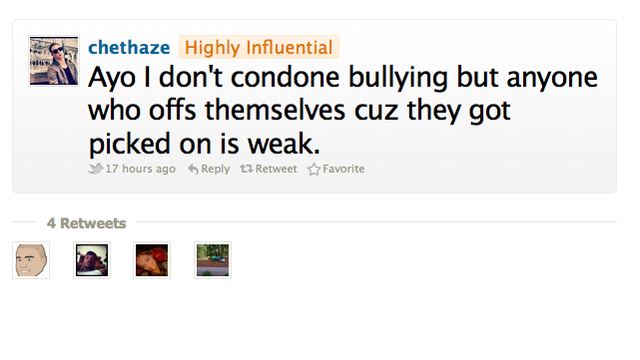
Chet Hanks, son of Tom Hanks and a student here at Northwestern, has this to say about victims of bullying:
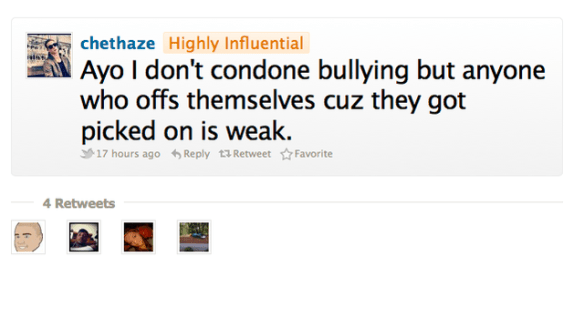
Chet's tweet: "Ayo I don't condone bullying but anyone who offs themselves cuz they got picked on is weak."

Credit: Gawker

And then, perhaps in response to people who responded to him (including yours truly), Chet tweeted these followups:

“I say real shit and I always speak my mind if you don’t like it I could give a fuck less.”

“Lol…Haters: I am sorry I do not cater to your demographic: shlubby dudes that don’t get laid enough it’s ok go back to your Internet porn”

“G’head check my feed, all the people hatin are mediocre Lames and cute girls show me love #whatdoesthattellyou

How mature.

Sometimes I wish someone would invent a technology that allows you to connect to someone else’s brain and actually feel what they feel. Because language is a poor substitute.

Maybe if we had such a technology, people would finally understand that mental illness and suicide do not happen to people because they are “weak.”

However, since we don’t have such a technology, the best we can do is educate ourselves about other people, something that college provides a great opportunity to do. It’s too bad that Chet Hanks seems not to be taking advantage of it.

Some of the comments on the Gawker piece I linked to, while generally dismissive of Chet Hanks, are hardly any better:

His expression of emotion is misguided and a bit douche-y, but I second the sentiment. Suicide is a horrible option to exercise as a bullying deterrent. It’s a permanent solution to a potentially temporary problem. It exchanges the pain you feel for the pain of those around you who love you and is essentially a selfish act.
Suicide is selfish and hurts people who care about you, but calling people who are potentially thinking about doing it weak is only going to make things worse. He could have expressed this sentiment in a way that was constructive and helped people, instead of highlighting what an asshat he is.

It’s probably true that some people are psychologically more susceptible to suicide than others, but that difference has nothing to do with “strength” or “weakness.” It also has nothing to do with “willpower” and “selfishness.” To put it broadly, suicide is what happens when a person no longer wants to live–which isn’t necessarily the same thing as wanting to die.

Tragically, most people who commit suicide do so at least in part because they don’t feel like anyone will miss them, and contrary to what the self-righteous commenters above seem to think, not everyone does have friends or family who care about them. It’s also worth noting that, with the exception of people like me who were bullied for being nerdy, kids who get bullied tend to already be marginalized by society in numerous ways–because of fatness or ugliness, mental or physical disability, perceived or real homosexuality, noncompliance with gender roles, and so on. Sometimes, these are the very children who are least likely to have supportive parents, siblings, teachers, and friends cheering them on through their trials.

What Chet seems to miss is that the causal relationship between bullying and suicide isn’t just that a kid goes to school one day and gets called a fag and comes home and tries to kill himself. Bullying is almost never a one-time thing; it can continue over months or years. It’s a constant wearing down of an individual’s self-worth and belief that he/she belongs in this world. Bullies don’t simply call you names and beat you up–they convince you that nobody wants you here.

While supportive friends and family can alleviate these tragic effects somewhat, as I mentioned, not everyone has supportive friends and family. And even if they do, that may not be enough. Children don’t have the freedom that adults have–they’re completely powerless to escape the situation by moving or dropping out of school. The only recourse they generally have is telling an authority figure at school, and that tends to do nothing at best or backfire at worst.

But of course, pretty much everyone reading this blog probably already knows all that. What they probably don’t know is how it actually feels to seriously consider suicide, and how little it has to do with concepts like “weakness” and “selfishness.” If you’d like to hear about it from someone who knows of what she speaks, feel free to ask me personally. Otherwise, I’d recommend this amazing book.

After we read about Chet’s tweet, some of my friends and I started talking about the whole concept of victim blaming and how pervasive it is in our society. Although it’s usually talked about in the context of sexual assault, there really isn’t a single shitty human experience that doesn’t routinely get blamed on its victims: mental illness, bullying, poverty, racism, sexual harassment, you name it. If you have depression, it’s because you’re just not looking on the bright side of life. If you’re getting bullied, it’s because you stick out too much or “react” too much. If you’re poor, it’s because you’re too lazy to get a job. If you’re fat, it’s because you eat crap and don’t exercise. If you feel discriminated against, it’s because you’re “too sensitive.” If you’re getting harassed on the street, your skirt’s too short. And so on and so forth.

(In fact, as Barbara Ehrenreich notes in her brilliant book Bright-sided, even cancer, that ultimate of tragedies, is increasingly getting blamed on its victims. Why? Because they didn’t “think positively” enough.)

Sometimes, it’s really difficult and unpleasant to acknowledge the fact that, even in our pull-yourself-up-by-the-bootstraps, when-there’s-a-will-there’s-a-way sort of culture, sometimes life just screws people. Sometimes it just does.

It’s easier to blame the victim than to make the sort of cultural changes we would need to make sure that people get screwed over as little as possible. Much easier than to figure out how to teach compassion to kids, how to eradicate racism, how to get people to realize that there’s never an excuse for raping people.

But just because we may not yet know how to do those things does not mean we should just throw up our hands and say, “Yeah well, if they off themselves, it’s just cuz they’re weak.”

The more I study psychology, bullying, and the many challenges faced by people that society continually marginalizes, the more I think: If only it were that simple.

*edit* Also, I’m going to try really hard to believe that underneath all that idiocy is some actual intelligence, and that that’s why Chet Hanks got into this school–not because of who his father is.

And, here’s an awesome blog post about this from my friend Derrick.
The “Right” Way to Be Depressed

CNN did a great thing today. They published a first-person account by one of their editors, Stephanie Gallman, about her experience of being diagnosed with depression, and of telling her friends and family about it.

Initially when I saw this article, I was overjoyed. It’s good to see mainstream media outlets publishing articles about depression that are personal rather than scientific in nature, and I’m relieved that more people are willing to publicly state the fact that they have depression.

But then I actually started reading it:

In August, after several months of seeing a therapist and a psychiatrist, I was diagnosed with depression.

The news came as a shock.

“I’m not depressed,” I said defiantly, shaking my head when the doctor deducted that must be what was ailing me.

“I hate depressed people.”

She laughed at my strange reaction, but I was serious. I don’t want to be in that category of people. Everything they take in and spew out just breathes negativity, and they are difficult to be around. I despise these people.

Gee, thanks, Stephanie. We despise you too.

She goes on to describe how, at her doctor’s urging, she finally realized that the symptoms of depression really did describe her experience. When her doctor suggests antidepressants, she’s not too excited about the idea but seems to at least consider it.

Then she discusses dropping the “D-bomb” to friends and family. Her favorite response from them, apparently, is surprise:

A lot of the people reacted to the D-bomb the same way I did — “You’re depressed?! You?  Stephanie Gallman? But you’re one of the happiest people that I know! You Hula-Hoop in Walmart!” (I really do Hula-Hoop in Walmart — every time I go.)

These are the people I wanted to reach out and hug; they made me feel like I hadn’t turned into Debbie Downer.

It’s true, to the outside world, I do appear happy. And I realize this is hard to grasp, even for me, but I am happy most of the time. I am fully aware of how blessed my life is and express gratitude for it daily. I have worked hard not to let what’s going on with me on the inside affect the way I present myself on the outside.

It’s hard not to notice how much this smacks of a certain self-congratulatory relief, of “doing” depression the right way. This woman is clearly such a considerate person, for not letting her depression affect how she presents herself!

Gallman’s gratitude for her blessed life strikes a chord with me, as it will with many other people with depression, because of how damn often we’re told to “count our blessings” and “be grateful for what we have.” There’s nothing worse, apparently, then being ungrateful.

That said, there are definitely some great things about the article. Gallman talks about her anger at being told to “do more of the things that you enjoy” rather than taking antidepressants. “Bite me,” she writes. “These patronizing (“The Secret”? Are you serious?) prescriptions infuriated me, as if the reason I wasn’t happy is because I hadn’t tried hard enough.”

She also makes a great point about the need for more openness surrounding mental illness. One of the responses she often received when she dropped the “D-bomb” was stories about friends and family members who had also suffered from depression:

I was dumbfounded. I wanted to scream like Adam Sandler in “The Wedding Singer”: “Gee, you know that information … really would’ve been more useful to me yesterday!” Why isn’t anyone talking about these illnesses that affect our most important body part — our brain?

Indeed, why aren’t more people taking about these common, devastating illnesses?

Unfortunately for Gallman, one answer is that it’s because of people like her.

Specifically, it’s because of the people who call us “Debbie Downers,” who tell us that we’re “spewing negativity,” who blame us for our own illness just like Gallman (tragically) blamed herself.

The problem with Gallman’s narrative is that we’re not all as “blessed” as she is. Her theory that she may be to blame for her own depression because she withdrew from friends may be applicable to her own life (though I doubt it), but it’s not very applicable to those depression sufferers who may not have a strong support network like she does. She writes, “No surprise, the wonderful people in my life have all been very kind and sympathetic, offering words of comfort and support.” Well…good for her. Not everybody has that.

Furthermore, not everybody is an accomplished adult who has a dream job as an editor at CNN. Gallman’s habits of eating well and exercising healthfully, which she is proud enough of to mention in this article, are not available as options to everybody. It’s clear that she has a full enough life that she’s able to throw herself into other things and avoid that terrible label of “unhappy.” Her optimistic personality, another trait of which she is very proud, is something that psychologists generally agree is inborn and possibly genetic–not something that all of us are so lucky to have.

After reading this article, I was struck by the pervasiveness of the message hidden between its lines–that there is a “right” way to be depressed. Gallman plays this role well. She does not embrace her diagnosis, nor her doctor’s suggested treatment; after all, doing so would imply that she “wants” to be a victim. She steadfastedly counts her blessings every day and reaches out to her supportive friends and family. She eats well and exercises. She is absolutely not to blame for her depression because she does everything “right.”

And most of all, she sees her depressive side as something shameful and ugly, just a foil to her sunny personality.

What about those of us who don’t have a sunny personality?

I feel for Gallman, not just because of her struggle with depression, but because of how indelibly she has internalized the idea of depression and unhappiness in general as something Wrong and Bad. There’s no room in this article for the scandalous idea that depression, while being difficult and unpleasant, is something that a person can make peace with–the way they might make peace with having asthma or diabetes.

There’s also no room in this article for sympathy for those who don’t play the role of Optimistic Depression Sufferer as well as Gallman does. No sympathy for those who don’t identify themselves as happy people at all.

I’m glad that Gallman has shared her story, and I wish more people would do the same–with their real name attached. But I hope that readers who don’t have experience with depression do not assume that Gallman speaks for all of us.

Edit 4/2/12: If you want to see a brilliant, prominent person discuss her experiences with depression without being judgmental and promoting stigma like Gallman does, read this.

Liking Yourself and Being a Good Person–Is There a Connection?

Read this quote:

“I am now the most miserable man living. If what I feel were equally distributed to the whole human family, there would not be one cheerful face on the earth. Whether I shall ever be better I can not tell; I awfully forebode I shall not. To remain as I am is impossible; I must die or be better, it appears to me.”

If you were to take a wild guess, would you say that the person who wrote this was a productive member of society? Do you think that he or she was the type of person who helped others, who contributed meaningfully to his or her community? Was he or she a good person?

If you’re like most people (which, if you read this blog, you’re probably not, but bear with me), you’d probably answer “no” to those questions.

And you’d be dead wrong, because the author of those dismal thoughts was Abraham Lincoln.

This past weekend, my Jewish education group had its second retreat of the quarter. (I wrote about the first one here.)

One of our many discussions during the retreat was on which qualities are necessary for someone to be a good person (however one defines “good”). Some of my group’s suggestions, such as empathy, seemed completely accurate.

Some, however, did not. One student mentioned that she thinks that liking yourself is a prerequisite to being a good person, and everyone enthusiastically agreed.

I waited for her to explain. She said that you have to be fine with yourself before you can focus on being a good person to other people. She said that not liking yourself is unhealthy. (And unhealthy, by extension, must mean bad.)

I said, “What if the person you are right now just isn’t likable to you?”

She said, “Well, then you would just be bitter.”

I said, “I don’t like myself and I’m not bitter.”

She stammered, said sorry, and left the subject alone.

Here’s the thing. I would agree that genuinely liking yourself is a pretty good goal to have in terms of your own psychological development. However, I completely oppose the moralization of this quality. That is, I oppose the idea that liking yourself makes you a “good” person and that not liking yourself makes you a “bad” person. I also oppose the idea that you can’t be a “good” person unless you like yourself.

I have several reasons for opposing this concept. One is that I truly don’t believe that your opinion of yourself is strongly correlated with your treatment of others and your ability to contribute positively to society. There’s a stereotype of people who have low self-worth as selfish, miserable, and–as the girl in my group said–bitter. While it’s quite possible that not liking yourself would lead some people to be this way, it can also push people to turn outwards and do incredible things for others. Abraham Lincoln, for instance, may have been one such person.

Second, while the argument that you must like yourself in order to be a good person does not necessarily imply that liking yourself automatically makes you a good person, I think that’s something that should be examined. Once you do that, you’ll hopefully realize that there’s simply no connection. Some people who like themselves are great people. Some are horrible people. Some like themselves so much that they don’t give a crap about anyone else.

Third, there is an illness that up to a quarter of adults will experience at some point during their lives that has as one of its symptoms feeling worthless and hating yourself. That, of course, is depression. I hope I don’t have to explain why I find the suggestion that depressed people can’t be “good” people to be inaccurate, superficial, and downright offensive.

Fourth, all of this hinges on one’s personal definition of a “good person,” which was never elaborated on during our discussion. (I find that in conversations of a religious nature, these things tend to just be left undefined.) To me, a person who isn’t good is a person who has the opportunity to help others but chooses not to. A person who cannot help others due to circumstances beyond his or her control should not be labeled as “bad.” So if disliking yourself really is keeping you from helping others, that doesn’t mean you’re not a good person. It just means you have to work on your issues before you can put your goodness into action.

As I told the girl in my group, I dislike myself. There are two main reasons for that. One is that I have depression, and as I mentioned, that’s one of its symptoms. The other is that the culture I live in rejects many of my most defining traits, and it’s really, really hard to like yourself when you’re bombarded with cultural messages that tell you that you’re unlikeable.

With time, I’ll probably learn how to ignore those messages. But to suggest that I can’t be a good person right now because of them (and because of my depression) is extremely condescending. I do my best to be a good friend, daughter, sister, and leader in the Northwestern community. I have found causes that I support and advocate for them tirelessly. Because of my openness about my own experiences with mental illness, I have been able to serve as a source of information and support for many other people that I’ve met over the past few years.

Now, that’s hardly on the level of, say, Abraham Lincoln. But it’s more than a lot of other people my age do. A lot of the ones, I might add, who insist that this time of our lives is a time to “just focus on me” and “just do what I want.”

Liking yourself is great. It feels nice. But we shouldn’t confuse it with having the ability and the desire to do good.