Yes, We Need Psychiatric Labels

Recently I stumbled upon a Huffington Post article by one Dr. Peter Breggin, who lists himself on HuffPo as a “reformed psychiatrist.”

This should’ve told me everything I needed to know, but I read on.

The article is titled “Our Psychiatric Civilization” and tries to make the tired point that in this day and age, we are defining ourselves by our psychiatric diagnoses and not by anything else. It’s difficult to fully dissemble this argument because Breggin unceremoniously shoves so many unrelated arguments into the same sad little article, but his main points seem to be:

  • Psychotropic medication is overprescribed.
  • Psychiatric diagnoses (i.e. major depression, bipolar disorder, ADHD, etc.) oversimplify the human condition.
  • Back in the good ol’ days, people apparently did a lot of spiritual soul-searching rather than resorting to all those damn pills.
  • The way people connect in our culture is through their psychiatric diagnoses.

I honestly don’t know which planet Breggin is living on, but it’s certainly not mine. I’ve addressed the overprescription crap elsewhere so I won’t talk about that now.

As for the second point, this is, to a certain extent, true. Psychiatric diagnoses DO oversimplify one’s psychological state, but that’s because you have to have a starting point. If you’re diagnosed with ADHD, you know that, some way–whether it’s through medication, therapy, or some combination of the two–you need to learn how to focus your attention better. If you’re diagnosed with major depression, you know that you need to somehow learn how to fix your cognitive distortions and become more active. If you’re diagnosed with seasonal affective disorder, you know that you need to do things that counteract the shortening of the days–use a full-spectrum lamp, take vitamin D supplements, etc.

Just as knowing that I have, say, asthma or the flu doesn’t describe the full state of my entire body, a psychiatric diagnosis isn’t meant to describe my entire psychological condition. Breggin seems to think that we live in a world where all we know about each other is what pills we’re popping, and nothing else. This is ludicrous. In fact, that’s something we don’t often know, given the stigma that still exists regarding mental illness.

Breggin goes on to claim in a condescending way that there’s no reason for people to connect with each other based on psychiatric diagnoses at all:

Patients ask me, “Should I join a bipolar support group?” If I were flippant, which I never am with patients, I could respond, “Only if you want support in believing you’re bipolar and need to take psychiatric drugs.”

My first thought upon reading this drivel was, Thank G-d he doesn’t say this to patients. My second was more like, What the fuck?

The idea that seeking support from others who face similar issues as you is somehow disempowering and promotes seeing oneself as a victim is quite possibly the most batshit stupid thing I’ve ever heard from someone whose profession is helping the mentally disordered. Shockingly enough, people like to feel like they’re not the only ones with problems. Perhaps this has truly never occurred to Dr. Breggin.

Quite the contrary, I have benefited immensely from connecting to other people who have depression and other mental disorders. Many of my friends have one, and together we’ve formed a sort of support network. All of us can always count on having someone to talk to, and those of us who aren’t as far along in the process of recovery as others can ask friends for advice. I don’t know where I’d be right now without that.

(Maybe in a perfect world, we could just have support groups called “Fucked-up People Support Group,” but somehow this seems counterintuitive.)

Anyway, psychiatric diagnoses can also be immensely helpful in explaining to healthy friends and family what the deal is. While Breggin seems to think that “depressed” is some sort of insulting, disempowering label I ought to reject, let me tell you some of the labels that my close friends and family described me with before they knew I had depression:

  • overdramatic
  • overemotional
  • bitchy
  • attention whore
  • immature
  • insensitive
  • selfish
  • crazy
  • weird
  • fucked up

Yeah um, I’d take “depressed” over that any day.

Not surprisingly, you don’t make a particularly strong case for yourself when you try to insist to people that, no, it’s not that you’re really overdramatic, it’s just that you have this problem with, well, being overdramatic, and you’re trying to work on it, you promise!

Trust me, that doesn’t work. What does work is saying, “I have a disorder called depression that distorts my thinking and sometimes makes me act in a way that seems overdramatic. With therapy and medication, it’ll improve.”

Apparently, though, Dr. Breggin is much too intent on destroying his own profession to allow those with mental illnesses even that small comfort. After all, he makes it pretty obvious that the reason he hates psychiatric labels so much is because they make it possible to prescribe medication, and that, of course, is a big no-no.

If I got a dollar every time some well-meaning fool tried to inform me that the medication that saved my life is unnecessary, I would have enough money to actually afford a therapist.
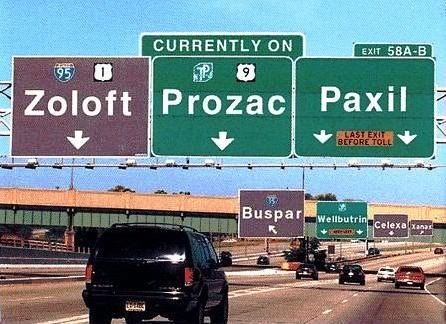
Antidepressants and Strength of Character

You're not a bad person if you take any of these roads. I promise.

Spoiler alert: They have nothing whatsoever to do with each other.

There are different levels of stigma surrounding mental illness. There’s the stigma of having a disorder in itself, the stigma of being in treatment for a disorder, and, perhaps most of all, the stigma of that treatment being pharmacological.

People love to hate psychopharmacology, especially antidepressants, the efficacy of which is constantly being questioned (often for good reason). However, I’ve noticed that drugs like antidepressants receive a special type of scorn, one that cannot be based solely on the efficacy mystery.

I’ve found that where mental treatment is concerned, therapy holds some sort of moral superiority over drugs in many people’s eyes. I think many people still feel that mental disorders are spiritual illnesses, not medical ones, and that treating them with a pill is some sort of cop-out. (Imagine the public furor if researchers came up with a pill to, say, erase the feeling of guilt.)

This would explain why, though therapy is still stigmatized–after all, the Ideal Person works out these issues on his or her own–it is considerably less looked down upon than psychotropic medication. Our culture values struggle and hard work so much that even recovering from an illness should be mentally effortful.

What people don’t realize is that there are plenty of perfectly legitimate reasons why someone might choose medication over therapy, at least in the short term. Consider, for instance, the situation I found myself in a month before I began my sophomore year of college. Having spent my entire freshman year growing progressively more depressed, I’d thought that coming home for the summer would magically fix everything. It didn’t. With a month to go, I realized that I felt like I’d rather die than go back to school.

That was when I was first diagnosed with depression, and I think my psychiatrist realized, as did I, that I just didn’t have time to muck around with my feelings–I had to get better quickly, or else going back to school would be more upsetting and stressful than I could handle. So I started taking antidepressants and quickly improved enough to feel like I could deal with being in school. The mucking around with my feelings came later.

Aside from that, I can think of many other reasons medication can at times make more sense than therapy. For example:

  • Financial concerns. Antidepressants cost me $30 a month, while therapy costs $80 for four weekly sessions. That’s a pretty big difference for many people.
  • Time. Some people are at a point in their lives where they literally can’t spare an hour or more a week for therapy. That might sound ludicrous to you, but if you’re a college student, a new parent, or a low-income worker, it probably doesn’t.
  • Availability. Unfortunately, not everyone lives in an area where good therapists are available and accessible (and bad therapists will do more harm than good). This is especially true for members of marginalized communities, who may have a hard time finding therapists who are sensitive to their issues. Not all therapists are as open and accepting as they should be.
  • Insurance. I’m lucky to have a fantastic insurance policy that covers basically everything I’ve ever needed. However, many policies are very picky with regards to therapy (as opposed to medication, which does require a prescription from a person with an MD). For instance, some policies refuse to cover therapy unless there’s an official diagnosis, and you don’t necessarily need to have a diagnosable mental disorder in order to need help. Besides, you can’t be diagnosed without going to a specialist to begin with.
  • Nature of the disorder. Although most mental illnesses obviously involve a psychological component, some do not. For example, many people in temperate climates get Seasonal Affective Disorder (SAD) during the winter months, which is characterized by a low-grade depression as well as various physical symptoms. It’s usually treated with antidepressants or light therapy, which actually has people sit in front of full-spectrum light.
  • Language. Therapy requires people to talk pretty extensively about themselves and their lives, something that would be very difficult for, say, a new immigrant who’s just learning English. Unless such people are able to find a therapist who speaks their native language, it would be pretty hard for them to get anything out of therapy.
  • Comfort. As a future therapist, I obviously wish that everyone were comfortable with the idea of therapy. But not everyone is. That could be because of cultural factors, family attitudes, personality, or negative experiences with therapy in the past. I think that using medication to improve your quality of life while working up the courage to see a therapist is perfectly okay.

I hope that this list shows that making decisions about mental health isn’t that different from making decisions about physical health–it has more to do with personal preferences and practical concerns than with the strength (or lack thereof) of one’s character.

Of course, I do believe that therapy is really important and generally awesome, which is why one of my upcoming posts will be about why I think that everyone (or almost everyone) should see a therapist. Stay tuned.

Mental Illness Is Not a Punchline

Damn, I’m certainly on a crusade against humor these days.

That was sarcasm, by the way. I love humor. I just think it should be deployed carefully.

A few days ago in my Psychology of Personality class, the following happened:

Some people were having their own conversations while the professor was trying to give a lecture. The professor cracked a joke–“Hey guys, I have ADD so I can’t focus if other people are talking, so please stop!” followed by “I don’t really have ADD, but still.”

Now, for the record, I totally get that it sucks for a teacher when people are talking in class. But I also feel that there are other ways to address that situation without making a joke about having a mental illness that you don’t actually have. Especially, you know, if you’re a person who has a PhD in psychology and conducts research on people with actual mental illnesses.

The sad thing is, before he followed his comment up with that disclaimer, I was actually really touched. I thought it was wonderful that a professor of psychology would take a stand against the stigma of mental illness by stating in class that he has one. But then, you know, it turned out to just be a joke.

~~~

Last spring, I took a class on Cognitive Behavioral Therapy. It was an advanced class, with just around ten students or so, taught by one of the most esteemed professors in the department. We got to the chapter on Borderline Personality Disorder, which, as you may know, is considered one of the most frustrating mental disorders–both for clinicians and for the patient’s friends and family. So naturally, no discussion of it could be complete without my professor’s bombastic explanations about how she tries to avoid treating BPD patients because they’re just SUCH a pain and about how she once had a friend with BPD who was just SO hard to deal with. Everyone gasped and laughed at her descriptions.

Then, of course, the other students had to start raising their hands and talking about their own friends that they’d taken the liberty of diagnosing with BPD, and how  horrific those people were.

This was a time in my life when I was seriously wondering if I had BPD myself, so, yeah, that was pretty unpleasant.

~~~

Last fall, I took a class on psychopathology. It was my second psychology course ever, and my first that related specifically to mental disorders–a topic very close to my heart at the time since I’d been diagnosed with major depression only a month before.

Before the course started, the professor sent out an anonymous survey to the entire class about our experiences with mental illness. On the first day of class, she disclosed the stunning results–more than half of us said we’d been diagnosed with one.

So we got to the chapter on depression and the professor started talking about depressive cognitive distortions, using specific examples. The professor started listing them off in such a way that the whole class started laughing. And laughing, and laughing.

Now, I totally get that it sounds funny. Consider this dialogue:

X: I’m getting a B in calculus. I’m a total failure.

Y: You’re not a failure at all! You have straight As in the rest of your classes.

X: Well, those don’t count. They’re easy anyway.

Y: Yes, and calculus is pretty hard, so it makes sense that you wouldn’t do as well. Besides, a B is a pretty good grade.

X: No, it’s a shitty grade. Everything I do is shitty and I’m always going to be a failure.

That is an example of several cognitive distortions, including overgeneralization, disqualifying the positive, magnification, and labeling. And, when read aloud in a particular tone of voice, I can see how it might sound kind of funny.

But having been through it myself and studied it extensively, I can also hear the pain behind what X is saying. It’s not a punchline. It’s a cry for help from a person trapped inside their malfunctioning mind.

~~~

Here’s the thing. I get it. People with PhDs in psychology have spent years and years reading, writing, and talking about stuff like this. I’m sure that it’s completely normal for two psychologists to crack jokes about mental illness to each other.

Knowing that many people who pursue degrees in psychology are spurred to do so by their own experiences with mental illness (I’m an example of this), I understand the urge to joke about it because I joke about it myself. It helps alleviate the fear and pain of living with mental illness.

That doesn’t mean I’d joke about it to a room full of 100 people who don’t know me well and who may be dealing with their own issues, though.

Case in point–at the time I took the aforementioned psychopathology class, I was still learning how to recognize cognitive distortions in myself, and I was beginning to realize the extent to which they’d ruined all of my previous interactions, friendships, and relationships. To have a room full of 100 people laughing uproariously about something that nearly brought you to suicide just three short months before is, well, no laughing matter.

~~~

I’m not saying there’s no room for humor about mental illness. There definitely is, and humor has been one of several strategies that have helped me process what happened to me. But humor must be used carefully.

I’ve written before about the complex relationship between humor and mental illness–here, here, here, here, and here. But this time, the situation is very different because the off-color jokes are coming not from comedians, television writers, novelists, or clueless friends of mine, but from people who know more about psychology than 99% of the population.

Unfortunately, I still haven’t quite worked up the courage to tell a person with a PhD that they’ve offended me.

But I’m working on it.

How Depression Feels

I feel like there’s a disease in my head. I want to excise the brain parts that it lives in, the parts responsible for loneliness, worthlessness, apathy, cynicism, seriousness, sensitivity, and all the other ways in which I could be described.

I feel like a book lying open on the grass. The wind blows the pages around and one can’t help but read them. Nothing that’s written can ever be forgotten.

I feel like I’ve wound up my body’s pocket watch all wrong. It doesn’t go at the same pace as everyone else’s. Sometimes it ticks when it shouldn’t. Sometimes it doesn’t when it should. Where is that damn watchmaker?

I feel like a sinking ship. All of my most beautiful parts are underwater now, my framework waterlogged and rotting. Up on the tilting deck, an orchestra plays for anyone who dares to listen.

I feel like there’s a darkness following me wherever I go. Some call it a black dog, others call it a raincloud, others call it the noonday demon. Sometimes we sit on a bench next to each other, just gazing out into the world through our foggy, listless eyes. When it’s with me, I see in black and white.

I feel like a piece of driftwood on a beach. Why am I here, and not there? Is this sandy spot any better than that one?

I feel like there’s another spirit inside me and it’s more compassionate and optimistic and hopeful than I’ve ever been able to be.

I feel like there’s a flood slamming against the levee walls of my brain.

I feel like there’s a screeching phoenix beating in my heart, trying to burn a hole in the scarred tissue and escape.

I feel like I’m moments, or days, or years away from coming alive. It’ll happen, someday.

The Trivialization of Mental Illness

I’m reading a very interesting novel called The Four Fingers of Death. It’s somewhat science-fiction, with a distinctly Vonnegut-esque tone to it–very sarcastic and cynical. The story takes place in the 2020s, and the author, Rick Moody, gives several hints as to the general milieu of the future. Few people have cars as gas is very hard to come by, India and China are dominating the world, and paper books are mostly a thing of the past. One little detail that the narrator mentions several times–a detail that most readers would skim over, but that the author undoubtedly meant to make a point with–was the 8th version of the Diagnostic and Statistical Manual of Mental Disorders (DSM).

Currently the DSM is in its fourth version–DSM-IV–but the DSM-V is in the works. However, in the world in which Four Fingers takes place, the DSM-VIII has medicalized all sorts of everyday issues, such as a disdain for hygiene (“aggravated hydrophobia with hygiene avoidance”), opening a game of chess in an unusual way, being rude to waitstaff, and speaking unusually (“conversational pseudo-uremia”). What completely got me, though, was when the narrator diagnosed a new friend with “mixed caffeine obsession with chronic caffeine dependence” when–get this–the friend suggested that they meet up at a coffee shop!

The author’s point, of course, is easy to see. It’s a satire of the supposed overdiagnosis of mental disorders even today, and of the presence of useless and non-clinical “disorders” in the DSM. As in, hahaha, at the way things are going, soon we’ll call not showering a mental disorder! To this point, the narrator of the story mentions that everyone has been diagnosed with a mental disorder these days. The way he talked about the DSM–“I flip through it looking for symptoms I have yet to contract”–makes this attitude even clearer. Through his satire, Moody implies that mental illnesses are not something to be taken seriously.

Forgive me for making a big deal out of a (probably insignificant) novel, but this mindset right here–that mental disorders are just some sort of farce invented by people yearning for attention for their minuscule problems–this is what’s responsible for one of the biggest threats to adequate mental healthcare in America. I’ll attack this mindset point-by-point.

First of all, contrary to popular opinion, “everyone” does not have a mental disorder these days. I’m sure you’ve heard someone comment, perhaps after hearing of another person’s diagnosis with a disorder, something to the effect of, “Oh, lord, everyone’s popping pills for something these days!” No. Everyone is not popping pills for something these days. Many people do, at some point in their lives, take medication for a mental issue. But most psychotropic medications are meant as temporary solutions while the person works on their problems in therapy or on his/her own. People aren’t meant to take them for their whole lives.

And even if every single person in this country does, at one point or another, take psychotropic medication, that doesn’t mean much on its own. Almost everyone takes drugs for colds or headaches at some point, but nobody seriously advocates against this. I use the word “seriously” carefully here–a radical diet book I came across recently, Skinny Bitch, claims that we should basically never take medication for anything. It says, “Yeah, getting cramps totally sucks. It’s supposed to. Every month you endure cramps (without medication), you are preparing for the physical pain of childbirth. So suck it up. Stop interfering with Mother Nature.” Pardon my coarseness, but I actually nearly crapped myself when I read this. What?!

Most of us are glad that with things like modern surgical techniques, dentistry, drugs, and diagnostic tools (like x-rays and blood tests), we now live happier, healthier lives. Before these things were developed, people had 40-year lifespans and got all kinds of gruesome illnesses. Similarly, back in the good ol’ days, people with mental disorders either spent their lives in misery, got committed to mental asylums, or simply offed themselves, depending on the nature of the disorder. If we can prevent that by having “everyone pop pills,” so be it–at least until we can find a better solution.

Second, the fact that some mental disorders may be overdiagnosed does not mean that every diagnosis is illegitimate. Some parents, for instance, push for their children to be prescribed medication for ADHD in order to help them get ahead in school, even if they do not actually have ADHD. It should be noted that there are standard screening procedures for this disorder that ensure that people are diagnosed correctly. If a parent gets their child to somehow cheat the screening tests, or if an unscrupulous doctor prescribes medication even though the child doesn’t fit the diagnostic criteria, well, guess what–these people are being unethical. That does not mean that ADHD isn’t a legitimate disorder that many people–adults included–legitimately suffer from.

Furthermore, although some people probably do “imagine” their disorders and seek treatment in order to get attention, I should point out that this can only be a minority. There is nothing at all pleasant or fulfilling about spending hundreds of dollars, taking medications that give you really crappy side effects, and telling a complete stranger about the most shameful aspects of your life. This is not fun. Anyone who invents a mental illness and seeks treatment for it as a way to entertain themselves is an idiot.

I should also point out that even though some people do falsify their problems and some psychiatrists do overprescribe, this is a general trend that you can’t really apply to individual people. Unless you are a psychiatrist, you are simply not qualified to judge whether or not a particular person’s problem is “real” enough to merit treatment. Everyone told me there was “nothing wrong” with me and that I should stop being a crybaby, until it got so bad that my daydreams changed from imagining that cute guy from class asking me out to imagining which method of suicide is most effective. Don’t be the person who trivializes someone else’s illness. Just don’t do it.

Third, Moody suffers from the mistaken assumption–shared by many people–that the trend in the field of mental health is for increasingly insignificant and non-clinical problems to be classified as mental disorders. With this view in mind, it’s easy to see how the author could come up with the hypothesis that in 20 years, a disinclination to take showers could be considered a clinical disorder.

However, if there’s any trend here at all, it’s in the opposite direction. For instance, premenstrual dysphoric disorder–more commonly known as PMS–was in the DSM until the revision of the DSM-III in 1987. Much earlier, in the 19th century, women who suddenly showed a strong desire to have sex were labeled with the diagnosis of “hysteria.” The cure? An orgasm. (This diagnosis was also a catch-all term for any medical complaint made by a woman. Obviously, it’s not longer considered a disorder.)

Finally, I’m pretty sure that nobody who has this author’s opinion of the DSM has actually looked at one. I’m no DSM expert, but I’ve looked through it a number of times, and I can tell you that very few of the disorders listed in it seem trivial to me. (There are disorders that shouldn’t be there, perhaps, but for different reasons. For instance, gender identity disorder, which refers to a very strong feeling that one has been born into the wrong sex, is probably in the DSM because psychologists have assumed that it leads to a lot of distress and problems for the person who has it. Before it was possible to change one’s biological sex, that was probably true. But today, it has become clear that if a person who’s “suffering from GID” is able to change their sex, things get better. The remaining problems are caused more by society’s lack of acceptance for trans* people than by their psychological makeup.)

However, Moody is echoing the prevailing cultural sentiment that mental disorders are nothing but insignificant little problems that people have in their daily lives. If this were true, popping pills to solve these problems would indeed seem pretty silly. However, it’s not true, and unfortunately for those of us who have to struggle to find adequate mental healthcare and to get friends and family to accept and understand that struggle, people like Moody are busy spreading this misconception around through various media–in this case, a satirical novel.

Contrary to what Moody seems to think, recognized mental disorders cause significant problems in daily living, relationships, and work. Some involve hallucinations or delusional beliefs. Some involve uncontrollable episodes of panic, which are said to feel somewhat like heart attacks. Some cause people to be unable to experience pleasure from anything they do (this is called anhedonia). Some cause people to become so preoccupied with cleanliness, order, and performing particular rituals that they are literally unable to go through the day without taking care of these things. Some keep people from getting a good night’s sleep–ever. Some cause people to try to throw up every bit of food they eat, or stop eating altogether. Some cause people to want to kill themselves.

Do you see anything trivial here? I don’t.