Days I’ve Been An Adult

[TMI Warning]

According to our culture and our legal system, I just became an adult.

That is, I just turned 21. Happy birthday to me.

Although 18 is the age of majority, 21 is the age at which we gain control over our own bodies by getting the legal right to pump them full of alcohol until we vomit everywhere and/or engage in inadvisable sexual relations.

Needless to say, I won’t be doing much of that, not on my birthday and not ever. But 21 is still an important age to me. Now I can bring a bottle of wine to a friend’s house as a gift. Now I can order a glass of champagne at a restaurant to celebrate something important.

I’m an adult today.

I’m an adult today, but I’ve been an adult many other days of my life. I want to reflect on those times now.

I was an adult on all the days I left my family behind, when I pretended that my family didn’t matter to me because that’s what adults do.

I was an adult on the day I fell in love with my best friend, and on the day when I left him two years later because it wasn’t right.

I was an adult on the day I sat clutching the phone for half an hour before finally dialing Counseling and Psychological Services.

I was an adult on the day I sat with my notebook and voice recorder, freaking because I was about to go talk to strangers, but I did it anyway.

I was an adult on the day I had my first panic attack and sat sobbing on a bench in downtown Chicago, punishing myself for all the things I couldn’t do.

I was an adult on the day I told my mom that I needed help.

I was an adult on the day my psychiatrist told my mom that I’d been cutting myself, and she turned to me and asked if it was true.

I was an adult on the day a careless driver totaled my car, with me and my little siblings inside. I jumped out of the car, my face stinging from the airbag, and carried my brother and sister off of the street, glass crunching underneath my flipflops.

I was an adult on the day I took my first dose of antidepressants, the first of many, and I was an adult on the day I decided that I didn’t need them anymore.

I was an adult on the day I turned down a paying job for the chance to volunteer in New York City.

I was an adult on the day I realized that I wanted to die, and I was an adult every single day after that, when I chose to keep living anyway.

I was an adult on the day I chose my major and my future career.

I was an adult on the day I told the world I have depression, and on every day I’ve done it ever since.

I was an adult on the day I had to tell a guy “no” for the first time, and when I realized how much worse things could’ve gone.

I was an adult on the day I had to tell my best friend what to do when I can’t stop crying.

I was an adult on the day I lost a close friend because of who I am.

I was an adult on the day I met my newborn nephew and wondered how there could be a whole person there that hadn’t even existed 48 hours ago.

I was an adult on the day I realized that I have enemies. I have enemies because I like to say what’s on my mind. That’s not a reason anyone should ever have enemies.

I was an adult on the day I realized that my little brother is growing up to be just like me, and the thought of that made me feel awful.

I was an adult on the day I realized that I could never believe in God again, and I was an adult on the day I begged Him for help anyway.

I was an adult on the day I knew that I never wanted to leave New York, and when I decided that I was going to return even if I had to crawl there all the way from Ohio.

I was an adult every day I opened up and gave someone new a chance.

I was an adult every day I sat at the kitchen table, waiting for my dad to drive me back to college, crying.

I was an adult on the day I realized that things were never going to be the same again.

And I was an adult today.

I know that anyone reading this probably thinks this is all really sad. They will probably wonder why I would choose to think about such sad things on my 21st birthday.

It’s because, sad as they are, these things give me strength. I feel prepared for an adult life because I have been an adult so many times already. While reflecting on happy memories feels nice, it doesn’t give me that feeling of inner strength, because everyone can deal with happiness. Not everyone can deal with despair.

I can.

The Happiest Day of My Life

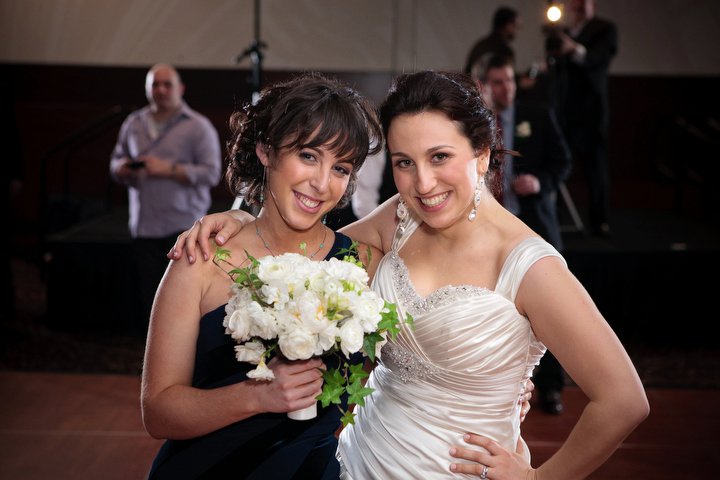
My sister-in-law and me, on the happiest day of my life. And maybe of hers, too.

[TMI Warning]

On April 3 of this past year, my older brother got married. I’d known his wife-to-be almost as long as he had–nearly two years–and she was basically part of our family by then. So to me, that day wasn’t just about the joy of one of my family members, but two. Though, actually, it was about the joy of all of us.

I woke up early on the day of my brother’s wedding after spending the night at the hotel with my whole family. My sister-in-law, her sister, their mother, and I all had our hair and makeup done professionally. The photographer posed us with our bouquets and snapped hundreds of shots.

The wedding itself was beautiful. It was an Orthodox Jewish wedding, and everyone received a little booklet explaining the traditions and why things were done the way they were. I found it all fascinating and unforgettable.

During the ceremony, I walked my little sister, the flower girl, down the aisle. I shed some stereotypical tears. I’m pretty sure my mom did too, and we probably weren’t the only ones. A Jewish wedding ceremony isn’t something I can easily describe or explain, so all I can say is that I hope you witness one someday.

The reception was fantastic. I got to see friends and family I hadn’t seen for years, and we danced for hours. I’d worn four-inch heels and my feet were killing me, but I didn’t care, for the most part.

And then it was over, I went home and went to bed, and woke up the next morning to the same life I’d lived before.

I’ve been thinking about that day a lot ever since. Not just because it was a major event in the story of my family, but because it holds a very special significance for me. It was, so far, the happiest day of my life.

On its own, that might not seem so strange. After all, since I’ve never gotten engaged or married myself, I don’t really have a choice but to live vicariously through those who have. Since I love and care about my brother and sister-in-law, it would make sense that their marriage would make me very happy.

But at the same time, it’s not the sort of thing you’d really expect as the happiest day of a young adult’s life. Most would probably say something like their high school graduation day, the day they were accepted to their dream college, the day they won a major competition or award, and so on. Self-directed things.

It was also kind of a weird time for the happiest day of my life to occur. Last winter and spring, I was going through a major depressive episode–I’ve lost count of the number by now, but it was probably my fourth or fifth one. In fact, I spent the night before the wedding and the night after it doing the exact same thing–sobbing on my bed for no immediately discernible reason. I remember it very clearly.

But in between those two nights, something was different. I wasn’t thinking about any of that. I wasn’t thinking about what a failure I am or how I have no friends or how I’m terrible at everything I ever try to do, or any of that other stuff that seemed so obvious to me.

And it wasn’t because I was “thinking happy thoughts” or “just ignoring it” or any of the other things depressives are constantly extolled to do.

It was because all of my attention was focused on someone else and on their happiness. Rather than trying to avoid my own thoughts, I actively directed them somewhere else.

In other words, the happiest day of my life was the day I almost didn’t think about myself at all.

I knew almost the instant the night was over that it had been a very special day for me. For months afterwards I kept replaying it in my mind, desperately trying to figure out how to get that feeling back. My parents told me later that their friends couldn’t stop telling them how amazing I looked–not just because I was dressed and coiffed and made up so well, but because I seemed to glow. I seemed alive, and it might’ve been the only time these people had ever seen me that way. It might’ve been the only time I ever have looked that way. I looked like a young person ought to look.

It was only tonight that I finally figured it out. And it made perfect sense. Because the truth is, I’m never going to love myself. I might not ever even like myself. I’ll probably always wish I were born another person. So for me, happiness will never come by focusing on myself and my own life. It will only ever come during those times when I can forget my own existence, my own self.

To be honest, I’m not sure that I’ll ever have a day as happy as that one again, except perhaps when my other siblings or close friends get married. I’m not sure that I’ll ever find someone who tolerates me enough to marry me, and even if I do, I doubt my own wedding day could make me as happy as someone else’s.

On a normal day, it’s just not possible to pretend that the world doesn’t exist. It exists, and it sucks a lot of the time. On normal days my family isn’t going through one of the happiest things that can happen to a person. On normal days, I don’t have anything this momentously joyous to think about.

But I think I can apply what I’ve learned to these normal days, too. That’s why the best advice I can offer to other people struggling with mood disorders is to “get out of your head.” The hard part is figuring out how to do that–it’s different for everyone–and summoning the strength to actually do it. For me, getting out of my head means getting into someone else’s and living through their eyes instead.

That day changed my life in many ways. It inspired me to learn more about the religious traditions I’ve thus far ignored, it obviously changed my family life pretty drastically, and, for about fourteen hours, it let me live without depression.

For those fourteen hours, I was alive. The black cloud over me was gone. The haze before  my eyes was gone.

I’ll never forget how that felt.

Storytelling

(Or: Massive Annual New Year’s Eve Note, Vol. 5)

[TMI Warning]

Many psychologists believe that it’s not what happens to us that matters, it’s the stories we tell ourselves about what happens.

Some people unfortunately interpret this to mean that we ought to “look on the bright side of life” and “find the silver lining” and all that crap.

I don’t really see things that way. Never have. Life sucks a lot of the time, and anyone who tells you otherwise is either stupid, in denial, or trying to sell you something.

But I have learned, over the past year, how powerful personal storytelling can be. This was the year I took a lot of pain and turned it into a force of energy.

~~~

A year ago, I thought I was done with this whole depression thing forever. That didn’t turn out to be the case. It came back almost as soon as the new year started, worse than ever before, seemingly undefeatable.

This has been a painful year. People hurt me this year. They lied, broke my heart, used me, and took my friendship for granted.

I was alone a lot, more alone than ever before. In fact, I spent most of the summer alone in New York. It was a fantastic experience, but a lonely one nonetheless.

It was hard, a lot of the time, not to think about all the ways depression limits me. If I didn’t have it, everything about my life would be different. I’d be outgoing, I’d go to parties, I could stay up late and take harder classes. I wouldn’t be so tired all the time, I wouldn’t have such a hard time talking to people, and, of course, I wouldn’t be so sad.

But sometime over the course of this year, I stopped thinking about all the things I couldn’t do because of depression, and started thinking instead about all the things I could.

For instance, I would never have started NU Listens, my peer-listening organization, if I hadn’t been depressed. I wouldn’t have the skills that allow me to help people. I wouldn’t write so much, or so well. I wouldn’t be able to fully appreciate my family and the other people I have in my life. I probably wouldn’t know what my calling is.

Some people, knowing that, would assume that I’m “thankful” for the experience of being depressed, or that I consider it “part of God’s plan” for me, or that it was “all for the best.”

Well, sorry to burst your bubble, but no. I don’t think any God would put a person through this, and that’s one of the reasons I don’t believe in God. I’m not thankful and I don’t think it was for the best. I want my adolescence back. I want the first two years of college back.

In our culture, preoccupied as it is with constantly finding the silver lining to everything from rejection to failure to broken hearts, I think it’s bold of me to say that I’m not thankful for what happened. I know I’m expected to offer up some grand lesson to be learned from all this, but I’m sorry to say that there just isn’t one. Sometimes shit happens. It definitely happened to me.

Knowing that, I’ve given up trying to find some sort of grand meaning in my experiences with depression. I sure as hell don’t accept the Judeo-Christian notion that I somehow deserved it, and although it has had some positive consequences, I’d say it did more harm than good. By far.

So how to go on? Well, that’s a complicated question for someone who prefers to see things in complicated ways. The story I’ve decided to tell about my own life isn’t necessarily happy, but it’s empowering for me. It’s about working within my limitations to achieve great things.

After all, the truth is that I’m probably not going to ever fully recover. I live at the mercy of something I can’t fully control, and my entire being–from feelings and moods to thoughts, beliefs, and actions–is tempered by it. Some days it leaves me alone, and some days it barely lets me get out of bed.

It means I have to be on my best behavior all the time. Nine hours of sleep, fruits and veggies, not too much carbs or meat, brisk walking every day, at least. Schoolwork has to be done before 9 PM or so, or else I can’t concentrate on it. I get overwhelmed by information easily, hence all the organization–categorized to-do lists and a calendar, a notebook that I carry everywhere, everything in filing folders in a box under my desk. In class I have to write by hand because it keeps me more alert. Otherwise, I start dozing off after sitting still for five minutes, no matter how much sleep I’ve been getting, because that’s how my body is.

I have to always stay busy, because as soon as I have a moment to myself, my mind starts conjuring up nasty thoughts. You’re such a bitch. Go kill yourself. The reason I take five/six classes, work two jobs, and run two student groups isn’t for my resume. It’s for my health.

~~~

So those are my limitations. Sometimes they seem pretty extreme. Sometimes they seem like a blessing compared to what some people are given.

Regardless, I’m not going to define myself through them anymore.

Instead, I’m going to define myself through the unique gifts that I have, and that I’ve become aware of because of my experience with depression.

When I’m helping someone, my self disappears–and with it, so do all of my fears, insecurities, and dysfunctions. I feel like I’m entering the other person’s being. It’s almost a spiritual experience.

Of course, my ideas about others aren’t always correct, but I start down a path of understanding. I start to see why the love the people they love, why the fear the things they fear, why they do things I would never do, why they believe things that I don’t believe.

I’m not looking for any accolades or sense of moral superiority when I say that my calling is to help people feel better. In a way, I’m just as selfish as anyone else. Some people are happy when they make money, or when they do experiments, or when they play sports; I’m happy when I make others happy.

It’s pretty much that simple.

~~~

It’s been a year since I “came out” as having a mental disorder. Since then, my relationships have only grown stronger and my sense of being valued and respected has only increased. Sometimes people do imply–usually via anonymous comments on my blog, as they know better than to say it to my face–that I’m making people “uncomfortable.” My response to this is always the same: they’ll get over their discomfort. I won’t get over my depression.

The truth is that–and I’m terribly sorry about this–I really don’t give a fuck about your comfort. I just don’t. It’s not my job to make anyone comfortable. I don’t really care about fitting in or being cool or normal. I must be missing that gene, or whatever.

If I sound completely different right now than I did just a few paragraphs before, I wouldn’t blame you for being confused. My life’s work will be to help people find happiness, but never at the expense of my own ability to live and express myself as I see fit. My understanding of psychology is that if you’re so concerned with how I live that you’re made “uncomfortable” by my depression, it’s you who needs to change, not me.

I don’t think most people realize the extent of my lack of fuck-giving because, unlike many other young malcontents, I don’t wear it on my body. My clothes are normal. I talk like a more-or-less average educated person. I don’t have any tattoos or extra piercings and don’t plan on getting any, and my hair is dyed, but only slightly. It’s styled in a mostly average way. I don’t choose to “rebel” by doing lots of drugs or people, and I don’t smoke, drink, or listen to unusual music.

But internally, I feel like an alien in this world. There’s a thick glass wall between me and everyone else. There’s a terrible creature that has its tentacles wrapped around my brain, and every time it squeezes, I want to rip my head off.

That’s what depression is.

~~~

That’s not to say this year has been all bad. It certainly hasn’t. I made many friends this year–not just any friends, but best friends. I started working on two different research projects at school. I found a way to connect with the Jewish community at Northwestern. I made Dean’s List this past quarter, started my own peer listening group, got accepted as a columnist for the Daily Northwestern next quarter, drastically increased my blog’s readership, tried therapy for the first time, successfully navigated my first quarter in my own apartment, went on quite a few dates, learned how to make my own jewelry, was accepted to a quarter-long Jewish education program, and befriended a few professors.

I went to New York three times, growing more and more certain with each time that this is where I want to live someday. I watched my older brother get married and found out that I’ll be an aunt in a couple of weeks. I met distant family members I hadn’t even known about before. I decided to wean myself off antidepressants when the new year starts.

Depression keeps me from being truly happy, but I refuse to let it rewrite the story of my life any longer. What I’ve been able to do despite of (and perhaps because of) my limitations makes me glad to be alive. I hope to recover someday, but even if I don’t, my life is going to be worthwhile.

~~~

A few days ago. I’m walking near Union Square in Manhattan. The sun has nearly set and the wind is chilling. I hear a man begging for money.

“Can you spare some change?” he’s saying, over and over. The passerby walk past him and he says, “That’s okay. Maybe next year.”

I put a dollar bill in his cup and he says, “God bless you, miss. I really mean that.”

He says happy New Year, and I say happy New Year too.

And then I continue on my way.

Maybe next year.
My Facial Expression is None of Your Business

[Snark Warning]

I am not a cheerful person. I don’t wear my happiness on my face, and I do not consider it my moral duty to brighten the day for perfect strangers.

I am an introvert despite the fact that I’m usually pretty friendly and sociable when spoken to. Most of the time, I inhabit a world that nobody really knows. When you see me sitting still with a facial expression that is technically neutral but that many would characterize as “glum”, I’m actually anything but. Usually I’m making up music, writing my next blog post, planning out my love life or my career, or analyzing people I know, all silently in my mind.

But most people don’t bother to ask what I’m doing that’s taking up so much of my attention that I haven’t bothered to plaster a smile onto my face for others’ benefit. Instead, they assume.

And so it begins. “What are you looking so miserable about?” “What’s wrong with you?” Or, simply, “Smile!”

Some of these responses are passive-aggressive attempts to chastise me for not doing my womanly duty to keep everyone around me happy at all times. Others are genuine attempts to understand me, or genuine concern that I might be in a bad mood.

What they all have in common, though, is the shared assumption that underlies them–that there is something “wrong” with my facial expression and that this fact is anybody’s business but mine.

It’s not only people that I choose to associate with who claim the right to dictate what should be on my face. What woman hasn’t walked down a city street, perhaps on the way to work or to run errands, and encountered a random man yelling at her to “Smile!” or “Put a smile on that beautiful face!”?

Such remarks, which feminists call “street harassment” and most non-feminists call “a compliment,” represent the most glaring and offensive of non-physical intrusions into a person’s private self. My facial expression is even less the business of a total stranger on the street than it is of a person who does know me.

(Speaking of feminism, my inner feminist compels me to ask: how often are men publicly berated for the arrangement of their facial features? Quite the contrary, moody, brooding men are often considered very sexually appealing in that mysterious way. A moody, brooding woman, on the other hand, is usually called “difficult” euphemistically, or just “a bitch” if we’re really being honest.)

This issue is intimately related to something I wrote about just recently, on the concept of Debbie Downers and how sad or negative people are constantly accused of “bringing people down.” In contrast, this situation is even more absurd because the facial expressions in question usually aren’t even negative; they’re just neutral. They’re just missing that socially mandated smile. But if you read my argument for why people shouldn’t allow themselves to be “brought down” by “Debbie Downers,” you’ll see that it applies just as well for those of us who, for whatever personal reason, choose not to go about grinning like maniacs.

Furthermore, lest anyone attempt to feed me platitudes about how people who concern themselves with my facial expression are just worried about my mental wellbeing, let me ask you this: when you’re concerned about someone, do you ask them privately if everything’s okay, or do you draw attention to them in a group setting and demand to know why their face looks the way it does?

(For the sake of your friends, I hope you choose the former.)

What strikes me as most ironic about all of this is that, for all the constant blather I hear about how the unappealing configuration of my face means I’m “selfish” and “don’t care” that I’m “upsetting” people and whatnot, I’ve chosen a life that’s infinitely more helpful to those around me than many other possibilities. I’m going to be a therapist, which means that, yes, it’ll be my actual job to help people feel happy. If that’s not more important than my transient facial expression, I honestly don’t know what is.

Moral of the story (or tl;dr, for my fellow internet nerds): If you don’t like what my face looks like, don’t fucking look at it.

An example of my neutral facial expression. No, it is not a personal insult to you.

I Love My Body

[TMI Warning]

I’m going to say something women aren’t supposed to say–I love my body.

My favorite part of my body are my shoulders. I’m not entirely sure why; it’s an irrational feeling. During the summer I like to show them off as much as possible with halter-top shirts and dresses.

I also love my curves, but I try to keep those more covered up. Those are for me, and for whoever else has earned the right, to enjoy.

I love my legs. I have really strong legs from years of dancing, walking, and riding my bike all the time. My legs can do just about anything I want them to.

I love my stomach, which makes rolls when I slouch like most healthy stomachs do. When I want to look thinner I can suck it in, but I think it looks fine even when I don’t.

I love my thighs. They store most of my body’s fat, so it’s often hard to find jeans that will fit them. They jiggle. When I’m naked and I draw my thighs up to my stomach, it feels warm and comforting.

I love my hands. I have long fingers that are perfect for playing piano. The nails on my fingers are strange–they’re all different shapes. Some are rectangular, some are ovular, and some are nearly square.

I love my face. My bottom lip is much bigger than my top lip, and one of my eyes opens much wider than the other. My parents asked me if I wanted to have surgery to get that corrected, and for a while I did, but honestly, I’m terrified of surgery and I don’t really care that much about how wide my eyes can open. My eyes are either brown, hazel, or green; it depends.

I love my feet, which are too wide for many types of shoes and rather ugly because of ballet. I’ve had so many blisters on so many parts of my feet over the years, both from ballet and from my habit of wearing insensible shoes, but my feet have taken it all in stride.

My body is conventionally attractive, but that’s not why I love it. I love it because it’s always been there for me, because of the good sensations it provides, because I’m so intimately familiar with it, and because it’s all mine.

It wasn’t always this way. Until very recently, I hated my body, or thought I did. It was the same story–too fat, too weird, too asymmetrical, too disproportional. I pinched my thighs and stomach all the time. Sometimes I’d stop reading or doing homework and realize that, unthinkingly, my hand had drifted to my stomach and was grabbing it and trying to hide the extra fat.

When I dieted or exercised, it felt like I was punishing my body. I took a sick pleasure in this. I liked to make myself hungry, sweaty, and exhausted. I counted calories, and some days I ate as little as 700 calories. That qualifies as a starvation diet. There, I said to my body. Take that.

Things are very different now. When I exercise, I like to think about my muscles working. Sometimes I even touch them while I’m working out so that I can feel them move. When my muscles are sore, I feel like they’re happy and exhausted. I stretch them and imagine them thanking me.

When I try to diet, I enjoy the feeling of eating well and of not having too much food in my body. I hate feeling stuffed; I prefer small portions. When I’m dieting, I’m more mindful of what I eat, and I feel my body appreciating each bite, and I like that feeling.

People think that loving your body means either thinking it’s flawless or completely abandoning the idea of health or beauty. The media perpetuates this myth–only “perfect” people (who don’t exist anyway) should love their bodies, and those who are “flawed” but love them anyway must simply be blinding themselves.

It’s not true. I don’t think my body’s perfect at all. It has plenty of flaws, some of which I mentioned above. Some of those flaws I counteract–I tweeze my eyebrows, wear makeup, diet (sometimes), wear flattering clothes, and use lotion. Other flaws I genuinely don’t care about.

But don’t we love people who aren’t perfect? Don’t we love our favorite writers, even though they might’ve written a couple books we could barely get through? Don’t we love our childhood homes despite the peeling paint and faded crayon marks on the walls?

You don’t have to be perfect to be loved, and neither does your body. I don’t think I’m the only woman who knows this. But I’m one of the few who’s willing to stick up for my body and declare that I love it despite a culture that says that women ought to be ashamed of what they were born with.

My body is there for me even when no one else is. I refuse to devalue it.