
Should the Personal be Political?

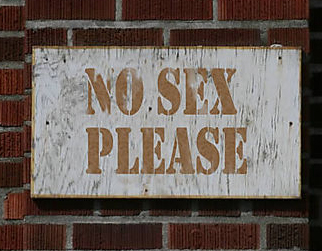
I recently came across the site Does This Make Sense? and I already love it. It’s got a lot of intelligent, thoughtful commentary. One piece that I particularly liked is called “Hell, No. I Won’t Say No.” It concerns the idea that women who want to change their society should withhold sex from men until their wishes are fulfilled. Lorraine Berry writes:

In principle, choosing not to have heterosexual sex as a protest against policies that restrict women’s abilities to have autonomy over their bodies seems the ultimate in women’s power. It did, to some extent, work in the case of Liberia, where the brave women there forced their men to continue negotiating for peace by sitting naked outside the building where the negotiations were taking place.

Ultimately, though, Berry argues that this form of protest is not only ineffective but counterproductive for women who happen to enjoy sex (which is, I might argue, almost all of them). There are many problems with a “sex boycott, such as what gays and lesbians would do, and the fact that it almost seems to confirm right-wingers’ anti-sex campaign (no abortion, no contraception, no pornography, no comprehensive sex ed, no premarital sex, no non-hetero sex, and so on).

However, I have another problem with it, and it involves the concept of “the personal is political.”

Here I’m going to just be a bad feminist and say that I disagree with this principle. Of course, I do believe that people should live according to their values (political ones included), but I cannot condone manipulating personal relationships for the sake of one’s politics. Unless your partner is personally overseeing the campaign to take control of women’s bodies, it’s completely unreasonable, not to mention unethical, to punish him for the actions of certain other members of his gender. (This is not even to mention that I cannot imagine a feminist woman dating an anti-feminist man to begin with.)

And, in general, I don’t think that politics should direct one’s personal life. If I choose to date a woman, it’ll be because I like her, not because I want to make a political statement about bisexuality. If I choose to date someone of a different race, it’ll be because I like him/her, not because I want to make a political statement about interracial dating. In contrast, the so-called “political lesbianism” movement advocated choosing to be a lesbian for political purposes. How is this an authentic way of living?

Of course, sometimes the personal becomes political, as when an anti-gay politician is revealed to be having same-sex relations, or when people speculate on whether or not Elena Kagan is a lesbian. In the first case, although people may bristle at the obvious hypocrisy, I think being anti-gay is bad enough regardless of what one does in his spare time (and sending inappropriate messages to teens is bad enough regardless of their gender). As for the second, most would agree that it shouldn’t matter. The fact that people make it matter is the crux of the problem.

So, is the personal political? Maybe, but it shouldn’t be. In my opinion, personal relationships are a sort of refuge from the outside world. I don’t bring politics into the bedroom, just like I wouldn’t bring my cell phone or my laptop or God into it.

Sex Positive Manifesto

[TMI Warning]

I am sex positive.

This means that I am open about sexuality (my own and in general) and believe that sex of any sort is healthy as long as it’s consensual. It means that I disagree with the idea that sexuality needs to be repressed and that there are right and wrong ways to be sexual. It means that I will enthusiastically answer questions about sexuality. It means that I fully support anyone who identifies as gay, lesbian, bisexual, queer, pansexual, polyamorous, kinky, transgender, transsexual, asexual, intersex, or any other identification. It means that I support full and open access to education, contraceptives, and abortion. It means that I believe that the reason people get raped is because somebody raped them, and not for any other reason.

What does it not mean?

It does not mean I’m willing to sleep with anyone who shows up at my door. Just because I’m willing to show you how a vibrator works or tell you what kind of porn I watch or explain the female orgasm, does not mean I’m willing to sleep with you. If you get turned on and don’t like that I’m not willing to do anything about that, sorry. That’s what you have hands for.

It also doesn’t mean you can or should make assumptions about my sex life. When I tell people that I’m a sexual health peer educator, you’d be amazed what sorts of conclusions they immediately jump to. Usually it’s something along the lines of, “You must have wild crazy sex with random people of either gender all the time!” Actually, no. I like serious relationships. Got a problem with that? Too bad. So I don’t fit your typical college student mold.

It doesn’t mean that no means yes. Ever.

Sex, Morals, and Academic Freedom

A fucksaw.[First, some backstory–this post concerns a controversial event at Northwestern in which the professor for a class called Human Sexuality held an optional live demonstration that showed a man penetrating a woman with a sex toy. The story, which was first reported by our campus newspaper (the Daily Northwestern), quickly blew up and was featured in media outlets all over the world, including the front page of the Chicago Tribune. Here are the NYT and CNN articles on it.

Second, I wrote this piece for the blog of Northwestern Sex Week, an annual event that I’m on the planning committee of. Here’s the original post.]

Much has already been written about the infamous Professor Bailey and the optional sex-toy demonstration he held for his Human Sexuality class. I’m going to throw my hat in the ring.

First of all, I’m not in the class and did not witness the demonstration. From what I’ve heard, I’m not sure that it would’ve had educational value for me, personally. That said, I am a member of SHAPE (Sexual Health and Assault Peer Educators) and the Sex Week committee, and therefore, I already know quite a bit about sex. And yes, I know that women have g-spots and can potentially ejaculate. I also know that the range of human sexualities and sexual proclivities is virtually limitless, and that each individual views and experiences sex differently.

However, not everybody realizes this. For much of my adolescence, I didn’t either. Like some of the people I’ve met here at Northwestern, I freely labeled others’ sexual behaviors as disgusting, weird, abnormal, pathological. I didn’t realize how wrong this perspective was. The impression I get of Professor Bailey’s class and this demonstration is that they aim to eradicate this perspective. To that end, I can only endorse them both with complete confidence.

Second, even supposing that this demonstration had no educational value for anyone–which I highly doubt–we enter dangerous territory when we advocate banning something simply because we, as individuals, do not see its value. This is especially true in the academic realm. The concept of intellectual freedom does not exist to protect someone’s right to claim that the sky is blue; it exists to protect someone’s right to challenge existing norms and assumptions. It does not exist just to protect my English professor’s right to interpret a Dickens novel in a particular way; it exists to protect a human sexuality professor’s right to teach controversial material to his students. Even if Professor Bailey’s demonstration ultimately taught nothing, he should have the right to try unorthodox teaching styles, just like he has the right to conduct unorthodox research. Even if he failed, he has learned. That’s what academic life is all about.

I am also disappointed to read the numerous online comments from Northwestern alumni claiming that, because they disagree with this demonstration, they will no longer be donating money to Northwestern. This is, to put it bluntly, incredibly selfish and narrow-minded. In my opinion, one donates to an institution to support its overall mission, not because one agrees with every policy, every professor, every class, and every lecture. I, for instance, do not agree with some of the things that Northwestern faculty and administrators do–quite a lot of things, actually. Yet you can be sure that after I graduate, I will be donating money to this amazing school, probably for the rest of my life.

Third, this entire controversy, in my opinion, was started by a campus media given to sensationalism. With the media firestorm that has ensued, you would think that there had been some high-profile complaint from a student or parent, some allegation that the demonstration deeply disturbed a student–something. To my knowledge, there was not. In the article that broke the story, the Daily Northwestern failed to quote even a single person, student or otherwise, who had been offended or displeased by the presentation. Yet the article’s headline referred to this event as a “controversy.”

Finally, I would like to challenge all those who oppose this demonstration on moral grounds. Professor Bailey himself said it perfectly in his statement of apology:

Those who believe that there was, in fact, a serious problem have had considerable opportunity to explain why: in the numerous media stories on the controversy, or in their various correspondences with me. But they have failed to do so. Saying that the demonstration “crossed the line,” “went too far,” “was inappropriate,” or “was troubling” convey disapproval but do not illuminate reasoning. If I were grading the arguments I have seen against what occurred, most would earn an “F.” Offense and anger are not arguments.

Students were warned multiple times of the graphic nature of the presentation, and told that they were free to leave at any time. The individuals who staged and participated in the demonstration were all consenting adults. The course itself involves watching videos of people having sex, and no controversy has arisen because of that. The course, and this demonstration, involves an act that is as normal and natural as breathing, eating, and sleeping. Like Professor Bailey, I have yet to find a convincing argument for why this should not have happened that does not hinge on personal values, and that does not seek to impose one’s personal values on others.

In short, the fact that Professor Bailey was forced to apologize for the world’s closed-mindedness is tragic. And it means that we, the Sex Week committee, have our work cut out for us this year.

Let’s not forget that there was a time when you couldn’t say the word “pregnant” on television. There was a time when discussing sexuality in a classroom setting would’ve been impermissible. There was a time when a play like the Vagina Monologues could never have been staged in public, and there was a time when Sex Week could never have happened on a university campus.

Apparently, there is also a time when demonstrating the use of a sex toy on a consenting woman in front of a hundred consenting adults is unacceptable, too. That time is now. But we should remember how strange–how silly–yesterday’s taboos seem to us today.

Kids These Days

I am going to do something I rarely do–label something with an “ism.”

A post on CNN’s health blog, The Chart, points out that oral sex can increase cancer risk–valuable information, to be sure. But for some unknown reason, the blog frames the information like this:

Here’s a crucial message for teens: Oral sex carries many of the same risks as vaginal sex, including human papilloma virus, or HPV. And HPV may now be overtaking tobacco as the leading cause of oral cancers in America in people under age 50.

“Adolescents don’t think oral sex is something to worry about,” said Bonnie Halpern-Felsher professor of pediatrics at the University of California, San Francisco. “They view it as a way to have intimacy without having ‘sex.'”

Actually, the author of this blog and the professor quoted in it might be surprised to know that adults also occasionally engage in oral sex, so this might be a “crucial message” for them as well as for teens. In fact, sometimes these adults even view it as a way to have intimacy without having ‘sex’!

But of course, there’s no need to miss another valuable opportunity to insert a “kids these days” reference into a completely unrelated topic. Which is, yes, ageism.

On another note, since when does a random doctor or professor get to unilaterally define “sex”? Just because oral sex undoubtedly carries risks doesn’t make it equivalent to, say, vaginal or anal sex. Different people ascribe different significance (or lack thereof) to different sexual behaviors. To many people, oral sex is not as “serious” or meaningful as penetrative sex. This doesn’t mean they shouldn’t be aware of its risks, but it does mean that no higher authority can or should try to define “sex” for everybody.

Middle Class Sexuality

I saw this interesting op-ed at the New York Times’ website today. It talks about the “Viagra for women” (flibanserin) that was recently rejected by the FDA and how the sexual problem for American women isn’t medical but societal, because the “white upper middle class” has essentially become uptight and frigid.

I agree with the op-ed in some ways, because it’s true that American culture is actually extremely Puritan despite the gratuitous amount of sex present in its media (including advertising and entertainment, of course). Once when my grandma came from Israel for a visit, she was shocked that at the swimming pool, men wear huge, baggy trunks rather than the tight little briefs they wear in Israel. That’s a rather trivial example, but it showcases one of the many strange contradictions in American culture. Nearly-naked men abound in the movies and in advertising, but they’re unacceptable at the pool (which, one would think, is a place where people go to be nearly naked).

In any case, there are probably better examples of this, like the fact that the government spends millions of dollars on teaching junior high students that one should never have sex before marriage, and high schools will make students call their parents and ask them to bring a different shirt if they wear one that bares–gasp–their shoulders. (The fact that schools try to send such a strict message when kids are bombarded with highly sexualized media every day is nothing short of ludicrous. It’s media literacy they should be teaching, not abstinence till marriage.)

The fact that all of this eventually leads to a complete lack of sexuality is unsurprising. When you spend your entire life being told that sex is sinful and shameful, I can see how you’re not going to get terribly enthusiastic in the bedroom. However, where I take issue with Paglia (the writer of the op-ed) is her suggestion that this is all attributable to “white” culture. Christian culture, maybe. But white culture? The op-ed uses the example of female celebrities to argue that since Latinos and African Americans seem to be more sexualized, the overall sexual deficiencies of American women can be attributed to white women:

Furthermore, thanks to a bourgeois white culture that values efficient bodies over voluptuous ones, American actresses have desexualized themselves, confusing sterile athleticism with female power. Their current Pilates-honed look is taut and tense — a boy’s thin limbs and narrow hips combined with amplified breasts. Contrast that with Latino and African-American taste, which runs toward the healthy silhouette of the bootylicious Beyoncé.

I’m just not sure about this generalization. After all, Beyoncé may be African American, but plenty of white people love her, too, and it’s pretty much universally agreed that she’s gorgeous. Does the fact that black women tend to be curvier than white women make black women more sexual? And aren’t there plenty of thin black women and curvy white women?

I suppose I’m just uncomfortable with the idea that women of color are somehow more sexual than white women. I think Paglia takes it too far there. However, white culture has been the dominant culture in America since its inception (due to demographics and discrimination), so I guess you can blame most of our societal quirks on it.

Aside from that, though, the op-ed made many great points. This paragraph struck me as very insightful:

In the discreet white-collar realm, men and women are interchangeable, doing the same, mind-based work. Physicality is suppressed; voices are lowered and gestures curtailed in sanitized office space. Men must neuter themselves, while ambitious women postpone procreation. Androgyny is bewitching in art, but in real life it can lead to stagnation and boredom, which no pill can cure.

I can’t say I could offer up a solution to that, but it’s a keen observation all the same. Yes, in terms of sexuality, American culture is downright boring, and no pill can fix that. Or rather, I’m sure they’ll find a pill to fix that eventually, just like they find pills to fix everything else, but it’d be nice if we didn’t need pills.

Paglia ends the op-ed by writing, “Pharmaceutical companies will never find the holy grail of a female Viagra — not in this culture driven and drained by middle-class values. Inhibitions are stubbornly internal. And lust is too fiery to be left to the pharmacist.” No one would suggest that we return to all being poor and leaving 99% of the nation’s wealth to a few elites, but clearly, a culture mostly controlled by the middle class has some unfortunate drawbacks.