Inside the Mind of a Serial Rapist

In case it’s not obvious, MASSIVE TRIGGER WARNING for this entire post and all outgoing links. Even if you’re not a survivor, you’re going to find a lot of this extremely uncomfortable and upsetting so please take care of yourself.

r/AskReddit, a section of Reddit in which people can ask each other questions, recently had a post with this title: “Reddit’s had a few threads about sexual assault victims, but are there any redditors from the other side of the story? What were your motivations? Do you regret it?

Reddit has what I would call, bluntly, a woman problem. Reddit’s users are 74% male, first of all–the highest percentage of all the well-known social networks. Many of its subreddits, such as r/MensRights, r/Atheism, and, of course, r/AskReddit, are notorious for general misogyny, rape apologism, and, at times, even tacit (or not-so-tacit) approval of violence against women, pedophilia, child pornography.

So, nobody familiar with Reddit will be surprised at the kinds of stories and comments that this AskReddit thread has attracted. However, it’s worth talking about for several reasons, which I’ll explain later.

The thread has nearly 13,000 comments as of this writing, so I couldn’t possibly read them all. (I’m pretty sure I’d lose my mind long before I finished, anyway.) However, there’s one particular comment that I want to examine:

First off, I must say, I was at a dark and horrible place in my life, that I’ve since grown from. I’m ashamed of the person I was, if the people who I’m close to now knew who I was, I would be ruined. I’m known for being a great guy, friendly and easy to get along with, a community/political activist, a fervent volunteer in the community, and a person who rises through the ranks quickly due to successes at work. That was my mask, and I was good at it, so good that maybe I convinced myself along the line that was who I could really be, and that may of helped me change, and stop doing what I did.

I’m somewhat remorseful for what I did to those girls, but I don’t think I could ever face them to apologize. I knew what I was doing was wrong, but I had this certain insatiable thirst that brought me to do what I did. I didn’t know how to stop, and just when I thought maybe I could, I’d find myself back in my pattern, back on the hunt.

Several things immediately jump out at me. First of all–and this will be a common theme throughout the post–this person seems very invested in his positive self-image, despite his supposed remorse. He makes sure that we know that he’s known as a “great guy,” that he’s friendly and easy to get along with, etc. Second, although he says he’s ashamed of who he was back then, the rest of this suggests that that’s mostly because he wouldn’t want to be found out. The creepiest part is definitely this: “I knew what I was doing was wrong, but I had this certain insatiable thirst that bought me to do what I did.”

The post continues:

I’m a good looking guy, and I can get girls pretty easily. I’m currently married to a beautiful woman that I met during this time of my life (not someone I raped, but someone who knew my mask during this time). So, anyways, after a while it became boring to go after the sluts and sorority girls that would easily throw their cunt after you. I wanted the thrill of the chase, and that’s what led me to forcing myself on girls. I would find attractive girls that were self-conscious about their looks….Hopefully a girl who was a bit damaged, had a shitty ex-boyfriend, or family issues, came from a small shut in town, that sort of thing. So, when I showed interest in them they’d be completely enamored, they’d almost be shocked that a popular, good-looking, and well liked guy would be talking to them.

Note that, once again, he mentions his good looks and that it’s easy for him to “get girls” (present tense). His misogyny becomes apparent in his language here (“sluts and sorority girls that would easily throw their cunt after you”).

The man then describes how he would meet these girls and invite them over to watch a movie. His need to have total control over the situation is very apparent: “They would come over, and I’d always make sure it was real cold in the room, cold enough so that when we started watching the movie I’d say something about being chilly, and grab a big fleece blanket for the both of us.”

After kissing and putting his hands under their clothes (without consent, obviously):

It was then that I could turn around and get on top of her. The girls usually didn’t know how to respond. Some of them were into it, and those nights were usually consensual and boring sex, sometimes followed up by a few more nightly visits before getting the boot. However, the great nights were the ones who squirmed, ones who didn’t want to give in. I’d have to shush them down, and try to work on them slowly enough so they didn’t know what was going on until it was pretty much already happening. I’m a muscular guy, over 6′ around 200 lbs. and most of these girls may have been 125-130, really tiny and easy to pin down. To be honest, even remembering it now, the squirming always made it better, they didn’t want it to happen, but they couldn’t do anything about it. Most girls don’t say no either. They think you’re a good guy, and should pick up on the hints, they don’t want to have to say “no” and admit to themselves what’s happening.

[…]Some girls left after about 15 minutes after. Some girls would stay until the morning and then leave. A few tried to call back, maybe blaming themselves for what happened or something. I never worried too much about being caught. Everyone knew me, and I worked with the police a lot, with administrators, and campus officials. I was on first name basis with the Chancellor and the President of Student Affairs, so if anything came down to a he/she-said I figured I’d be in the clear.

Ladies and gentlemen, this is rape culture: the fact that this man knew he was unlikely to be brought to justice because he was so respected and popular at school, the fact that he admits that some of the women probably blamed themselves, the fact that he knows that they don’t say no out of fear and not because they consent.

The man later edited the post to explain that he had answered questions posed by commenters and that he was deleting this account (it had been made only for this purpose, though, anyway). He also added this:

Let me leave you with this message, you never know who someone truly is, so be careful. I’m going back to my main account to do normal reddit looking at cats and posting pictures of bacon, and I think it’s kind of funny that no one will ever know if the person they’re talking to on reddit, or someone who moderates their subreddit, is me on my main account… just food for thought.

Most of the comments to his post were very angry, and many were basically homicidal. One person said, “You are why my daughter will be armed, to deal with filth like you.” The man responded, “Teach your daughter to be a strong willed, independent woman, and hopefully she’ll never attract the type of filth I was at that point in my life.” In other words, even though he claimed to be “remorseful,” he admits that he sought out “weak” women and seems to believe that it’s women’s responsibility to be “strong willed” enough for men like him to leave them alone.

In the midst of the angry comments, though, there were many that seemed steeped in admiration–or, at least, respect. References to the OP’s “bravery” were common. Here’s one: “Thank you for sharing. This is what I came to this thread for. You are brave to talk about it. Here is an actual look into how the predator feels.” Here’s another: “I just wanna say, thank you for posting this. It seems that every other guy in this thread is trying to guilt shame you but I’m pretty sure a total of none of them could possibly empathize with you.” And another: “I admit you are a really smart guy. I bet you know it yourself and probably are ashamed of it since you used it to do this. You are also really brave for sharing this story and being here to take the generic ‘fuck you’ from the mass.”

There seems to be some confusion on the part of these commenters about what “brave” means. What’s brave is getting up the next morning after you’ve been raped, and getting up every day after that. What’s brave is telling people about your sexual assault, knowing full well that they might ask you what you were wearing and if you’d been drinking. What’s brave is trusting another person sexually after an experience like that. Using a temporary, anonymous account to tell some people on the internet about what a Big Manly Man you are is not “brave.”

As a survivor of something much less horrific than what these young women went through, but scarring all the same, I can’t see the telling of this story as “brave.” Perhaps that’s just my bias talking.

Also disturbing is the fact that many of the commenters refuse to believe the story. One even asked the OP if he’s “a female IRL trying to make a point with this.” Others laugh it off. Their disbelief reveals their privilege. Most women will tell you that there is nothing unrealistic about this story, because they have either been victimized by men like this, escaped them narrowly (as I did), or have friends who did.

Finally, and unsurprisingly, several commenters jumped to the man’s defense, explaining how “difficult” it is to be a man and to interpret women’s signals and to get women to sleep with you, period. One comment:

This isn’t rape. This is the story of a guy who studied and played the game well. He went after certain girls and worked those angles to get laid. Some people will feel this is underhanded, sleezy, wrong. Others will praise him.

[…]These girls aren’t victims. OP’s behavior may be considered unethical, immoral, and wrong but that’s only moral constructs perceived by others looking at OP. I’m not a player these days but those of you blasting him for rape need to read some player’s books and websites. He did exactly why most players do.

[…]Overall OP isn’t a rapist, he’s a player who feels bad about how good he was at the game.

Another: “What the hell. You’re NOT A RAPIST! The didn’t say no. They wanted it. You’re a player. Actually, they should thank you because that’s probably the only sex those girls will get. You gave them a life experience and you should be proud about it.” And this: “I’ve been told this by female friends – girls purposely put up a bit of a fight before sex to not seem easy, even if they want sex, and they enjoy the back and forth and having the guy ‘try’.”

And one more:

Not defending his actions, but nearly every 19 year old college kid with a dick and a heartbeat is trying to get laid, and EVERY SINGLE ONE OF THEM has some sort of game plan they employ to coerce women into advantageous situations that their female counterpart might not want to be in, or otherwise find themselves in. Whether its through physical force or mental manipulation, some game plans fail miserably and some work every time. Some guys are obviously better than others at getting what they want, and some of course cross the line.

There’s many, many more where all of these came from. There was also the comments from rape survivors, to one of which the OP responded with some explanation followed by, “Anyways, fuck off you twit.” (How about that remorse?)

I should point out that this particular man’s post, and the responses to it, are unusual for several reasons. Most of the other people who disclosed having committed sexual assault (including some women) were more remorseful and generally did it only once. Some told stories of having nearly done it but stopped themselves. And the comments on those posts are much less condemnatory, and more full of apologism and praises of the rapists’ “bravery.”

Jezebel has a post about the thread and why we should listen to the rapists’ explanations. The article makes a good point in that the thread shows many of the reasons why rape happens and goes unpunished, and the cognitive fallacies that rapists subscribe to.

However, the article fails to note the negative consequences of sharing these stories on a site like Reddit. As I mentioned, Reddit users have a tendency for rape apologism. Many of the people who confessed having committed or attempted sexual assault said that they felt terrible for what they did, but commenters told them not to feel bad. The stories of backing off rather than raping elicited lots of “Congrats, you didn’t rape her!” comments–as if that’s something worthy of a gold star. One comment to such a story reads, “Shitty situation, man. Good on you for realizing what was up and pulling yourself out of that.” Another: “You aren’t a rapist, or close really, don’t beat yourself up about it.”

In other words, men (they were almost all men) who come to this thread with genuine remorse receive dozens of comments patting them on the back for not going ahead and sticking their penis into an unwilling woman–all the other nonconsensual stuff they did leading up to that, apparently, doesn’t really matter. (Although some of these commenters insist that the women couldn’t possibly have been hurt that much by it because they weren’t “actually” raped, I can speak from experience and say that attempted rape (or rape threats, or sexual harassment) can be traumatizing too.)

Furthermore, some of the apologism is directed at men who did actually commit sexual assault, and it really scares me that these men are getting the message that what they did was “not rape.”

It’s taken me a while to write about this because it’s been difficult to come up with any takeaway other than aisfa;ifja;sdfjas;df. However, now that I’ve had a chance to think about it, I think there are a few things to glean from this.

  1. Rapists usually know what they’re doing. Although there’s a pervasive myth that rape is caused by “miscommunication” (generally, women not being “clear” enough about not giving consent), this thread and this fascinating study show that this is completely false. They know what they’re doing, most of the time. But they don’t really care. They think they “can’t stop” because having a penis just “makes” you do these things. They convince themselves that the woman would say no (or say it louder) if she really didn’t want to do it. And so on.
  2. Rapists aren’t necessarily identifiable. None of the men in this thread seem like your stereotypical stranger in a dark alley type. Many of them have the ability to be very personable and likable, and they use this ability to their advantage. (This is, by the way, a symptom of psychopathy.) So, not only is the standard victim-blamey advice for women to avoid revealing clothing, bars, parties, etc. wrong, but it’s also ludicrous to suggest that women can avoid sexual assault by avoiding “certain types” of guys. Some victimizers (of any gender) certainly do give off a creepy vibe, but not all do.
  3. Sexual assault prevention is a very, very complicated thing, and I don’t think it’s as simple as “telling rapists not to rape.” As boys and young men grow up, they learn a series of messages about gender and sexuality, just like women do. If you’re interested in this, I’d recommend reading Brad Perry’s piece in the fantastic book Yes Means Yes: Visions of Female Sexual Power and A World Without Rape. The piece is called “Hooking Up with Healthy Sexuality: The Lessons Boys Learn (and Don’t Learn ) About Sexuality, and Why a Sex-Positive Rape Prevention Paradigm Can Benefit Everyone Involved.” (Holy shit that’s a long title.) You can read it here. The piece focuses on teaching sexuality to boys in a way that prevents rape and promotes a healthy approach to women, dating, and sex. Unfortunately, right now our country is still besieged by abstinence-only sex education, which promotes rape culture in a million ways that I don’t have room to discuss here.
  4. Despite all the comments that “well everyone knows rape is bad” and therefore we should stop shaming rapists, it’s clear that there’s a sort of doublethink going on here. Yes, almost all people, except the most psychopathic perhaps, know that rape is “bad.” But many convince themselves that things that are definitely rape are not. Cognitive dissonance does scary things to people sometimes–they want what they want at all costs, but they don’t want to believe that they’re Bad People (i.e. rapists). Nope, they’re just “playing the game,” or the victim “should’ve said no (louder),” or “she wanted it anyway.”

So no. Even decades after the start of the modern women’s movement, not everyone knows what rape is. And that’s how we know that our work is not yet done.

All I know is that we need real sex education, and we need it now. We need to start it early. We need to stop believing that teaching kids about safe and healthy sex will “make” them do it. We need to stop teaching them gender roles that put women into the role of sexual gatekeepers, always needing to push their male partners off rather than being asked for consent first, and men into the role of aggressors, always needing to coerce their female partners or face losing their masculinity.

Mostly, though, we need to teach empathy in general. Because that’s lacking in our society in every possible way.

And this needs to happen now.

Note: This has been really difficult to write for many reasons, but I felt that I needed to do it. There will be extra comment moderation. Anyone who comes on here to explain to me how I “don’t understand” these men and their actions will be sent on their merry way. Thank you.

In Case You Haven’t Heard, Rape Isn’t Funny

“Rape is funny and so am I! Right? …Right?”

Some comedian I’ve never even heard of before–but now have–is under fire right now for a “joke” he made in one of his shows. I use the word “joke” (just as I will use the word “humor”) broadly here.

In the words of a woman who attended a show by comedian Daniel Tosh, this is what happened:

So Tosh then starts making some very generalizing, declarative statements about rape jokes always being funny, how can a rape joke not be funny, rape is hilarious, etc. I don’t know why he was so repetitive about it but I felt provoked because I, for one, DON’T find them funny and never have. So I didnt appreciate Daniel Tosh (or anyone!) telling me I should find them funny. So I yelled out, “Actually, rape jokes are never funny!”

[…]After I called out to him, Tosh paused for a moment. Then, he says, “Wouldn’t it be funny if that girl got raped by like, 5 guys right now? Like right now? What if a bunch of guys just raped her…” and I, completely stunned and finding it hard to process what was happening but knowing i needed to get out of there, immediately nudged my friend, who was also completely stunned, and we high-tailed it out of there. It was humiliating, of course, especially as the audience guffawed in response to Tosh, their eyes following us as we made our way out of there. I didn’t hear the rest of what he said about me.

So, what we have here is a (male) comedian insisting that rape jokes are funny (in itself a barely defensible position), getting called out for it by a female audience member, and insisting that it would be “funny” if she got gang-raped.

Naturally, Tosh made a typical non-apology:

Credit: Feministing

I just love how he claims, as usual, that his comments were taken “out of context.” Is there any context in which, “Wouldn’t it be funny if that girl got raped by like, 5 guys right now?” is an acceptable thing to say?

While I’m pretty sure that most decent people would see this “humor” for the crap that it is, a number of online conversations I’ve had the misfortune of having today suggest otherwise. For the record, every single person who has defended Tosh in this situation is 1) a man, and 2) someone who admitted to having previously watched and enjoyed Tosh’s show. So something tells me that there’s a little bit of “But I like this guy and I need to convince everyone that I’m still a good person!” psychological trickery going on here. In technical parlance, we call that “cognitive dissonance,” and it helps explain why some people defend assholes like Tosh so rabidly.

Here are some Actual Arguments that I’ve seen.

But humor relies on offensive jokes!

Now, that’s just false. My favorite comedians, such as Jon Stewart and Tina Fey, may make fun of people, but they don’t need to try to crack jokes about rape to be “funny.” And, as I’ll discuss later, there are different ways to be offensive.

But that’s just his Thing!

Um, so…get a new Thing, then? If you need to remind people of some of the most terrible things they’ve ever experienced in order to earn a living, you might want to consider getting a different career. Just sayin’.

But joking about terrible things makes it easier to get past them!

Why don’t you ask the survivors of said terrible things? Most rape survivors would disagree with you. Also, while there are definitely ways to incorporate sexual assault into a comedy routine that are sensitive and useful (Donald Glover has one that I can’t find the link to right now), joking about the gang-rape of an audience member is emphatically not one of those ways.

But FREE SPEECH!

Words cannot describe how tired I am of this argument. Anyone who makes it lacks even the most basic understanding of our Constitution. All the First Amendment means in this context is that the government can’t restrict Tosh’s right to include offensive material in his routines. It can’t censor videos of his routines, it can’t impose any fines or penalties on him for doing his routines, it can’t make it illegal to joke about rape, and so on.

But that’s it. The rest of us can still speak out when someone says something terrible. A company that employs that person or syndicates that person’s material can still fire the person or stop syndicating the material.

Yes, you have a God-given, constitutional right to be an asshole. But why, why must you exercise it?

But people should know what they’re getting into if they’re going to his show!

Well, that sounds awfully victim-blamey, doesn’t it? Should women also “know what they’re getting into” if they go to a bar alone? Should people going to prison “know what they’re getting into” if they get sexually assaulted there?

First of all, this isn’t always practical. The woman in question here was going to see a show that included several comedians, some of whom she knew of and others that she did not. It’s unreasonable to ask everyone going to a comedy show to research the comedian’s entire oeuvre to make sure that it’s free of rape jokes.

Second, Tosh has a show on Comedy Central. One of my friends pointed out that it’s often playing at the gym when she goes. Should she just avoid the gym, then? Should she call every gym she’s considering going to ahead of time to make sure that none of their TVs are currently playing Tosh’s show?

Third, jokes about rape have an effect that goes far beyond their potential to trigger and terrify an individual audience member. I’ll quote Melissa McEwan from Shakesville, complete with links to relevant pieces on her blog: “Rape jokes are not funny. They potentially trigger survivors, and they uphold the rape culture. They tacitly convey approval of rape to rapists, who do not appreciate “rape irony.” There is no neutral in rape culture, and jokes that diminish or normalize rape empower rapists. Rape jokes are pro-rape.

But other Comedy Central shows are offensive too! Why focus on this one?

This argument generally refers to South Park, which is well-known for being offensive. But there are different kinds of offensive. South Park, for the most part, is “offensive” because it covers taboo subjects and uses strong language. Such things can be shocking and unpleasant if you’re not expecting them, but they’re not outright prejudiced and harmful. And in fact, this type of “offensive” material can actually break down stigmas and encourage more openness around these subjects, which is great.

Joking about rape, as I mentioned above, is different from joking about religion or bodily functions or sex. It’s not merely “offensive,” it’s actually harmful to individuals and to society as a whole.

But other comedians are offensive too! Why focus on this one?

This is a stupid argument. I can’t speak for every single person offended by this incident, but I speak out every time I encounter something like this. Nobody is singling out poor Tosh, so calm down.

But she “heckled” him!

Am I to assume that interrupting a comedian’s show makes one deserving of rape?

First of all, as this woman makes clear in her blog post, we have a responsibility to speak out when something isn’t right. Could she have waited till afterwards? Sure. Could she have written Tosh a nice, polite, friendly letter that never made it past his secretary? Sure. But she wanted to be heard, and she had the right to be.

Second, even assuming that she was acting improperly (not something you’d ever accuse a man of, is it?), that still doesn’t make it okay to announce in front of an audience how “funny” it would be if she were gang-raped. I honestly have trouble believing that there are really people who would justify Tosh’s behavior this way, but I saw them with my own eyes on Facebook earlier this afternoon.

But you’re just taking it too personally!

Congratulations, you’ve now completely failed at being a decent person. Yes, there is such a thing as taking an insult too personally. If a comedian made a joke about brunettes or writers or psychology majors or other such mundane groups that I belong to, and I exploded at him, then yes, I would probably be “taking it too personally.”

But sexual assault is not something that can be “taken too personally.” It is personal. It’s personal even if you haven’t personally experienced it, because I guarantee you that someone you care about has.

It’s personal because a woman who accuses a man of sexual assault is still questioned about what she was wearing at the time. It’s personal because a man who accuses a woman of sexual assault is still laughed at and considered less of a man. It’s personal because a man who accuses a man of sexual assault is still called a f*****. It’s personal, people.

Perhaps there will come a day when sexual assault is treated exactly the same as other crimes. When it does not disproportionally affect women, people of color, young people, poor people, and others who are already marginalized. When we can all agree that there’s nothing anyone can do to “ask” for rape.

Perhaps when that day comes, it’ll be possible to joke about sexual assault and wonder how it could ever have been that people didn’t treat it seriously.

But I doubt it.

*Edit* Sign the petition!

*Second Edit* New arguments!

But Nobody Cares™! That’s Just How Things Are™! Nothing Will Ever Change™!

You’re creating a self-fulfilling prophecy. The more people care, the faster things will change. Because they’re already changing. If you’re not interested in helping, bugger off while the rest of us change things.

But he said he’s sorry!

First of all, no, he really didn’t. He said, “All of the out of context misquotes aside, I’d like to sincerely apologize.” Out of context? Misquotes? Honey, stop. Here’s what should be a primer on how to actually apologize for something you’ve publicly said.

Second, even if he had made a genuine-sounding apology, I don’t understand this requirement that we have in our culture to accept any and all apologies and then never speak of the Matter again. What if I don’t accept your apology? What if the words “I’m sorry” are simply not sufficient to make up for what you did?

Nobody owes forgiveness to anyone, and even if Tosh had actually apologized, that doesn’t mean we should stop analyzing his words and making sure that others understand why he was wrong. You don’t get to be like “Yeah well I said I was sorry so why can’t you just get over it already!” Sorry, nope.

“Vagina” is Not a Four-letter Word

You would be forgiven for assuming that our elected politicians are mature adults who can handle using words that designate genitalia. You would especially be forgiven for assuming that given that many of these politicians are very eager to legislate what can and cannot be done with genitalia.

However, you’d be wrong.

This is old news now for anyone who follows these things, but in case you don’t, here’s a recap. On June 14, the Michigan House of Representatives was debating a new bill that would severely limit a woman’s ability to get an abortion by placing new restrictions on abortion providers. The bill passed the House and will go to the Senate most likely in September. (They were also debating a separate bill, which did not pass, that would’ve restricted all abortions after 20 weeks, with no exception for rape or incest).

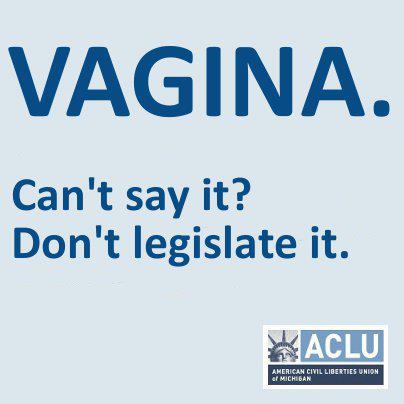
In response to this, Representative Lisa Brown (three guesses which party) gave a speech in opposition and said, “I’m flattered that you’re all so interested in my vagina, but ‘no’ means ‘no.'” You can see her speech in its entirety here.

The shock! The horror! Brown was quickly forbidden from speaking on the House floor by Republican leadership of the House. A spokesman for Republican Speaker of the House Jase Bolger said, “House Republicans often go beyond simply allowing debate by welcoming open and passionate discussion of the issues before this chamber…The only way we can continue doing so, however, is to ensure that the proper level of maturity and civility are maintained on the House floor.”

To that end, Republican Representative Mike Callton said that Brown’s remark “was so offensive, I don’t even want to say it in front of women. I would not say that in mixed company.”

What Bolger, Callton, and the rest of these concern trolls apparently do not realize is that language is malleable and entirely based on context. In general, words might be inappropriate to say for three different reasons:

  1. They are derogatory and hurtful slurs (i.e. the n-word, fag, retard)
  2. They have been designated as “profane” by our society (i.e. fuck, piss, shit, cunt)
  3. They refer to things or functions that are generally considered inappropriate for polite conversation (i.e. penis, vagina, feces)
These three categories of Bad Words operate in different ways. The first category is inappropriate to say basically always, unless, in some cases, you belong to the group targeted by the slur, or you are using the word in a conversation about the word (but even that is controversial).

The second category are words that are usually used to make a statement. They are much more frequently okay to use than the words in the first category. That’s why when people curse, they use these words. That’s why many writers, such as myself, use them for effect. They’re generally okay to say around your friends, but many people avoid using them in front of people they don’t know well.

The third category comprises words for things that we usually avoid discussing in polite company without a good reason. You wouldn’t exclaim, “That looks like a penis!” in front of your grandma, and you wouldn’t say, “My vagina feels funny” in front of your boss (I mean…unless you have a very open-minded boss/grandma). It’s not the words themselves that are “bad,” it’s the fact that you usually shouldn’t talk about the things those words refer to if you want to be polite.

But all of this falls apart when the context demands discussion of such topics. If you’re at a doctor’s appointment and the doctor needs to tell you something about your penis or vagina, it would be laughable for him or her to avoid using those words. If you’re negotiating sex with a partner, you shouldn’t have to worry that he or she will be offended if you use those words. And if you’re attempting to legislate what women can and cannot do with their private parts, you’re going to have to face the fact that those parts have names.

The most ironic thing here, though, is Callton’s remark about the word “vagina”: “I don’t even want to say it in front of women.” First of all, that’s patriarchal as hell; women can handle naughty words just as well as men can. Second, it’s not just a naughty word; it’s a word for a thing that (most) women experience on a constant basis.

Some conservatives have apparently made a slightly more legitimate criticism of Brown in that she connects restricting abortion with rape (via her “no means no” allusion). I say “slightly more legitimate” only because, having once been a pro-lifer, I understand how they would take offense.

After all, pro-life politicians do not wake up in the morning thinking, “Yo, I’m gonna take away some rights from women and tell them what to do with their own vaginas today.” They think, “Abortion is murder and I have a duty to stop it just like I would stop the murder of a child or adult.” To them, drawing any parallels whatsoever between restricting abortion and committing sexual assault would naturally seem preposterous. It is only those of us who couch the debate in the language of personal liberty who see the similarities.

That’s why this whole incident really highlighted for me the divisions between liberals and conservatives on the matter of reproductive rights. It’s not even just that they can’t agree on whether or not abortion should be legal; it’s that they can’t agree on what abortion is, and on the terms with which the debate should be framed. Liberals say abortion is a woman’s right over her own body; conservatives say it’s the murder of an unborn human being. How can we ever reach a consensus if we define our terms differently?

I don’t know how to solve this problem–and if I did I would probably be the savior of American politics–but at least this story has a partially-happy ending. Brown and several of her colleagues performed the play The Vagina Monologues with its playwright Eve Ensler on the steps of the statehouse last Monday night as a tribute to our right to speak the names of our own body parts. About 2,500 spectators came to watch.

But as for the bill that the House passed, that’ll go on to marinade in the state Senate, which currently has 26 Republicans and 12 Democrats. I’m not getting my hopes up.

How Not to Argue Against Abortion

Our campus magazine, North by Northwestern, recently did a cool feature called “Dormroom Debate” in which it pitted a conservative and a liberal against each other to discuss the recent Arizona abortion laws.

I think that it’s great to expose yourself to dissenting viewpoints, not just for the sake of understanding and kumbaya (though that too) but so that you can learn how to better counter them.

However, just from glancing over the article, you’ll see a problem–both of the writers are men.

Now, as a disclaimer, I don’t see anything wrong with men discussing issues like abortion and contraception. I don’t think that having a penis and/or lacking a vagina makes you unqualified to even talk about these things. I do think, however, that it’s more difficult to have a well-informed opinion on these things if you’re a man. Why?  Because it means you have to take extra efforts to learn about things that women already know by default, such as how hormonal birth control actually works.

What I do think is downright wrong is the fact that women are continually being left out of conversations about their own bodies. It happens in congressional hearings, and it’s happening–albeit to a much less drastic and harmful degree–in our own campus magazine.

I’ll grant that this particular “panel” only involved two student writers, so it’s almost certain that women were left out of it entirely by accident. However, considering that Northwestern has slightly more women than men, and the school of journalism is even more skewed towards women, I find it very unlikely that the editors of NBN could not have produced at least one woman to participate in this debate.

What bothers me much more than the fact that NBN chose two men to discuss what women should and should not be able to do with their bodies, however, was the content of the conservative writer’s piece. Now, obviously, I knew from the get-go that I was going to disagree. However, I expected an entirely different line of argument.

For instance, as a conservative, you can make the argument that abortion laws should be left up to the states. You can make the argument that these laws make restrictions on abortion without actually taking away the right to get one. You can make the argument that these restrictions are necessary because they actually make abortion safer. You can even make the argument that abortion is morally wrong because you believe that life begins at conception.

You can make all those arguments, and I’d disagree with all of them, but they would at least be legitimate, logical arguments. Up until the end, the arguments that the conservative writer was making were mostly these. But then:

Opponents of this law do not really prioritize women’s health and their right to choose. Instead of wanting women to make smart decisions for themselves, they become “pro-abortion.” Their ultimate goal is the slaughter of innocent babies, so women can maintain their more comfortable lifestyles rather than live with the results of their choices — both the trials and the blessings.

Reread this: “Their ultimate goal is the slaughter of innocent babies.”

I’m going to go line by line now:

“Opponents of this law do not really prioritize women’s health and their right to choose.”

There is absolutely no evidence for this claim. None whatsoever.

“Instead of wanting women to make smart decisions for themselves, they become ‘pro-abortion.'”

Classic strawman fallacy. If indeed there are any pro-choice advocates who think that abortion is a “good” thing, or even that it is a decision to be made lightly, they can only be a tiny minority. In fact, the liberal writer in this piece explicitly states, “I believe every abortion is a tragedy.” Why not take him at his word?

“Their ultimate goal is the slaughter of innocent babies…”

Do I even need to say anything about this?

Just in case, I will anyway. Because there is no scientific or legal consensus regarding when life begins, individuals are free to define it for themselves as they choose. Those who believe life begins at conception probably would not choose to get an abortion. But those who believe that life begins at birth (or at the third trimester) do not believe that abortion is murder. Therefore, accusing them of promoting “the slaughter of innocent babies” is unfair. In other words, because there is considerable ambiguity in the definition of life’s beginning, it’s quite intellectually disingenuous to accuse those who disagree with your personal definition of advocating murder. Also, hello appeal to emotion.

“…so women can maintain their more comfortable lifestyles rather than live with the results of their choices — both the trials and the blessings.”

This statement shows a stunning lack of understanding of why women might choose to get abortions. First of all, statistically, most women who find themselves in that situation never had “comfortable lifestyles” to begin with. They tend to be young, single, and working-class. A woman who winds up accidentally pregnant is likely to be someone who didn’t have sufficient access to contraception–or, more tragically, a victim of sexual assault.

Second, the wording of this sentence clearly shows that the writer considers pregnancy, childbirth, and child rearing to be an acceptable consequence for a woman’s “choice”–meaning, obviously, the choice to have sex. Since I’m guessing this writer is someone who believes that sex should be for procreation only, there’s little I can really say in response except that, guess what, that’s not how the vast majority of people see it anymore.

I’m neglecting something here, of course. This writer made it clear from the very beginning of his piece that he’s not basing his arguments on logic or on conservative political ideology at all. At the very beginning, he writes:

My dad is a confessional Lutheran pastor, my mom a parochial school teacher, and I went to a Lutheran High School. Because of this upbringing, I have a strong belief in my innate sinfulness and need for my Savior, Jesus Christ. My faith is the primary foundation for my political ideology and is why I would say I’m a pretty staunch conservative all around. I believe that we should be good stewards of the blessings God has given us and we should live in a way that is pleasing to Him.

That’s right. He comes right out and says that the basis for his political beliefs is his religion–a religion that is legitimate and meaningful to him, but a religion that not all of us share.

Political arguments must not be based on religion. We have separation of church and state for a reason.

A Handy List of Ludicrous Anti-Abortion Legislation

For your reference. I’ll try to update this as needed. Read the linked articles for more information about these bills and why they are so harmful.

  • Oklahoma State Bill 1433–defines a fertilized egg as a “person” and seeks to extend human rights to said “persons”; conflicts with Roe v. Wade.
  • Georgia House Bill 954–bans all abortions after 20 weeks, even in cases of rape and incest, unless the woman’s life or health was threatened (this last exception was only added later); also conflicts with Roe v. Wade; this is the bill that a George state rep defended by comparing women to lifestock.
  • Mississippi House Bill 1390–would close the state’s last remaining abortion clinic on a technicality to “prevent back-room abortions.”
  • Arizona House Bill 2036–bans all abortions after 20 weeks because, according to lawmakers, that’s when fetuses begin to feel pain (which is false); conflicts with Roe v. Wade; defines fetal age as beginning at fertilization–up to two weeks before a woman’s last period, which is how fetal age is usually calculated. So really, it’s after 18 weeks, not after 20 weeks like the other dumb bills.
  • Mississippi Senate Bill 2771would make all abortions performed after a fetal heartbeat can be detected illegal; doctors who perform such abortions could serve up to 30 years in prison. Women seeking abortions would be forced to undergo an invasive transvaginal ultrasound to check for a heartbeat, which can be detected just 6 weeks after gestation.
  • Alabama Senate Bill 12–would have mandated all women seeking abortions, even victims of rape and incest, to undergo a transvaginal ultrasound and view the image. Why? To help “a mother to understand that a live baby is inside her body.”
  • Virginia House Bill 62–slashes state funding for low-income women who are pregnant with complications and need abortions.
  • Arizona Senate Bill 1359–allows doctors to withhold information from pregnant women that may cause them to seek an abortion (such as fetal abnormalities) by shielding them from potential lawsuits.
  • Kansas House Bill 2598–same as above, plus a bunch of other restrictions for good measure.
  • H.R. 2299–would prevent women under 18 from crossing state lines to get an abortion without their parents’ consent.
  • Tennessee House Bill 3808–would create an online list of the names and addresses of all abortion doctors. Not insignificant given the recent bombing of a Planned Parenthood clinic in Wisconsin.

One note–I’ve chosen not to attempt to find updated information on how these bills did in HRs and Senates, first of all because that would take all of my time, and second because that’s not the point. Some of these bills passed, some of them are still being deliberated. Point is, none of them should’ve made it onto the floor to begin with.

Another note–I stopped writing this post not because I was unable to find any more bills, but because I just got tired and sad from looking at them.