
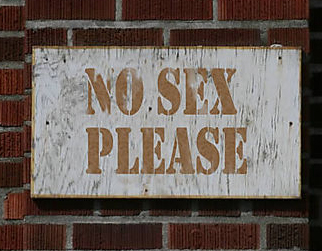
Should the Personal be Political?

I recently came across the site Does This Make Sense? and I already love it. It’s got a lot of intelligent, thoughtful commentary. One piece that I particularly liked is called “Hell, No. I Won’t Say No.” It concerns the idea that women who want to change their society should withhold sex from men until their wishes are fulfilled. Lorraine Berry writes:

In principle, choosing not to have heterosexual sex as a protest against policies that restrict women’s abilities to have autonomy over their bodies seems the ultimate in women’s power. It did, to some extent, work in the case of Liberia, where the brave women there forced their men to continue negotiating for peace by sitting naked outside the building where the negotiations were taking place.

Ultimately, though, Berry argues that this form of protest is not only ineffective but counterproductive for women who happen to enjoy sex (which is, I might argue, almost all of them). There are many problems with a “sex boycott, such as what gays and lesbians would do, and the fact that it almost seems to confirm right-wingers’ anti-sex campaign (no abortion, no contraception, no pornography, no comprehensive sex ed, no premarital sex, no non-hetero sex, and so on).

However, I have another problem with it, and it involves the concept of “the personal is political.”

Here I’m going to just be a bad feminist and say that I disagree with this principle. Of course, I do believe that people should live according to their values (political ones included), but I cannot condone manipulating personal relationships for the sake of one’s politics. Unless your partner is personally overseeing the campaign to take control of women’s bodies, it’s completely unreasonable, not to mention unethical, to punish him for the actions of certain other members of his gender. (This is not even to mention that I cannot imagine a feminist woman dating an anti-feminist man to begin with.)

And, in general, I don’t think that politics should direct one’s personal life. If I choose to date a woman, it’ll be because I like her, not because I want to make a political statement about bisexuality. If I choose to date someone of a different race, it’ll be because I like him/her, not because I want to make a political statement about interracial dating. In contrast, the so-called “political lesbianism” movement advocated choosing to be a lesbian for political purposes. How is this an authentic way of living?

Of course, sometimes the personal becomes political, as when an anti-gay politician is revealed to be having same-sex relations, or when people speculate on whether or not Elena Kagan is a lesbian. In the first case, although people may bristle at the obvious hypocrisy, I think being anti-gay is bad enough regardless of what one does in his spare time (and sending inappropriate messages to teens is bad enough regardless of their gender). As for the second, most would agree that it shouldn’t matter. The fact that people make it matter is the crux of the problem.

So, is the personal political? Maybe, but it shouldn’t be. In my opinion, personal relationships are a sort of refuge from the outside world. I don’t bring politics into the bedroom, just like I wouldn’t bring my cell phone or my laptop or God into it.

Periods and Misogyny


This is what I hate.

This is from a Tumblr called, appropriately, “Fuck Periods.” It exists solely to bitch about various feminine problems, most notably, periods. As a woman, I’m all in favor of bitching about periods, but the stereotypes that are often expressed are pretty problematic.

First of all, this isn’t even accurate. I don’t know about any other women who may be reading this, but personally, I don’t “sit in one fucking place for fear of leakage” when I’m on my period. I also don’t get pissed the fuck off by “anything with a face.” When I’m on my period, I go to class, do homework, hang out with friends, go shopping, work out, eat, and sleep just like I do when I’m not on my period. Shocker! Women don’t stop functioning just because it’s that time of the month. Life goes on.

Second, this whole public period-bashing thing makes it even more likely that others (notably men) will attribute any negative mood or opinion expressed by a woman as simply a consequence of her menstrual cycle. If you’re female, chances are you’ve said something negative or gotten upset or angry and had a (again, probably male) friend say, “Are you just on your period or something?”

Honestly, there are few things more offensive than that. The idea that a woman has no legitimate, external reasons to ever be angry or upset–only the internal vicissitudes of her hormones–is preposterous.

Third, and most importantly, rants like these only reinforce the stereotype of women as crazy, overemotional beings controlled entirely by their hormonal cycles. People. Give us a bit more credit than that, please. And I understand that that’s difficult to do when women themselves are painting themselves that way.

Love vs. Work

“Some women choose to follow men, and some women choose to follow their dreams. If you’re wondering which way to go, remember that your career will never wake up and tell you that it doesn’t love you anymore.”

— Lady Gaga

As much as I respect and admire Lady Gaga, this is some of the worst advice I’ve ever heard, because it’s incredibly misleading.

First of all, it’s probably just as easy to lose your career as it is to lose your partner. Here are a few examples:

  • a pro football player permanently injures his leg
  • a writer gets depressed and loses her creativity
  • a doctor loses a malpractice suit and is no longer allowed to practice medicine
  • a politician becomes disenchanted with the system in which she works
  • an artist starts losing his vision
  • a lawyer at a prestigious firm gets burned out

And so on.

Furthermore, if it were the case that everyone who puts aside relationships for the sake of their careers ends up doing what they love most and getting paid millions for it like Lady Gaga, perhaps her advice would hold up. But for most of today’s young people, who sacrifice love and dating for the sake of working 60-hour weeks and making comparatively little money, the choice isn’t really such an obvious one.

Second, it’s exactly this mentality that prevents people from making the sort of commitment that prevents relationships from breaking down. I’m not saying all relationships (and marriages) are made to last, but putting your career first every time is one way to make sure they don’t. I know students here who will break off perfectly good relationships because 1) they can’t deal with spending one summer apart, and 2) they’re so obsessed with getting the perfect summer internship that they don’t even try to end up in the same city together. Of course, one could argue that college relationships don’t matter much (though I’d never argue that, personally), but people keep acting like this long after graduation. For instance, by doing as Lady Gaga recommends and choosing careers over relationships.

I feel like sentiments like this one are an overblown response to the old-fashioned way of looking things, which was that a woman should sacrifice all of her ambitions for the sake of a marriage. Obviously, I disagree with that completely, but I feel like asking women to sacrifice all of their relationships for the sake of their ambitions is just as one-sided and faulty way of looking at things. Statements like this one construct these two aspects of adult life as diametrically opposed when they really aren’t. Plenty of women manage to have fulfilling careers and loving marriages. It just takes a bit of work, that’s all.

The truth is that nothing in your life is ever going to be perfect, all the time. When your relationships aren’t going well, an interesting and meaningful career can help you get through it. But what about when your career isn’t going well?

In short, yes, balancing love and work is difficult. That doesn’t mean we should just opt out of that balance altogether and pick one over the other. It’s unfortunate that people like Lady Gaga, whom many young women consider a role model, has made it sound like we need to abandon one of these important things for the sake of the other.

On Girlcotts

The fact that Abercrombie & Fitch tried to market a push-up bikini top for pre-pubescent girls is old news now, but I read an interesting post on Fbomb about it and whether or not a “girlcott” would be effective. This got me thinking about the concept of “girlcotts” and of personal boycotts in general.

[Random aside: How would a push-up top work if there’s nothing there to push up? Anyways.]

The Fbomb post mentions a so-called “girlcott” led by the Women and Girls Association of Pennsylvania against stupid stuff from Abercrombie in the past. Apparently, it turned out to be effective and Abercrombie stopped selling the stupid stuff in question (though, of course, its shelves are still overflowing with various other crap.)

However, egregious overthinker that I am, I naturally have a problem with the term “girlcott” in the first place. Namely–and the people protesting these sort of issues would do well to recognize it–this is not a women’s issue. This is everybody’s issue. It should not be just women boycotting stores that sell products like this. There are men who don’t want to see these things marketed to their daughters and little sisters. There are men who refuse to buy into our society’s fetishization of little girls, who find themselves sexually attracted to women who look like women, not women who look like prepubescent girls. While men obviously wouldn’t be shopping for this stuff, framing this issue as one that only women should and do care about only robs us of potential allies.

Clearly, this neologism is a response to the perceived gender-specificity of the original word, “boycott.” However, some quick Wikipedia research has uncovered the fact that the word actually comes from someone’s name (specifically, that of Captain Charles Boycott) and has nothing to do with boys whatsoever. Furthermore, the solution to gender-specific words is not more gender-specific words, it’s gender-neutral words.

My second issue with this whole concept stems from a point brought up later in the Fbomb post, which discusses the idea of personally choosing not to shop at a certain store in order to make a point. I have mixed feelings about this. If you’re doing it for your own personal comfort and integrity–as in, you’d feel uncomfortable shopping at a store that doesn’t share your values–then sure. But it definitely annoys me when people think that they’re actually going to have an impact on the store itself if they refuse to shop there. If that’s what you want to do, organize a protest.

At any rate, nobody’s going to care that you personally refuse to shop there. At most, you’ll be preventing yourself from owning things you potentially like and making no impact whatsoever. It just doesn’t make sense.

Sex Positive Manifesto

[TMI Warning]

I am sex positive.

This means that I am open about sexuality (my own and in general) and believe that sex of any sort is healthy as long as it’s consensual. It means that I disagree with the idea that sexuality needs to be repressed and that there are right and wrong ways to be sexual. It means that I will enthusiastically answer questions about sexuality. It means that I fully support anyone who identifies as gay, lesbian, bisexual, queer, pansexual, polyamorous, kinky, transgender, transsexual, asexual, intersex, or any other identification. It means that I support full and open access to education, contraceptives, and abortion. It means that I believe that the reason people get raped is because somebody raped them, and not for any other reason.

What does it not mean?

It does not mean I’m willing to sleep with anyone who shows up at my door. Just because I’m willing to show you how a vibrator works or tell you what kind of porn I watch or explain the female orgasm, does not mean I’m willing to sleep with you. If you get turned on and don’t like that I’m not willing to do anything about that, sorry. That’s what you have hands for.

It also doesn’t mean you can or should make assumptions about my sex life. When I tell people that I’m a sexual health peer educator, you’d be amazed what sorts of conclusions they immediately jump to. Usually it’s something along the lines of, “You must have wild crazy sex with random people of either gender all the time!” Actually, no. I like serious relationships. Got a problem with that? Too bad. So I don’t fit your typical college student mold.

It doesn’t mean that no means yes. Ever.