Leggings Are Pants, End of Story

Does it cover her butt? Then it's clothing.

[TMI Warning]

Since most of the people who read this probably know me in person, I can probably assume that you, my reader, know how I look. Specifically, you may have noticed that I’m curvy.

And when I say curvy, I’m not using that as a euphemism for “fat,” because that’s not what I am. I’m curvy. Specifically, I have fairly large boobs and a rather large giant ass.

Despite our society’s idolization of hourglass-shaped women such as Marilyn Monroe and Kim Kardashian (neither of whom I am attempting to compare myself to except where waist-to-hip ratio is concerned), this is not a body type that the American fashion industry tends to keep in mind. According to the clothes you find in virtually any store, be it a Walmart or a Prada, American women come in one shape only–a stick. Sometimes it’s a very thin stick and sometimes it’s a very fat stick, but it’s still a stick.

Jeans, the staple of casual style, are unfortunately no exception. Here’s what happens when you have a big ass and you try to wear jeans. First of all, any size that actually fits around your ass and zips all the way up will generally be way too long for you and much too loose around your actual waist. When you sit down, the back of the jeans rides down and everyone from London to France can see your underpants. Your thighs, if they’re nice and juicy like mine, will be constricted by the jeans and it’ll sometimes hurt to sit. Putting the jeans on and taking them off will be a Herculean effort. Usually, the jeans will be way too tight in general your body will literally spill out of them at the top.

Needless to say, I don’t like jeans very much, and most girls with my proportions don’t either. So if we want to wear jeans like everyone else does, we have two options:

  • Be really uncomfortable.
  • Starve ourselves, because that’s the only way to rid a curvy body of its curves.

Needless to say, neither of those options sound particularly appealing. So during the warmer months, we wear lots of skirts and dresses. But fall, winter, and spring pose a problem. Many girls, myself included, prefer to wear leggings because they’re comfortable and stretchy and fit our proportions. Unfortunately, however, many people seem to believe that leggings are “not pants.” Why? Because they’re form-fitting. This has apparently even inspired a Huffington Post article (which, then again, may not be saying much).

What this means is that if you want to wear leggings, you must always choose a top that’s long enough to cover your butt, because God forbid anyone be able to discern the outline of your behind–not that jeans hide it either. However, when you have a large ass, it’s pretty hard to find tops long enough to cover it up completely, meaning that this style is best suited for stick-women, too.

Well, what can I say. I apologize deeply for the fact that my body isn’t of the shape that this particular culture values, and I offer my condolences to anyone who has ever been offended by the sight of the outline of my ass when I wear leggings.

Actually, just kidding. I’m not fucking sorry! This sartorial snobbery is ridiculous. Here’s a quick guide to identifying whether or not something qualifies as clothing. Does it cover up all the body parts that need to be covered up? If yes, then–ding-ding-ding!–it’s clothing.

And if you’re one of these rabid “but but but leggings aren’t pants!” people, then I’d suggest that you issue yourself a stern reminder of the fact that not everyone’s willing to starve to gain the ability to dress themselves in the way you’d like them to.

Still not convinced? Well, find me a pair of jeans that will fit these T&A, and then we’ll talk. 😉

Got a Job? No Fun For You

[Snark Warning]

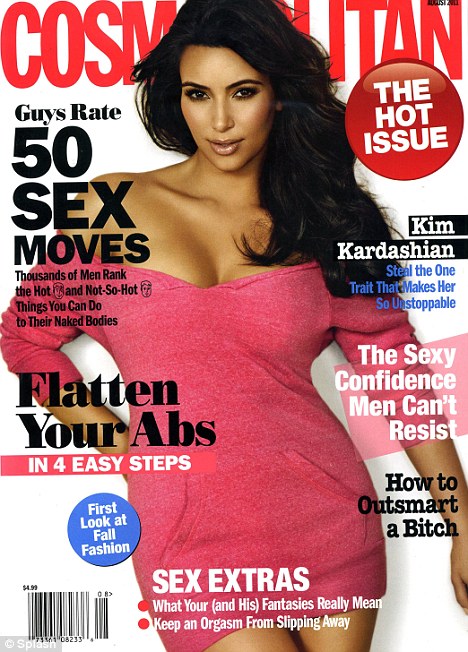
I read one of the advice columns in this month’s Cosmo. A woman was writing in and asking if it would be okay to wear a top that reveals her tan lines to work, provided the top was modest and work-appropriate. The response was, no, it wouldn’t. Why? Because you wouldn’t want your boss to think that you spend your free time lying around at the beach:

Even though the best of us can fall victim to zebra skin by accident, exposing your sun stripes at work would be flaunting your bad judgement (baking does lead to skin cancer, after all). Perhaps worse, as far as your boss is concerned, it suggests you spend lots of your free time being at one with your beach towel–not exactly impressive.

“Not exactly impressive?” What does that even mean? Apparently, you shouldn’t let your boss know that you actually have fun on your days off. Oh, heavens no! You ought to be at home, catching up on emails.

(As for the skin cancer thing, I’d just like to point out that even if you wear sunscreen, you’re eventually going to get a tan if you spent a lot of time outside. Trust me, my mom slathers my little brother and sister with sunscreen obsessively, yet at the end of the summer they still have those cute little freckles and tan lines.)

Naturally, I immediately thought back to an earlier post I wrote about why adults are always so miserable and try to make me as miserable as they are. Now I’m not surprised. Apparently, once you’re all grown up and have a job, you’re not even allowed to have a good time when you’re off work. No wonder adults are always in such a crappy mood, and no wonder they want to warn me that in a few years I’ll be in a crappy mood too.

What shocks me is that Cosmo isn’t exactly a serious, business-y magazine. It’s mostly read by people who like to enjoy themselves every now and then (or every day/night, as the case may be). If even Cosmo is saying that you can’t have fun once you’re a grown-up (or, at the very least, that you have to do it in secret), what’s the world coming to?

This doesn’t even make sense to me, because I would hope that my boss would want me to come to work refreshed and in a good mood. I would want him/her to know that I’m not going to be asking for time off to go see a therapist about how miserable I am because I never have fun.

(I’m hoping, perhaps in vain, that since I’m going into the mental healthcare field, things will be different for me. After all, if there’s anyone who knows that relaxing and having fun is absolutely necessary, it’s a therapist. In my opinion, therapists should be able to model healthy behavior for their clients. If a client casually asks me what I did over the weekend and I’m forced to either lie or confess that I spent the entire time huddling over my laptop in a corner, crying, and biting my nails off while my husband played with the kids, that’s not good.)

Where did we go wrong? Why is it that in other countries and cultures, it’s perfectly normal to take a nap after lunch before coming back to work? Why is it that the United States is the only country I could find that does not mandate a minimum amount of paid vacation time for all employees? Why is the United States one of the only developed countries that does not offer paid maternity leave (to say nothing of paternity leave)?

One thing that never fails to surprise me about American culture is how fixated it is on work.  Russians, for instance, seem to view work mostly as a means to an end (money, security, providing for one’s family), whereas for Americans, it’s an end in itself. I rarely hear my parents talking about work when they’re home, and the only time I’ve seen them doing work-related things at home is when my dad starts maniacally writing some sort of equations on a napkin. My parents don’t have smartphones or tablets. If you send an email to their work address on Friday evening, you won’t receive a response till Monday. And yes, they go to the pool on weekends, and evenings, and any other time they fucking feel like it. That, in my opinion, is how it should be.

Bullying as a Social Regulator

If only it worked this way.

I came across a post by Tea Party Nation blogger Dr. Rich Swier called “Bullying, Peer Pressure and Gulf Coast Gives.” (You need a TPN account to see it, unfortunately.) I won’t describe the way in which the contents of my stomach forcibly exited my body upon my reading this, and I will also ignore the homophobia in this article because it’s obvious and there’s no need to comment on it. Rather, I’m going to simply explore an interesting idea that Swier brings up.

In this article, Swier is opposing Gulf Coast Gives, a charity foundation that, among many other things, advocates against LGBT-related bullying. He opposes this foundation because he disagrees with its stance on this issue:

This is not bullying. It is peer pressure and is healthy. There are many bad behaviors such as smoking, under age drinking and drug abuse that are behaviors that cannot be condoned. Homosexuality falls into this category. Homosexuality is simply bad behavior that youth see as such and rightly pressure their peers to stop it…

I agree with Gulf Coast Gives that “LGBT youth are up to five times more likely to attempt suicide than their straight counterparts”. Homosexuality, like drugs, harms young people if they experement with it. That is the greatest tragedy.

Again, I’m going to just ignore the self-evident homophobia and dissect Swier’s concept of bullying as some sort of social regulator. He reframes bullying as “peer pressure” and claims that it prevents young people from engaging in unsafe behaviors, in this case, homosexuality.

Leaving aside for now the fact that, unlike the other behaviors listed here, homosexuality is not a choice, I am left to wonder if Swier somehow managed to completely miss the reasoning behind all the anti-drugs and alcohol campaigns that public school kids are subjected to these days. Peer pressure isn’t typically a force that promotes healthy behavior. If it were, we wouldn’t need all these “just say no” lessons to teach kids how to resist it.

It seems that bullying and peer pressure serve more to encourage “normalcy” than anything else. Luckily for Swier’s argument, heterosexuality happens to be normative. But so are underage drinking and, in some circles, smoking and drug use. People don’t get bullied for doing things that are unsafe; they get bullied for doing things that are “weird.” Contrary to Swier’s argument, kids and teens don’t see homosexuality as “bad behavior.” They see it as weird.

Not only do kids not bully each other for doing things that are actually unsafe, but they frequently bully each other for doing things that most adults would see as positive. I’m sure that even social conservatives would agree with me that reading books is good for kids. Yet every avid reader I know, myself included, was made fun of for it in grade school. To quote the great Bill O’Reilly, you can’t explain that.

Of course, norms change. Homosexuality is becoming increasingly accepted in American society, so it’s only a matter of time before that acceptance starts trickling down to kids and teens and Swier’s argument starts falling apart, like all Tea Party arguments inevitably do.

Why Are Adults So Negative?

[Snark Warning, TMI Warning]

No, really, that’s a legitimate question. Why are people older than me–even by just a few years–so eager to put down all of my hopes and dreams?

Let me give a few nonspecific examples of Things Older People Have Said recently to me:

  • “You know, guys really don’t go for complex women.” (Women like me, that is, in the context of that conversation.)
  • “Oh, trust me, by the time you have a job, you’re not going to care about making a difference. It’ll just be about how you hate your boss and can’t wait to go home by the end of the day.”
  • “You’re never going to be successful if you don’t learn how to be pushy.”
  • “It’s going to be even harder to make friends after college, you know.”
  • “You’re gonna go for a PhD? You do realize how much work that is, right?”
  • “Psychologists don’t make that much money. You should try to get an MD instead.”

Perhaps you Well-Meaning Adults are all under the impression that I have excessively high expectations and need a Dose of Healthy Realism to prevent myself from getting disappointed later on. Perhaps you just don’t realize what weight your words can carry for someone who is younger and looking for someone to help them find their way.

Well, this might be news to you, but I have a mental disorder that basically means that my expectations are already unhealthily low. That’s what depression does. It robs you of all the hope and optimism you used to have. Every bit of genuine excitement that I have for the future is something I’ve worked very, very hard to muster up. And guess what you’re doing. You’re taking it away from me.

People. My disorder does a perfectly fine job of putting me down all on its own. It really doesn’t need any help from you. I don’t need to be reminded of how hard it’s going to be to make friends, get a job, find a partner. Trust me, I’ve been over this in my mind over and over and over again Many, many sleepless nights. I’ve been over it until I’ve cried my head off and wanted to kill myself. Really. I do not need your help.

You know what, I appreciate that maybe your life didn’t turn out the way you wanted. And that sucks. I’m sorry you have a shit job, I’m sorry  you have an awful time meeting people and dating. If you’d like, feel free to tell me about that. Or go tell a therapist. Or whatever. But your experiences do not give you the right to take my hope away from me. Especially when you’re some measly three or four years older! Jesus Christ! You’re still finding your own way. You’re not dead yet. At least wait till you get your own kids before you start dispensing your Divine Wisdom to someone else.

I’m seriously considering kicking these people out of my life, because as much as I’ve always believed that friendship with people older than me is important and extremely valuable, I can’t have these people making me feel crappy all the time.

Why does this happen? I think we have a cultural stereotype of young adults as exceedingly cocky, optimistic, and entitled. Well, guys, you know what they say about people who assume. First of all, as I’m pretty sure everyone I’m acquainted with knows, I’m not even from this country. Take everything you know about “American Young Adults” and toss it the fuck out, because I grew up with a different cultural background, one in which humbleness and realism are prized qualities.

Second, even supposing I were the most typical American girl you can imagine, you should still quit it with the damn stereotypes already. Everyone has their quirks and idiosyncrasies. Some people come from broken families. Some people grew up poor. Some people have a disability, maybe one you can’t see. Some people read a ton of books when they were kids. Some people grew up being bullied in school. Some people have depression, anxiety, OCD, ADHD, a substance abuse disorder, autism or Asperger’s, or some other condition. Some people are just plain different!

So throw out those silly magazine articles about “Today’s Entitled Bratty Self-righteous Cocky Inept Stupid Young Adults” and see what’s right in front of you. Some of us are just trying to get by. Some of us are just trying to scrounge up every last shred of hope we have and keep on living. Just because I’m young doesn’t mean I think it’s all rainbows and butterflies ahead. I work hard to keep my chin up. Don’t you dare take that away from me.

Fatism and Going to Extremes

Discrimination against fat people is a problem. People who are overweight are often judged to be less competent, less intelligent, and more lazy–not to mention less attractive–than people who are of a “normal” weight. They face discrimination in the workplace, and there are some jobs for which they are unlikely to ever be hired at all.

It’s only natural, then, that a movement has sprung up to combat “fatism”–and that’s awesome. What bothers me, however, is the tendency of anti-fatism activists to deny the fact that being severely overweight has negative effects on one’s health. I hear a lot of “weight has nothing to do with health” arguments these days, and this sort of denialism is simply dangerous. Obesity is a problem in America, and it does put you at increased risk for a lot of health problems, such as:

  • high blood pressure
  • heart disease
  • stroke
  • type 2 diabetes
  • sleep apnea
  • breast and colon cancer
  • osteoarthritis
Given that heart disease is the leading cause of death in the United States, I feel like its prevention is something that should be taken seriously.

Regardless, denying these health problems does not help anyone, and admitting that being obese is unhealthy is not tantamount to justifying discrimination against obese individuals. After all, one’s health is one’s own business, and not taking care of your body shouldn’t result in being discriminated against.

It worries me when social movements respond to a problem in society (such as fatism) by taking the extreme opposite view. This happens a lot with progressives. For instance, noticing that our society has pervasive and restrictive gender roles, some claim that gender is entirely socially constructed and has no basis in biology whatsoever. (Apparently these people never noticed that men and women do actually have at least one very noticeable biological difference.) Some note that homophobia is rampant in society, so they insist that heterosexuality is actually constructed and unnatural, and that same-sex relations are the only “genuine” ones. Similarly, some people think that because discrimination against fat people exists and discrimination is wrong, therefore, there is nothing whatsoever bad or unhealthy or in any way undesirable about being overweight.

But being fat isn’t the same as being part of other marginalized groups, such as being a woman, being gay, being transgender, or being Black. No reputable scientific study has ever found that being gay or transgender is in any way unhealthy or abnormal (except, of course, in the statistical sense). No reputable scientific study has ever found that women or African Americans are inferior in any way to men or Caucasians. But our entire body of medical evidence shows that being severely overweight comes with significant hazards to your health. This is something that is simply true. Regardless of whether you think BMI is a good measure of obesity, and regardless of how easy or difficult it is for you to lose weight, being obese is unhealthy. Does this mean that discrimination against fat people is okay? Hell no. But it does mean that obesity is something that should be discouraged.

Incidentally, some of the things that anti-fatism activists consider discrimination simply aren’t. For instance, when airlines ask obese people to buy two seats, guess what–it’s not because they just don’t like obese people. It’s because if your body requires more than one seat, then you should have more than one seat–in which case, it follows that you should pay for more than one seat, because it wouldn’t be fair to give some people a second seat for free. Furthermore, it would be unfair for a person who paid for a seat to effectively receive only half a seat because the person sitting next to them clearly requires part of theirs. Does it suck to have to pay more to fly if you’re fat? Yes. But in that case, lobby for airlines to make seats bigger, not to give you permission to use half of another customer’s seat.

Also, companies that provide incentives for their employees to exercise/get down to a healthy weight/whatever are not being fatist. They’re doing two things: 1) encouraging their employees to be healthier, and 2) saving themselves money by reducing lost productivity due to medical problems and by reducing the amount they have to pay as insurance. Fact: being healthier and not obese reduces medical expenditures. Similarly, doctors who recommend that their obese patients lose weight are not being fatist. They are being doctors. I am terrified of the day when doctors are prevented from dispensing sound, evidence-based medical advice for fear of offending someone.

Regardless, it is, in fact, quite possible to discourage obesity without promoting eating disorders, obsessive dieting and exercising, and holding oneself to an impossible standard of beauty, as the mass media does. Conflating  efforts to discourage obesity with efforts to promote unhealthy behaviors or stigmatize fat people is intellectually lazy. There is, for every issue, a solution that is healthy, reasonable, and benefits the greatest possible number of people. Just because that solution is extremely hard to find doesn’t mean it doesn’t exist. It’s there, and I can guarantee that it is almost never at one extreme or the other. It’s usually somewhere in the middle.